
Seconded Employee Leaving Japan: Final Payroll

When a seconded employee leaves Japan, the Japan subsidiary that ran their payroll has to close the employee's tax year early. That means a departure year-end adjustment on the last salary, a withholding slip (gensen choshu hyo, 源泉徴収票), loss filings for health insurance, pension and employment insurance, and a plan for the employee's remaining Japanese tax.
Most of these steps run on short statutory clocks counted from the last day of employment or the departure date, not from the next payroll. This checklist for HQ mobility, payroll and finance teams covers each legal duty, deadline and data set; the recurring monthly and annual deadlines around it are in our Japan payroll calendar.
Key Takeaways
- The year-end adjustment moves to the departure date. An employee leaving for an assignment abroad of one year or more is, in principle, settled on the last salary paid before departure, not in December.
- The withholding slip has a one-month deadline. A leaver must receive the gensen choshu hyo within one month of the retirement date.
- Insurance loss filings run on days, not months. Health insurance and pension loss is due within 5 days; employment insurance within 10.
- Pay after departure can still be taxed in Japan. Under NTA rules, director fees, and the Japan-work share of a bonus paid after departure whose calculation period includes Japan work, are withheld at 20.42%.
- A tax agent keeps the employee's Japanese tax affairs open. Without one, any final return falls due on the day the employee leaves, and for a departure on or after 1 July so can the remaining estimated tax.
What changes when a seconded employee leaves Japan
A secondee who leaves Japan for a year or more is presumed to have no domicile in Japan and is treated as a non-resident from departure. The Japan employer must settle that resident period through payroll before the employee goes, then treat any later payment under non-resident rules, while closing every insurance enrolment it opened.
The National Tax Agency's Tax Answer No. 2517 covers both halves: the year-end adjustment done by the date the employee leaves Japan, and withholding on salary paid after departure.
The exit-month checklist and statutory deadlines
Eight filings and payments decide whether a secondee's exit is clean. Each has its own legal trigger, so the payroll cut-off rarely lines up with them.
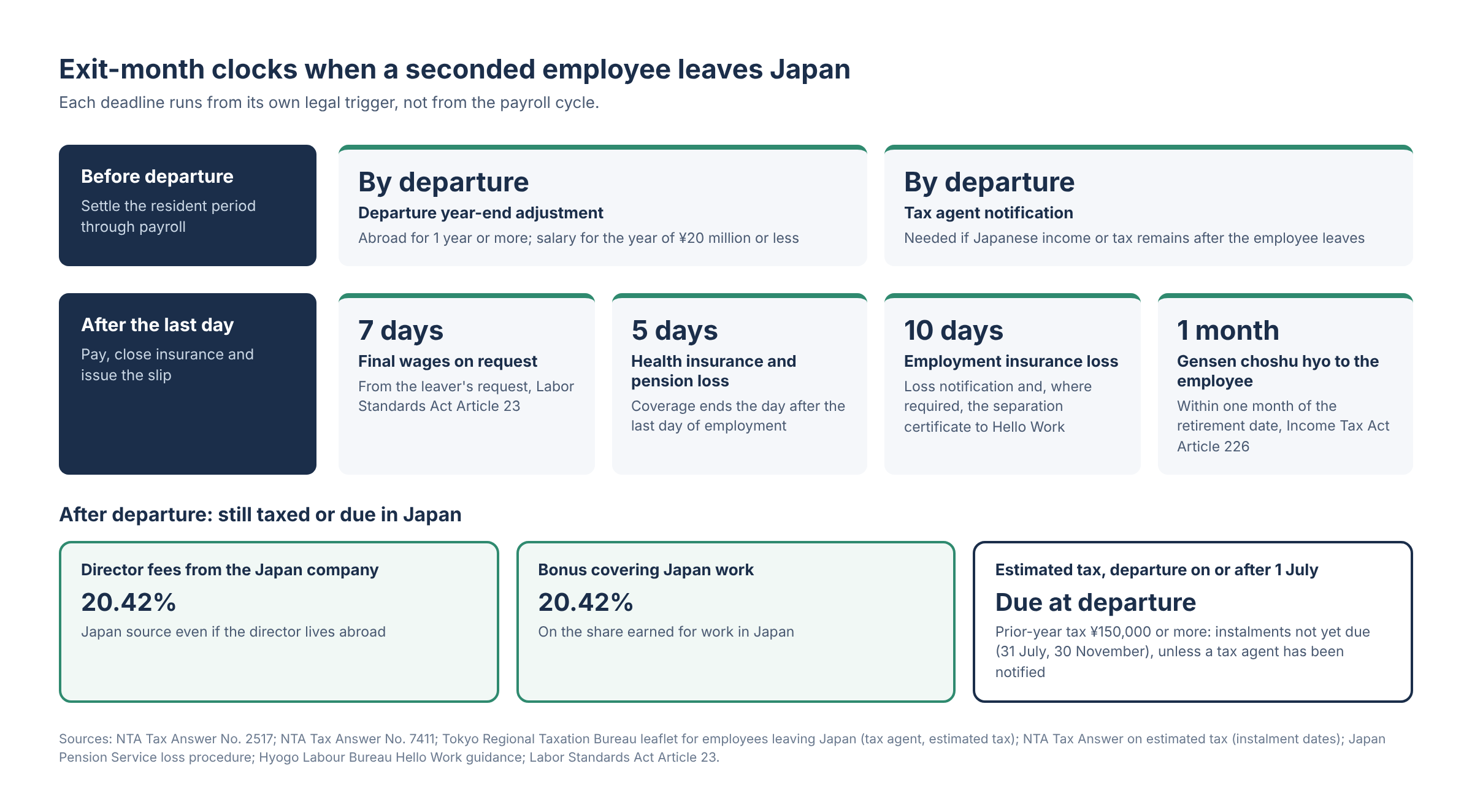
| Step | Legal duty and trigger | Deadline | Data and documents needed |
|---|---|---|---|
| Final wages | Labor Standards Act Article 23: pay wages owed to a leaver on request | Within 7 days of the request | Final timesheet, unused allowances, expense claims |
| Departure year-end adjustment | Income Tax Act Article 190: employee becomes a non-resident on departure | By the date the employee leaves Japan | Dependents declaration, insurance premium certificates, spouse and dependent income estimates |
| Withholding tax on the final pay | Withholding on the last salary, after netting the year-end adjustment result | 10th of the following month, in principle (later under the semiannual special rule) | Payroll register, adjustment worksheet |
| Gensen choshu hyo to the employee | Income Tax Act Article 226 | Within one month of the retirement date | Year-to-date pay, tax, social insurance deducted |
| Health insurance and pension loss | Loss of coverage on the day after the last day of employment | Within 5 days of the loss | Loss notification, any health insurance eligibility certificate issued |
| Employment insurance loss | Loss of coverage at Hello Work | Within 10 days from the day after leaving | Loss notification and, where required, the separation certificate |
| Resident tax change notice | Special collection through payroll stops | Set by the municipality | Change form, remaining instalments |
| Salary payment report (and slip) for the January filings | Salary payment report (kyuyo shiharai hokokusho) for a mid-year leaver paid over ¥300,000, to the municipality of the address on leaving; from 1 January 2027 filing it counts as filing the slip with the tax office (NTA No. 7411) | 31 January of the following year | Year-to-date pay and tax, as on the slip |
The resident tax step works differently from the rest; the rules for leavers, including when the remaining tax is collected in one sum from the final pay, are in our guide to resident tax special collection and leavers. The January filings for leavers are covered in the gensen choshu hyo and January 31 filings.
Departure year-end adjustment: who qualifies and how it is calculated
An employee who becomes a non-resident because of a transfer abroad gets a year-end adjustment at departure. Deductions are judged on the facts at departure, so the employer needs the employee's paperwork before the last payroll closes.
Per NTA Tax Answer No. 2517, the adjustment applies where the employee has filed a dependents declaration (fuyo koujo tou shinkokusho, 扶養控除等申告書), is moving abroad for one year or more, and has salary for the year of ¥20 million or less. The NTA deduction rules:
- Social insurance and life insurance premiums count only if paid while the employee was a resident.
- Spouse and dependent deductions depend on the situation on the departure date, with the spouse's or dependent's income estimated for the full calendar year.
The full mechanics of the calculation are in our year-end adjustment runbook.
Pay after departure that is still taxed in Japan
A non-resident is taxed in Japan only on Japan-source pay. Pay for work abroad drops out, but director fees and pay for Japan work still attract withholding at 20.42%, the non-resident rate in NTA Tax Answer No. 2517.
| Payment made after departure | Japan source? | Japanese withholding |
|---|---|---|
| Salary for work done abroad after departure | No | None |
| Director's fees from the Japan company | Yes, even if the director lives abroad | 20.42%, unless the director works abroad full time as an employee, such as an overseas branch manager |
| Bonus whose calculation period includes Japan work | Yes, for the Japan-work share | 20.42% on that share (NTA) |
| Final salary with a pay period of one month or less | Only if all of it relates to Japan work | None unless the whole period was worked in Japan |
| Pay for a temporary business trip back to Japan | Yes, for the days worked in Japan | On the Japan-work share; a separate trip allowance counts in full (NTA) |
| Equity earned while resident and exercised or vested after departure | Can be taxable in Japan | Depends on the plan; the employee needs a tax agent |
A tax treaty may reduce or remove this tax. Equity plans are covered in our guide to bonus, commission and equity plans for Japan employees. If the secondee also resigns as a director of the Japan subsidiary, the change must be registered within 2 weeks under the Companies Act; see director change registration.
Social insurance and employment insurance loss filings
Coverage ends on the day after the last day of employment. The timing also decides how many months of premiums the final pay must carry.
The Japan Pension Service requires the health insurance and pension loss notification within 5 days, and gives the example that an employee leaving on 31 March loses coverage on 1 April. The Hyogo Labour Bureau's Hello Work guidance requires the employment insurance loss notification, and where required the separation certificate, within 10 days from the day after the employee leaves.
Premiums follow the loss date. The Japan Pension Service explains that premiums are due up to the month before the month containing the loss date. A mid-month leaver pays nothing for the leaving month; a month-end leaver pays for that month too, and depending on the payroll cut-off the final salary may carry two months of the employee's share.
A secondee covered by a totalization certificate was never enrolled in the Japanese pension, so only the schemes the employee actually joined need a loss filing; enrolment itself is covered in our social insurance enrolment guide.
Tax agent, final return and estimated tax
If the employee will still have Japanese tax to deal with after leaving, the employee should appoint a tax agent (nozei kanrinin, 納税管理人) and notify the tax office before departure. Without one, the return and any tax due fall on the departure date.
The Tokyo Regional Taxation Bureau's leaflet for employees leaving Japan sets out when no filing is needed at all: salary from one employer only, all of it subject to withholding, and income up to departure of ¥20 million or less, settled by the departure adjustment. Even then, claiming medical expense or housing loan deductions needs a return or a tax agent. The leaflet flags three traps:
- Income that arises in Japan after departure, such as equity earned while resident or Japanese rental income, needs a tax agent.
- For a departure on or after 1 July, where the prior year's tax payable was ¥150,000 or more, the current year's estimated tax was fixed on 30 June. Any instalment not yet due (July by 31 July, November by 30 November, per the NTA estimated tax guidance) falls due at departure unless a tax agent has been notified.
- Since 1 January 2022 the tax office can require a tax agent to be named and can designate one if none is notified.
The exit tax rarely reaches a foreign secondee. Under the NTA's exit tax leaflet, it taxes the unrealised gain of a person holding securities and similar assets worth ¥100 million or more who lived in Japan for more than 5 of the 10 years before departure. Time on an Immigration Act Appended Table 1 status, such as intra-company transferee or engineer/specialist in humanities/international services, does not count towards the 5 years.
The rule mainly reaches secondees who were not on a Table 1 status, such as Japanese nationals or permanent residents. The employer does not file for them, but the exit tax is worth checking before the move date is fixed.
Common mistakes in the exit month
Each error below leads to a refund, a late filing, or a Japanese tax notice sent to an address the employee has already left.
- Running the last payroll on the normal pay date. A salary paid after the flight misses the departure adjustment.
- Collecting the dependents declaration and premium certificates in the final week. Without them the adjustment cannot apply the deductions.
- Using the flight date for the insurance loss date. Coverage follows the end of the Japanese employment contract, not the travel itinerary.
- Treating the secondee's Japanese address as the contact after departure. Tax office and municipal notices keep going there unless a tax agent is on file.
- Paying director's fees to a departed secondee without withholding. The fees remain Japan-source income (NTA No. 2517).
FAQ
What is the Japanese tax year for an employee who leaves mid-year?
Income tax runs on the calendar year, so the departure year splits into a resident and a non-resident period. Resident tax runs on a lag: per Setagaya City's resident tax guidance, the municipality of the 1 January address charges it on the previous year's income. Leaving before 1 January, for a year or more, avoids resident tax on the departure year's income, but the current year's bill on the prior year's income remains payable.
Why does a departing employee need the gensen choshu hyo?
The slip is the official record of Japanese salary, income tax withheld and social insurance paid for the year. Home-country tax returns, tax equalization and any Japanese return all start from it.
Can an employee who worked 8 years in Japan claim the pension lump sum?
A foreign national with 8 years of coverage has not reached the 10-year qualifying period for an old-age pension, so the lump-sum withdrawal is available. The Japan Pension Service calculates it on a maximum of 60 months and the claim must be made within 2 years of leaving Japan; our nenkin lump-sum guide explains the trade-off with totalization.
Working with AQ Partners. Our Tokyo team provides monthly payroll coordination with a licensed sharoushi, year-end adjustment and employee life-cycle filings for foreign companies operating in Japan. Book a consultation to discuss your situation.


Yuga Koda is a founding Director at AQ Partners, supporting foreign companies, funds, and families operating in Japan. His experience operating companies in both Japan and international markets gives him a practical understanding of back office operations from both sides.