
Global Bonus, Commission, and Equity Plans Applied to Japan Employees: Enforceability and Payroll Treatment

Applying a global bonus, commission, or equity plan to Japan employees means translating a plan written for the group into a Japanese employment relationship, where pay terms are governed by the Labor Standards Act, by the subsidiary's rules of employment, and by social insurance and tax reporting rules that treat bonuses differently from monthly salary. A plan that works as a discretionary incentive in the parent's jurisdiction can become a contractual wage in Japan, and a quarterly commission can change how an employee's social insurance is calculated. This guide, for the global HR, reward, and finance teams that own those plans, covers when a bonus becomes an enforceable wage, how clawbacks meet the full-payment rule, how bonuses are reported, and what a subsidiary files when the parent grants equity.
Key Takeaways
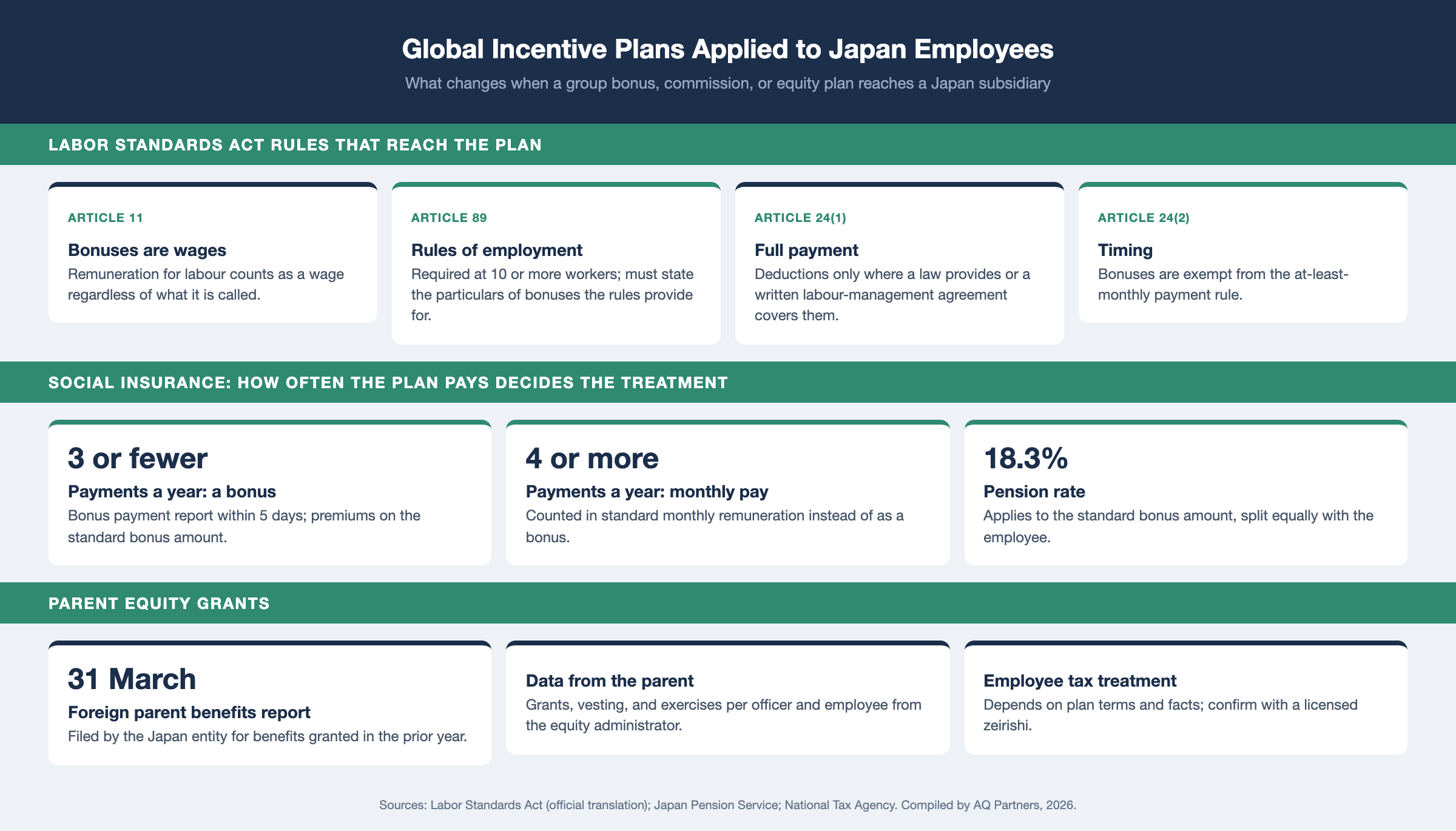
- A bonus is a wage once it is promised. The Labor Standards Act defines wages to include bonuses paid as remuneration for labour, regardless of what they are called, so plan wording decides how much discretion the employer keeps.
- Rules of employment must describe bonus terms. A subsidiary that continuously employs 10 or more workers must draw up rules of employment, and those rules must set out the particulars of any special wages such as bonuses that the rules provide for.
- Clawbacks meet the full-payment rule. Article 24 requires wages to be paid in full, and a deduction is lawful only where a law provides for it or a written labour-management agreement covers it.
- Payment frequency changes social insurance. Japan Pension Service treats payments made three times a year or fewer as bonuses with their own report and premium base; payments made four or more times a year count as monthly remuneration.
- Parent equity creates a subsidiary filing. Where a foreign parent grants economic benefits such as stock options or shares to officers or employees in Japan, the Japan entity files a report with the tax office by 31 March of the following year.
When a Global Bonus Becomes an Enforceable Wage in Japan
In Japan, a bonus promised by contract, rules of employment, or a fixed formula is a wage, so the plan's wording decides how much discretion remains.
Article 11 of the Labor Standards Act defines a wage as "wages, salary, allowances, bonuses, and anything else that the employer pays to the worker as remuneration for labor, regardless of what it is called." Once a bonus is promised in a form the employee can rely on, it falls within that definition, and the protections that apply to wages apply to it. Article 89 adds a documentation duty: an employer that continuously employs 10 or more workers must draw up and file rules of employment (就業規則, shugyo kisoku), and where those rules provide for special wages such as bonuses, they must set out the particulars. Article 24(2) exempts bonuses from the rule that wages are paid at least monthly on a fixed date.
The practical question is therefore whether the Japan documents still describe a discretionary bonus. A formula, a target percentage in the offer letter, and a payment date can together read as a commitment to pay once targets are met. The table sets out the plan elements to review before rollout.
| Plan element | Where it appears for Japan | Japan point | What to check |
|---|---|---|---|
| Discretion wording | Plan rules, offer letter | A bonus promised in a form the employee can rely on is a wage under Article 11 | Whether the offer letter quotes a target in a way that reads as guaranteed |
| Bonus criteria and formula | Rules of employment, plan rules | Article 89 requires the particulars of special wages that the rules provide for | That the rules of employment and the group plan describe the same criteria |
| Payment timing and frequency | Plan rules, payroll calendar | Bonuses are exempt from the monthly payment rule under Article 24(2) | How many payments a year the plan makes, which affects social insurance |
| Eligibility conditions such as being employed on the payment date | Plan rules, rules of employment | Enforceability depends on the wording and the facts | Wording reviewed by a Japanese employment lawyer before rollout |
| Commission advances and clawbacks | Commission plan, labour-management agreement | Deductions from wages need a law or a written agreement under Article 24(1) | Whether a deduction agreement exists and covers the clawback |
| Currency of payment | Plan rules | Article 24(1) requires payment in currency, with exceptions set by law or agreement | Whether a plan paid in the parent's currency or in kind needs adjustment |
| Parent equity grants | Grant agreement, parent plan | The Japan entity reports benefits granted by a foreign parent to the tax office | That the subsidiary receives grant, vesting, and exercise data each year |
Pay structure in general, including allowances and the summer and winter bonus tradition, is covered in Japan salary structure, allowances, and bonuses. The clause-by-clause view of a group employment template is in localizing group employment policies for Japan.
Commission Plans, Advances, and Clawbacks Under the Full-Payment Rule
Japan's full-payment rule means a commission clawback cannot simply be deducted from salary unless a law or a written workplace agreement allows it.
Article 24(1) of the Labor Standards Act requires an employer to "pay the full amount of wages in currency directly to the worker." It permits partial deductions only where laws and regulations provide for them, such as income tax and social insurance, or where the employer has a written agreement with a majority labour union or, if there is none, with a person representing a majority of the workers at the workplace. Netting an overpaid or unearned commission against the next payroll is a deduction from wages and needs one of those bases.
Three design points follow for a global sales compensation team. First, a commission paid as an advance against future earnings should say so in the plan and in the Japan documents, so the payment and its reconciliation are clear. Second, if the group wants to recover amounts through payroll, the subsidiary needs a written labour-management agreement that covers that type of deduction before the first recovery. Third, recovering an amount by asking the employee to repay it, rather than deducting it, is a separate legal question, and the enforceability of a repayment clause should be confirmed with a Japanese employment lawyer.
Social Insurance and Payroll Treatment of Bonuses in Japan
Japan treats payments made three times a year or fewer as bonuses for social insurance, with a separate report and premium base from monthly pay.
According to Japan Pension Service guidance on bonus reporting, a bonus for health insurance and employees' pension purposes is any payment received as consideration for labour, whatever it is called, that is paid three times a year or fewer. Payments made four or more times a year are treated as part of standard monthly remuneration instead. When a bonus is paid, the employer files a bonus payment report within 5 days of the payment date. Premiums are calculated on the standard bonus amount, which is based on the gross bonus, using the same health insurance and pension rates as monthly pay, split equally between employer and employee; the pension rate is 18.3% of the base in total. Both health insurance and pension apply caps to the standard bonus amount, set out on the same Japan Pension Service page.
The frequency rule matters most for commission plans. A quarterly commission paid four times a year is not a bonus for social insurance purposes; it feeds into the employee's standard monthly remuneration, which is reviewed through the annual standard remuneration report. A semi-annual plan paid twice a year is a bonus with its own report each time. Teams changing payment frequency should check the effect with the payroll provider and the sharoushi (社会保険労務士, labour and social security attorney) who handles the filings. Employment insurance and income tax withholding also apply to bonuses, with income tax withheld using a separate bonus rate table published by the National Tax Agency.
Parent Stock Options and Equity Grants for Japan Employees
When a foreign parent grants stock options or shares to Japan employees, the Japan subsidiary must report those benefits to the tax office each year.
Where the parent and its broker administer equity grants, they sit outside Japanese payroll, but the Japan entity still has a reporting obligation. The National Tax Agency's procedure page for the foreign parent benefits report (外国親会社等が国内の役員等に供与等をした経済的利益に関する調書) states that the report is filed by the head of the domestic company or office where the officers or employees who received economic benefits from a foreign parent work. It is due by 31 March of the year following the grant or provision, with a later date for certain non-residents, and can be filed through e-Tax or on paper.
Meeting that deadline depends on data the subsidiary does not hold. The Japan entity needs, for each officer and employee, the grants, vesting events, and exercises in the calendar year, and the values involved, from the parent's equity administrator. How the benefit is taxed in the employee's hands depends on the plan's terms and the facts, and is a question for a licensed tax accountant (税理士, zeirishi); employees who receive equity benefits may also need to file their own income tax returns. Where the subsidiary itself issues stock acquisition rights, the issuance is registered with the Legal Affairs Bureau.
Writing the Japan Version of a Global Incentive Plan
A Japan version of a global incentive plan aligns the plan rules, the rules of employment, the offer letter, and payroll before the first payment.
A practical rollout keeps one group plan and adds a short Japan supplement recording the points that differ, with the subsidiary's own documents updated to match. A workable sequence is:
- Map each plan element against the Japan documents: offer letters, employment contracts, and, where 10 or more workers are continuously employed, the rules of employment.
- Decide the payment frequency deliberately, knowing that four or more payments a year move the amounts into standard monthly remuneration.
- Put any payroll deduction for advances or clawbacks on a written labour-management agreement before the first recovery.
- Confirm discretion and eligibility wording with a Japanese employment lawyer, since enforceability turns on how the terms are written.
- Set up the annual equity data request from the parent's administrator so the foreign parent benefits report can be filed by 31 March.
- Brief the payroll provider so bonus runs, the bonus payment report, and withholding are scheduled with each payment.
Contract-level changes to the group template, including the employment contract and offer letter, are covered in employment contracts and labor rules in Japan.
Frequently Asked Questions
Can a Japan subsidiary keep a bonus fully discretionary?
It can describe a bonus as discretionary, but the Labor Standards Act counts bonuses paid as remuneration for labour as wages regardless of their name. Once an offer letter, rules of employment, or a fixed formula promises a bonus the employee can rely on, the employer's discretion narrows.
Is a quarterly commission a bonus for social insurance in Japan?
No. Japan Pension Service treats payments made three times a year or fewer as bonuses. A commission paid four or more times a year is treated as part of standard monthly remuneration and affects the monthly premium base.
Does a Japan subsidiary report stock options granted by its foreign parent?
Yes. The Japan entity where the recipients work files a report on economic benefits provided by a foreign parent, due by 31 March of the following year, according to the National Tax Agency.
Working with AQ Partners. Our Tokyo team provides back office operations for foreign companies operating in Japan, including monthly payroll coordination with a licensed sharoushi, bonus pay runs, the annual payroll statutory reports including equity-based income filings, and rules of employment. Book a consultation to discuss your Japan payroll setup.


Yuga Koda is a founding Director at AQ Partners, supporting foreign companies, funds, and families operating in Japan. His experience operating companies in both Japan and international markets gives him a practical understanding of back office operations from both sides.