
Employment Contracts & Labor Rules in Japan
Key Takeaways
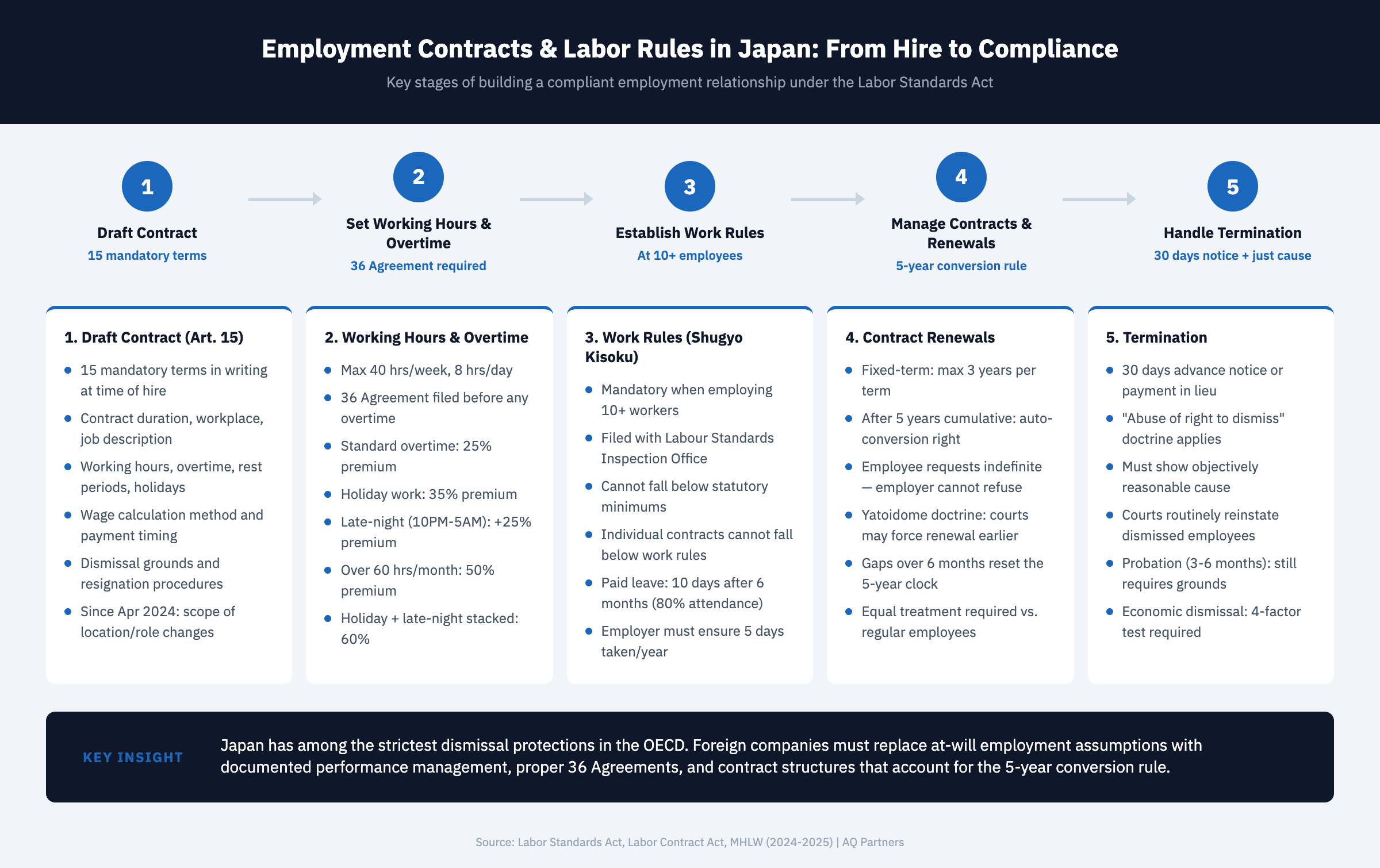
- Japanese employment contracts must include specific mandatory terms prescribed by Article 15 of the Labor Standards Act — contract duration, workplace, job description, working hours, wages, and termination conditions must be clearly stated in writing. Unlike many jurisdictions, oral agreements on these points are insufficient — the employer must provide written documentation (or electronic documentation with employee consent) at the time of hiring.
- Fixed-term contracts exceeding 5 years of cumulative renewals automatically convert to indefinite employment — under the 2013 Labor Contract Act amendment, employees on consecutive fixed-term contracts who reach 5 years of total service can request conversion to an open-ended contract, which the employer cannot refuse. According to the MHLW, this "5-year rule" (muki tenkan) has significantly reshaped how companies manage contract worker populations.
- Overtime premium rates in Japan are among the highest in the OECD: 25% for standard overtime, 35% for holiday work, and 50% for late-night overtime exceeding 60 hours per month — these rates are mandatory minimums that cannot be reduced by contract. When overtime occurs during both late-night hours (10 PM-5 AM) and holidays, premiums stack: holiday + late-night work commands a 60% premium.
- Dismissal in Japan requires both 30 days advance notice (or payment in lieu) and objectively reasonable cause — the "abuse of right to dismiss" doctrine (kaiko ken ranyou houri) makes termination far more restrictive than in at-will jurisdictions. Courts routinely reinstate employees who were dismissed without sufficient cause, making Japan one of the most employee-protective labor markets globally.
- Probation periods (shiyou kikan) in Japan do not create at-will employment — while courts apply a somewhat relaxed standard for dismissal during probation (typically 3-6 months), employers must still demonstrate objectively reasonable grounds. The probation period must be clearly specified in the employment contract and typically cannot exceed 6 months without justification.
What Must Be Included in a Japanese Employment Contract?
A Japanese employment contract must include mandatory terms covering 15 categories prescribed by Article 15 of the Labor Standards Act — employers are required to provide these terms in writing at the time of hiring, and failure to do so gives the employee the right to immediately terminate the contract. These requirements apply to all employment relationships in Japan regardless of the employer's country of origin. The full text of the Labor Standards Act is available through Japanese Law Translation.
The mandatory written terms include: (1) contract duration (fixed-term or indefinite); (2) workplace location; (3) job description; (4) start and end times of working hours; (5) overtime provisions; (6) rest periods; (7) holidays and leave; (8) shift rotation details if applicable; (9) wage determination method, calculation, and payment timing; (10) wage payment method; (11) rules on raises; (12) retirement age and retirement provisions; (13) dismissal grounds; (14) resignation procedures; and (15) applicable work rules. Since April 2024, employers must also specify the scope of potential changes to workplace location and job duties — a new requirement particularly relevant for companies that reassign employees between roles or locations.
Foreign companies frequently err by using their home-country contract templates, which often omit Japan-specific mandatory terms or include provisions that conflict with Japanese labor law (such as at-will termination clauses). Employment contracts in Japan form part of a hierarchy: the Labor Standards Act sets the floor, work rules cannot fall below statutory minimums, and individual employment contracts cannot fall below work rules. Any contract term less favorable than the work rules or statute is automatically void and replaced by the higher standard.
Fixed-Term vs. Indefinite Contracts: What Are the Differences?
Fixed-term contracts (yuki koyo keiyaku) in Japan can have a maximum duration of 3 years per term (5 years for certain specialized professionals), and cumulative renewals exceeding 5 years trigger an automatic right to convert to indefinite employment — making fixed-term contracts a temporary staffing tool rather than a permanent cost-control mechanism.
The 5-year conversion rule (muki tenkan ruru), enacted through the 2013 amendment to the Labor Contract Act, fundamentally changed the dynamics of fixed-term employment in Japan. When an employee's consecutive fixed-term contracts (with no gaps exceeding 6 months) accumulate to more than 5 years of total service, the employee gains the right to request conversion to an indefinite contract. The employer cannot refuse this request. Upon conversion, the employment terms remain the same except that the contract becomes open-ended.
| Feature | Fixed-Term Contract | Indefinite Contract |
|---|---|---|
| Maximum single term | 3 years (5 years for specialists) | No limit (until retirement age) |
| Conversion trigger | After 5 years of cumulative renewals | N/A — already indefinite |
| Termination at expiry | Non-renewal possible (with restrictions after repeated renewals) | Dismissal requires just cause |
| Non-renewal doctrine (yatoidome) | Courts may force renewal if employee had reasonable expectation | N/A |
| Social insurance eligibility | Same as indefinite if hours threshold met | Fully eligible |
| Annual paid leave | Accrues same as indefinite employees | Standard accrual schedule |
| Equal treatment requirement | Equal or balanced treatment vs. regular employees (2020 law) | Standard terms apply |
| Common use case | Project-based work, seasonal positions, initial evaluation | Core workforce, permanent positions |
A critical nuance is the "yatoidome" doctrine (refusal to renew). Even before the 5-year threshold, courts may force contract renewal if: the fixed-term contract was repeatedly renewed to the point where the employee had a reasonable expectation of continued employment, or the work performed was essentially the same as indefinite employees. Foreign companies relying on serial fixed-term contracts to maintain staffing flexibility should be aware that Japanese courts often look past the contractual form to the employment substance.
What Are Japan's Working Hours Rules and Overtime Premiums?
Standard working hours in Japan are capped at 40 hours per week and 8 hours per day — any work beyond these limits requires a valid 36 Agreement and triggers mandatory overtime premium payments that cannot be reduced by contract or employee waiver.
Overtime premium rates follow a tiered structure. Standard overtime (beyond 8 hours/day or 40 hours/week) commands a minimum 25% premium over the base hourly rate. Work on statutory holidays (shutsujitsu) requires a 35% premium. Late-night work between 10:00 PM and 5:00 AM adds a 25% premium. When overtime exceeds 60 hours in a single month, the premium increases to 50% for hours beyond the 60-hour threshold (applicable to all companies since April 2023, previously only large enterprises). These premiums stack: holiday work during late-night hours commands a combined 60% premium (35% + 25%).
The base hourly rate for overtime calculation must include base salary and most regular allowances, but may exclude certain items such as family allowances, commuting allowances, and housing allowances — provided these are paid uniformly without regard to individual circumstances. Companies that incorrectly exclude regular allowances from the overtime calculation base face retroactive wage claims and penalties. For comprehensive payroll processing guidance including overtime calculations, see our guide on how payroll works in Japan.
| Overtime Scenario | Premium Rate | Notes |
|---|---|---|
| Standard overtime (beyond 8hr/day or 40hr/week) | 25% | Requires valid 36 Agreement |
| Overtime exceeding 60 hours/month | 50% | All companies since April 2023 |
| Late-night work (10 PM - 5 AM) | 25% | Applies even during regular shift |
| Statutory holiday work | 35% | Min 1 day off per week or 4 per 4 weeks |
| Overtime + late-night (stacked) | 50% | 25% overtime + 25% late-night |
| Holiday + late-night (stacked) | 60% | 35% holiday + 25% late-night |
How Do Dismissal Restrictions Work in Japan?
Dismissal in Japan requires both procedural compliance (30 days advance notice or payment in lieu) and substantive justification (objectively reasonable cause and social appropriateness) — the burden of proof falls entirely on the employer, and courts frequently rule dismissals invalid even when notice was properly given.
The "abuse of right to dismiss" doctrine (kaiko ken ranyou houri), codified in Article 16 of the Labor Contract Act, establishes that a dismissal lacking objectively reasonable grounds and deemed inappropriate by social norms is treated as an abuse of the right to dismiss and is therefore invalid. Japanese courts have developed extensive case law defining what constitutes sufficient cause. Performance-based dismissals require documented evidence of underperformance, adequate improvement opportunities, warnings, and evidence that remediation was attempted. Economic dismissals (seiridaiko) require satisfying four criteria: genuine business necessity, exhaustion of alternatives, fair selection criteria, and adequate procedural consultation.
The practical implications for foreign companies are significant. Japan's dismissal protection is among the strictest in the OECD. According to OECD employment protection indicators, Japan ranks as one of the most restrictive countries for individual dismissal, with an index score reflecting extensive procedural requirements. JETRO provides additional guidance on employment regulations that foreign companies should review before establishing operations in Japan. Companies accustomed to at-will employment in the United States or relatively flexible termination in Singapore or Hong Kong must fundamentally adjust their personnel management approach when operating in Japan. For guidance on the broader labor compliance risks that dismissal disputes represent, see our companion article.
What Should Foreign Companies Know About Non-Compete Agreements and Post-Employment Restrictions?
Non-compete clauses in Japanese employment contracts are enforceable only if they meet strict reasonableness criteria — Japanese courts regularly invalidate overly broad non-compete agreements, particularly those lacking geographic limits, reasonable time restrictions, or adequate compensation.
Courts evaluate non-compete validity based on: (1) whether the employer has a legitimate interest to protect (trade secrets, key client relationships); (2) the employee's position and access to confidential information; (3) the geographic scope of the restriction; (4) the duration of the restriction (generally 1-2 years is the maximum courts will accept); (5) the scope of restricted activities; and (6) whether the employer provides compensatory consideration (such as additional pay during the restriction period). Non-compete agreements without compensatory payment are routinely invalidated.
Confidentiality agreements (himitsu hoji gimu) are more broadly enforceable and should be distinguished from non-compete restrictions. The Unfair Competition Prevention Act provides statutory protection for trade secrets meeting three criteria: secret management, usefulness, and non-public nature. Foreign companies are generally better served by robust confidentiality provisions than by aggressive non-compete clauses that Japanese courts are likely to narrow or void.
Frequently Asked Questions
Can we use our global employment contract template in Japan?
Global templates typically require significant modification for Japan. At minimum, they must include all 15 mandatory terms under Article 15 of the Labor Standards Act, remove any at-will termination language, specify overtime premium rates at statutory minimums (25%/35%/50%), and reference applicable work rules. Provisions common in other jurisdictions — such as non-compete clauses without compensation, unilateral contract modification rights, or probation periods with unrestricted termination — may be unenforceable or void under Japanese law. Having the contract reviewed by a Japan labor law specialist before use is strongly recommended.
What happens when a fixed-term employee reaches the 5-year conversion threshold?
When an employee on consecutive fixed-term contracts accumulates more than 5 years of total service (with no gap exceeding 6 months between contracts), they gain the right to request conversion to an indefinite-term contract. The employer cannot refuse this request. The conversion takes effect from the start of the next contract period. Employment terms remain unchanged except that the contract becomes open-ended. Companies cannot circumvent this rule by inserting strategic gaps — courts examine the totality of the employment relationship.
Is lifetime employment still a factor in Japan?
While "lifetime employment" (shushin koyo) is not a legal doctrine, its cultural residue significantly influences employment expectations, court decisions, and government policy. The dismissal restriction framework — particularly the high evidentiary bar for performance-based termination — reflects a societal expectation that employment relationships should be long-term. Foreign companies should understand that employees, courts, and labor inspectors share an underlying assumption that employment stability is a social good, which shapes how rules are interpreted and enforced in practice.
Employment contracts and labor rules in Japan create a framework that strongly favors employee protection. For foreign companies navigating these requirements, AQ Partners provides HR administration services including contract drafting, work rules preparation, and ongoing compliance support. Contact us to ensure your employment practices meet Japanese legal standards.


Yuga Koda is a founding Director at AQ Partners, supporting foreign companies, funds, and families operating in Japan. His experience operating companies in both Japan and international markets gives him a practical understanding of back office operations from both sides.