
Year One Failure Modes for Foreign-Owned Subsidiaries in Japan, and the Controls That Prevent Them

Year-one failure modes for a foreign-owned subsidiary in Japan are the predictable ways a new KK or GK falls out of compliance or out of cash in its first twelve months: a filing deadline that starts at registration and is missed, an employee enrolled late, a bank account that is not ready when payroll is due, or a provider handover that drops a record. Each failure is ordinary on its own. Together they explain most of the penalties, back payments, and lost headquarters confidence in a subsidiary's first year. This article sets out the common failure modes, the early warning sign for each, the control that prevents it, and who should own that control, so headquarters can check its new entity against a single list rather than discovering the gaps at the first year-end.
Key Takeaways
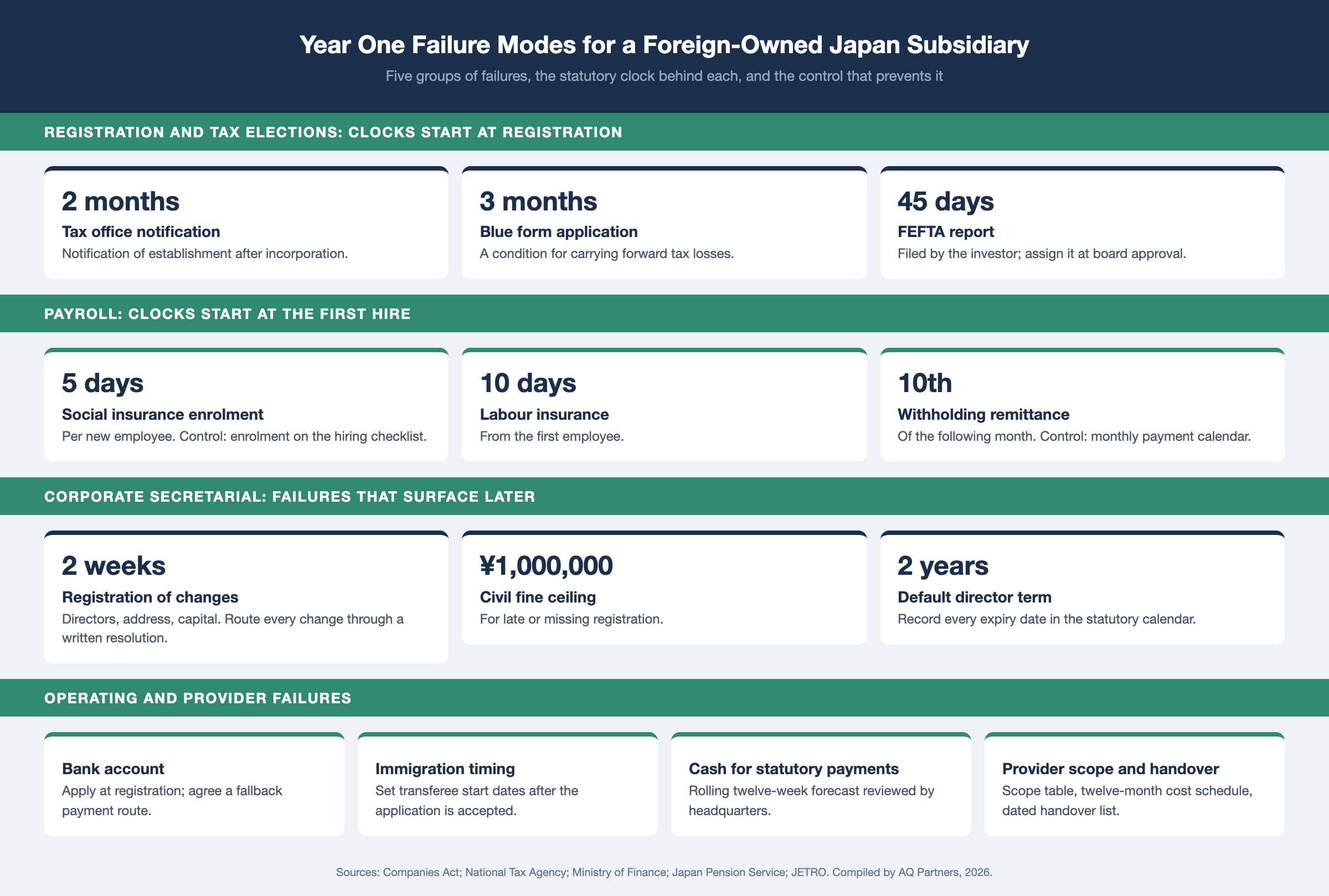
- Most first-year clocks start at registration. The tax office notification is due within 2 months, the blue form application within 3 months, and the FEFTA post-investment report within 45 days, whether or not the bank account or the first hire is ready.
- Payroll failures start on the first day of employment. Social insurance enrolment is due within 5 days of a hire and labour insurance within 10 days, and withholding tax is remitted by the 10th of the following month.
- Corporate secretarial failures surface late. Registration changes are due within 2 weeks, and director terms expire on a fixed cycle; a missed filing can draw a civil fine of up to ¥1,000,000 years after the event.
- Banking and immigration timing drive the operating calendar. A late bank account or a delayed residence permit for the first transferee pushes back payroll, tax payments, and hiring, so both need a fallback plan.
- Provider failures are preventable at contract stage. A shared scope, a twelve-month cost schedule, and a dated handover list remove the scope drift and dropped records that cause most provider disputes.
The Failure Mode Table for a Japan Subsidiary's First Year
A first-year failure in Japan usually shows an early warning sign weeks before the penalty, and a named owner with one control can catch it.
The table below is the working checklist. Each row pairs a failure mode with the earliest sign that it is developing, the control that prevents it, and the party best placed to own that control. Headquarters can send it to the local provider at set-up and review it at each quarterly call. The deadlines cited come from the statutes and official guidance linked in each section; the overall sequence of setting up a subsidiary is described in JETRO's Setting Up Business in Japan guide.
| Failure mode | Early warning sign | Preventive control | Owner |
|---|---|---|---|
| Tax office notification or blue form application missed | No filing receipts on file six weeks after registration | Post-incorporation filing list dated from the registration date | Local provider, confirmed by headquarters |
| FEFTA post-investment report missed | No one at headquarters can say who files it | Assign the report at board approval of the investment | Headquarters legal |
| First employee enrolled late in social or labour insurance | Offer letter signed before the insurance office registration is planned | Enrolment steps added to the hiring checklist | Sharoushi, coordinated by the provider |
| Withholding tax remitted late | Payroll run without a payment date for the withholding | Monthly payment calendar with an approver at headquarters | Local provider |
| Registration change filed late | Director or address changes approved by email only | Every change routed through a written resolution and the shiho-shoshi | Headquarters legal |
| Director term expires unnoticed | Articles silent on term length and no expiry date recorded | Term expiry dates in the statutory calendar | Local provider |
| Bank account not ready for the first payroll | Application still pending at offer stage | Bank application started at registration, with a fallback payment route | Headquarters treasury |
| Residence permit delays the first transferee | Start date set before the immigration application is filed | Start dates set only after the application is accepted | Headquarters HR with immigration counsel |
| Cash short for statutory payments | Tax and insurance payments not in the funding forecast | Rolling twelve-week cash forecast including statutory payments | Headquarters finance |
| Provider scope or fees change mid-year | Invoices with new line items | Agreed scope table and twelve-month cost schedule | Headquarters finance |
| Records lost in a provider handover | New provider asking for logins and prior returns | Dated handover list and an overlap month | Headquarters, with both providers |
Registration and Tax Election Failures in a Japan Subsidiary
Registration starts the tax and FEFTA clocks at once, and a missed election in month two or three can cost the subsidiary for years afterwards.
The notification of establishment is due at the tax office within 2 months of incorporation, and the blue form return application within 3 months, under the rules summarised on the National Tax Agency's corporation tax pages. The blue form matters more than its paperwork suggests: approval is a condition for carrying forward tax losses, so a first-year loss without blue form approval is a loss the subsidiary cannot use later. Where the parent's investment falls under the Foreign Exchange and Foreign Trade Act (外為法, gaitameho), a post-investment report is due within 45 days, a filing that belongs to the investor rather than the subsidiary and is therefore easy for both sides to assume the other has handled. The Ministry of Finance's foreign direct investment pages explain which investments need a report and which need prior notification.
The control is a single filing list dated from the registration date, issued on the day the registration certificate arrives, with each item assigned to a named person. The detailed sequence of these filings is in the first-year headquarters calendar for a new Japan subsidiary, and the FEFTA rules are covered in FEFTA inward direct investment notification and reporting.
Payroll and Social Insurance Failures in the First Year
A Japan subsidiary's payroll failures usually begin with the first hire, when enrolment and withholding deadlines start before any process exists.
A company with even one employee in Japan must enrol in employees' pension and health insurance, and the enrolment for each new employee is due within 5 days of the hire. Labour insurance registration is due within 10 days of the first employee. Withholding tax on salaries is remitted by the 10th of the following month. The Japan Pension Service administers the pension and health insurance side, and late enrolment typically leads to retroactive contributions for the months missed, collected from the employer.
The warning sign is an offer letter signed before anyone has planned the insurance office registration or the first payment date. The control is to add enrolment and the first withholding payment to the hiring checklist, so the first offer cannot be issued without them. Social and labour insurance filings prepared for a fee are reserved for a sharoushi (社会保険労務士, labour and social security attorney), so the checklist should name who that is. Calculation and record-keeping errors that follow later, such as standard remuneration and year-end adjustment mistakes, are covered in payroll compliance risks for foreign companies in Japan.
Corporate Secretarial Failures That Surface After Year One
Corporate secretarial failures rarely cause trouble in month one; they surface when a missed registration or expired director term is found later.
Under the Companies Act, a change to registered matters, such as a director appointment or resignation or a head office move, must be registered within 2 weeks, and a late or missing registration can draw a civil fine of up to ¥1,000,000 on the representative director personally. Director terms are a related trap. A KK director's term defaults to 2 years and can be extended to up to 10 years in a non-public company, and a re-election that is never resolved or registered leaves the company with an overdue registration that is only discovered when a bank or counterparty asks for a current certificate.
The warning sign is a director or address change that headquarters approved by email without a written resolution. The control is to route every change through a written shareholder resolution and the shiho-shoshi who files the registration, and to record every director's term expiry date in the statutory calendar from day one. The term rules are set out in director terms of office in Japan.
Banking, Immigration, and Cash Failures in a New Japan Entity
Bank account delays, residence permit timing, and cash shortfalls are the first-year failures that most often push back payroll and hiring.
Opening a corporate bank account for a new foreign-owned entity involves anti-money-laundering checks that can take longer than headquarters expects, and the first payroll, rent, and tax payments are due regardless. The control is to start the bank application as soon as the registration certificate is issued and to agree a fallback route for the first payments before any offer is made. Immigration timing works the same way: where the first employee is a transferee from the parent, the start date depends on the residence status application, so start dates should be set only after the application is filed and accepted, with immigration counsel advising on the timetable.
Cash is the quieter failure. A subsidiary funded for operating costs can still run short when statutory payments fall due together, such as social insurance contributions, withholding, and the first tax payments, and someone then has to front them. A rolling twelve-week cash forecast that includes every statutory payment, reviewed by headquarters finance, is the control. The funding options themselves are covered in funding a Japan subsidiary and getting cash out.
Provider Scope and Handover Failures
Provider-related failures in a subsidiary's first year come from unclear scope, unexpected fee changes, and records lost when work changes hands.
Three patterns recur. Scope is assumed rather than written down, so a filing falls between the provider, the sharoushi, and headquarters. Fees change mid-year because work that headquarters assumed was included is billed separately. And when the subsidiary moves from a set-up adviser to an ongoing provider, or between providers, e-filing credentials, prior returns, and payroll master data are not handed over on a fixed date. Each is a contract-stage problem with a contract-stage fix: a scope table that every party marks as included, priced separately, or not offered; a twelve-month cost schedule built on the subsidiary's actual profile; and a dated handover list with an overlap month. All three are set out in how to choose a back-office provider for your Japan subsidiary.
Working with AQ Partners. Our Tokyo team provides back office operations for foreign companies operating in Japan, from post-incorporation filings and bank account applications to payroll coordination with a licensed sharoushi and director change registrations. Book a consultation to review your subsidiary's first-year controls.

Yuga Koda is a founding Director at AQ Partners, supporting foreign companies, funds, and families operating in Japan. His experience operating companies in both Japan and international markets gives him a practical understanding of back office operations from both sides.