
How to Choose a Back-Office Provider for Your Japan Subsidiary: RFP Questions, Scope, Pricing Models, and Transition

Choosing a back-office provider for a Japan subsidiary means selecting the firm that will keep the entity's books, run payroll, file tax and social insurance returns, and maintain its corporate registrations on behalf of headquarters. For a multinational, the provider is usually the only party in Japan that sees every statutory deadline, so the selection decides whether the subsidiary stays compliant without a local finance team. This guide is written for the person at headquarters running that selection: the controller, the regional finance lead, or the general counsel who has been told to "find someone in Tokyo". It covers how to define the scope, which work in Japan legally requires a licensed professional, how the common pricing models differ, a 30-question request for proposal (RFP), how to score the answers, and how to move from an incumbent provider without missing a filing.
Key Takeaways
- Scope first, providers second. Write the scope as a checklist of recurring and event-driven services before contacting anyone. Proposals that answer a shared scope can be compared; proposals that each define their own scope cannot.
- Some of the work is reserved for licensed professionals. Tax returns and tax consultation belong to a zeirishi (tax accountant), social insurance and labour filings made for a fee belong to a sharoushi, and commercial registration filed on the company's behalf belongs to a shiho-shoshi. Ask every provider who holds each licence.
- Pricing models hide different costs. A coordination fee, an all-in retainer, per-run pricing, and an hourly engagement can all look similar in month one and diverge by year-end, when the annual payroll reports, the year-end adjustment, and the corporate tax return arrive.
- The transition is where compliance gaps appear. Switching providers moves e-filing credentials, tax agent authority, payroll master data, and residential tax notices. A dated handover checklist and an overlap month prevent a missed filing.
- Manage the provider with a calendar, not a feeling. A shared statutory calendar, a fixed monthly close date, and a quarterly review of open items give headquarters the visibility that a local finance team would otherwise provide.
What a Japan Back-Office Provider Covers for a Foreign-Owned Subsidiary
A Japan back-office provider runs the subsidiary's accounting, payroll, tax, and corporate filings, plus event-driven registrations and admin.
The scope is wider than most headquarters teams expect, because a Japanese subsidiary owes filings to four separate authorities: the tax office and the local tax offices for corporate, consumption, and withholding taxes; the pension office and the Labour Standards Inspection Office for social and labour insurance; the Legal Affairs Bureau for commercial registration; and, where foreign investment rules apply, the Bank of Japan for foreign exchange reports. A provider that covers only bookkeeping leaves headquarters to coordinate the rest. The first step in any selection is therefore to write down the full scope in a checkbox format, mark which items the subsidiary actually needs, and send the same list to every candidate.
Demand for outsourced operations continues to grow. According to Deloitte's Global Outsourcing Survey 2024, which polled more than 500 executives, 80% plan to maintain or increase their investment in third-party outsourcing, while 70% report that their vendor management function is not fully mature. That second figure matters for a Japan subsidiary: the provider can be capable while headquarters still lacks the process to direct and check it.
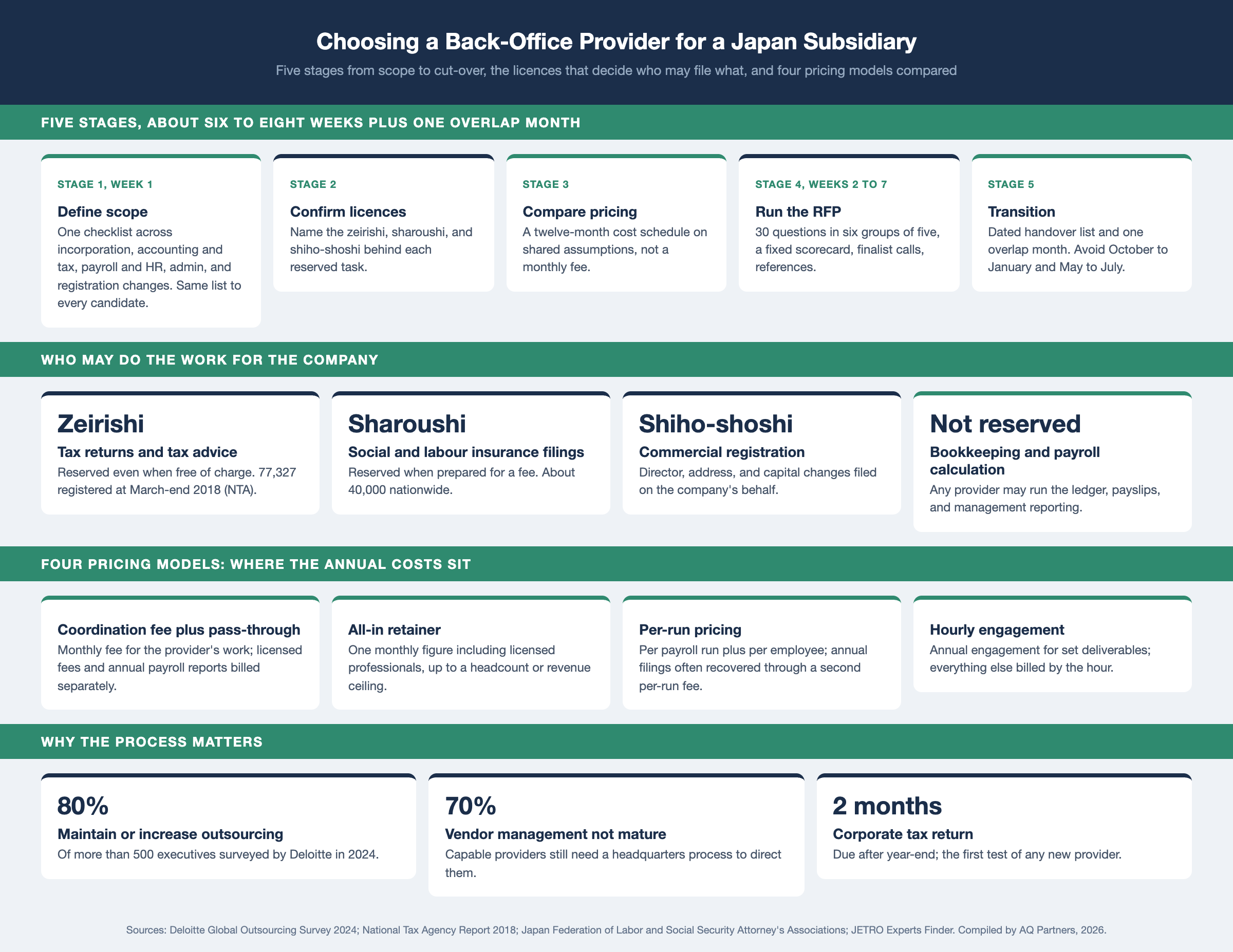
The scope table below follows the structure of a typical Japan back-office statement of work. It lists the services a foreign-owned KK or GK usually needs in its first three years, how often each recurs, and the question that separates a complete answer from a partial one.
| Service area | Typical items | Cadence | Question that tests the proposal |
|---|---|---|---|
| Incorporation and entity | KK or GK incorporation, registered address, company seal storage | One-off, then ongoing custody | Who holds the registered seal and seal card, and how does headquarters approve each use? |
| Post-incorporation filings | Tax office notification, blue form application, qualified invoice issuer registration | One-off, within 2 to 3 months of registration | Which filings are included in the setup fee and which are billed separately? |
| Banking | Corporate bank account application, administrator changes, payment execution | One-off, then monthly | Does the provider release payments, or only prepare them for an approver at headquarters? |
| Monthly accounting | Bookkeeping, month-end close, management reporting package | Monthly | On which business day after month-end does headquarters receive the package? |
| Annual tax filings | Corporate tax, local taxes, consumption tax, depreciable asset return | Annual, due 2 months after year-end | Is the return prepared and signed by a zeirishi, and is the fee tied to revenue bands? |
| Withholding and treaty filings | Withholding on salaries and cross-border payments, treaty relief forms | Monthly or semi-annual | Who files the treaty application before the first royalty or service fee is paid to the parent? |
| Payroll | Monthly payroll, bonus runs, year-end adjustment | Monthly, plus June to July and December events | Which sharoushi handles the filings, and is that fee inside or outside the quote? |
| Social and labour insurance | Enrolment within 5 days of hire, annual standard remuneration report, labour insurance renewal | Per event and annual | Are the annual payroll reports priced per filing, per employee, or included? |
| HR documentation | Rules of employment, employment contracts, 36 Agreement | One-off, then annual refiling | Who drafts the Japanese text, and is an English version supplied? |
| Corporate secretarial | Annual shareholder resolution, public notice, director re-election, registration changes | Annual and per event | How does the provider track director terms and the 2-week registration deadline for changes? |
The table doubles as the scope exhibit of the RFP. Candidates mark each row as included, priced separately, or not offered, and that single grid makes the proposals comparable. A detailed view of how these obligations fall across the first year is in the first-year headquarters calendar for a new Japan subsidiary.
The Licence Question: Which Japan Back-Office Work Needs a Zeirishi, Sharoushi, or Shiho-Shoshi
Japanese law reserves tax returns and tax advice for zeirishi, paid labour filings for sharoushi, and registration filed for others for shiho-shoshi.
The licensed professions in Japan are narrower and more numerous than in most headquarters countries, and each holds an exclusive area of work. The National Tax Agency's 2018 report on certified public tax accountants sets out the tax side clearly: tax proxy, preparation of tax documents, and tax consultation "must not be performed by persons other than CPTAs", even at no charge. The same report counted 77,327 registered zeirishi (税理士, certified public tax accountant) at the end of March 2018. On the labour side, the Japan Federation of Labor and Social Security Attorney's Associations puts the number of sharoushi (社会保険労務士, labour and social security attorney) at approximately 40,000; they act as proxy for employers in filings with the pension office, Hello Work, and the Labour Standards Inspection Office.
The practical consequence is that no single generalist firm can legally do everything a subsidiary needs. A provider either employs the licensed professionals, partners with them under a disclosed arrangement, or leaves the client to engage them directly. Each model can work. The risk is a provider that is vague about which applies. JETRO's Experts Finder directory uses the same six categories of professional and is a useful cross-check when a proposal names a partner firm.
| Task | Who may do it for the company | What a non-licensed provider can do |
|---|---|---|
| Corporate tax and local tax returns | Zeirishi or zeirishi corporation (also lawyers who have notified the tax authority) | Keep the books and prepare the trial balance the zeirishi works from |
| Consumption tax return | Zeirishi | Maintain invoice records and tax codes in the ledger |
| Advice on the tax treatment of a transaction | Zeirishi or tax lawyer, even when given free of charge | Collect the facts and route the question |
| Social insurance enrolment and loss filings, prepared for a fee | Sharoushi | Collect employee data and coordinate the sharoushi's submission |
| Labour insurance annual renewal and standard remuneration report | Sharoushi when prepared for a fee | Run payroll calculations that feed the filings |
| Rules of employment filed with the Labour Standards Inspection Office | Sharoushi when prepared and filed for a fee | Translate, track versions, and manage employee acknowledgement |
| Commercial registration (director change, address change, capital increase), including the resolutions and other documents filed with the Legal Affairs Bureau | Shiho-shoshi (司法書士, judicial scrivener) or lawyer, or the company itself | Track deadlines, collect signatures, and coordinate the shiho-shoshi |
| Residence status and visa applications | Gyosei-shoshi (行政書士, administrative scrivener) with filing authority, or lawyer | Coordinate documents with the employee and the parent |
| Payroll calculation and payslips | Calculation is not reserved; statutory labour records such as the wage ledger, prepared for a fee, are sharoushi work | Run the calculation and payslips; coordinate the statutory records with the sharoushi |
| Bookkeeping and management reporting | Not reserved | Full service |
The statutory basis for each row is set out in the professions' own acts: Article 27 of the Social Insurance and Labour Consultant Act (社会保険労務士法) bars anyone other than a sharoushi from preparing or submitting labour and social insurance filings, or the related books and records, for others for a fee; Article 73 of the Judicial Scrivener Act (司法書士法) reserves registration procedures and the documents submitted to the Legal Affairs Bureau for shiho-shoshi; and Article 19 of the Certified Administrative Procedures Legal Specialist Act reserves the paid preparation of documents for public agencies for gyosei-shoshi.
For the RFP, the useful request is a named list: for each reserved task, the licence holder's name, firm, registration number, and whether that firm is a subsidiary, a contracted partner, or a party the client must engage itself.
Pricing Models for Japan Back-Office Services and What Each Leaves Out
Japan back-office pricing follows four models, and they diverge most at year-end, when annual payroll reports and the corporate tax return are due.
Comparing monthly fees across proposals is misleading, because the four common models put the annual costs in different places. A coordination model charges a monthly fee for the provider's own work and passes the licensed professional's fee through separately. An all-in retainer includes the licensed professionals and most annual filings in one monthly figure. A per-run model charges per payroll run and per employee, often with a second per-run fee that recovers the annual filings. An hourly engagement, common at large accounting networks, quotes an annual engagement fee for defined deliverables and bills everything else by the hour.
| Cost item | Coordination fee plus pass-through | All-in retainer | Per-run pricing | Hourly engagement |
|---|---|---|---|---|
| Monthly bookkeeping and close | Monthly fee, often tiered by transaction volume | Included | Usually a separate monthly fee | Engagement fee or hourly |
| Annual corporate tax return | Separate annual fee, often by revenue band | Usually included up to a revenue ceiling | Separate annual fee | Separate engagement |
| Monthly payroll run | Base fee plus a per-employee fee | Included up to a headcount ceiling | Per run plus per employee | Hourly or per run |
| Licensed sharoushi fee | Billed separately by the sharoushi | Included | Usually included | Separate firm or included |
| Year-end adjustment | Per employee, billed in December | Usually included | Often recovered through the per-run fee | Hourly |
| Annual payroll reports (statutory reports, standard remuneration, labour insurance renewal) | Priced per filing | Included | Recovered through the per-run fee | Hourly |
| Bonus pay runs | Flat fee per run | Usually included | Charged as an extra run | Hourly |
| Registration changes and shareholder resolutions | Fixed fee per event | Often excluded | Excluded | Hourly plus shiho-shoshi fee |
| Questions outside the scope | Hourly | Fair-use limit, then hourly | Hourly | Hourly |
| Onboarding or transition from another provider | One-off fee per function | Often waived against a minimum term | One-off fee | Hourly |
The cleanest comparison is a twelve-month total cost for the subsidiary's actual profile. Give every candidate the same assumptions: headcount at month 1 and month 12, number of bonus runs, expected revenue band, number of registration changes, and monthly transaction volume. Ask each to return a month-by-month schedule rather than a single monthly fee. Coordination pricing usually looks higher on paper because the licensed fee is shown separately, and an all-in retainer usually looks lower until the headcount or revenue ceiling is passed. The schedule exposes both. Pricing changes mid-engagement are a common cause of friction, so ask what triggers a repricing and how much notice is given.
The 30-Question RFP for a Japan Back-Office Provider
A Japan back-office RFP should ask 30 questions in six groups: scope, licences, people, process and systems, reporting, and commercial terms.
The questions below are written to produce answers that can be scored, not marketing copy. Each one asks for a name, a number, a date, or a document. Send them with the scope table and the twelve-month assumptions, and give candidates two to three weeks to respond.
Scope and fit
- Mark each row of the attached scope table as included, priced separately, or not offered.
- How many foreign-owned subsidiaries of a similar size and industry do you serve today?
- Which services in the scope do you subcontract, and to whom?
- What work do you decline, and where do you refer clients for it?
- Describe one engagement that ended in the last two years and why it ended.
Licensed professionals
- Name the zeirishi who will sign our tax returns, with firm and registration number.
- Name the sharoushi who will submit our social and labour insurance filings.
- Who files our commercial registration changes, and is that fee included?
- Is each licensed professional an employee, a group company, or a contracted partner?
- What happens to our filings if the partner relationship ends mid-year?
People and continuity
- Who is our day-to-day contact, and what is their English level for written and spoken work?
- Who covers that person during leave, and how many people know our file?
- What was your staff turnover on client-facing roles last year?
- Who at your firm can escalate an issue with a bank or a government office?
- What time zone overlap do you commit to for calls with headquarters?
Process and systems
- Which accounting and payroll software do you use, and who owns the licence and the data?
- Can headquarters have read-only access to the ledger at any time?
- How are payments approved and released, and who holds bank administrator rights?
- How do you collect and protect employee personal data, including Individual Number (My Number) data?
- Describe your statutory calendar and how a missed deadline is detected internally.
Reporting and controls
- On which business day after month-end do we receive the management reporting package?
- Can the package follow our group chart of accounts and reporting calendar?
- How do you reconcile Japanese GAAP figures to our group reporting basis?
- What support do you provide for the group auditor's year-end requests?
- How do you report errors, penalties, or late filings to us?
Commercial terms
- Provide a twelve-month cost schedule for the attached assumptions.
- What triggers a price change, and how much notice is given?
- What is the minimum term, and what is the notice period to terminate?
- What do you hand over on exit, in what format, and at what cost?
- What is your liability cap, and what professional indemnity insurance do you hold?
Questions 5, 13, and 29 tend to separate candidates most. A provider that answers frankly about a lost client, its own turnover, and its exit handover is usually also frank when something goes wrong in the engagement.
How to Score Proposals and Run a Japan Provider Selection
Score Japan provider proposals on scope coverage, licence clarity, continuity, reporting, and twelve-month cost, then check references.
A weighted scorecard keeps the decision defensible to headquarters stakeholders who will not meet the candidates. A reasonable starting weighting for a subsidiary of 5 to 50 people is scope coverage 25%, licensed professionals and continuity 25%, reporting and controls 20%, twelve-month cost 20%, and communication 10%. Groups with a strict close calendar can raise the reporting weight; groups funding a cost-sensitive launch can raise the cost weight. The weights should be fixed before proposals arrive.
A typical selection runs six to eight weeks: one week to finalise scope and assumptions, two to three weeks for responses, one week for scoring and clarifications, one week for finalist calls with the named day-to-day contact, and one week for references and contract terms. Reference calls are most useful with a client that has been through a year-end with the provider, because the year-end adjustment in December, the statutory reports due 31 January, and the corporate tax return due 2 months after year-end are where a provider's process is tested. For a broader view of whether to outsource at all, see outsourcing versus in-house back office in Japan, and for a named comparison of firms, see the Japan back office outsourcing providers comparison.
Transitioning to a New Japan Back-Office Provider Without a Compliance Gap
A provider switch in Japan is safest after a return is filed, with a dated handover list and one month in which both providers are engaged.
Most compliance gaps during a switch come from items that live outside the ledger: e-filing credentials, the tax proxy certificate the zeirishi files with each return, residential tax notices that municipalities send each May, and the payroll master data behind standard remuneration. None of these transfers automatically. The timing also matters, and the safe windows are narrower than most headquarters teams expect. Accounting should move only after the corporate tax return for the last full year has been filed, never between the fiscal year-end and that filing. Payroll should move in a quiet period: February to April, after the statutory reports due 31 January, or August to September. The periods to avoid are October to January, when year-end adjustment preparation starts with employee declarations and runs through the statutory reports, and May to July, when municipalities issue residential tax notices and the labour insurance renewal and the standard remuneration report fall due.
| Handover item | Held by | Request by |
|---|---|---|
| General ledger, trial balances, and prior returns with attachments | Outgoing accounting provider | Notice date |
| Fixed asset register and depreciation schedules | Outgoing accounting provider | Notice date |
| e-Tax and eLTAX user IDs, and gBizID administrator access | Company, sometimes held by the provider | Notice date |
| Tax proxy authority for the incoming zeirishi | Incoming zeirishi files a new certificate | Before the first filing |
| Payroll master: salaries, allowances, standard remuneration grades, dependants | Outgoing payroll provider | One full run before cut-over |
| Residential tax special collection notices for each employee | Outgoing payroll provider or the company | As soon as issued each May |
| Social insurance and labour insurance office numbers and submitter registration | Outgoing sharoushi | One month before cut-over |
| Rules of employment, 36 Agreement, and filing receipts | Outgoing sharoushi or the company | Notice date |
| Registered seal, seal card, and bank tokens | Whoever holds custody | Cut-over day, against a signed receipt |
| Open items: pending filings, tax office queries, unpaid invoices | Outgoing provider | Final week of overlap |
An overlap month, in which the outgoing provider completes its last cycle and the incoming provider shadows it, costs one extra month of fees and is cheaper than a late filing. Common risks in a payroll handover are covered in payroll compliance risks for foreign companies in Japan.
Managing a Japan Back-Office Provider After the Contract Is Signed
Headquarters manages a Japan provider best through a shared statutory calendar, a fixed monthly close date, and a quarterly review of open items.
The provider runs the work; headquarters still owns the outcome, because the representative director signs the returns and the company pays any penalty. Three controls give headquarters enough visibility without a local finance hire. The first is a shared statutory calendar listing every filing, its owner, and its due date, including withholding tax remitted by the 10th of the following month, social insurance enrolment within 5 days of a hire, and labour insurance enrolment within 10 days of the first employee. The second is a fixed close date for the monthly package, with a short list of variances the provider must explain. The third is a quarterly call covering open items, upcoming events such as director re-elections, and any notice from a tax or labour office.
Warning signs tend to appear early. A package that arrives later each month, questions answered by a different person each time, a bank or government query that sits for weeks, and fees that rise without a scope change are all reasons to escalate before year-end. Japanese accounting choices that surprise group auditors are easier to resolve in month three than in month twelve; the main differences are summarised in how Japanese accounting differs from global standards. Corporate secretarial deadlines, which recur on cycles of one to ten years and are easy to lose track of, are listed in the corporate secretarial checklist for a foreign-owned KK or GK. For the full set-up sequence that precedes the provider decision, see the headquarters playbook for setting up a Japan subsidiary.
Frequently Asked Questions
Can one provider handle all of a Japan subsidiary's back office?
One provider can manage all of it, but no generalist firm can legally perform all of it alone. Tax returns and tax advice require a zeirishi, paid social and labour insurance filings require a sharoushi, and registration filings made for the company require a shiho-shoshi or lawyer. A single provider works well when it names those professionals and coordinates them, so headquarters has one contact and one calendar.
How long does it take to select a Japan back-office provider?
A structured selection usually takes six to eight weeks: scope and assumptions in one week, two to three weeks for RFP responses, then scoring, finalist calls, and references. Add one overlap month if the subsidiary is moving from an incumbent provider. Starting three months before the intended go-live date leaves room for the bank and e-filing access changes.
When is the best time to switch providers in Japan?
Move accounting only after the corporate tax return for the last full year is filed. Move payroll between February and April, or in August and September. Avoid October to January, when year-end adjustment preparation and the statutory reports fall, and May to July, when residential tax notices, the labour insurance renewal, and the standard remuneration report are due.
Should a Japan subsidiary use a Big Four firm or a specialist provider?
Large accounting networks suit subsidiaries with complex tax positions, audit requirements, or a group-wide engagement already in place, and they usually bill hourly beyond a defined scope. Specialist providers suit subsidiaries of roughly 5 to 50 people that need day-to-day operations run end to end. Compare both on the same scope table and a twelve-month cost schedule rather than on headline fees.
Working with AQ Partners. Our Tokyo team provides back office operations for foreign companies operating in Japan, from monthly bookkeeping and annual tax filings to payroll coordination with a licensed sharoushi and corporate registration changes. Book a consultation to discuss your provider selection.

Yuga Koda is a founding Director at AQ Partners, supporting foreign companies, funds, and families operating in Japan. His experience operating companies in both Japan and international markets gives him a practical understanding of back office operations from both sides.