
Setting Up Payroll in Japan: Timeline & Costs
Key Takeaways
- Setting up payroll in Japan typically takes 4-8 weeks from entity registration to the first payroll run — this timeline includes tax withholding agent registration, social insurance enrollment, bank account setup for salary transfers, and payroll system configuration. Companies that begin payroll setup concurrently with incorporation can compress the timeline to as few as 4 weeks.
- Social insurance registration requires separate filings with the Japan Pension Service and the Labor Bureau — health insurance and pension enrollment must be filed within 5 days of hiring the first employee, while employment insurance and workers' accident compensation insurance require registration with the Public Employment Security Office (Hello Work) and the Labor Standards Inspection Office respectively.
- Outsourced payroll costs for foreign companies in Japan typically range from ¥30,000-50,000 per month for 1-5 employees — with per-employee costs decreasing as headcount grows. According to JETRO's business setup guide, most foreign companies entering Japan outsource payroll rather than building in-house capability during the initial years of operation.
- Tax withholding agent registration must be completed before the first salary payment — the employer files a "notification of establishment of salary-paying office" (kyuyo shiharai jimusho to no kaishi todoke) with the local tax office. This registration enables the employer to withhold and remit income tax on behalf of employees.
- Ongoing monthly and annual obligations include 8+ distinct filings to 4 separate government agencies — monthly withholding tax remittance, social insurance premium payments, and residence tax transfers, plus annual processes including labor insurance updates (July), social insurance grade revisions (July), year-end adjustment (December), and withholding summary reports (January).
What Does Payroll Setup in Japan Involve?
Setting up payroll in Japan is the process of registering as a tax withholding agent, enrolling in mandatory social insurance programs, establishing salary payment infrastructure, and configuring a payroll calculation system — all before the first employee receives their first pay. For foreign companies establishing a new entity, payroll setup runs in parallel with incorporation and involves coordination with four separate government agencies.
The process differs from most Western countries in its reliance on separate registrations with distinct agencies that do not share information with each other. The National Tax Agency (NTA), Japan Pension Service, Public Employment Security Office (Hello Work), and Labor Standards Inspection Office each require independent filings. Completing these registrations in the correct sequence ensures the company can process its first payroll on time and in full compliance. For foreign companies evaluating whether to set up their own entity or use an employer of record, see our EOR vs. entity comparison guide.
What Is the Step-by-Step Registration Timeline?
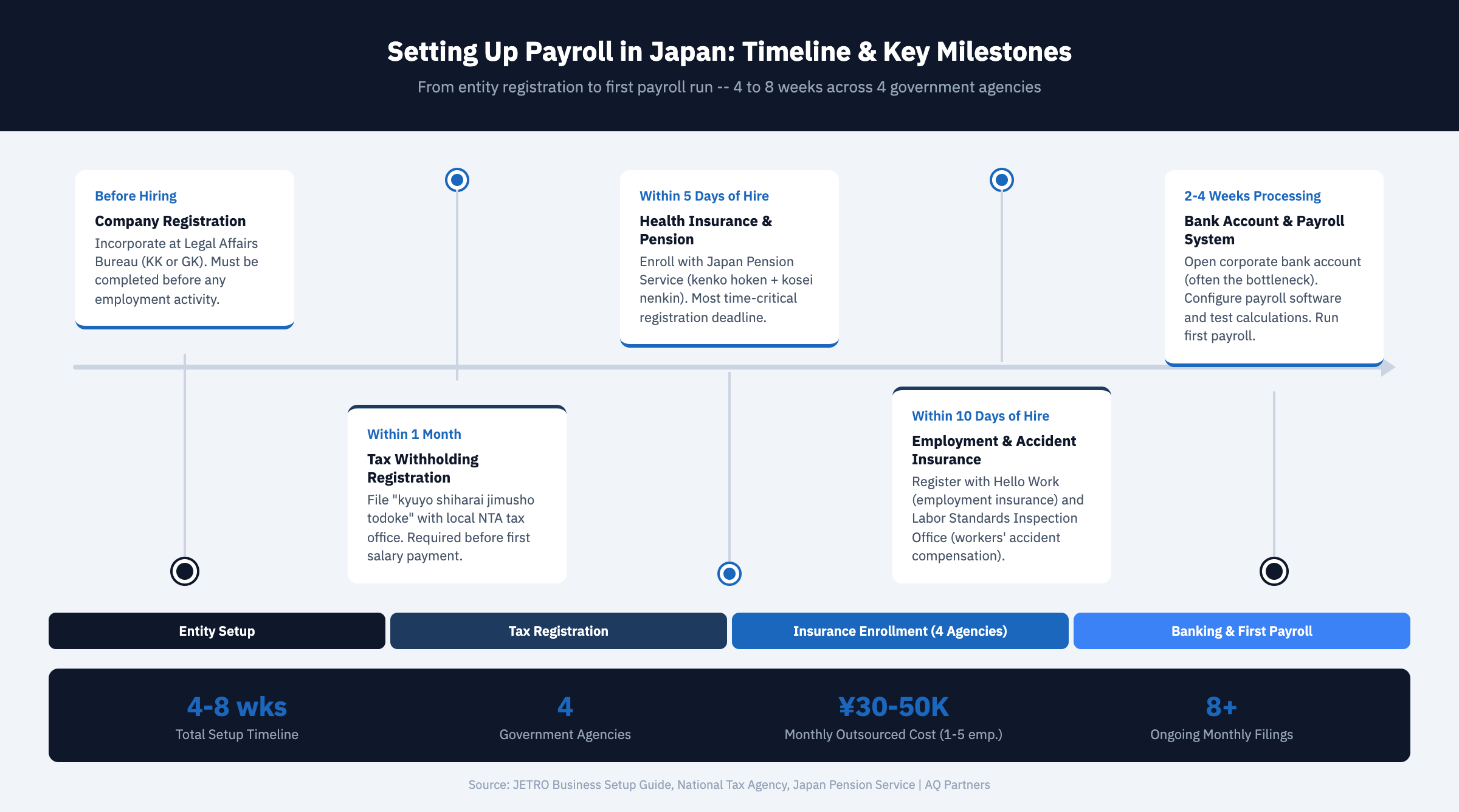
The payroll setup process follows a defined sequence over 4-8 weeks, starting with entity registration and culminating in the first payroll run — each step has specific filing deadlines that must be met to avoid compliance issues.
| Step | Action | Filing Deadline | Agency |
|---|---|---|---|
| 1 | Company registration (incorporation at Legal Affairs Bureau) | Before any hiring | Legal Affairs Bureau |
| 2 | Tax withholding agent registration (kyuyo shiharai jimusho todoke) | Within 1 month of establishing salary-paying office | Tax Office (NTA) |
| 3 | Health insurance & pension enrollment (kenko hoken / kosei nenkin kanyuu) | Within 5 days of first hire | Japan Pension Service |
| 4 | Workers' accident compensation insurance enrollment | Within 10 days of first hire | Labor Standards Inspection Office |
| 5 | Employment insurance enrollment | Within 10 days of first hire | Hello Work (Public Employment Security Office) |
| 6 | Corporate bank account setup for salary payments | Before first payroll date | Bank (2-4 weeks processing) |
| 7 | Payroll system setup and testing | Before first payroll date | Internal / Payroll provider |
| 8 | First payroll run (calculate, deduct, pay, remit) | Per employment contract pay date | Internal processing |
The most time-sensitive registrations are social insurance enrollment (5 days from first hire) and workers' accident compensation insurance (10 days). Foreign companies often underestimate the bank account setup timeline — Japanese banks typically require 2-4 weeks to open a corporate account, and some banks require the company to have been registered for at least 6 months. This banking requirement frequently becomes the bottleneck in the payroll setup timeline. For guidance on the bank account process, see our corporate bank account guide.
In-House Payroll vs. Outsourced: How Should Foreign Companies Decide?
Most foreign companies entering Japan outsource payroll during the first 1-3 years of operation — the specialized knowledge required for Japanese payroll calculation, the Japanese-language government interfaces, and the compliance risk of errors make outsourcing the pragmatic choice until headcount justifies in-house capability.
In-house payroll requires at least one staff member fluent in Japanese who understands social insurance calculations, tax withholding procedures, and government reporting requirements. The company must also invest in payroll software capable of handling Japan-specific calculations. For companies with fewer than 20 employees, the cost of a dedicated payroll specialist (¥4-6 million annual salary) typically exceeds the cost of outsourcing.
Outsourced payroll providers handle the monthly calculation cycle, government remittances, annual filings, and employee inquiries. According to industry surveys, approximately 60% of foreign-owned subsidiaries in Japan with fewer than 50 employees outsource their payroll function. For companies evaluating payroll software options, the choice between domestic platforms (SmartHR, Freee, MoneyForward) and global platforms (ADP, Deel) depends on headcount, budget, and integration requirements with parent company systems.
| Factor | In-House Payroll | Outsourced Payroll |
|---|---|---|
| Setup time | 6-12 weeks (hire staff + configure system) | 2-4 weeks (provider onboarding) |
| Monthly cost (1-5 employees) | ¥350,000-500,000 (staff + software) | ¥30,000-50,000 |
| Monthly cost (10-20 employees) | ¥350,000-500,000 (same staff) | ¥80,000-150,000 |
| Monthly cost (50+ employees) | ¥500,000-800,000 (may need 2 staff) | ¥200,000-400,000 |
| Language requirement | Japanese-fluent staff required | Provider handles Japanese interfaces |
| Compliance risk | Borne by company | Shared with provider (contractual) |
| Regulatory updates | Staff must track independently | Provider updates automatically |
| Best suited for | 50+ employees, long-term presence | 1-50 employees, market entry phase |
What Are the Ongoing Monthly and Annual Payroll Obligations?
Once payroll is established, employers face a continuous cycle of monthly remittances and annual filings — missing any single deadline can trigger penalties and create downstream compliance complications.
Monthly obligations include: processing the payroll calculation (gross-to-net), remitting withheld income tax to the tax office by the 10th of the following month, paying social insurance premiums to the Japan Pension Service by the end of the following month, and transferring residence tax special collection amounts to the employee's municipality by the 10th. The MHLW's labor standards guidelines detail the employer's obligations for labor insurance premium calculations and reporting. Companies with 10 or fewer employees can apply for semi-annual income tax remittance (twice per year instead of monthly).
Annual obligations concentrate in specific periods. The July cycle includes the labor insurance annual update (rodo hoken nendo koushin) and the social insurance standard remuneration revision (santei) filing — both due by July 10. The December-January cycle involves year-end adjustment processing, issuance of withholding tax certificates, and submission of the annual withholding summary report (houkoku sho) by January 31. Separately, the residence tax reporting to municipalities for the new June-May cycle occurs in January. For comprehensive guidance on how each of these calculations works, see our guide on how payroll works in Japan.
What Budget Should Foreign Companies Plan For?
Total first-year payroll setup and administration costs for a foreign company with 5 employees typically range from ¥500,000 to ¥1,000,000, including initial registration, system setup, and 12 months of outsourced processing — a fraction of the cost of the compliance failures these services prevent.
Initial setup costs include: payroll provider onboarding fees (¥50,000-150,000), social insurance registration assistance (typically included in provider setup or ¥30,000-50,000 if separate), and payroll system configuration. Ongoing monthly costs depend on employee count and service scope. Basic payroll processing (calculation, payslip generation, government remittance) for 5 employees typically costs ¥30,000-50,000 per month. Adding services like year-end adjustment processing, labor insurance annual updates, and employee onboarding/offboarding support increases costs to ¥50,000-80,000 per month.
Companies should also budget for one-time annual events: year-end adjustment processing (¥5,000-10,000 per employee), labor insurance annual update (¥10,000-30,000), and social insurance santei processing (¥10,000-20,000). These costs vary by provider but are predictable and should be included in the annual HR administration budget. For guidance on the broader financial considerations of establishing operations in Japan, including back-office setup costs, see our market entry guide.
Frequently Asked Questions
Can we run the first payroll before all registrations are complete?
Technically, a company can pay employees before all social insurance registrations are finalized, but this creates compliance risk. The tax withholding agent registration must be completed before the first salary payment so income tax can be properly withheld and remitted. Social insurance enrollment should be backdated to the employment start date, so any premiums owed from the gap period will need to be collected retroactively from the first payroll that processes after enrollment is confirmed. Planning the hire date to align with registration completion avoids these complications.
How long does it take to open a corporate bank account for payroll?
Opening a corporate bank account in Japan typically takes 2-4 weeks, and some major banks (Mitsubishi UFJ, Sumitomo Mitsui, Mizuho) may require the company to have been registered for at least 6 months before accepting applications. Online banks (e.g., GMO Aozora, PayPay Bank) and regional banks often have shorter processing times and fewer restrictions for newly incorporated entities. The bank account is essential for salary transfers (furikomi), as cash payments are uncommon and direct deposit is the standard payment method for Japanese payroll.
Do we need separate registrations for each branch office?
If a company operates from multiple locations in Japan, each location that pays salaries must register separately as a tax withholding office with the local tax office. Social insurance enrollment, however, can be managed centrally through the Japan Pension Service office covering the head office, with a "multiple office" notification. Employment insurance and workers' accident compensation insurance similarly require notifications for each work location where employees are based. Companies planning multi-site operations should factor these additional registrations into their setup timeline.
Setting up payroll in Japan requires coordinating with multiple government agencies on tight deadlines while establishing the financial infrastructure for ongoing compliance. AQ Partners manages the entire payroll setup process for foreign companies — from registration through first payroll and ongoing administration. Contact us to discuss your timeline and requirements.


Yuga Koda is a founding Director at AQ Partners, supporting foreign companies, funds, and families operating in Japan. His experience operating companies in both Japan and international markets gives him a practical understanding of back office operations from both sides.