
Payroll Software in Japan: The Complete Guide
Payroll software in Japan refers to digital platforms that automate salary calculation, statutory deductions, social insurance filings, and year-end tax adjustments in compliance with Japanese labor and tax law. Japan's payroll environment is among the most technically demanding in the Asia-Pacific region: employers must manage two parallel social insurance systems, file monthly premium contributions to multiple government agencies, execute a mandatory annual income tax reconciliation process (nenmatsu chosei) that is handled by the employer rather than the employee, and comply with strict My Number (individual identification number) data management requirements. For foreign companies operating a Japan entity, the choice of payroll software is a direct compliance decision — the wrong platform will not only create administrative burden but exposes the company to penalties from the Ministry of Health, Labour and Welfare (MHLW), the Japan Pension Service, and the National Tax Agency.
Key Takeaways
- ✓Japan payroll is uniquely complex — dual social insurance systems, mandatory year-end tax adjustment by the employer, and My Number compliance requirements make generic global payroll software a poor fit for most Japan operations.
- ✓Domestic platforms lead for compliance out of the box — SmartHR (~60,000 companies), freee HR, MoneyForward Cloud Payroll, and Yayoi Kyuyo are purpose-built for Japanese statutory requirements, including social insurance calculation and nenmatsu chosei workflows.
- ✓Global payroll platforms can cover Japan, but require localization — Workday, SAP SuccessFactors, and ADP GlobalView offer Japan modules, but implementation is costly and nenmatsu chosei handling varies significantly by platform.
- ✓My Number compliance is non-negotiable — all payroll systems processing Japan employee data must store My Numbers securely with a 7-year retention requirement; violations carry criminal penalties under the Act on the Use of Numbers to Identify a Specific Individual in Administrative Procedures.
- ✓Company size and structure determine the right path — small subsidiaries (under 20 employees) typically benefit most from domestic cloud platforms; large multinationals with group reporting requirements are better served by global systems with certified Japan localization modules.
Why Japan Payroll Is Uniquely Complex
Japan's payroll obligations extend well beyond salary calculation — employers must administer two parallel statutory insurance systems, execute a mandatory annual tax reconciliation on behalf of employees, and manage sensitive identification data under strict legal rules.
For the full operational walkthrough of Japan payroll — monthly cycle, salary deductions, and the annual compliance calendar — see our Japan payroll complete guide.
Dual Social Insurance Systems: Shakai Hoken and Rodo Hoken
Japan operates two distinct social insurance systems, each with separate enrollment, contribution calculation, and filing obligations. The first — shakai hoken (社会保険) — encompasses health insurance (kenkou hoken) and employees' pension insurance (kousei nenkin). Contributions are calculated as a percentage of standard monthly remuneration (hyojun hoshu geppu), which is reviewed annually in April and reported to the Japan Pension Service by July of each year in the salary reporting cycle (santeiki teishutsu). The second system — rodo hoken (労働保険) — covers employment insurance (koyo hoken) and workers' accident compensation insurance (rousai hoken). Both systems require the employer to split contribution costs with employees, withhold the employee share from salary, and remit the combined amount to the relevant government agency on a defined schedule. According to PwC Japan Tax Summaries, combined employer social insurance contributions typically represent approximately 15–16% of standard monthly remuneration per employee — a material labor cost that payroll software must calculate accurately every month.
The complexity increases because contribution rates are not static. Health insurance rates vary by prefecture and the health insurance association to which the company belongs, while pension contribution rates are set nationally. Employment insurance rates differ by industry. Payroll software must maintain current rate tables for all these variables and apply the correct rate to each employee based on their enrollment status, employment type, and workplace location.
Year-End Tax Adjustment (Nenmatsu Chosei)
Japan's year-end tax adjustment — nenmatsu chosei (年末調整) — is a mandatory employer-administered process in which the employer recalculates each employee's annual income tax liability, applies eligible deductions (for dependents, life insurance premiums, earthquake insurance, and housing loan deductions, among others), and reconciles the result against monthly withholding tax collected throughout the year. Any excess withholding is refunded to the employee in December; any shortfall is collected. This process is unique to Japan: in most other countries, annual income tax reconciliation is the individual's responsibility. In Japan, the employer handles it for all employees whose primary income source is their employment. The National Tax Agency (NTA) publishes the official nenmatsu chosei calculation procedures and form templates annually. Payroll software must provide a built-in nenmatsu chosei workflow that generates the required forms — including Form A (withholding tax return) and the summary report (haihu shotoku zei kankei choshu nozei meisai) — and files the aggregate payroll data with the tax office. For foreign companies, this process is a common source of errors when using software not designed for Japan.
My Number Compliance Requirements
Japan introduced the My Number system (individual identification numbers) in 2016, and all employers are legally required to collect, verify, and use My Numbers for specific administrative purposes including social insurance enrollment filings, year-end tax adjustment forms, and withholding tax payment records. The Act on the Use of Numbers to Identify a Specific Individual in Administrative Procedures (the "My Number Act") imposes strict security and retention requirements: My Numbers must be stored securely with access limited to designated personnel, used only for permitted purposes, and retained for seven years from the date of the last use in a statutory filing. Payroll software handling Japan employees must provide a dedicated My Number management module that enforces these controls, with audit trails for access and defined deletion workflows at the end of the retention period. Violations of the My Number Act — including unauthorized disclosure or use — carry criminal penalties of up to two years' imprisonment or fines of up to ¥1 million.
Monthly Variable Contributions and Salary Reporting Deadlines
Social insurance contributions in Japan are subject to monthly deadlines. Health insurance and pension contributions must be paid to the Japan Pension Service (or the relevant health insurance association) by the end of the following month for most employers, though bank transfer deadlines apply. Employment insurance premiums are collected annually through a labor insurance premium return process but calculated monthly from payroll. The standard remuneration determination (santeiki teishutsu) — which sets the premium base for health insurance and pension for the year — must be submitted in July, covering the April–June salary period. Payroll software must generate the required forms, track the determination period accurately, and alert HR teams to upcoming deadlines. Missing the salary reporting deadline to the pension office can result in incorrect premium assessments that are difficult to retroactively correct. For a detailed walkthrough of these compliance requirements, see our post on Japan payroll compliance: social insurance and nenmatsu chosei.
Domestic vs Global Payroll Software: The Core Decision
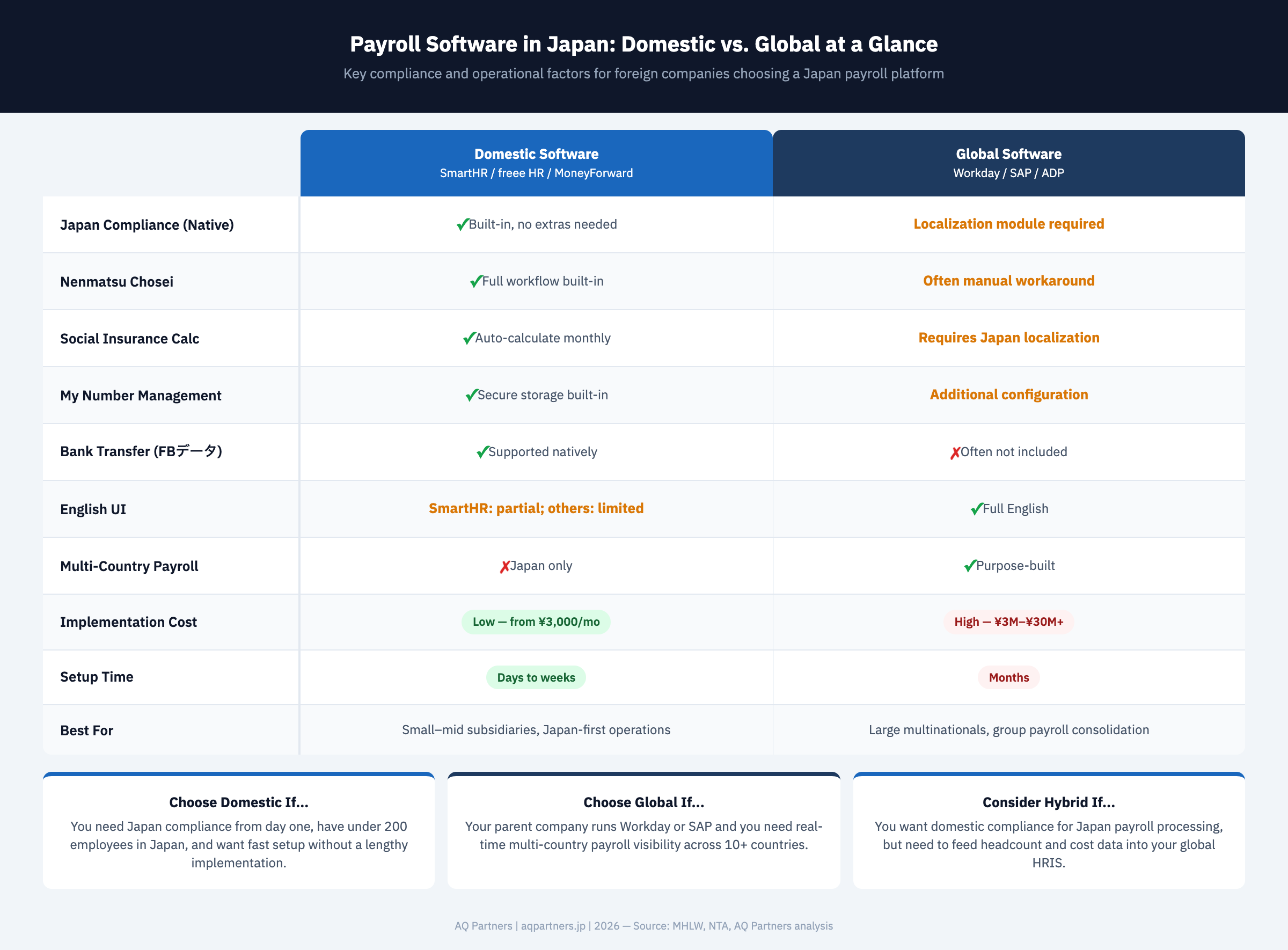
The most consequential payroll software decision for any Japan entity is whether to use a domestic Japanese platform or to extend a global system — and the right answer depends on company size, group reporting requirements, and internal language capability.
Domestic payroll platforms built for the Japanese market — SmartHR, freee HR, MoneyForward Cloud Payroll, and Yayoi Kyuyo — handle Japan's statutory requirements natively. Social insurance calculation, nenmatsu chosei, My Number management, and residence tax reporting are built-in features, not add-ons. These platforms are updated automatically when Japanese law changes, and they are designed for the Japanese-language workflow that HR teams in Japan typically follow. The tradeoff is limited English interface capability and minimal support for cross-border group reporting or integration with global HCM systems.
Global payroll platforms — Workday, SAP SuccessFactors, ADP GlobalView, and newer entrants like Rippling — offer multi-country payroll management, strong English interfaces, and integration with global HR systems. Japan coverage exists on all major global platforms, but the depth of localization varies. Nenmatsu chosei in particular is a process that not all global platforms handle fully in-system; some require manual workarounds or rely on a local payroll service partner to complete the process alongside the software. Implementation costs for global platforms with Japan localization typically range from ¥3 million to ¥20 million or more, depending on complexity and the number of countries in scope.
For a detailed analysis of this trade-off, including scenarios where a hybrid approach — domestic payroll for Japan compliance, global platform for group reporting — is the most practical path, see our dedicated post on global vs. domestic payroll software for Japan operations.
Leading Domestic Payroll Platforms
Four domestic platforms dominate Japan's payroll software market and collectively serve the compliance needs of the vast majority of Japanese companies — each with a distinct positioning by company size, language requirement, and deployment preference.
SmartHR
SmartHR (smarthr.co.jp) is Japan's leading cloud-native HR and labor management platform, used by approximately 60,000 companies as of 2025. Originally built around labor document management and social insurance procedures, SmartHR has expanded to cover payroll processing, attendance management integration, and data analytics. Its strength is the tight integration between employee records, social insurance enrollment procedures, and payroll — eliminating the manual data transfer that creates errors in siloed systems. SmartHR is designed primarily for Japanese-speaking HR teams, with Japanese as the primary interface language. For foreign companies with Japanese-speaking HR staff, SmartHR represents the most comprehensive domestic option.
freee HR
freee (English) offers a payroll module within its broader cloud accounting and HR platform. freee HR handles Japan payroll calculation, social insurance, nenmatsu chosei, and My Number management, and benefits from freee's partial English interface — making it arguably the most accessible domestic option for foreign companies with non-Japanese-speaking HR staff. The integration with freee Accounting means that payroll journal entries can be automatically posted to the general ledger, reducing month-end reconciliation work. freee is widely used by SMEs and foreign subsidiaries in Japan.
MoneyForward Cloud Payroll
MoneyForward Cloud Payroll is part of the MoneyForward HR suite, which also includes attendance management, expense management, and social insurance procedure support. MoneyForward Cloud Payroll connects to more than 2,000 Japanese bank feeds — a significant advantage for processing salary bank transfers. The platform supports full Japan payroll compliance including social insurance, nenmatsu chosei, and My Number management, and integrates natively with MoneyForward Cloud Accounting for seamless payroll-to-GL posting. It is well-regarded for its modular architecture: companies can start with payroll and add attendance management or social insurance procedures as their HR operations mature.
Yayoi Kyuyo
Yayoi Kyuyo (yayoi-kk.co.jp) is a desktop-first payroll application that has been a staple of Japan's SME market for decades, with approximately 3 million users as of 2024. Yayoi Kyuyo handles all Japan statutory payroll requirements — including social insurance, nenmatsu chosei, and residence tax reporting — and is particularly well-suited to small Japanese companies that work with external tax accountants (zeirishi). The platform's primary interface is Japanese-only, and its desktop architecture means updates for tax law changes require manual installation rather than automatic cloud deployment. For foreign-owned subsidiaries, Yayoi Kyuyo is most practical when payroll processing is outsourced to a Japanese accountant already familiar with the platform.
| Feature / Criterion | SmartHR | freee HR | MoneyForward Cloud Payroll | Yayoi Kyuyo |
|---|---|---|---|---|
| J-Compliant Payroll | Full — native | Full — native | Full — native | Full — native |
| Social Insurance Calculation | Built-in + filing support | Built-in | Built-in + MF HR suite sync | Built-in (manual filing) |
| Nenmatsu Chosei | Full in-system workflow | Full in-system workflow | Full in-system workflow | Supported (wizard-based) |
| My Number Management | Dedicated module, 7-yr retention | Included, access controls | Included, access controls | Included (desktop) |
| English UI | Japanese only | Partial English available | Limited | Japanese only |
| Deployment | Cloud-only | Cloud-only | Cloud-only | Desktop + Cloud |
| Indicative Monthly Pricing (JPY) | Custom quote (per-employee) | ~¥3,828–¥39,600+ | ~¥3,828–¥40,000+ | ~¥1,000–¥20,000+ (cloud tier) |
| Approx. Users / Companies | ~60,000 companies | ~2.6M total freee users | Widely used, part of MF suite | ~3M users (all Yayoi products) |
| Best For | Mid-size Japanese companies; HR-led teams | Foreign entrants; English-needed ops | Growing SMEs; MF accounting users | Small firms using local accountants |
For a deeper comparison of these platforms including feature-by-feature breakdowns and pricing tiers, see our dedicated post on the best payroll software in Japan: SmartHR, freee, and MoneyForward.
Global Payroll Software with Japan Coverage
Global payroll platforms can manage Japan payroll, but the quality of Japan localization varies significantly — the critical evaluation question is not whether Japan is listed as a supported country, but how completely the platform handles nenmatsu chosei, social insurance filings, and My Number compliance in-system.
Workday
Workday (workday.com) offers a Japan localization module within its Human Capital Management (HCM) suite, covering payroll calculation, social insurance, and statutory reporting. Workday is positioned as an enterprise-grade solution and is most commonly deployed by large multinationals with 500+ employees in Japan. The Japan localization requires implementation by a certified Workday partner with Japan-specific expertise. Nenmatsu chosei support in Workday has improved in recent versions, but organizations should verify current scope with a certified implementation partner before assuming full in-system capability.
SAP SuccessFactors
SAP SuccessFactors (sap.com) provides Japan payroll localization through the Employee Central Payroll module. SAP has a long-established presence in Japan and offers comprehensive localization for Japanese statutory requirements, including social insurance, nenmatsu chosei, and My Number. SAP implementations are typically reserved for large multinationals given the cost and implementation complexity. Japanese SAP partner ecosystem is mature, with multiple certified implementation partners in Japan. For companies already running SAP globally, extending to Japan via Employee Central Payroll is often the most efficient path to a compliant Japan payroll.
ADP GlobalView
ADP GlobalView (adp.com) is ADP's enterprise multi-country payroll platform, covering Japan as part of a broad global network. ADP operates its own payroll processing in Japan and combines software with managed payroll services, meaning Japan compliance — including social insurance filings and nenmatsu chosei — is handled by ADP's in-country team rather than purely by the software itself. This managed service model is advantageous for multinationals that want to outsource Japan payroll execution rather than manage it internally. GlobalView is positioned for large enterprises; ADP's Celergo product covers mid-market multi-country payroll.
Rippling
Rippling (rippling.com) is a newer entrant to the multi-country payroll space and has been expanding its Japan coverage in recent years. Rippling's platform combines payroll, HR, and IT management, and its Japan payroll capability is growing — though as of early 2026, the depth of Japan-specific compliance handling (particularly nenmatsu chosei and social insurance filing integration) should be verified directly with Rippling before deployment. Rippling is best suited for companies with a primarily English-speaking HR function that values a unified global HR and IT platform. For a full assessment of HR compliance considerations for global teams in Japan, see our guide on Japan HR compliance strategies for global teams.
| Platform | Japan Compliance Depth | Implementation Cost (Est.) | English UI | Best For |
|---|---|---|---|---|
| Workday HCM | High — Japan module; verify NMC depth | ¥10M–¥50M+ | Full | Large multinationals (500+ in Japan) |
| SAP SuccessFactors | High — mature Japan localization | ¥10M–¥80M+ | Full | Large MNCs already on SAP |
| ADP GlobalView | High — managed service model | ¥5M–¥20M+ (setup + annual) | Full | MNCs outsourcing payroll execution |
| Rippling | Growing — verify current Japan scope | Lower than enterprise peers | Full | English-first teams; global IT+HR unification |
| Domestic (SmartHR, freee, MF) | Full — purpose-built for Japan | ¥200K–¥800K (setup) | Partial (freee); Limited/None (others) | Small to mid-size Japan entities |
| Hybrid (domestic + global) | High — best of both approaches | Varies; two system overhead | Depends on domestic choice | Mid-size MNCs with group reporting needs |
| EOR (Employer of Record) | Managed externally — no software needed | Per-employee monthly fee | Full (EOR platform) | Pre-entity or very small Japan headcount |
Key Compliance Features Every Japan Payroll System Must Have
Before selecting any payroll platform for a Japan entity, verify that these five compliance capabilities are present as built-in features — not manual workarounds or third-party add-ons that require separate maintenance.
Social Insurance Calculation and Filing
The payroll system must calculate both shakai hoken (health insurance and pension) and rodo hoken (employment insurance and workers' compensation) contributions accurately for each employee, applying the correct rates for the relevant health insurance association, industry, and employee type. It must also generate the required filing documents — including the monthly premium statement (hokenryo nokoku nosai shomeisho), the annual salary reporting form (santeiki teishutsu), and enrollment/withdrawal notifications — either for electronic submission via the e-Gov portal or for printed submission. Any platform that requires manual transfer of contribution data to a separate filing system introduces both operational risk and compliance risk.
Nenmatsu Chosei Workflow
The year-end tax adjustment workflow must be fully integrated into the payroll system, not a standalone offline process. This means the system must collect employee deduction declarations electronically, apply the correct deduction calculations for dependents, insurance premiums, and housing loans, recalculate annual income tax, and generate the required NTA forms including Form A (withholding tax return) and the aggregate summary report. The system must also handle the edge case of employees who joined or departed mid-year, which requires proration and coordination with prior employer withholding records. According to the NTA, over 85% of Japan's salaried workers have their annual income tax finalized through nenmatsu chosei rather than self-assessment — meaning this process is executed at scale for virtually every Japan payroll. See our detailed guide on Japan payroll compliance including nenmatsu chosei for a step-by-step breakdown.
My Number Storage and 7-Year Retention
Every payroll system handling Japan employees must have a dedicated My Number management module. This module must enforce role-based access controls (limiting who can view My Numbers), maintain an audit log of all access events, support the use of My Numbers only for permitted statutory purposes (social insurance filings, nenmatsu chosei forms, withholding tax records), and provide a documented deletion workflow at the end of the 7-year retention period. The My Number Act requires that companies be able to demonstrate compliance with access controls and data handling procedures — payroll software should generate audit reports suitable for internal and external review.
Residence Tax (Juuminzei) Reporting
Japan's residence tax (juuminzei, or local inhabitant tax) is assessed by the municipal office where each employee resides, based on the prior year's income. Employers receive juuminzei payment notifications from each municipality in May or June and must withhold the specified monthly amount from salary (for most full-time employees) and remit it to the relevant municipality. Payroll software must accommodate juuminzei withholding as a separate deduction line, import the annual determination amounts from municipality notifications, and generate the year-end payment records. Companies with employees in many different municipalities — common in larger organizations — must manage dozens of separate juuminzei remittance relationships, which is impractical without software automation.
Labor Standards Act Attendance Rules
Japan's Labor Standards Act (Rodo Kijunho) sets minimum requirements for overtime calculation, rest periods, annual paid leave accrual, and late-night premium pay. Payroll software must apply the correct overtime multipliers — 125% for standard overtime beyond 8 hours per day or 40 hours per week, 135% for late-night overtime (10pm–5am), and 150% for holiday work — and integrate with attendance records to calculate each employee's gross pay accurately. As discussed in our post on Japan labor compliance risks, failure to correctly calculate overtime is one of the most common and costly compliance exposures for foreign companies in Japan.
Integration Considerations
Japan payroll software does not operate in isolation — it must connect reliably to Japan-specific banking infrastructure, attendance management systems, and accounting software to avoid the manual data transfers that create errors and compliance risk.
Bank Transfer Files: FB Data Format
Salary payments in Japan are almost universally processed by bank transfer, and Japanese banks use a specific data format — FB (Full Bank) data format — for bulk transfer instructions. Payroll software must be able to generate FB-format transfer files compatible with the company's banking institution. Not all global payroll platforms natively output FB data; some require manual export and reformatting, which introduces errors and delays. Domestic platforms — particularly MoneyForward Cloud Payroll and freee HR — generate FB data natively. When evaluating global platforms, confirm FB data output capability with the vendor before implementation.
Attendance Management (Kinmu Kanri) System Integration
Japan's Labor Standards Act requires employers to record working hours accurately for all employees, and attendance management (kinmu kanri) software is widely used to capture clock-in/out data, manage annual paid leave, and track overtime hours by employee. Payroll accuracy in Japan is directly dependent on the quality of attendance data — because overtime pay, late-night premiums, and holiday pay multipliers all derive from attendance records. Payroll software must either include its own attendance management module (as SmartHR and MoneyForward HR Suite do) or offer a certified API integration with standalone kinmu kanri systems. Before selecting a payroll platform, map the attendance management system it will connect to and verify the integration is bidirectional — payroll pulling approved attendance records, and attendance receiving payroll period confirmations.
Accounting Software Integration
Payroll journal entries — salary expenses, social insurance expense, social insurance payable, withholding tax payable, and bank transfers — must be posted to the general ledger accurately each payroll cycle. Manual journal entry of payroll data is error-prone and time-consuming. Domestic payroll platforms integrate natively with their accounting counterparts: freee HR integrates with freee Accounting, and MoneyForward Cloud Payroll integrates with MoneyForward Cloud Accounting. SmartHR offers data export in formats compatible with major accounting platforms. For foreign companies using a global ERP for accounting and a domestic platform for payroll, a data integration layer — either API-based or via scheduled file export — must be designed and tested before going live.
How to Choose: Decision Framework
Selecting payroll software for a Japan entity should follow a structured decision path based on headcount, group reporting obligations, internal language capability, and whether payroll will be managed in-house or outsourced to a local service provider.
Small subsidiary — under 20 employees. For a small Japan entity, a domestic cloud platform — freee HR or MoneyForward Cloud Payroll — is almost always the right choice. Implementation is fast (typically 4–8 weeks), costs are low, and Japan compliance is delivered out of the box. If the HR team is Japanese-speaking, SmartHR is also a strong option. If an external payroll service provider is used, confirm which platform they operate on and align your software choice accordingly. The EOR (Employer of Record) model is worth considering for companies pre-entity or in early stages — see our guide on EOR vs. entity setup for Japan hiring for a full comparison.
Mid-size company with group reporting requirements — 20–200 employees in Japan. The decision depends heavily on whether the parent company operates a global HCM platform. If yes, evaluate whether that platform's Japan localization meets compliance requirements — specifically for nenmatsu chosei and social insurance filings. If the global platform's Japan coverage is insufficient, a hybrid approach — domestic payroll for Japan compliance with structured data export to the global HCM — is often the most practical solution. Implementation of a hybrid model typically costs ¥800,000–¥3 million and takes 2–4 months.
Large multinational — 200+ employees in Japan or Japan as part of a multi-country rollout. Enterprise global payroll platforms — Workday, SAP SuccessFactors, or ADP GlobalView — are the appropriate category. The key selection criteria are the depth of Japan localization (specifically nenmatsu chosei support), the availability of certified Japan implementation partners, and the total cost of ownership over a 3-year period. For multinationals, the payroll software decision for Japan should be made in coordination with the global HR technology team and a Japan-experienced implementation partner. Our post on Japan HR compliance strategies for global teams provides detailed guidance on structuring the Japan payroll function within a global organization.
Frequently Asked Questions
Is there Japanese payroll software available in English?
Yes, but options are limited. Among domestic platforms, freee HR offers the most developed English interface — partial English UI is available, and freee has English-language support documentation and a growing international user base. MoneyForward Cloud Payroll has limited English interface elements. SmartHR and Yayoi Kyuyo operate primarily in Japanese. For teams requiring a full English interface, global platforms (Workday, ADP, Rippling) deliver a complete English experience but require additional implementation work for Japan compliance. A practical middle path for many foreign companies is to use freee HR or MoneyForward Cloud Payroll with a bilingual HR administrator or a Japan payroll service provider who handles the Japanese-language compliance workflows on the client's behalf.
Can global payroll systems like Workday handle nenmatsu chosei?
Workday's Japan localization module includes nenmatsu chosei functionality, and the platform has improved its Japan-specific compliance coverage in recent releases. However, the completeness of in-system nenmatsu chosei handling — including employee declaration collection, deduction calculation, and NTA form generation — should be verified with a certified Workday Japan implementation partner before assuming full capability. SAP SuccessFactors via Employee Central Payroll also covers nenmatsu chosei for Japan. In practice, some large multinationals using global platforms supplement in-system nenmatsu chosei workflows with specialist Japan payroll service providers for the most complex employee scenarios (e.g., employees with mid-year job changes, housing loan deductions, or multiple dependent categories). For companies where nenmatsu chosei accuracy is critical, confirming exact current functionality with the vendor — not only relying on sales materials — is essential.
What is the penalty for incorrect social insurance reporting?
Incorrect social insurance reporting in Japan can result in retroactive premium assessments, late payment penalties, and in cases of intentional evasion, criminal prosecution. The Japan Pension Service and the relevant health insurance associations conduct periodic audits of employer records. Under the Social Insurance Act, employers who fail to enroll eligible employees, underreport standard monthly remuneration, or miss filing deadlines are subject to back-payment demands covering up to two years of unpaid premiums, plus a surcharge. In cases where an employer is found to have deliberately understated remuneration to reduce contribution obligations, penalties under the criminal provisions of the Act may apply. For a detailed analysis of compliance risks including social insurance, see our post on Japan labor compliance risks.
Do I need separate attendance management software?
Whether you need standalone attendance management software depends on the payroll platform you select. Some domestic platforms — MoneyForward HR Suite and SmartHR — include integrated attendance management modules that can replace standalone kinmu kanri tools. freee HR also includes basic attendance management. If your payroll platform does not include attendance management, a standalone kinmu kanri system is strongly recommended given the Labor Standards Act's requirement to record working hours accurately and the direct link between attendance data and overtime pay calculations. Standalone attendance management systems — including KING OF TIME (timedesigner.com), Jobcan Attendance (jobcan.ne.jp), and SmartHR Attendance — integrate via API with the leading payroll platforms. The Ministry of Health, Labour and Welfare provides attendance management guidelines at Ministry of Health, Labour and Welfare (MHLW).
Setting Up Payroll for Your Japan Entity
Japan payroll is one of the most technically demanding compliance areas for foreign companies operating in the country. The combination of dual social insurance systems, nenmatsu chosei, My Number obligations, residence tax reporting, and Labor Standards Act attendance requirements means that the wrong software — or an underimplemented correct software — creates both operational burden and regulatory exposure.
AQ Partners provides back-office services for foreign companies in Japan, including payroll setup, social insurance enrollment, nenmatsu chosei administration, and ongoing payroll processing. Whether you are selecting payroll software for a new Japan entity, migrating from one platform to another, or troubleshooting compliance gaps in your current setup, AQ Partners can advise on the right approach for your entity size, team structure, and reporting requirements.
Setting up payroll for your Japan entity? Contact AQ Partners →


Yuga Koda is a founding Director at AQ Partners, supporting foreign companies, funds, and families operating in Japan. His experience operating companies in both Japan and international markets gives him a practical understanding of back office operations from both sides.