
Japan Secondment Agreements: Who Is the Employer?
A secondment to a Japan subsidiary is an arrangement in which an employee of headquarters keeps that employment and also works for the Japanese KK or GK for a set period. Japanese law calls it zaiseki-gata shukko (在籍型出向) and treats the secondee as employed by both companies at once.
So "who is the employer?" has no single answer: each regime applies its own test, and the secondment agreement supplies most of the facts.
Key Takeaways
- The secondee has two employers. The Ministry of Health, Labour and Welfare (MHLW) treats a secondee as employed by both companies, which separates secondment from worker dispatch.
- Each regime asks a different question. Workers' accident insurance follows who directs the work, employment insurance the main wages, and shakai hoken the employment relationship and who pays.
- Pay from abroad still counts in Japan. Where salary a foreign parent pays abroad is not subject to Japanese withholding, a resident secondee must file a Japanese return for it, whatever the amount.
- A salary recharge is salary. The subsidiary's payment to headquarters for the secondee's pay is salary for corporate tax, even when invoiced as a management fee, and is not subject to consumption tax.
- The agreement fills the gaps. Where it is silent, dismissal and recall stay with headquarters and the right to direct the work moves to the subsidiary.
How Japanese Law Treats a Secondment to a Japan Subsidiary
Japanese law treats a secondment as two employment relationships and limits how an employer may order one.
Under the MHLW handbook on in-place secondment, because the subsidiary also employs the secondee, this is not worker dispatch, where only the agency employs the worker.
The handbook classifies secondment as labour supply, which Article 44 of the Employment Security Act prohibits as a business. A secondment with one of four purposes is in principle not done as a business: securing employment at an affiliated company instead of letting the employee go, management or technical guidance, skills development, or personnel exchange within the corporate group.
Ordering a secondment needs the employee's individual consent, or rules of employment that set pay, conditions, the period and the return in a way that protects the employee. Under Article 14 of the Labor Contract Act, an order that abuses that right, judged by its necessity and how the employee was selected, is void.
Which Employer Duties Fall on the Japan Subsidiary
Most day-to-day employer duties land on the Japan subsidiary, because it directs the work, while headquarters keeps those tied to the employee's status and any salary it pays.
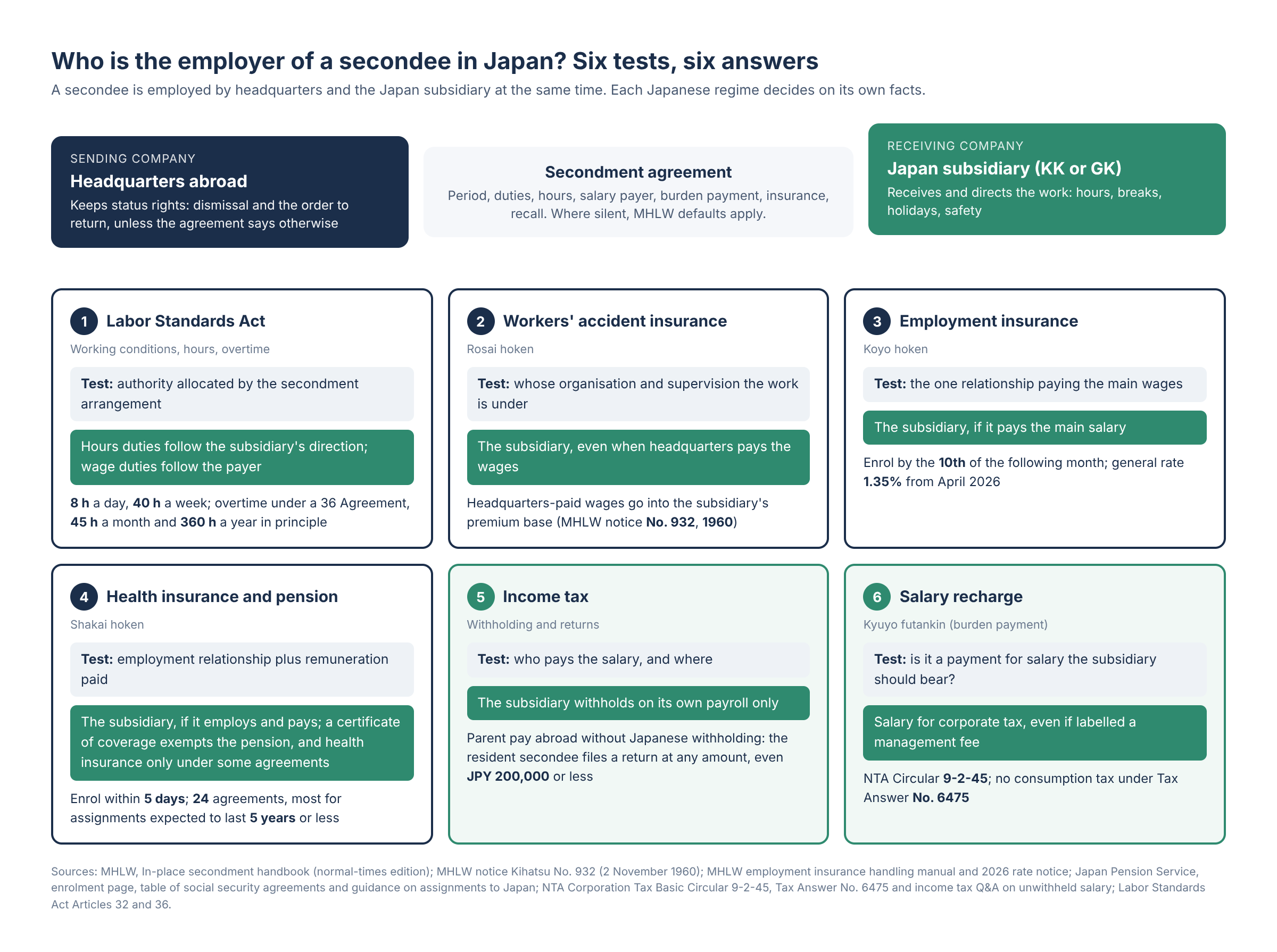
Under the MHLW handbook, each company bears the Labor Standards Act duties for the authority allocated to it; other regimes apply their own tests:
| Regime | Legal test | Usual result for an inbound secondee |
|---|---|---|
| Labor Standards Act | Authority allocated by the secondment arrangement | Hours, breaks, holidays and safety follow the subsidiary's right to direct the work; wage duties follow the company that pays |
| Workers' accident insurance (rosai hoken) | Whose organisation the secondee joins and whose supervision the work is under | The subsidiary, with salary paid by headquarters added to its wage base |
| Employment insurance (koyo hoken) | The one relationship that pays the main wages | The subsidiary, if it pays the main salary |
| Health insurance and employees' pension (shakai hoken) | An employment relationship plus remuneration paid by that company | The subsidiary, if it employs and pays the secondee; a certificate of coverage exempts the pension, and health insurance only under some agreements |
| Income tax withholding | The payer of salary in Japan | The subsidiary withholds on what it pays, not on salary the parent pays abroad |
Shakai Hoken, Koyo Hoken and Rosai Hoken for a Seconded Employee
A secondee working under the Japan subsidiary's direction is covered by its workers' accident insurance, and joins its employment insurance and shakai hoken when it pays the main salary.
Workers' accident insurance. Under an MHLW notice of 2 November 1960 (Kihatsu No. 932), a secondee who is part of the receiving company's organisation and works under its supervision is covered by that company's insurance, even when the sending company pays the wages. The receiving company adds those wages to its premium base.
Employment insurance. MHLW's employment insurance handling manual allows coverage in one relationship only, the one paying the main wages. Foreign nationals living in Japan are covered, except foreign civil servants and people shown to be in a foreign unemployment compensation scheme. Enrolment at Hello Work is due by the 10th of the month after the employee joins. The general-business rate MHLW set from April 2026 is 1.35%: 0.85% employer, 0.50% employee.
Health insurance and pension. The handbook places a secondee in shakai hoken at the company or companies that have an employment relationship with the secondee and pay remuneration. The subsidiary enrols the secondee within 5 days, as our guide to shakai hoken enrolment explains.
Premiums are split equally between employer and employee, although a health insurance society may set a larger employer share under Article 162 of the Health Insurance Act. The employees' pension rate is 18.3% of standard remuneration. Kyokai Kenpo health insurance in Tokyo is 9.85% from March 2026.
The Japan Pension Service table of social security agreements lists 24 countries and the schemes each covers. A certificate of coverage, issued by the home authority on the home employer's application, exempts the secondee only from those schemes: always the employees' pension, health insurance only under some agreements, such as those with the United States, France and the Netherlands, and employment insurance under those with Finland, Italy and Austria.
Under the agreements with Germany, the United Kingdom, Korea, China and India, among others, the secondee still joins Japanese health insurance.
Under most agreements, Japan Pension Service guidance says, an assignment expected to last 5 years or less qualifies and a longer one is covered in Japan from the start; some agreements exempt the first 5 years whatever the expected length. Extensions need both countries' agreement.
Payroll and Income Tax When Headquarters Keeps Paying the Salary
The Japan subsidiary withholds income tax only on salary it pays, so pay that headquarters makes abroad without Japanese withholding reaches Japanese tax through the employee's own return.
The MHLW handbook names two payment methods: the subsidiary pays the secondee directly, or pays a burden payment to headquarters, which pays the secondee. Withholding falls on the payer of salary in Japan, as our guide to withholding tax in Japan explains.
In an NTA question-and-answer case, a resident paid by a foreign parent without Japanese withholding, alongside year-end-adjusted salary from a Japanese employer, had to file a return although the parent's payment was JPY 200,000 or less, under Articles 120 and 121 of the Income Tax Act. The subsidiary's year-end adjustment covers only its own share.
How Japan Taxes the Salary Recharge
A payment from the Japan subsidiary to headquarters for a secondee's salary is the subsidiary's own salary expense for corporate tax, and salary rather than a service for consumption tax.
Under Corporation Tax Basic Circular 9-2-45, the burden payment (給与負担金, kyuyo futankin) that the receiving company pays the sending company for salary it should bear is treated as its salary, even when labelled a management guidance fee. Our post on intercompany management fees covers genuine service charges.
Circular 9-2-46 covers a secondee who becomes a director of the subsidiary. Where shareholders have resolved on the burden payment as director pay and the secondment contract fixes the period and amount in advance, it is director remuneration under Article 34 of the Corporation Tax Act; our guide to hiring a country manager in Japan covers that role. Any amount above what the sending company actually pays the secondee is not a burden payment.
For consumption tax, NTA Tax Answer No. 6475 treats the burden payment as salary under any of the three payment methods it lists, so it is not subject to consumption tax, as our post on consumption tax on intercompany charges sets out.
Clauses a Secondment Agreement to a Japan Subsidiary Needs
A secondment agreement should state the period, the work, the working conditions, who pays what and which company enrols the secondee, because Japanese law fills any gap with defaults.
The MHLW handbook lists what a secondment contract should cover and the defaults where it is silent: dismissal and recall stay with the sending company, and direction of the work moves to the receiving company.
| Clause | Why Japanese law cares | What goes wrong if it is missing |
|---|---|---|
| Period and return | Under most agreements, an expected period of 5 years or less allows a certificate of coverage | No stated period to support the certificate application, and no agreed date to return |
| Duties, title and place of work | Place and work, and their scope of change, must be given in writing | Written conditions do not match the role performed |
| Hours, breaks and holidays | The company directing the work carries the hours duties | Overtime falls outside a 36 Agreement and premiums go unpaid |
| Salary payer and burden payment | Decides withholding, employment insurance and corporate tax treatment | Unwithheld pay, enrolment in the wrong place, or a recharge challenged as a fee |
| Allowances, commuting allowances and overtime pay | Wages under Article 11 of the Labor Standards Act and remuneration for shakai hoken | Amounts headquarters pays are left out of the subsidiary's workers' accident insurance wage base |
| Social and labour insurance | Each scheme applies its own test | The secondee is treated as exempt without a certificate, or from health insurance under a pension-only agreement |
| Early termination and recall | Sets notice and the grounds for ending the secondment early | The arrangement cannot be ended cleanly |
Working Conditions the Secondee Must Receive in Writing
The receiving company must give the secondee the Japanese working conditions, mostly in writing, although headquarters may do it on its behalf.
Article 15 of the Labor Standards Act requires the conditions to be made explicit when the contract is made, in writing for the contract period, place of work and duties, hours, breaks and holidays, wages, and retirement, including grounds for dismissal, as our post on employment contracts and labor rules in Japan sets out.
Where the subsidiary directs the hours, Article 32 caps work at 8 hours a day and 40 hours a week, and overtime needs a 36 Agreement filed for the workplace, capped in principle at 45 hours a month and 360 hours a year, as our post on the 36 Agreement explains.
Frequently Asked Questions
Does shakai hoken cover a seconded employee's family in Japan?
In Japanese health insurance, a spouse or child who meets the dependant requirements is covered once a dependant notification is filed. Under a certificate of coverage, each agreement decides; under the agreement with Austria, for example, the family is exempt from the Japanese pension only, not from national health insurance.
What happens to koyo hoken if the secondee is paid by two companies?
Unemployment benefits are calculated only on wages from the company where the secondee is insured. The MHLW handbook therefore recommends consolidating pay in one company.
Which company's rosai hoken covers a seconded employee who is injured?
Benefits use an average wage combining the pay from both companies. The claim goes on the receiving company's own premium-rate record.
Can a secondee work more than 45 hours of overtime a month under the subsidiary's 36 Agreement?
Only through a special clause for temporary peaks, which keeps annual overtime at 720 hours or less, monthly overtime plus holiday work under 100 hours, the 2 to 6 month average at 80 hours or less, and months over 45 hours to 6 a year. Managers in a position of supervision or management are exempt from the hours rules under Article 41 of the Labor Standards Act.
Working with AQ Partners. Our Tokyo team provides social and labour insurance enrolment, monthly payroll coordination with a licensed sharoushi, year-end adjustment, and Japanese employment contracts and offer letters. Book a consultation to discuss the payroll and enrolment behind your secondees.


Yuga Koda is a founding Director at AQ Partners, supporting foreign companies, funds, and families operating in Japan. His experience operating companies in both Japan and international markets gives him a practical understanding of back office operations from both sides.