
Hiring a Country Manager in Japan: Contract, Title, Authority, and Director Appointment

Hiring a country manager in Japan means appointing the person who will run the subsidiary day to day, and deciding at the same time whether that person is an employee, a director, or both. The answer matters in Japan because the two statuses carry different legal protections. An employee is protected by the Labor Standards Act and Japanese dismissal rules; a director (役員, yakuin) holds a mandate under the Companies Act and can be removed by the shareholder. Only a representative director has statutory authority to bind the company, whatever the business card says. This guide covers the employee and director routes, appointment and registration, titles and authority, delegation and the seal, and the employment contract.
Key Takeaways
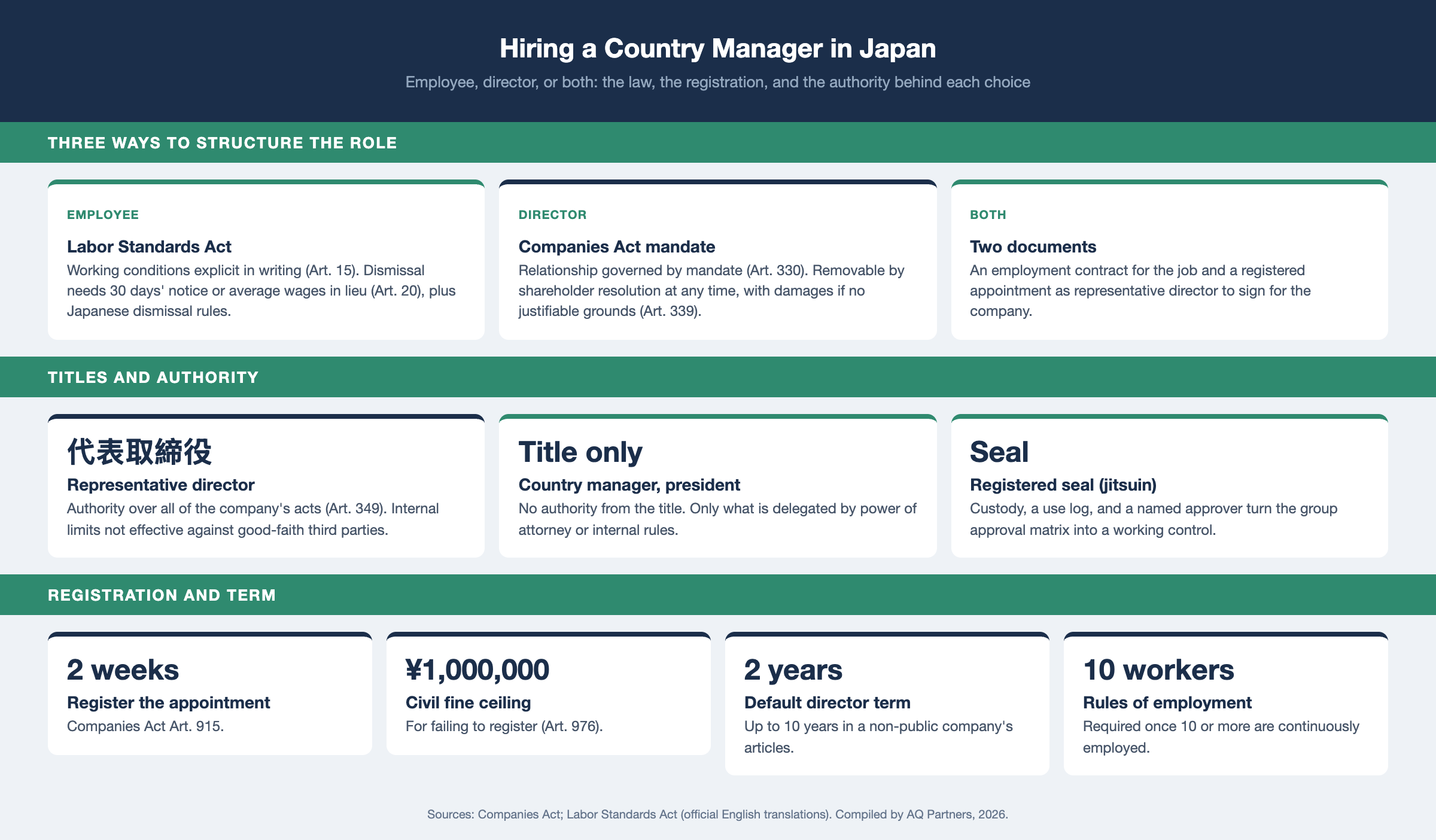
- Decide the status before the offer letter. An employee falls under the Labor Standards Act; a director's relationship with the company is a mandate under the Companies Act. Many country managers hold both roles, and each needs its own document.
- The title carries no authority on its own. Under Article 349 of the Companies Act, only a representative director has authority over all of the company's acts. "Country manager" and "president" are internal titles.
- Appointment is a registered event. A new director or representative director must be registered within 2 weeks, and late registration can bring a civil fine of up to ¥1,000,000.
- Internal limits do not bind outsiders. A representative director's authority cannot be limited against a third party acting in good faith, so group approval limits must be enforced inside the company, through delegation and seal control.
- Removal works differently for each role. The shareholder can remove a director at any time, subject to a damages claim without justifiable grounds; ending the employment is governed by Japanese dismissal rules, including 30 days' notice or pay in lieu.
Employee, Director, or Both: The First Decision When Hiring a Country Manager in Japan
A Japan country manager can be an employee, a director, or both, and each status brings different law, removal rules, and paperwork.
The two statuses rest on different statutes. The Labor Standards Act defines a worker in Article 9 as a person employed at a business to whom wages are paid, regardless of occupation. A worker has the protection of Japanese labour law, including written working conditions, statutory hours, paid leave, and dismissal restrictions. A director is different. Article 330 of the Companies Act states that the relationship between a stock company (KK) and its officers is governed by the provisions on mandate, and Article 339 allows the shareholders to dismiss an officer at any time by resolution, with a damages claim available to the officer where there were no justifiable grounds.
Many multinationals give the country manager both roles: an employment contract for the operating job and an appointment as representative director so the person can sign for the company. That creates two relationships with two sets of rules. Whether a director is also a worker for labour law purposes depends on the actual working relationship, including whether the person works under direction and receives wages, not on the title. Headquarters should decide the structure before the offer letter, because every later document follows from it.
| Point | Employee | Director (including representative director) |
|---|---|---|
| Legal basis | Labor Standards Act and labour contract law | Companies Act; relationship governed by mandate (Article 330) |
| How the role starts | Employment contract, with working conditions made explicit in writing (Article 15) | Shareholder resolution, or as the articles provide; acceptance by the appointee |
| How the role ends | Japanese dismissal rules, including 30 days' notice or average wages in lieu (Article 20) | Shareholder resolution at any time; damages claim if no justifiable grounds (Article 339) |
| Pay set by | Employment contract and rules of employment | Articles of incorporation or shareholder resolution (Article 361) |
| Working-hours rules | Apply, unless the role falls within the supervision or management exemption in Article 41 | Do not apply to the mandate itself |
| Public record | None | Registered in the commercial register; changes registered within 2 weeks |
| Fixed term | None unless the contract sets one | 2 years by default for a KK director, extendable up to 10 years in a non-public company |
Appointing and Registering a Country Manager as Representative Director in Japan
A country manager who signs for a Japan KK is appointed representative director under the articles and registered within 2 weeks of appointment.
In a KK without a board of directors, Article 349 of the Companies Act allows a representative director to be appointed under the articles of incorporation, by the directors from among themselves where the articles provide for it, or by a shareholder resolution. For a wholly owned subsidiary, the usual route is a written shareholder resolution signed by the parent. The appointment is then registered at the Legal Affairs Bureau. Companies Act Article 915 requires registration of a change within 2 weeks, and Article 976 provides for a civil fine of up to ¥1,000,000 for failing to register. Registration tax on a director change is ¥10,000 for a company with capital of ¥100 million or less, and ¥30,000 above that.
A representative director of a KK also registers a seal with the Legal Affairs Bureau, used for registration filings, bank changes, and major contracts. The document set, the foreign-resident quirks, and the follow-on notifications after a register change are covered in director change registration in Japan. Since 2015, a KK no longer needs a Japan-resident representative director, but banks and landlords often still look for one; the practical options, including nominee directors, are set out in representative director residency and nominee directors.
A KK director's term is 2 years by default, extendable up to 10 years in a non-public company's articles. Each re-appointment is a new registration, so the term is worth setting at hiring.
Country Manager Titles in Japan and the Legal Authority Behind Each
In Japan, only a representative director has statutory authority to bind a KK; country manager, president, and similar titles are internal labels.
Titles such as country manager, general manager, or Japan president are not legal offices. Article 349 of the Companies Act gives a representative director authority to do any and all judicial and non-judicial acts in connection with the company's operations, and Article 349(5) provides that no limitation on that authority may be asserted against a third party in good faith. The effect runs both ways: a country manager who is not a representative director cannot sign for the company on their own authority, and one who is a representative director can bind the company even beyond the limits headquarters has set internally.
| Title | Legal status | Authority to bind the company |
|---|---|---|
| Representative director (代表取締役, daihyo torishimariyaku) | Statutory office under the Companies Act, registered | Full authority over the company's acts; internal limits not effective against good-faith third parties |
| Director (取締役, torishimariyaku) | Statutory office, registered | Represents the company individually only where no representative director is designated |
| President (社長, shacho) | Customary title | None from the title itself; depends on whether the person is also representative director |
| Country manager or general manager | Internal job title | Only what is delegated by power of attorney or internal rules |
| Executive officer (執行役員, shikko yakuin) | Internal title, not a statutory office | Only what is delegated |
| Branch manager of a foreign company | Registered representative in Japan of the foreign company | Represents the foreign company for its Japan business |
The practical choice is between two models: the country manager as representative director with internal limits, or a headquarters executive as representative director and the country manager acting under a power of attorney. The first suits a senior hire who will deal with banks, landlords, and government offices directly.
Limiting a Japan Country Manager's Authority Through Delegation and the Seal
Headquarters limits a Japan country manager's authority inside the company, through an approval matrix, powers of attorney, and seal control.
Because internal limits on a representative director cannot be asserted against a good-faith third party, the controls have to work before a document is signed. Three instruments do that. The first is an approval matrix adopted by the shareholder or the directors, listing which decisions need headquarters approval. The second is a power of attorney for a country manager who is not representative director, defining exactly what they may sign. The third is custody of the registered seal (実印, jitsuin) and the bank seal, with a log of each use and a named approver. How a group approval matrix maps onto Japanese company law and the seal is covered in detail in delegation of authority in a Japan subsidiary.
The employment contract and the director appointment should both refer to the matrix. A representative director who ignores it still binds the company to a good-faith counterparty, but breaches duties owed to the company.
Employment Contract Essentials for a Country Manager in Japan
A Japan country manager's employment contract must state working conditions in writing and align with Japanese rules on hours, pay, and dismissal.
Article 15 of the Labor Standards Act requires the employer to make wages, working hours, and other working conditions explicit when the contract is made, with key particulars given in writing. For a country manager, the points that most often need localising from a group template are the following:
- Working hours and overtime. Statutory working hours are 8 hours a day and 40 hours a week. A country manager is often treated as exempt under Article 41 as a person in a position of supervision or management; the statute refers to the position, so the role's actual authority should support the exemption.
- Pay and bonus. Base pay, allowances, and any bonus formula should be stated clearly. Where the person is also a director, remuneration for the director role is fixed by the articles or a shareholder resolution under Companies Act Article 361, separately from employee wages.
- Termination. Group at-will language does not carry over. Dismissal of an employee requires at least 30 days' notice or average wages in lieu under Article 20, and Japanese dismissal rules apply on top of that.
- Rules of employment. Once the subsidiary continuously employs 10 or more workers, it must draw up and file rules of employment, and the country manager's contract should not conflict with them.
- Status of residence. A non-Japanese hire needs a status of residence that permits the activity, as listed by the Immigration Services Agency, and the start date should allow for it.
The general content of a Japanese employment contract is covered in employment contracts and labor rules in Japan, and the clause-by-clause localisation of group templates is in localizing group employment policies for Japan.
Frequently Asked Questions
Does a Japan country manager have to be a director?
No. A country manager can be an employee acting under a power of attorney, with a headquarters executive as representative director. Making the country manager representative director suits a hire who will deal directly with banks, landlords, and government offices.
How quickly must a new representative director be registered in Japan?
Within 2 weeks of the appointment, under Article 915 of the Companies Act. Failure to register can bring a civil fine of up to ¥1,000,000 under Article 976.
Can headquarters remove a country manager who is also representative director?
The shareholder can remove a director at any time by resolution under Companies Act Article 339, but the person may claim damages if there were no justifiable grounds. If the person is also an employee, ending the employment is a separate step governed by Japanese dismissal rules, including 30 days' notice or pay in lieu.
Working with AQ Partners. Our Tokyo team provides employment contracts and offer letters, director change registrations, and monthly payroll coordination with a licensed sharoushi for foreign companies operating in Japan. Book a consultation to discuss your Japan hire.


Yuga Koda is a founding Director at AQ Partners, supporting foreign companies, funds, and families operating in Japan. His experience operating companies in both Japan and international markets gives him a practical understanding of back office operations from both sides.