
The 36 Agreement and Working-Hours Rules a Global HR Team Does Not Expect

The 36 Agreement (三六協定, saburoku kyotei) is the written labour-management agreement that a Japanese employer must conclude and file with the Labour Standards Inspection Office before any employee works beyond the statutory 8 hours a day and 40 hours a week, or works on a statutory day off. It takes its name from Article 36 of the Labor Standards Act, and without it, overtime in Japan is not merely unpaid or unapproved but unlawful. For a global HR team, the agreement is the first of several working-hours rules that do not map onto US or UK practice: hard overtime ceilings set by statute, premium rates fixed by law, a manager exemption far narrower than the US "exempt" category, and an agreement that expires every year. This guide covers the agreement, its ceilings, premiums, the manager exemption, and annual renewal.
Key Takeaways
- No agreement, no lawful overtime. Work beyond 8 hours a day or 40 hours a week, or on a statutory day off, is permitted only under a 36 Agreement concluded with the workplace majority and filed with the Labour Standards Inspection Office.
- The ceilings are statutory, not negotiable. Overtime under a standard agreement is capped at 45 hours a month and 360 hours a year, and a special clause cannot lift the annual total to 720 hours or more.
- Premiums are set by law. Overtime carries a premium of at least 25%, rising to at least 50% for overtime above 60 hours in a month, and late-night work carries its own premium of at least 25%.
- "Manager" is a narrow legal category. The Article 41 exemption covers people in a position of supervision or management, which is decided by role and treatment, not by a title or a global grade.
- The agreement expires every year. The applicable period is limited to one year, so the agreement has to be renewed and refiled before the old one lapses.
What the 36 Agreement Is and Why Japan Requires It
The 36 Agreement is a filed labour-management agreement that makes overtime and day-off work lawful in Japan; without it, any overtime is illegal.
The default rule in Japan is a working-hours limit, not a pay rule. Article 32 of the Labor Standards Act provides that an employer must not have workers work more than 40 hours a week or 8 hours a day, excluding breaks. Article 36 then creates the only ordinary route past that limit: the employer concludes a written agreement with the labour union organised by a majority of the workers at the workplace or, where there is no such union, with a person representing a majority of the workers, and files it with the relevant government agency, the local Labour Standards Inspection Office (労働基準監督署, rodo kijun kantokusho).
This differs from the US model, where the Fair Labor Standards Act sets no general cap on hours for adults and regulates overtime through premium pay. A US-headquartered HR team that treats overtime as a payroll question will miss that, in Japan, it is first a permission question. The agreement is also workplace-specific: it is concluded with the majority at the Japan workplace, so an agreement signed by headquarters or a regional HR lead does not satisfy Article 36.
Article 36(2) lists what the agreement must state: the scope of workers covered, the applicable period, the cases in which overtime or day-off work may be required, the number of hours of overtime per day, month, and year, and the number of days off on which work may be required, plus particulars set by ministerial order.
The Overtime Ceilings a 36 Agreement Cannot Exceed
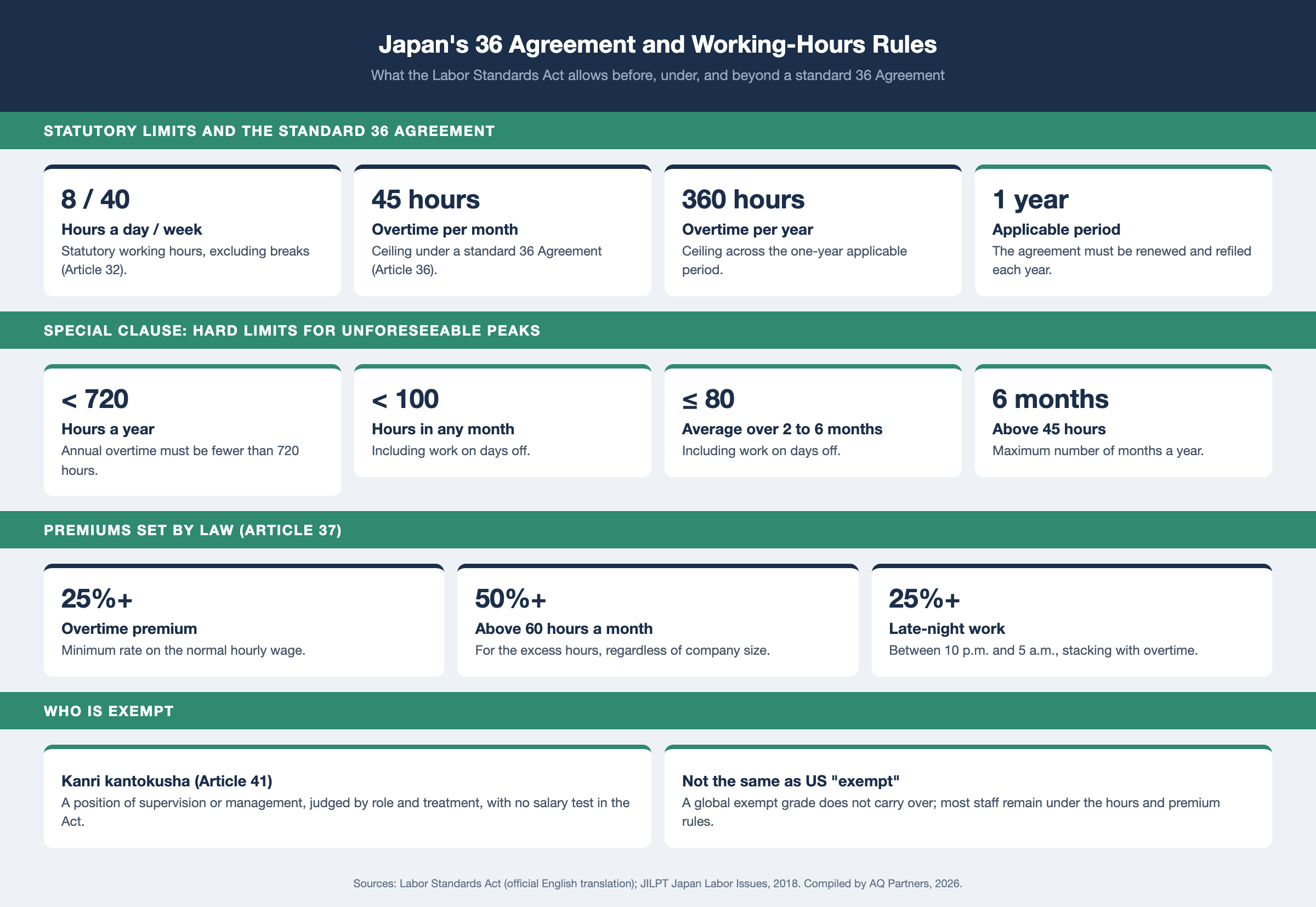
A standard 36 Agreement caps overtime at 45 hours a month and 360 hours a year; a special clause raises the cap within hard statutory limits.
Before the Work Style Reform amendments, the 45-hour and 360-hour figures were administrative guidance with no legal upper limit under a special clause. According to the Japan Institute for Labour Policy and Training's 2018 Japan Labor Issues report on the Work Style Reform Bill, the reform turned these into legal limits from April 2019 for large enterprises and from April 2020 for SMEs. The current structure under Article 36 is set out below.
| Limit | Statutory figure | Source | What it means for group policy |
|---|---|---|---|
| Statutory working hours | 8 hours a day and 40 hours a week, excluding breaks | Article 32 | A group policy of 45 contracted hours a week builds in overtime from day one |
| Standard overtime ceiling, monthly | 45 hours a month | Article 36(4) | The ordinary maximum the agreement may set |
| Standard overtime ceiling, annual | 360 hours a year | Article 36(4) | Applies across the one-year applicable period |
| Special clause, annual | Fewer than 720 hours a year | Article 36(5) | Only for an ordinarily unforeseeable, significant increase in workload |
| Special clause, single month | Fewer than 100 hours, including day-off work | Article 36(5) and (6) | A hard limit for any one month |
| Special clause, multi-month average | No more than 80 hours on average over any two to six months, including day-off work | Article 36(6) | Requires rolling tracking, not a monthly check |
| Special clause, frequency | No more than 6 months a year above 45 hours | Article 36(5) | Peak months must be counted and capped |
| Applicable period | Limited to one year | Article 36(2) | The agreement must be renewed and refiled every year |
The special clause is not a general extension. Article 36(5) permits it only where the employer needs to exceed the standard ceiling temporarily because of an ordinarily unforeseeable, significant increase in workload, and the agreement must state those circumstances. Regular quarter-end peaks above 45 hours are a staffing question, not a special-clause question.
Overtime and Late-Night Premiums Set by Law
Japan fixes minimum premiums by law: at least 25% for overtime, at least 50% above 60 hours a month, and at least 25% for late-night work.
Article 37 requires premium wages for overtime and day-off work at a rate set by Cabinet Order between 25% and 50%; the overtime minimum is 25%. For overtime above 60 hours in a month, the premium for the excess hours is at least 50%. The JILPT report notes that the reform abolished the earlier exemption from the 50% rate for SMEs, so the same rate applies regardless of company size. Article 37(4) adds a separate premium of at least 25% for work between 10 p.m. and 5 a.m., which stacks with the overtime premium when overtime runs late.
Two features catch global payroll teams. First, the premium is calculated on the "normal wage per working hour", and Article 37(5) excludes certain allowances, including family and commuting allowances, from that base; other allowances stay in. A group pay structure that labels part of salary as an allowance does not automatically reduce the overtime base. Second, where an offer includes fixed overtime pay (a monthly amount that pre-pays a stated number of overtime hours), it does not replace the statutory calculation: hours worked beyond the pre-paid amount still have to be paid at the premium rate. Payroll for a Japan subsidiary therefore needs an accurate record of hours, not just a salary figure. Rules on how payroll is run and documented are covered in HR administration and employer responsibilities in Japan.
Who Is Exempt: Japan's Manager Category Versus the Global "Exempt" Grade
Japan's working-hours exemption covers people in a position of supervision or management, judged by role, and is far narrower than US exempt.
Article 41(ii) of the Labor Standards Act removes the working-hours, break, and day-off provisions for "one in a position of supervision or management", known in Japan as kanri kantokusha (管理監督者). The exemption is defined by the position, not by salary, and the Act sets no salary test. The Ministry of Health, Labour and Welfare has published guidance on keeping the scope of kanri kantokusha appropriate, a sign that employers have applied the label too widely.
The US "exempt" grade under the Fair Labor Standards Act combines a salary threshold with duties tests and covers many professional and administrative staff who would not be kanri kantokusha in Japan. A global grading system that marks every employee above a band as exempt cannot be carried into Japan unchanged. A Japan subsidiary of 5 to 50 people may have only one or two people whose role, authority, and treatment support the classification. Article 41 lifts only the rules on working hours, breaks, and days off; it does not mention the annual paid leave or late-night work provisions, so a group that treats a Japan manager as fully exempt from all time rules should confirm the position with its sharoushi or employment lawyer before relying on it.
Keeping the 36 Agreement Current Each Year
A 36 Agreement covers an applicable period of no more than one year, so it must be renewed, re-signed by a majority representative, and refiled.
Because Article 36(2)(ii) limits the applicable period to one year, a 36 Agreement is an annual obligation, not a one-off set-up task. Overtime worked after the old agreement lapses and before the new one is filed has no legal basis. The renewal is also the point to check that the scope of workers, the cases in which overtime is needed, and the hour limits still match reality.
For a small subsidiary, the practical controls are simple and worth writing down:
- Renewal date in the statutory calendar. Record the start and end of the applicable period and the refiling step alongside the tax and social insurance deadlines.
- Hours tracking that matches the ceilings. Track monthly totals, the annual total, the rolling two-to-six-month average, and the count of months above 45 hours.
- A trigger for special-clause months. Require a documented reason when an employee approaches 45 hours, so the special clause is used only as Article 36(5) allows.
- Payroll alignment. Make sure the hours that drive the 25% and 50% premiums come from the same records used to monitor the ceilings.
- A consistent filing owner. The 36 Agreement is a filing with the Labour Standards Inspection Office; preparing and submitting it for a fee is work reserved for a licensed sharoushi under the Social Insurance and Labour Consultant Act.
The 36 Agreement sits alongside the rules of employment, which become mandatory at 10 employees, and the other localisation decisions covered in the guide to localising group employment policies for Japan. Broader labour compliance exposure for foreign employers is set out in Japan labor compliance risks.
Frequently Asked Questions
Can a Japan subsidiary with only a few employees skip the 36 Agreement?
No. The requirement does not depend on headcount. Any employer that needs an employee to work beyond 8 hours a day or 40 hours a week, or on a statutory day off, needs a 36 Agreement concluded with a majority representative and filed with the Labour Standards Inspection Office before that work happens.
Does a special clause allow unlimited overtime in busy periods?
No. Even with a special clause, annual overtime must be fewer than 720 hours, any single month must stay below 100 hours including day-off work, the average over any two to six months must not exceed 80 hours, and no more than 6 months a year may exceed 45 hours.
Are employees on the group's "exempt" grade exempt in Japan?
Not automatically. Japan's exemption under Article 41 covers people in a position of supervision or management, decided by their actual role and treatment. Many employees who are exempt under US rules are covered by Japan's working-hours limits and premium rules.
Working with AQ Partners. Our Tokyo team provides back office operations for foreign companies operating in Japan, including 36 Agreement drafting and annual refiling, rules of employment and employment contracts, and monthly payroll coordination with a licensed sharoushi. Book a consultation to discuss your Japan employment setup.

Yuga Koda is a founding Director at AQ Partners, supporting foreign companies, funds, and families operating in Japan. His experience operating companies in both Japan and international markets gives him a practical understanding of back office operations from both sides.