HR Administration in Japan: Employer Obligations
Key Takeaways
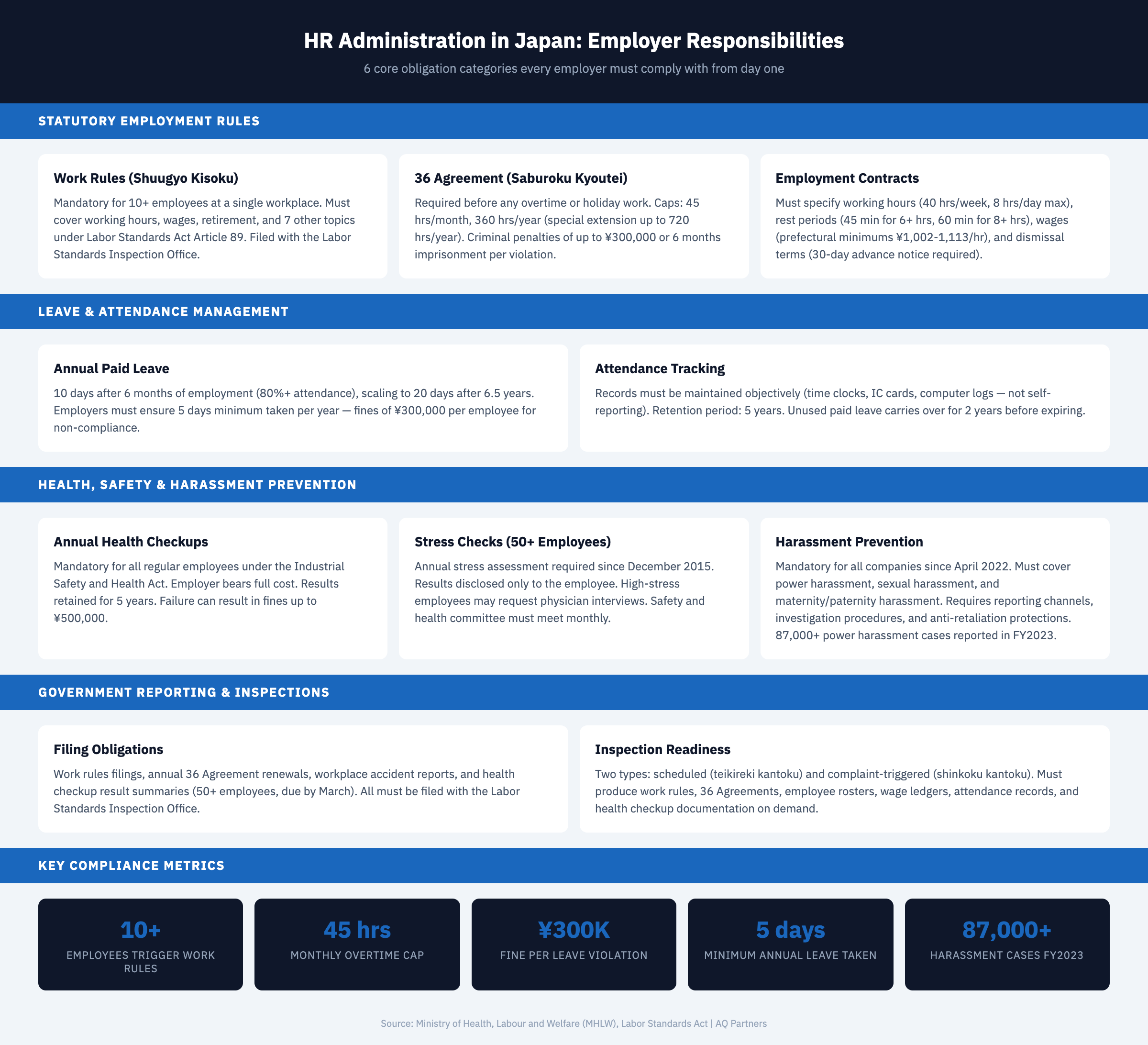
- Employers with 10 or more employees must establish written work rules (shuugyo kisoku) and file them with the Labor Standards Inspection Office — these rules must cover working hours, wages, retirement, and 7 other mandatory topics prescribed by the Labor Standards Act (Article 89). Work rules that fail to meet minimum statutory standards are automatically superseded by the law, even if employees have agreed to them.
- The 36 Agreement (saburoku kyoutei) is mandatory for any overtime or holiday work — without a valid labor-management agreement filed with the Labor Standards Inspection Office, any work beyond 40 hours per week or 8 hours per day is illegal. According to the Ministry of Health, Labour and Welfare (MHLW), the overtime cap is 45 hours per month and 360 hours per year, with a special extension limit of 720 hours annually.
- Employers must ensure each employee takes at least 5 days of annual paid leave per year — the 2019 amendment to the Labor Standards Act made this a legal obligation enforceable with fines of up to ¥300,000 per violation per employee. Employees earn 10 days of paid leave after 6 months of continuous employment with 80% or greater attendance, increasing to 20 days after 6.5 years.
- Annual health checkups (kenko shindan) are a mandatory employer obligation, not a voluntary benefit — the Industrial Safety and Health Act requires employers to provide and fund general health examinations for all regular employees at least once per year. Failure to provide health checkups can result in fines of up to ¥500,000 and liability for health-related workplace claims.
- Harassment prevention measures became mandatory for all companies in April 2022 — employers must establish reporting channels, investigation procedures, and prevention policies covering power harassment (pawahara), sexual harassment, and maternity/paternity harassment. The MHLW reports that power harassment consultations at labor bureaus exceeded 87,000 cases in fiscal 2023, underscoring the enforcement environment.
What HR Administration Obligations Do Employers Have in Japan?
HR administration in Japan encompasses the full scope of employer obligations under the Labor Standards Act, the Industrial Safety and Health Act, the Equal Employment Opportunity Act, and related legislation — covering work rules, working hours management, leave tracking, health and safety, harassment prevention, and government reporting. For foreign companies, these obligations begin from the first employee hire and apply regardless of company size, with additional requirements scaling at specific headcount thresholds.
Unlike jurisdictions where many HR practices are discretionary or governed primarily by contract, Japan mandates employer responsibilities through statute with enforcement by the Labor Standards Inspection Office (rodo kijun kantoku sho). This agency conducts scheduled and complaint-triggered inspections, and has authority to issue correction orders, recommend criminal prosecution, and impose fines. Understanding these obligations before hiring is essential — building compliant HR systems retroactively is significantly more costly and disruptive. JETRO provides an overview of Japan's labor regulations for foreign companies considering market entry. For the broader strategic framework, see our Japan HR compliance strategies guide.
When Are Work Rules (Shuugyo Kisoku) Required and What Must They Cover?
Work rules become legally mandatory when a business employs 10 or more workers at a single workplace — the rules must be filed with the Labor Standards Inspection Office and communicated to all employees, covering at least 10 categories prescribed by the Labor Standards Act.
The mandatory content categories under Article 89 of the Labor Standards Act include: (1) start and end times of working hours, rest periods, holidays, and leave; (2) methods of wage determination, calculation, and payment, plus pay dates and raises; (3) retirement provisions including dismissal grounds. Additionally, if the company has policies on the following, they must also be documented: bonuses, minimum wages, employee expense obligations, safety and hygiene, vocational training, accident compensation, commendations and disciplinary measures.
Work rules serve a unique legal function in Japan. Once properly established and filed, they become binding on all employees — even those who were not individually consulted. The full text of the Labor Standards Act is available in English translation for reference. However, work rules cannot set conditions below statutory minimums. An employer who specifies 5 days of annual leave in the work rules when the law mandates 10 days after 6 months would find the statutory standard automatically applied. The employer must seek the opinion of a worker representative (elected by majority vote) before filing work rules, though the employer is not required to obtain the representative's agreement.
| Mandatory Topic | Statutory Minimum / Standard | Common Pitfall for Foreign Companies |
|---|---|---|
| Working hours | 40 hours/week, 8 hours/day | Assuming flexible hours without proper variable hours agreement |
| Overtime | 36 Agreement required; 45hrs/month, 360hrs/year cap | Operating without filing the 36 Agreement |
| Rest periods | 45 min (6+ hrs), 60 min (8+ hrs) | Treating lunch as optional or flexible break |
| Annual paid leave | 10 days (after 6 months); mandatory 5 days taken | Not tracking usage or enforcing mandatory 5-day minimum |
| Wages | Minimum wage varies by prefecture (¥1,002-1,113/hr in 2024) | Using national average rather than prefectural minimum |
| Dismissal | 30-day advance notice or pay; just cause required | Assuming at-will termination is permissible |
| Retirement | Must specify retirement age and conditions | Setting retirement below 60 (statutory minimum) |
| Safety & hygiene | Per Industrial Safety and Health Act | Omitting mental health provisions (stress checks) |
What Is the 36 Agreement and Why Is It Non-Negotiable?
The 36 Agreement (saburoku kyoutei, named after Article 36 of the Labor Standards Act) is a written agreement between employer and employee representative that must be filed with the Labor Standards Inspection Office before any employee can work overtime or on holidays — without it, overtime is illegal regardless of employee consent or contract terms.
The agreement must specify: the types of work requiring overtime, the number of employees affected, the maximum overtime hours per day, month, and year, and the applicable period. Standard limits allow up to 45 hours of overtime per month and 360 hours per year. Companies requiring more overtime can file a special clause (tokubetsu joko) extending the limit to 100 hours per month and 720 hours per year, subject to conditions including that the average monthly overtime across any 2-6 month period does not exceed 80 hours.
The MHLW strengthened 36 Agreement enforcement in April 2019 with criminal penalties for violations: employers who exceed overtime limits face fines of up to ¥300,000 or imprisonment of up to 6 months. These penalties apply per violation, meaning systematic overtime abuse can result in cumulative penalties. Foreign companies accustomed to jurisdictions without hard overtime caps must carefully calibrate workload expectations to Japanese legal limits.
How Must Employers Manage Leave and Attendance?
Employers must track attendance records for all employees and ensure that each eligible employee takes a minimum of 5 days of annual paid leave per year — this is an employer obligation, not merely an employee right, with fines of up to ¥300,000 per employee for non-compliance.
Annual paid leave (nenjiyu kyuka) accrues based on tenure: 10 days after 6 months of continuous employment with 80% or higher attendance, increasing by 1-2 days annually up to a maximum of 20 days after 6.5 years. Unused leave carries over for 2 years before expiring. Since April 2019, employers with employees holding 10 or more days of annual leave entitlement must proactively ensure those employees take at least 5 days within the year — if employees do not voluntarily schedule leave, the employer must designate dates.
Attendance records must be maintained objectively, not based solely on employee self-reporting. The MHLW guidelines recommend using time clocks, IC cards, or computer login/logout records. Employers must retain these records for five years. Companies using Japanese HR software like SmartHR or Freee can automate attendance tracking and leave management to meet these requirements.
What Are the Mandatory Health and Safety Obligations?
Employers must provide annual health checkups (kenko shindan) for all regular employees and stress checks for workplaces with 50 or more employees — these are legal obligations under the Industrial Safety and Health Act, not discretionary benefits.
General health checkups must be conducted at least once per year for all employees. For employees engaged in specified hazardous work (chemical exposure, dust, radiation), additional specialized examinations are required at intervals of 3-6 months. The employer bears the full cost of these examinations and must maintain the results for five years. If examination results indicate health concerns, the employer must consult with a physician and take appropriate measures, which may include reassigning the employee to different duties.
Stress checks became mandatory for workplaces with 50 or more employees in December 2015. Employers must offer an annual stress assessment questionnaire to all employees, with the results disclosed only to the employee unless the employee consents to sharing with the employer. When high-stress employees request an interview with a physician, the employer must arrange it and implement recommended measures. Companies with 50+ employees must also appoint a safety and health manager (anzen eisei kanrisha) and establish a safety and health committee that meets at least monthly.
What Harassment Prevention Measures Are Required?
All employers in Japan must implement comprehensive harassment prevention measures covering power harassment, sexual harassment, and maternity/paternity harassment — this became mandatory for large enterprises in June 2020 and for SMEs in April 2022.
The required measures include: (1) establishing and disseminating a company policy prohibiting harassment; (2) creating a consultation and reporting system accessible to all employees; (3) implementing prompt and appropriate investigation and response procedures when reports are received; (4) protecting complainants and witnesses from retaliation; and (5) addressing the root causes of harassment through training and awareness. The MHLW defines power harassment (pawahara) as conduct involving a superior position that exceeds the scope of business necessity and harms the employee's working environment — covering six categories including physical violence, psychological intimidation, isolation, excessive demands, underutilization, and invasion of privacy.
The enforcement environment is significant. Labor bureau consultations on power harassment exceeded 87,000 cases in fiscal 2023, according to MHLW data. Companies found to have inadequate prevention measures may be publicly named by the MHLW and face administrative guidance. For foreign companies, the cultural dimension of harassment prevention — particularly regarding management communication styles that may be normal in the home country but perceived as power harassment in Japan — requires deliberate attention. For guidance on related employment relationship issues, see our article on employment contracts and labor rules.
What Reporting Obligations Apply to the Labor Standards Inspection Office?
Employers have ongoing reporting obligations to the Labor Standards Inspection Office covering work rules filings, 36 Agreement renewals, workplace accident reports, and health checkup result summaries — with specific filing deadlines and formats that must be followed.
Key reporting obligations include: filing or amending work rules whenever changes are made (no specific deadline but must be filed before implementation), renewing the 36 Agreement annually or as specified in its validity period, submitting workplace accident reports (rodo saigai) within a specified timeframe after any work-related injury or illness, and submitting an annual summary of health checkup results for workplaces with 50 or more employees by March.
The Labor Standards Inspection Office conducts two types of inspections: scheduled inspections (teikireki kantoku) and complaint-triggered inspections (shinkoku kantoku). During inspections, employers must produce work rules, 36 Agreements, employee rosters, wage ledgers, attendance records, and health checkup documentation. Inspectors have authority to issue correction orders (zesei kankoku) requiring compliance within a specified period, and repeated non-compliance can result in criminal referral. For a deeper understanding of the broader labor compliance risks that inspections target, see our companion guide.
HR administration in Japan requires systematic compliance with statutory obligations that cover every aspect of the employment relationship. For foreign companies building their Japan operations, AQ Partners provides integrated HR administration services — from work rules drafting to leave management and compliance reporting. Contact us to discuss your HR compliance needs.


Yuga Koda is a founding Director at AQ Partners, supporting foreign companies, funds, and families operating in Japan. His experience operating companies in both Japan and international markets gives him a practical understanding of back office operations from both sides.