
Month-End Close in Japan on a Group Calendar: What Slows It Down and How to Fix It

The month-end close for a Japan subsidiary is the set of tasks that turns a month of Japanese transactions into a trial balance and reporting package headquarters can consolidate: cut-off of vendor costs, payroll and social insurance entries, bank reconciliation, foreign currency revaluation, and intercompany agreement. When the subsidiary is small and its books are kept by an outsourced provider, the close is rarely slow because of the volume of work. It is slow because a handful of inputs arrive late or arrive in a form the group process does not expect. This guide explains the common causes of a slow close in a Japan entity, the fix for each, how to tell whether the close is actually improving, and which parts of the process sit with headquarters rather than the provider. It sets no day target: the deadline is the one in the group calendar.
Key Takeaways
- Late inputs, not workload, slow a small entity's close. Vendor invoices, payroll data, bank files, and intercompany confirmations that arrive after month-end hold up every later step.
- An accrual policy removes the invoice wait. Booking known costs before the invoice arrives, and truing up the next month, stops the close from depending on when a vendor sends paper.
- Payroll belongs in the close calendar, not alongside it. Japanese law requires wages on a fixed date at least once a month; the payroll journal and the employer's social insurance accrual should be locked to that date.
- Intercompany is the most avoidable difference. Agreeing recharges and balances in yen before month-end removes the item that most often stops consolidation.
- Measure the close by its errors, not only its speed. Late items, corrections after submission, and unreconciled balances show whether the process is improving.
Why a Small Japan Subsidiary Falls Behind the Group Close
A small Japan subsidiary falls behind the group close when vendor, payroll, bank, and intercompany inputs reach the provider after month-end.
Group close calendars are designed around the largest entities, and a subsidiary of 5 to 50 people is expected to report on the same schedule. Benchmarks give useful context. According to APQC data published by CFO.com in 2018, drawn from about 2,300 organizations, top-quartile companies complete the monthly close in 4.8 days or less, the median takes 6.4 calendar days, and the bottom quartile needs 10 or more. Those figures describe whole organizations, not small subsidiaries, and they are not a target for any particular entity. What they show is that the gap between fast and slow closes is large, and that it is usually a process gap rather than a headcount gap.
For an outsourced Japan entity, the provider can only close what it has received. The table below lists the causes that most often hold up a small subsidiary's close, the symptom headquarters sees, and the fix.
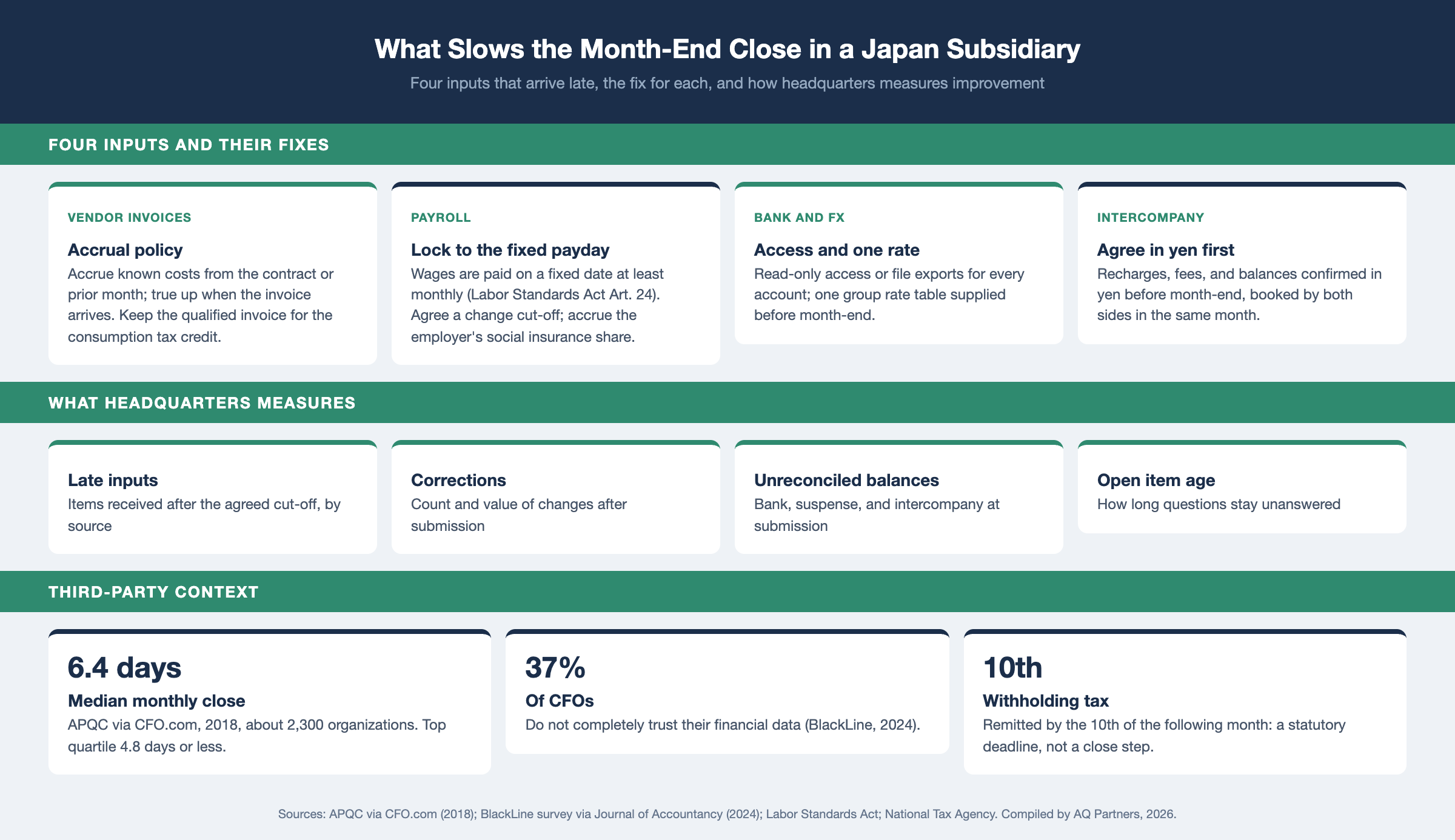
| Cause | What headquarters sees | Fix | Owner |
|---|---|---|---|
| Vendor invoices received after month-end | Expenses jump between months; late true-ups | Accrual policy for known costs; true-up the following month | Provider, with budget holders |
| No list of recurring costs | Accruals missed for rent, software, and services | A standing accrual schedule reviewed each quarter | Provider |
| Payroll data changes after the cut-off | Payroll journal reposted after submission | A payroll change cut-off agreed with HR and the sharoushi | Headquarters HR and provider |
| Employer social insurance not accrued | Personnel cost understated in some months | Accrue the employer share for the month it relates to | Provider |
| Bank and card data not available to the provider | Unreconciled cash at submission | Read-only access or a scheduled file export for every account | Headquarters treasury |
| Foreign currency rate source unclear | FX differences between the Japan and group ledgers | A single group rate table supplied before month-end | Headquarters |
| Intercompany recharges agreed late | Elimination differences at consolidation | Recharges and balances confirmed in yen before month-end | Headquarters and provider |
| Questions answered slowly at headquarters | Open items roll from month to month | A named reviewer and an open-items log | Headquarters |
Vendor Invoices and Cut-Off in a Japan Subsidiary
Vendor cut-off in a Japan subsidiary works when known costs are accrued at month-end instead of waiting for the vendor's invoice to arrive.
A Japanese supplier may bill on a fixed closing date each month, a practice known as shime (締め), and its invoice can then reach the subsidiary after the group's month-end. Whether that applies to a given vendor is worth checking at onboarding rather than assuming: the provider should record each recurring vendor's billing cycle and closing date in the accrual schedule. Where an invoice is expected after month-end, the cost is accrued from the contract, the purchase order, or the prior month's amount, and the true-up is posted when the invoice arrives.
The invoice still matters after the close. Under Japan's qualified invoice system, a consumption tax credit depends on holding an invoice that meets the requirements, so the provider must match each accrual to a valid invoice before the consumption tax return. The details of what a qualified invoice must contain, and how accounting software handles it, are covered in the qualified invoice system and accounting software. Electronic invoices received since January 2024 must also be kept in electronic form, which makes the provider's document repository part of the close rather than an afterthought.
Payroll and Social Insurance in the Japan Month-End Close
Payroll speeds up a Japan close when the journal is locked to the fixed payday and the employer's social insurance share is accrued each month.
Article 24 of the Labor Standards Act requires wages to be paid at least once a month on a fixed date. Because the payday is fixed, the payroll journal can be booked on the same day every month, and the close calendar can treat it as a known input rather than a variable one. The practical risk is changes after payroll has run: a late overtime claim, a new hire, or a leaver processed after the cut-off forces a repost. A payroll change cut-off agreed between headquarters HR, the provider, and the sharoushi (社会保険労務士, labour and social security attorney) who handles the filings keeps the journal stable.
Employer social insurance is the second payroll item. The timing of the employee deduction and the employer's payment for a given month should be confirmed with the sharoushi at set-up, and the employer's share should be accrued in the month to which the premium relates, so personnel cost is not understated in some months and doubled in others. Withholding tax on salaries is remitted by the 10th of the following month, which is a statutory deadline rather than a close step, and belongs on the statutory calendar alongside the close. Wider payroll risks for foreign-owned entities are covered in payroll compliance risks for foreign companies in Japan.
Bank Data, Foreign Currency, and Intercompany for a Japan Entity
Bank access, a single group FX rate, and intercompany balances agreed in yen before month-end remove the most common reconciling items.
A provider cannot reconcile cash it cannot see. Each Japanese bank and card account should have either read-only online access for the provider or a scheduled statement export, set up when the account is opened rather than when the first close is late. Where the subsidiary also holds foreign currency accounts, the same applies to each currency; the account options are compared in multi-currency accounts and foreign exchange in Japan.
Foreign currency revaluation is a policy question as much as a mechanical one. If the Japan ledger revalues at the bank's posting rate and the group revalues at its own month-end rate, the two will never agree. Headquarters should supply the group rate table before month-end and the provider should use it for both bank and intercompany balances. Intercompany recharges are the most avoidable cause of consolidation differences: management fees, cost recharges, and loan interest agreed in yen, with both sides booking the same amount in the same month, eliminate cleanly. The pricing and withholding questions behind those charges are set out in intercompany management fees for a Japan subsidiary.
How to Tell Whether a Japan Subsidiary's Close Is Improving
A Japan close improves when late inputs, corrections after submission, and unreconciled balances fall month on month, not only when it gets faster.
Speed alone is a weak measure for a small entity, because a fast close that is corrected the following week has moved the work rather than removed it. Finance teams themselves report doubts about their numbers: a BlackLine survey reported by the Journal of Accountancy in 2024, covering more than 1,300 finance professionals in seven countries, found that 37% of CFOs do not completely trust the accuracy of their organization's financial data, and 27% of those who distrust their data cited reliance on spreadsheets. Four measures give headquarters a clearer view of a Japan entity:
- Late inputs. The number of invoices, payroll changes, bank files, and confirmations received after the agreed cut-off, by source.
- Corrections after submission. The count and value of entries changed after the package was submitted.
- Unreconciled balances. Bank, suspense, and intercompany balances left unexplained at submission.
- Open item age. How long questions to headquarters or the provider stay unanswered.
Tracking these by source shows whether the delay sits with vendors, headquarters, or the provider, which is the information needed to fix it. How the close fits within the wider finance operating model is covered in Japan subsidiary finance for the group CFO, and the bookkeeping differences that often surface during the close are explained in how Japanese accounting differs from global standards.
Frequently Asked Questions
How long should a Japan subsidiary's month-end close take?
There is no single right answer: the deadline is whatever the group calendar requires and the provider has agreed to. For context, APQC data published in 2018 put the median monthly close at 6.4 calendar days across about 2,300 organizations. For a small Japan entity, the quality measures, such as corrections after submission and unreconciled balances, say more about the process than the day count.
Why can Japanese vendor invoices arrive after month-end?
A supplier that bills on a fixed monthly closing date, known as shime, may send its invoice after the group's month-end. The fix is to accrue known costs from the contract or prior month and true up when the invoice arrives, while keeping the qualified invoice on file for the consumption tax credit.
Does headquarters need to do anything for the Japan close?
Yes. Headquarters owns the FX rate table, the intercompany confirmations, the approval of material accruals, and answers to the provider's questions. Each of these can hold up the close as easily as a missing vendor invoice, so each needs a named owner at headquarters.
Working with AQ Partners. Our Tokyo team provides monthly bookkeeping, accounting software setup, and annual tax filings for foreign companies operating in Japan. Book a consultation to discuss your month-end process.

Yuga Koda is a founding Director at AQ Partners, supporting foreign companies, funds, and families operating in Japan. His experience operating companies in both Japan and international markets gives him a practical understanding of back office operations from both sides.