
Statutory Audit, Group Audit, and Kansayaku: Which Audits a Japan Subsidiary Actually Faces

Japan subsidiary audit requirements are the set of audits and examinations a foreign-owned KK or GK can face: a statutory audit under the Companies Act, an audit by a statutory auditor (監査役, kansayaku), the parent's group audit, tax examinations, and reviews by the pension office and the Labour Standards Inspection Office. Only some of these apply to any given subsidiary, and the triggers differ. A statutory audit depends on the size of the balance sheet. A kansayaku depends on the governance structure the company chooses. The group audit depends on the parent. Tax and labour examinations apply to every employer. This guide sets out which audits a wholly owned subsidiary actually faces, what triggers each one, and what headquarters should prepare so the same records serve all of them.
Key Takeaways
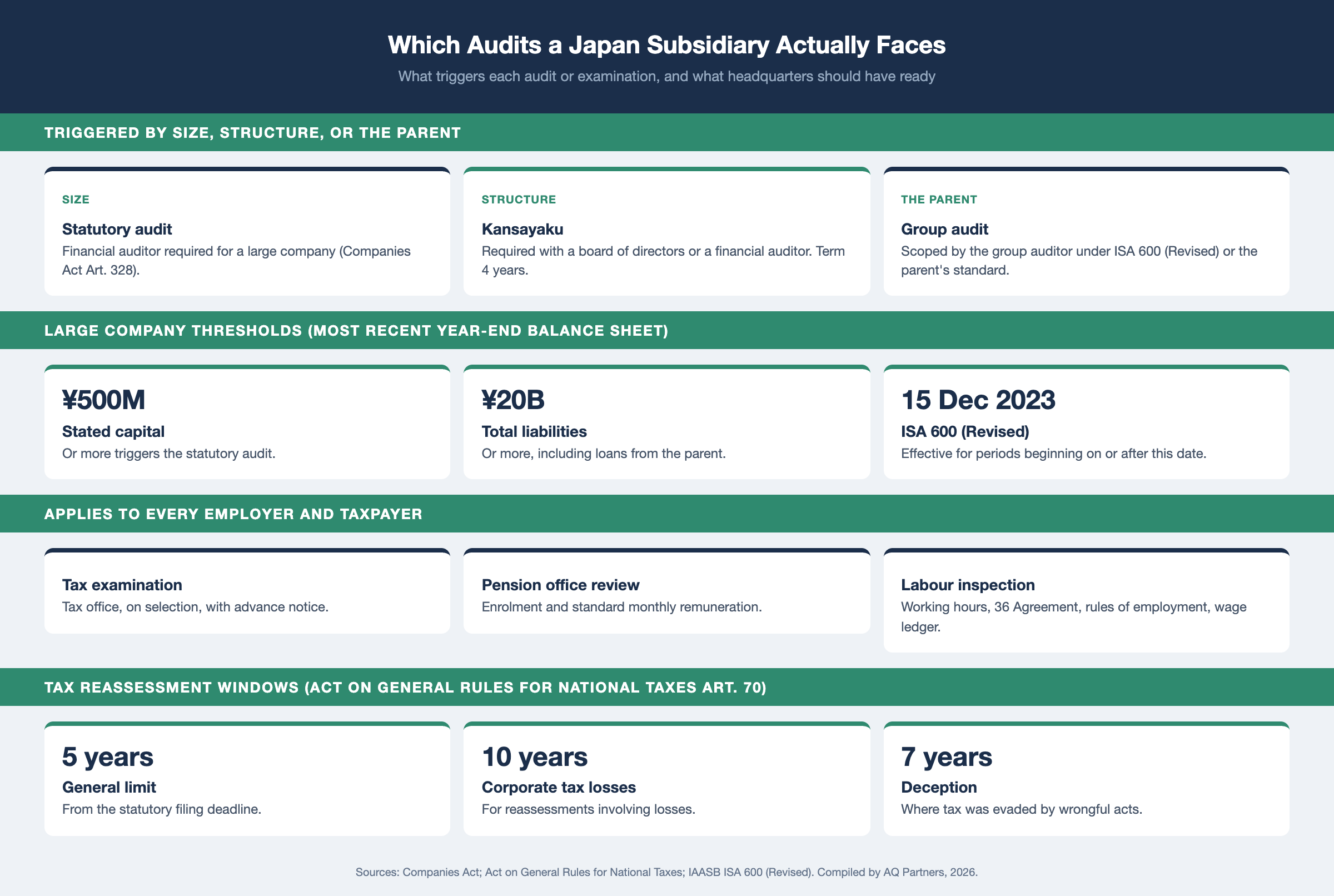
- Most small subsidiaries need no statutory audit. The Companies Act requires a financial auditor only for a large company: stated capital of ¥500 million or more, or liabilities of ¥20 billion or more, at the end of the most recent business year.
- Parent loans count toward the liabilities test. A subsidiary funded mainly by intercompany debt can cross the ¥20 billion line without any change in its operations, and the statutory audit follows.
- A kansayaku follows from structure, not size. A KK with a board of directors, or with a financial auditor, must have one. A KK run by one or two directors without a board usually does not.
- The group audit applies regardless of Japanese law. Under ISA 600 (Revised), effective for periods beginning on or after 15 December 2023, the group auditor decides how much work to do on the Japan entity.
- Tax examinations reach back years. The tax office can reassess for 5 years from the filing deadline, 10 years for corporate tax losses, and 7 years where tax was evaded by deception, so records must outlast those windows.
The Audits and Examinations a Japan Subsidiary Can Face
A Japan subsidiary can face up to six kinds of audit or examination, each with its own trigger, examiner, and set of records to produce.
Headquarters teams often use "audit" for all of these, but they differ in who performs them, what triggers them, and what they can lead to. A statutory audit produces an opinion that the shareholder receives. A group audit produces evidence for the parent's consolidated opinion. A tax examination can produce a reassessment, additional tax, and penalties. Pension office reviews and labour inspections can lead to retroactive corrections and written recommendations to correct.
| Audit or examination | Performed by | Legal basis | Applies when | What headquarters supplies |
|---|---|---|---|---|
| Statutory audit | Financial auditor (会計監査人, kaikei kansanin), a CPA or audit firm | Companies Act Art. 328 | Large company by capital or liabilities, or voluntary appointment | Statutory financial statements, ledger access, confirmations |
| Kansayaku audit | Statutory auditor elected by the shareholder | Companies Act Arts. 327 and 381 | KK with a board of directors or a financial auditor, or voluntary appointment | Financial statements, business report, board materials |
| Group audit | Parent's auditor or a component auditor in Japan | ISA 600 (Revised) or the parent's national standard | The parent's consolidated accounts are audited | Reporting package, reconciliations, tax computation |
| Tax examination | Tax office or regional taxation bureau | Act on General Rules for National Taxes | Any taxpayer, on selection | Books, invoices, contracts, the zeirishi's working papers |
| Social insurance review | Pension office (年金事務所, nenkin jimusho) | Employees' Pension Insurance and Health Insurance Acts | Any enrolled employer, on selection | Wage ledger, attendance records, enrolment filings |
| Labour inspection | Labour Standards Inspection Office (労働基準監督署, rodo kijun kantokusho) | Labour Standards Act | Any employer, on selection or complaint | Working-hour records, 36 Agreement, rules of employment |
| Internal audit | Parent's internal audit function | Group policy | As planned by the group | Control documentation, provider walkthroughs |
When the Companies Act Requires a Statutory Audit in Japan
A statutory audit is required only for a large company, defined by capital of ¥500 million or more or liabilities of ¥20 billion or more.
The Companies Act defines a large company (大会社, daigaisha) by its balance sheet at the end of the most recent business year: stated capital of ¥500 million or more, or total liabilities of ¥20 billion or more. Under Article 328, a large company that is not a public company must appoint a financial auditor, and under Article 327 a company with a financial auditor must also have a kansayaku. A wholly owned subsidiary whose shares carry transfer restrictions is a non-public company for this purpose, so it needs the financial auditor and a kansayaku but not a full board of kansayaku.
The capital test is easy to monitor because capital changes only by resolution and registration; the mechanics are covered in capital increase and capital reduction in Japan. The liabilities test is the one headquarters tends to miss. Liabilities include loans from the parent, so a subsidiary financed mainly by intercompany debt, or one carrying large intercompany payables, can cross ¥20 billion while its operations stay the same. Groups that fund Japan through debt should track the liabilities total at each year-end alongside the thin capitalisation and earnings stripping limits covered in intercompany loans to a Japan subsidiary.
A company below both thresholds can still appoint a financial auditor voluntarily under Article 326, and some groups do so where a lender, a regulator, or a planned listing calls for audited Japanese statements.
Kansayaku: When a Wholly Owned Japan Subsidiary Needs One
A KK needs a kansayaku if it has a board of directors or a financial auditor; one run by one or two directors without a board usually does not.
Under Article 327 of the Companies Act, a company with a board of directors must have a kansayaku, unless it is a non-public company with an accounting advisor, and a company with a financial auditor must have one too. Many wholly owned subsidiaries avoid both by operating with one or two directors and no board, which keeps the governance load light. Adding a board brings the kansayaku requirement with it.
A non-public company without a financial auditor or a board of kansayaku may limit the kansayaku's audit to accounting matters in its articles of incorporation under Article 389. The kansayaku then reviews the financial statements but not the directors' business conduct more broadly. The term of office is 4 years. The role, eligibility, and independence rules are set out in detail in the kansayaku guide, and the governance choices around boards in corporate governance requirements for Japan entities.
How the Group Audit Reaches a Japan Subsidiary
The parent's auditor decides how much audit work the Japan subsidiary needs, under ISA 600 (Revised) or the parent's national standard.
For groups reporting under International Standards on Auditing, the IAASB's ISA 600 (Revised) governs how the group auditor plans work on components, including foreign subsidiaries. It took effect for audits of group financial statements for periods beginning on or after 15 December 2023 and replaced the older approach of classifying components as significant or not with a risk-based judgement about where audit work is needed. For a small Japan entity, the outcome can range from analytical review at group level to specific procedures performed by a component auditor in Japan. US-listed groups follow the equivalent PCAOB requirements.
Whatever the scope, the group auditor's requests reach the subsidiary through headquarters. The requests that come up most often for a Japan entity are a trial balance that ties to the group package, a reconciliation from the J-GAAP statutory accounts to the group numbers, the zeirishi's corporate tax computation, bank balance confirmations from Japanese banks, and evidence of controls over payments and the company seal. Keeping these in a single year-end file, prepared on the same basis each year, shortens the exchange. The monthly reporting and year-end sequence that produce these documents are covered in the guide to Japan subsidiary finance for the group CFO.
Tax Examinations and the Reassessment Window in Japan
Any Japan subsidiary can be examined by the tax office, which can reassess for 5 years, 10 years for losses, and 7 years for deception.
Tax examinations are not triggered by size. The tax office selects corporations for examination and gives advance notice of the taxes and periods to be covered. What limits how far back an examination can reach is Article 70 of the Act on General Rules for National Taxes, which sets the period within which the tax office can reassess. The general limit is 5 years from the statutory filing deadline. For corporate tax losses, which a company carries forward to use against later profits, the limit is 10 years. Where tax was evaded through deception or other wrongful acts, the limit is 7 years.
For headquarters, the practical consequence is record retention. Books, invoices, contracts, payroll records, and the zeirishi's working papers need to stay accessible for at least as long as the reassessment window, and longer where losses are being carried forward. The examination process itself, from the advance notice to the outcome, is described in tax audits in Japan for foreign companies.
Pension Office Reviews and Labour Inspections
Every Japan employer can be reviewed by the pension office and inspected by the Labour Standards Inspection Office, whatever its size.
The pension office reviews whether employees who should be enrolled in social insurance are enrolled, and whether the standard monthly remuneration reported for each employee matches actual pay. The Japan Pension Service's English pages set out the enrolment rules employers are measured against. The Labour Standards Inspection Office examines working-hour records, overtime against the limits in the 36 Agreement, the rules of employment, and the wage ledger. Both can lead to retroactive corrections and written recommendations to correct.
For a subsidiary that outsources payroll, these reviews test the provider's records as much as the company's. Headquarters should confirm that attendance records, the wage ledger, the 36 Agreement and its filing receipt, and the rules of employment are kept current and can be produced on request. Where a licensed sharoushi makes the filings, the sharoushi's records form part of the evidence. Common gaps are described in payroll compliance risks for foreign companies in Japan.
Frequently Asked Questions
Does a small Japan subsidiary need an audit?
Usually not a statutory one. The Companies Act requires a financial auditor only for a large company, with capital of ¥500 million or more or liabilities of ¥20 billion or more at the end of the most recent business year. A small subsidiary is still covered by the parent's group audit, and every employer can face tax examinations, pension office reviews, and labour inspections.
Does a wholly owned KK need a kansayaku?
Only if it has a board of directors or a financial auditor, subject to the exception for a non-public company with an accounting advisor. A KK managed by one or two directors without a board usually does not need one. Where a kansayaku is appointed, a non-public company without a financial auditor can limit the audit to accounting matters in its articles.
How far back can the Japanese tax office reassess?
Under Article 70 of the Act on General Rules for National Taxes, the general limit is 5 years from the statutory filing deadline. Reassessments involving corporate tax losses can go back 10 years, and cases of deception 7 years. Records should be kept accessible for at least these periods.
Working with AQ Partners. Our Tokyo team provides back office operations for foreign companies operating in Japan, including monthly bookkeeping, annual tax filings, payroll coordination with a licensed sharoushi, and corporate document storage. Book a consultation to discuss your Japan entity's records.

Yuga Koda is a founding Director at AQ Partners, supporting foreign companies, funds, and families operating in Japan. His experience operating companies in both Japan and international markets gives him a practical understanding of back office operations from both sides.