
How to Choose the Right Japan Work Visa: Complete Guide to Visa Categories

Key Takeaways
- ✓Engineer/Specialist is the default choice for most hires — covering software engineers, marketers, consultants, and other white-collar professionals, this visa accounted for 458,109 holders as of mid-2025, making it Japan's most common work visa by a wide margin.
- ✓HSP status dramatically accelerates permanent residence — while standard work visas require 10 years of residence for PR eligibility, Highly Skilled Professionals with 70+ points can apply in just 3 years, or 1 year with 80+ points, plus receive 5-year visas from the start.
- ✓Intra-Company Transferee bypasses education requirements — employees already working at your foreign office for 1+ years can transfer to Japan without a degree, making this ideal for global mobility programs and rapid deployment of experienced staff.
- ✓Business Manager visa requirements tightened significantly in October 2025 — the minimum capital requirement increased to 30 million yen, and new mandates for JLPT N2 Japanese, educational or management experience, and third-party business plan verification now apply.
- ✓Visa selection shapes your entire workforce strategy — choosing the right category affects processing timelines (typically 2-4 months from CoE application to arrival), employee retention through PR pathways, career flexibility, and long-term compliance obligations.
Introduction
The right Japan work visa category depends on your candidate's qualifications, your company structure, and your long-term workforce goals — and choosing correctly can mean the difference between a 2-month onboarding and a year of delays.
Choosing the right work visa category is one of the most critical decisions in hiring foreign talent for your Japan operations. The wrong choice can lead to application rejections, months of delays, and frustrated candidates. The right choice accelerates processing, sets employees on optimal paths to permanent residence, and ensures long-term compliance.
Japan's immigration system offers several work visa categories, each designed for specific employment situations and worker qualifications. According to the Immigration Services Agency of Japan (ISA), the total foreign resident population reached 3.96 million as of mid-2025, with work visa holders representing a rapidly growing share of that figure. While our Complete Guide to Japan Work Visas provides an overview of the entire visa process, this article dives deep into each major visa category to help you make informed decisions about which visa best fits your hiring needs.
Understanding the nuances between visa categories—from eligibility requirements to permanent residence pathways—enables strategic workforce planning and helps you attract and retain top international talent in Japan.
| Visa Category | Best For | Requirements | Path to PR | Employer Flexibility |
|---|---|---|---|---|
|
Engineer/Specialist in Humanities/ International Services |
Most professionals: software engineers, accountants, marketers, consultants, translators, language teachers |
• Bachelor's degree OR 10 years experience
• 3 years for interpreter/language teaching
• Salary equal to Japanese nationals
|
10 years to PR
|
Can change employers
|
|
Highly Skilled Professional (HSP) |
Senior executives, high earners (10M+ yen), PhD holders, employees seeking fast-track permanent residence |
• 70+ points (based on education, experience, salary, age, achievements)
• Extensive documentation required
|
1-3 years to PR
5-year visa
|
Can change employers; multiple activities
|
|
Intra-Company Transferee |
Internal transfers, temporary rotations, global mobility within corporate groups, employees without degrees |
• 1 year employment with foreign entity
• Proven corporate relationship
• Cannot change employers in Japan
|
10 years to PR
|
Cannot change employers
|
| Business Manager | Entrepreneurs starting businesses, senior executives with genuine management authority and decision-making power |
• 30M yen paid-in capital OR executive management role
• Physical office required (no virtual offices)
• JLPT N2 + degree or 3yr mgmt exp (Oct 2025)
• Viable business plan & third-party verification
|
10 years to PR
or 1-3 years via HSP
|
Self-employed or executive role
|
| Skilled Labor | Foreign cuisine chefs, specialized craftspeople, pilots, sports trainers with hands-on expertise |
• 3 years experience (chefs) OR 10 years (other skills)
• Documented practical expertise
• Limited to specific skill categories
|
10 years to PR
|
Same skill category only
|
| Dependent | Spouses and children (under 20) of work visa holders relocating to Japan |
• Legally married spouse or child under 20
• Primary visa holder must show sufficient income
• Separate application for work permission
|
Via primary holder or own visa
|
28hr/week with permission (full for HSP spouses)
|
|
Specified Skilled Worker (SSW) |
Workers in designated shortage industries: nursing care, construction, food service, manufacturing, agriculture, and 11 other fields |
• Pass industry skills exam + Japanese language test (JLPT N4+)
• Employer must meet support plan requirements
• SSW Type 2 allows PR pathway and family
|
Type 1: No PR path
Type 2: 10 years to PR
|
Can change employers in same field
|
|
Designated Activities (Startup / Digital Nomad) |
Entrepreneurs preparing business launch (startup visa), remote workers employed by overseas companies (digital nomad visa) |
• Startup: Municipality endorsement + business plan
• Digital Nomad: 10M+ yen annual income, insurance
• Time-limited; must transition to other visa
|
No direct PR path
Must change to Business Manager or other
|
Limited to designated activities
|
Scroll horizontally to view all columns on mobile devices
Engineer/Specialist in Humanities/International Services Visa
What This Visa Covers
The Engineer/Specialist in Humanities/International Services visa is Japan's most-used work visa category, covering the vast majority of white-collar professional roles from software engineers to marketing managers.
The Engineer/Specialist in Humanities/International Services visa (技術・人文知識・国際業務) is the workhorse of Japan's professional immigration system. According to ISA foreign resident statistics (moj.go.jp), this category reached 458,109 holders as of June 2025 — a 9.4% year-over-year increase — making it by far the most commonly issued work visa for foreign professionals in Japan.
Engineer category includes roles requiring technical expertise: software developers, IT specialists, mechanical engineers, architects, industrial designers, and technology consultants. The work must involve applying engineering or scientific knowledge to solve technical problems.
Specialist in Humanities category covers business and administrative professionals: marketing managers, financial analysts, human resources specialists, legal professionals (non-practicing), business consultants, accountants, and corporate strategists. These roles require specialized knowledge in humanities, social sciences, or business administration.
International Services category applies to roles leveraging international perspective or language skills: translators, interpreters, international sales representatives, global marketing specialists, and positions requiring foreign language ability or cross-cultural business knowledge.
The key distinction is that all these roles require specialized knowledge or skills that justify hiring a foreign professional. Basic clerical work, general labor, or positions that don't require specific expertise don't qualify. The ISA's official page for the Engineer/Specialist in Humanities/International Services visa (moj.go.jp) outlines the specific activities permitted under this status of residence.
Eligibility Requirements
To qualify for this visa category, candidates must meet educational or experience requirements that demonstrate specialized expertise.
Educational path: A bachelor's degree or higher in a field related to the intended work. The degree field should reasonably connect to the job duties—engineering degrees for technical roles, business or humanities degrees for business positions, language or international relations degrees for international services roles. Immigration authorities review this connection carefully.
Experience path: 10 years of relevant work experience in the field, even without a degree. For IT and technology positions specifically, this requirement is reduced to 3 years. Experience must be documented through employment certificates, contracts, and detailed work history records.
Salary requirements: The offered salary must be appropriate for the role and qualifications, typically comparable to what Japanese nationals receive for similar positions. Significantly below-market salaries raise red flags and often result in rejections. Before you can even sponsor these visas, ensure you have the proper entity structure established in Japan.
Path to Permanent Residence
The Engineer/Specialist visa offers a standard pathway to permanent residence, though it's longer than some alternatives.
Standard timeline: 10 years of continuous residence in Japan with valid visa status. This includes time on student visas or other statuses, though certain periods may be weighted differently.
Visa renewal periods: First-time applicants typically receive 1-year visas initially. Subsequent renewals may grant 3-year or 5-year periods based on employment stability, company standing, and compliance history. Larger, established companies often secure longer renewal periods for their employees.
Acceleration through HSP: If your employee qualifies for Highly Skilled Professional points (discussed below), they can potentially achieve permanent residence in as little as 1-3 years instead of 10. Many Engineer/Specialist visa holders strategically upgrade to HSP status once they meet the points threshold through salary increases or additional qualifications.
Common Application Challenges
Several issues frequently cause Engineer/Specialist visa applications to face scrutiny or rejection.
Degree-job mismatch: A marketing role for someone with an engineering degree, or a software development position for a literature graduate. While some flexibility exists, the connection should be logical. Immigration may request detailed explanations of how the educational background applies to the role.
Vague job descriptions: Generic duties like "general business operations" or "assist with various tasks" don't demonstrate the specialized nature required. Job descriptions must clearly articulate specific technical or specialized responsibilities.
New company concerns: Newly established companies without operating history face additional scrutiny. Immigration wants evidence of genuine business operations and financial stability to pay the promised salary. If you're a new company, completing all post-incorporation filing requirements strengthens your application.
When this visa works best: For established companies hiring professionals with clear educational backgrounds and well-defined roles. It's ideal for the majority of professional hiring scenarios and offers flexibility across many industries and positions.
Highly Skilled Professional (HSP) Visa
Understanding the Points System
The HSP visa uses a points-based system where candidates scoring 70+ points gain access to Japan's most generous immigration benefits, including permanent residence in as little as 1 year.
Japan's Highly Skilled Professional visa operates on a points-based system designed to attract top global talent. To qualify, applicants need a minimum of 70 points calculated across multiple factors. The Ministry of Foreign Affairs (MOFA) provides detailed guidance on the HSP visa categories and their respective benefits.
Points are awarded for:
Academic background: Points increase with educational level—bachelor's degree (10 points), master's degree (20 points), doctorate (30 points). Multiple degrees or degrees from top-ranked universities earn bonus points.
Professional experience: Years in relevant fields earn points on a sliding scale. 10+ years of experience can earn 25 points, with adjustments based on position level and industry.
Annual salary: Higher compensation equals more points. The threshold varies by age, but generally salaries above 10 million yen annually earn significant points. This is the most influential factor for many applicants.
Age: Younger applicants receive more points, with the highest points (15) for those under 30, decreasing as age increases. This reflects Japan's preference for longer-term economic contribution.
Additional factors: Japanese language proficiency (JLPT N1 or N2), achievements like patents or awards, graduating from a Japanese university, working at innovative companies, or having research achievements all contribute additional points.
The Immigration Services Agency provides an online points calculator. Candidates should calculate their points before applying to ensure they meet the 70-point threshold. Those with 80+ points qualify for even faster permanent residence tracks.
HSP Benefits vs. Standard Work Visas
The HSP visa offers substantial advantages over standard work visas, making it highly attractive for senior professionals and companies competing for top talent.
5-year visa periods from the start: Unlike standard visas that typically begin with 1-year periods, HSP visa holders receive 5-year visas immediately, reducing renewal administrative burden.
Fast-track permanent residence: The most significant benefit. HSP holders with 70-79 points can apply for permanent residence after just 3 years in Japan. Those with 80+ points can apply after only 1 year. This compares to the standard 10-year requirement for most visa categories.
Multiple work activities permitted: HSP visa holders can engage in multiple types of work activities simultaneously without additional permissions. This allows flexibility for side businesses, consulting, or diverse roles within the same company.
Spouse work permission: Spouses of HSP visa holders can work in Japan without the usual restrictions on dependent visa holders, making family relocation more attractive.
Parent and domestic helper sponsorship: HSP visa holders can bring parents and even domestic helpers to Japan under certain conditions, a unique privilege not available with standard work visas. This is particularly valuable for families with young children or elderly parents.
Simplified immigration procedures: Faster processing times and priority handling at immigration offices.
Who Should Apply for HSP
The HSP visa makes strategic sense for specific candidate profiles and business situations.
Senior executives and high earners: C-level executives, senior managers, and specialists commanding salaries above 10 million yen annually often naturally qualify based on compensation and experience alone.
PhD holders and researchers: Academics and researchers with doctorates gain significant points from educational credentials, making HSP status accessible even with moderate salaries.
Mid-career professionals with strong profiles: Those in their 30s with master's degrees, 7-10 years of experience, and competitive salaries (8-10 million yen) frequently hit the 70-point threshold.
When to upgrade from standard visa to HSP: Employees currently on Engineer/Specialist visas should calculate their HSP points whenever they receive promotions, salary increases, or complete additional education. Upgrading to HSP status accelerates their permanent residence timeline dramatically. Understanding Japanese HR compliance requirements helps structure compensation packages that support HSP qualification.
Strategic Considerations
While the HSP visa offers clear benefits, companies should consider both advantages and requirements when deciding whether to pursue this category.
Documentation intensity: HSP applications require extensive documentation proving all claimed points—original diplomas with apostilles, detailed employment certificates for all claimed experience, salary documentation, achievement evidence, and sometimes Japanese language test results. The documentation burden is significantly higher than standard visa applications.
Salary transparency: Applying for HSP requires disclosing exact salary figures to immigration authorities, as compensation determines points. Some candidates or companies prefer more privacy around compensation details.
Employee retention advantages: The fast-track to permanent residence creates powerful retention incentives. Employees who can achieve PR in 1-3 years versus 10 are more likely to commit to long-term careers in Japan and with your company.
Competitive recruiting advantage: Marketing positions as "HSP eligible" attracts top-tier talent who value the immigration benefits. It signals that your company offers competitive compensation and values long-term employee investment.
Cost-benefit for employers: While HSP applications involve more documentation work, the benefits—reduced renewal frequency, improved retention, and employee satisfaction—often outweigh the additional effort for senior positions.
Intra-Company Transferee Visa
Transfer Requirements
The Intra-Company Transferee visa allows companies to move existing employees to Japan without degree requirements, provided they have worked at the foreign entity for at least one continuous year.
The Intra-Company Transferee visa (企業内転勤) is specifically designed for employees being transferred from foreign offices to Japanese operations within the same corporate group.
One year minimum employment abroad: The employee must have worked for the foreign entity for at least one continuous year immediately before transfer. This employment must be documented with contracts, payslips, and employment certificates.
Corporate relationship documentation: You must prove the legal relationship between the foreign entity and Japanese entity. This includes corporate registration documents, ownership structures, shareholder agreements, or subsidiary relationships. Both parent-subsidiary and sister-company relationships qualify, but the connection must be clear and documented.
Role requirements: The transferred employee must work in technology, humanities, or international business categories—the same general categories as the Engineer/Specialist visa. However, the specific job duties in Japan can differ from their role abroad.
The key distinction from other visas is that this category is relationship-based (employee-company connection) rather than qualification-based (education or experience credentials). For an overview of all working statuses available in Japan, JETRO provides a comprehensive reference on their investment portal.
Advantages for Multinational Companies
The Intra-Company Transferee visa offers unique benefits for global organizations rotating talent through international offices.
No educational requirement: Unlike Engineer/Specialist visas, transfers don't need specific degrees. The one-year work history with the company substitutes for educational credentials. This enables companies to transfer talented employees who may lack formal university education but have proven skills and company knowledge.
Faster processing for established companies: Large multinational corporations with track records of successful transfers often experience smoother processing. Immigration authorities become familiar with these companies' operations and structure.
Global mobility and rotation: Companies can strategically rotate employees through different markets for career development, knowledge transfer, and operational needs without visa obstacles based on educational backgrounds.
Knowledge and culture transfer: Transferring employees who deeply understand company culture, processes, and standards accelerates Japan operations setup and ensures consistency across global operations.
Limitations and Restrictions
The Intra-Company Transferee visa comes with constraints that don't apply to other visa categories.
Cannot change employers in Japan: This visa is tied specifically to the sponsoring corporate group. If the employee wants to work for a different company in Japan, they must apply for a complete change of status, typically to Engineer/Specialist visa, and meet those category's requirements.
Must maintain corporate relationship: If the corporate relationship changes—the foreign entity is sold, the Japanese subsidiary becomes independent, or corporate structures reorganize—the visa status may be affected. Significant corporate changes require immigration notifications and potentially new applications.
Path to permanent residence: Standard 10-year timeline applies, same as Engineer/Specialist visas. The Intra-Company Transferee status itself doesn't offer accelerated permanent residence, though qualifying for HSP points can still provide that pathway.
When to Use This vs. Engineer/Specialist
Strategic decision-making between these visa categories depends on your hiring scenario and long-term workforce plans.
Use Intra-Company Transferee for:
- Existing employees from foreign offices who need Japan experience
- Temporary rotations (1-3 years) before returning to home country
- Employees without formal educational credentials who've proven themselves in your organization
- Rapid deployment when you need someone immediately and they're already working for your company abroad
Use Engineer/Specialist for:
- New hires who don't have existing relationship with your company
- Long-term Japan-based positions where you want employees to have flexibility to advance careers
- Building local Japanese teams rather than rotating international staff
- When you want employees to have option to change roles or even companies without visa complications
For companies just entering Japan, you might initially use an Employer of Record (EOR) solution before establishing your entity and sponsoring visas directly.
Business Manager Visa
Two Paths to Qualification
The Business Manager visa serves entrepreneurs and executives, but October 2025 reforms significantly raised the bar — minimum capital jumped to 30 million yen and new language, education, and business plan verification requirements now apply.
The Business Manager visa (経営・管理) can be obtained through two distinct pathways, each with different requirements. According to ISA data, there were 39,616 Business Manager visa holders in Japan at the end of 2024, an 8.8% year-over-year increase reflecting continued foreign entrepreneurial interest in the Japanese market.
Path 1: Starting a business in Japan
Foreign entrepreneurs can obtain this visa by establishing a business with minimum paid-in capital of 30 million yen (approximately $200,000-210,000 depending on exchange rates). As of October 2025, applicants must also demonstrate JLPT N2 level Japanese ability and have either a relevant university degree or 3+ years of management experience. The business must be properly registered, have a physical office in Japan, employ at least 1 full-time employee, and show a viable business plan with third-party verification. This path is popular among foreign entrepreneurs and small business owners entering the Japanese market.
Path 2: Managing an existing business
Senior executives hired to manage Japanese operations of existing companies can qualify without the capital requirement. However, the role must involve genuine management responsibilities—strategic planning, business operations oversight, supervising staff, and making business decisions. Job titles alone don't qualify; actual management duties matter.
Both paths require demonstrating business substance and ongoing viability, not just meeting initial requirements.
Important: October 2025 Regulatory Updates
Effective October 16, 2025, the Business Manager visa requirements were significantly strengthened. New applications and renewals must now meet these enhanced criteria:
• Capital requirement: Minimum 30 million yen paid-in capital (increased from the previous 5 million yen requirement)
• Employee requirement: At least 1 full-time employee (previously 2+ employees in many cases)
• Japanese language: JLPT N2 level or equivalent Japanese language ability (newly required)
• Educational or experience background: Relevant university degree OR at least 3 years of management or business operation experience (newly required)
• Business plan verification: Third-party confirmation of business plan required (newly required)
These changes also affect Highly Skilled Professional (HSP) Type 1(c) holders engaged in management activities. Applications submitted before October 16, 2025 were evaluated under the previous requirements.
What Counts as "Management"
Immigration authorities carefully scrutinize whether Business Manager visa applications involve actual management activities.
Actual management responsibilities required:
- Strategic planning and business direction decisions
- Budget management and financial oversight
- Supervising and managing staff (though specific numbers aren't mandated)
- Business development and operations management
- Authority to make binding decisions for the company
What doesn't qualify:
- Advisory roles without decision-making authority
- Individual contributor positions, even if highly skilled
- Nominal "manager" titles without actual management duties
- Passive investor roles without operational involvement
Minimum business scale: As of October 2025, you must employ at least 1 full-time employee in addition to yourself. The business must have scale that justifies a management position. While the regulatory minimum is 1 employee, many successful applications show 2-3 full-time employees beyond the Business Manager visa holder to demonstrate substantial business operations.
Office requirements: You must have a physical office space—not a virtual office or residential address. The office should be appropriate for the claimed business operations. Immigration may request office photos, lease agreements, and evidence of actual business activity at the location.
Permanent Residence Pathway
Business Manager visa holders face the standard 10-year timeline for permanent residence, with some unique considerations and an important accelerated pathway option.
Standard 10-year timeline: Like most work visa categories, Business Manager visa holders typically need 10 years of continuous residence in Japan before qualifying for permanent residence applications.
Accelerated pathway via HSP: Business Manager visa holders who qualify for Highly Skilled Professional points can upgrade to HSP Type 1(c) status, which dramatically accelerates the permanent residence timeline to just 1-3 years (1 year with 80+ points, 3 years with 70-79 points). Note that the October 2025 Business Manager amendments (JLPT N2 requirement, educational/experience background, business plan verification) also apply to HSP Type 1(c) holders engaged in management activities. This makes HSP qualification particularly valuable for successful entrepreneurs and high-earning executives on Business Manager visas.
Business stability matters: Unlike employee visa holders whose permanent residence depends primarily on length of stay and compliance, Business Manager visa holders must demonstrate continued business viability. If the business fails or significantly contracts, it can negatively impact visa renewals and eventual permanent residence applications.
How business performance affects renewals: Immigration reviews business tax filings, financial statements, and operational evidence at each renewal. Consistently losing money or minimal business activity raises concerns. You don't need to be highly profitable, but you must show sustainable business operations and ability to support yourself.
Visa renewal periods: Similar to other categories—typically 1 year initially, then potentially 3 or 5 years for subsequent renewals. Established businesses with solid track records receive longer renewal periods. Once you have an established business, understanding your tax filing obligations is critical for maintaining good standing with immigration.
Common Pitfalls
Business Manager visa applications face several common challenges that lead to rejections or complications.
Insufficient management duties: The most common issue. Applications describing mostly technical work, sales activities, or individual contributor tasks rather than management rarely succeed. Your job description must clearly emphasize management, oversight, and strategic responsibilities.
Business viability concerns: Vague business plans, insufficient capital beyond the 30 million yen minimum, unrealistic revenue projections, or inability to demonstrate how the business will generate sustainable income all raise red flags. Immigration wants evidence of serious business operations, not visa-seeking schemes.
Documentation gaps: Missing or incomplete business documentation—articles of incorporation without proper capitalization proof, lease agreements that don't clearly show commercial space, insufficient evidence of business operations—frequently cause delays or rejections.
Virtual offices: Using virtual office services or mail forwarding addresses instead of physical office space almost always results in rejection. You need genuine office space where actual business operations occur.
Skilled Labor Visa
Skill Categories
The Skilled Labor visa covers hands-on technical expertise acquired through years of practice rather than academic study, with foreign cuisine chefs being the most common applicants at a reduced 3-year experience threshold.
The Skilled Labor visa (技能) covers specialized technical skills acquired through extensive practical experience rather than academic study. It's fundamentally different from the Engineer/Specialist visa's emphasis on theoretical knowledge.
Foreign cuisine chefs: The most common category. Chefs specializing in cuisine from their home country or region can qualify with just 3 years of professional experience (instead of the standard 10 years). This reduced requirement reflects recognition that culinary skills are often learned through apprenticeship rather than formal education. Chinese, French, Italian, Indian, Thai, and other international cuisine chefs frequently use this visa.
Other specialized skills requiring 10 years:
- Aircraft pilots
- Sports trainers and coaches
- Sommeliers
- Precious metals/gem processing specialists
- Animal trainers
- Oil/geothermal drilling supervisors
The list is specific and limited. Immigration maintains strict interpretations of what qualifies as "skilled labor" versus work that should fall under other visa categories or doesn't require foreign nationals.
Proving Your Expertise
Skilled Labor visa applications hinge entirely on documenting practical experience and expertise.
Experience documentation requirements:
- Employment certificates from every employer during the claimed experience period
- Detailed job descriptions showing actual duties performed
- Length of employment at each position
- Recommendation letters from supervisors or restaurant owners
- For chefs: menu samples, photos of dishes, evidence of cuisine specialty
Certification and licenses: While not always required, relevant certifications strengthen applications significantly. Culinary school diplomas, professional chef certifications, sommelier credentials, or pilot licenses provide concrete evidence of expertise beyond just employment records.
Employer attestations: The hiring company in Japan must clearly explain why they need this particular skilled foreign worker. For restaurants, this often involves explaining the authentic cuisine concept and why Japanese chefs cannot provide the same authenticity. Immigration scrutinizes whether the skill is genuinely specialized or could be performed by local workers.
Permanent Residence Considerations
Skilled Labor visa holders face the standard 10-year pathway to permanent residence with some practical challenges.
Limited upgrade options: Unlike Engineer/Specialist visa holders who might accumulate HSP points through salary increases or additional education, Skilled Labor visa holders have fewer options to accelerate permanent residence timelines. The nature of these roles often comes with compensation below HSP thresholds.
Visa stability: Renewal periods typically follow the 1-3-5 year progression similar to other visas, assuming continued employment in the skilled capacity and good compliance records.
Industry-specific challenges: Restaurant industry volatility means some skilled labor visa holders experience employment disruptions when establishments close or reorganize. Maintaining continuous valid status is critical for permanent residence applications, making job stability particularly important.
Pathway to other status: Some Skilled Labor visa holders eventually transition to Business Manager status if they open their own restaurants or businesses, or rarely to Engineer/Specialist if they later obtain relevant educational credentials and shift to different work.
Dependent Visa
Who Qualifies
Dependent visas allow spouses and children under 20 of work visa holders to live in Japan, with work permitted up to 28 hours per week — or unrestricted for spouses of HSP holders.
Dependent visas allow family members of work visa holders to live in Japan, supporting employee relocation and family life.
Spouses: Legally married spouses of work visa holders qualify for dependent status. Common-law partnerships or unmarried domestic partners don't qualify under current regulations. Marriage must be legally recognized and documented with official marriage certificates.
Children under 20: Biological children and legally adopted children under age 20 qualify. Once children turn 20, they must obtain their own visa status if they want to continue living in Japan—typically student visas if in university, or their own work visas if employed.
The primary visa holder (the employee) must demonstrate sufficient income to support their dependents without those dependents needing to work.
Work Permissions
Dependent visa holders can work in Japan with proper authorization, though with restrictions.
Part-time work allowed: Up to 28 hours per week with Permission to Engage in Activity Other Than That Permitted by Status of Residence. This permission must be applied for separately at immigration—it's not automatic with the dependent visa.
Application process: Dependent visa holders apply at immigration offices for work permission. The process is straightforward and usually approved quickly. The permission is noted on the residence card.
Restrictions and limitations:
- 28-hour weekly limit strictly enforced
- Cannot work in entertainment or adult industry establishments
- Part-time or contract positions only—full-time regular employment requires different visa status
- Violations can affect both the dependent's status and the primary visa holder's renewals
Independent Status Changes
Dependents can transition to their own visa status under certain circumstances.
When dependents can get own work visas: If a dependent secures full-time employment and meets the qualifications for Engineer/Specialist or other work visa categories (education, experience, appropriate job), they can apply to change status from Dependent to that work visa. This requires the employer to sponsor them just like any new hire.
Benefits of changing to work visa: No work hour restrictions, independent immigration status not tied to spouse's employment, own path to permanent residence, and greater career flexibility.
Maintaining vs. changing status: Many dependents prefer to keep dependent status if they only want part-time work or if the primary visa holder's immigration benefits (like HSP fast-track PR) extend to the family. The choice depends on career goals, work hours desired, and family immigration strategy. Proper labor compliance applies whether dependents work part-time or transition to their own work visas.
Comparing Visa Categories: Decision Framework
Key Decision Factors
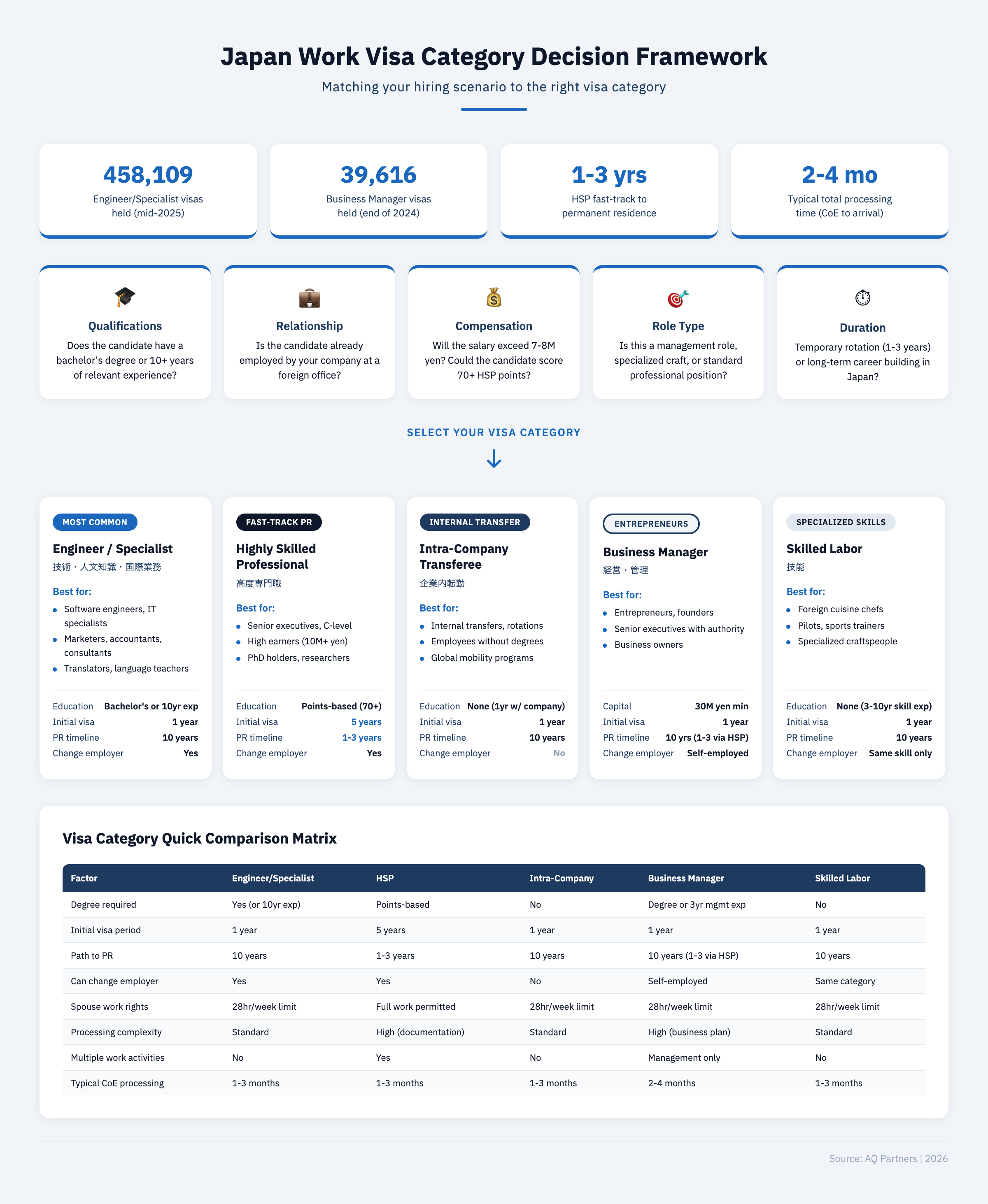
Selecting the right visa category comes down to five factors: the candidate's qualifications, your company structure, salary level, the role type, and whether this is a short-term rotation or long-term career move.
Selecting the right visa category requires analyzing multiple factors specific to each hiring situation.
Educational background vs. experience: Candidates with bachelor's degrees or higher in relevant fields naturally fit Engineer/Specialist category. Those with extensive experience but no degree should explore the experience pathway (10 years for most, 3 years for IT). Candidates with neither should consider whether Intra-Company Transferee (if already employed by your foreign office) or Skilled Labor (for specific technical skills) applies.
Company structure: New hires from outside your organization typically require Engineer/Specialist or Business Manager visas. Existing employees from foreign offices can use Intra-Company Transferee, which often processes faster and doesn't require specific educational credentials.
Salary level and HSP eligibility: Calculate HSP points for any candidate earning above 7-8 million yen annually. The benefits of HSP status—particularly fast-track permanent residence—make it worth the additional documentation effort for qualifying candidates.
Long-term career plans in Japan: Employees planning 2-3 year rotations before returning home may prefer Intra-Company Transferee simplicity. Those building long-term Japan careers benefit from Engineer/Specialist or HSP status with clearer paths to permanent residence and career flexibility. Understanding the full landscape of your Japan market entry helps align visa strategies with business objectives.
Visa Category Comparison Table
| Factor | Engineer/Specialist | HSP | Intra-Company | Business Manager | Skilled Labor | SSW | Dependent |
|---|---|---|---|---|---|---|---|
| Education Required | Bachelor's or 10yr exp | Points-based (70+) | No (1yr w/ company) | Degree or 3yr mgmt exp | No (3-10yr skill exp) | Skills exam + JLPT N4+ | N/A |
| Initial Visa Period | 1 year | 5 years | 1 year | 1 year | 1 year | 1 year (T1) / 3yr (T2) | Matches primary |
| Path to PR | 10 years | 1-3 years | 10 years | 10 yrs (1-3 via HSP) | 10 years | T1: No / T2: 10 years | Via primary or own visa |
| Change Employer | Yes | Yes | No | Self-employed | Same category | Same field | 28hr/week w/ permission |
| Spouse Work Rights | 28hr/week limit | Full work permitted | 28hr/week limit | 28hr/week limit | 28hr/week limit | T1: No family / T2: Yes | N/A |
| Processing Complexity | Standard | High (documentation) | Standard | High (business plan) | Standard | Moderate (exams req) | Low |
| Multiple Work Activities | No | Yes | No | Management only | No | Designated field only | With permission |
| Typical Processing Time | 1-3 months (CoE) | 1-3 months (CoE) | 1-3 months (CoE) | 2-4 months (CoE) | 1-3 months (CoE) | 1-3 months (CoE) | 1-3 months (CoE) |
Scroll horizontally to view all columns on mobile devices. Source: Immigration Services Agency of Japan, compiled by AQ Partners (2026).
When to Consult Immigration Specialists
Professional immigration guidance adds value in specific circumstances.
Complex cases requiring expert guidance:
- Candidates with educational credentials from countries with difficult-to-verify documentation
- Degree fields that don't obviously align with job duties, requiring careful explanation
- Previous visa denials or immigration violations that need addressing
- Business Manager applications for new businesses without operating history
- HSP applications near the 70-point threshold where point optimization matters
- Companies sponsoring their first work visas without internal expertise
Cost vs. benefit considerations: Immigration lawyer fees typically range from 100,000-300,000 yen per initial application and 50,000-150,000 yen for renewals. For straightforward Engineer/Specialist cases with clearly qualified candidates, many companies handle applications internally. For complex cases, previous denials, or high-value positions, professional guidance often pays for itself by avoiding delays and rejections. The ISA's procedural guidelines for work visa applications (moj.go.jp) provide the foundational requirements that both applicants and legal professionals reference.
Well-established companies with HR teams experienced in immigration may handle most applications in-house, using specialists only for unusually complex cases. Smaller companies or those new to hiring foreign talent benefit from specialist guidance initially, then gradually building internal capability.
Conclusion
Choosing the right work visa category shapes your entire hiring timeline, costs, and long-term workforce strategy in Japan. Engineer/Specialist visas serve the vast majority of professional hiring needs with their flexibility and broad coverage — with 458,109 holders as of mid-2025, it remains the dominant category for a reason. Highly Skilled Professional status offers compelling benefits for qualified senior talent through accelerated permanent residence and extended privileges. Intra-Company Transferee visas enable efficient global mobility within corporate groups. Business Manager visas support entrepreneurship and senior executive hiring, though the October 2025 reforms require careful attention to the strengthened requirements. Skilled Labor visas fill specific technical roles requiring hands-on expertise.
Strategic visa selection considers not just immediate eligibility but long-term implications—permanent residence pathways, career flexibility, renewal burden, and employee retention. With Certificate of Eligibility processing typically taking 1-3 months and the total visa timeline running 2-4 months from application to arrival, planning ahead is essential. The investment in understanding these categories and choosing appropriately pays dividends through smoother immigration processes, better talent attraction, and reduced compliance risk.
For deeper guidance on specific aspects of the visa process, explore our related resources including the entity structuring strategy for Japan entry and our complete guide to Japan work visas.
Working with AQ Partners. Our Tokyo team provides KK and GK incorporation, rules of employment, employment contracts and offer letters and monthly payroll coordination with a licensed sharoushi for foreign companies operating in Japan, so the entity and payroll that support the application are in order. Book a consultation to discuss your situation.

Yuga Koda is a founding Director at AQ Partners, supporting foreign companies, funds, and families operating in Japan. His experience operating companies in both Japan and international markets gives him a practical understanding of back office operations from both sides.