
Transitioning Japan Payroll and Accounting Between Providers Without a Compliance Gap

Switching accounting or payroll providers in Japan means moving a subsidiary's books, payroll records, filing authority, and government-facing registrations from one firm to another without missing a statutory deadline. The risk is not the ledger, which exports cleanly; it is everything around it. A zeirishi (税理士, certified public tax accountant) must hold written authority before filing for the company, a sharoushi (社会保険労務士, labour and social security attorney) handles the social and labour insurance filings, and Japan's payroll year contains two heavy seasons in which a handover is likely to break something. This guide sets out what has to move, when payroll and accounting can each move safely, how to run an overlap month, and which contract terms decide whether the outgoing provider cooperates. It is written for the headquarters controller or regional finance lead managing the switch.
Key Takeaways
- Move accounting after a return, not before. Accounting should move only after the corporate tax return for the last full fiscal year has been filed, so one zeirishi owns that year from close to filing.
- Payroll has two windows. February to April and August to September are the quiet periods. October to January and May to July carry the year-end adjustment, statutory reports, residential tax notices, the labour insurance renewal, and the standard remuneration report.
- Authority does not transfer with the files. The incoming zeirishi needs its own written tax proxy authority, and the incoming sharoushi needs the company's insurance office numbers and records before it can file anything.
- One overlap month pays for itself. Running the last cycle with the outgoing provider while the incoming one shadows it costs one month of fees and exposes data gaps before they become late filings.
- The exit clause decides cooperation. A contract that names the handover deliverables, the format, and the fee gives the outgoing provider a defined job; without one, the handover depends on goodwill.
What a Japan Provider Transition Actually Has to Move
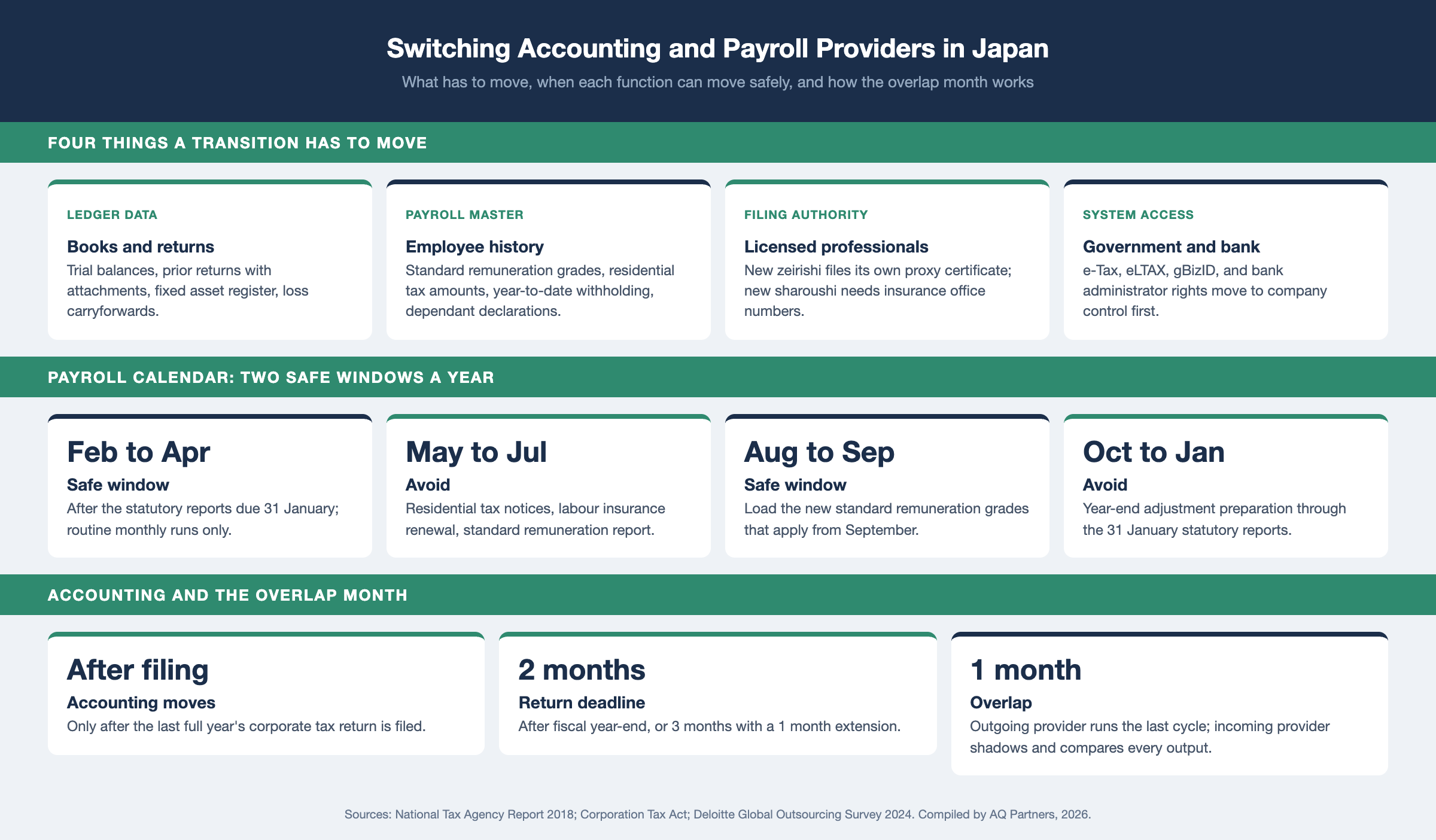
A Japan provider switch moves four things: ledger data, payroll master data, filing authority, and access to government and bank systems.
Headquarters teams usually plan for the first item and underestimate the other three. Ledger data and trial balances export from any accounting system. Payroll master data is harder because it carries history: each employee's standard remuneration grade, dependant declarations, residential tax amounts set by the municipality, and year-to-date withholding. Filing authority is personal to the licensed professional. Under Article 30 of the Certified Public Tax Accountant Act, a zeirishi files a written certificate of tax proxy authority, and the National Tax Agency's 2018 report on certified public tax accountants notes that tax proxy, preparation of tax documents, and tax consultation are reserved for the 77,327 zeirishi registered at that time. Access covers e-Tax, eLTAX, the gBizID account used for e-Gov filings, and bank administrator rights, any of which may sit with the outgoing provider rather than the company.
| Item | Why it does not move on its own | Who acts |
|---|---|---|
| Tax filing authority | Each zeirishi files its own written proxy certificate; the outgoing firm's authority does not pass to the new one | Incoming zeirishi, with the company's signature |
| Prior returns and attachments | The incoming zeirishi needs them to carry forward losses, depreciation, and tax balances | Outgoing provider supplies; company confirms completeness |
| Social and labour insurance office numbers | The incoming sharoushi cannot file enrolments or changes without them | Company supplies; outgoing sharoushi confirms |
| Standard remuneration grades | Grades set by the annual report and by change filings drive monthly deductions | Outgoing payroll provider exports with effective dates |
| Residential tax amounts | Municipalities set each employee's annual amount and notify the employer, not the provider | Company forwards; incoming provider loads |
| Year-to-date payroll and withholding | The year-end adjustment needs the full calendar year for every employee | Outgoing payroll provider exports by employee |
| Dependant declarations and Individual Numbers | Needed for withholding and the year-end adjustment; access is restricted | The company or its sharoushi transfers under its own data controls |
| e-Tax, eLTAX, and gBizID access | Accounts may be registered to the outgoing provider's staff | Company takes administrator control, then grants the new provider access |
Every row has an owner on the company side. That is deliberate: a transition goes wrong when the company assumes the two providers will talk to each other directly and neither has a reason to.
When to Switch Payroll Providers in Japan
Switch Japan payroll between February and April or in August and September, and avoid October to January and May to July.
The Japanese payroll year has two concentrated seasons. The first runs from October, when year-end adjustment (年末調整, nenmatsu chosei) preparation starts with employee declarations, through the adjustment in the final payroll of the year and the statutory reports and withholding slips due 31 January. The second runs from May, when municipalities issue residential tax notices for the year starting with the June payroll, through the labour insurance renewal in June and early July and the standard remuneration report in July. A provider that changes hands in either season either splits a single annual process between two firms or starts on the hardest month of the year.
| Month | Payroll events | Switch? |
|---|---|---|
| January | Statutory reports and withholding slips due 31 January | Avoid |
| February to April | No annual filings; routine monthly runs | Safe window |
| May | Municipalities issue residential tax notices for the new year | Avoid |
| June | New residential tax amounts start; labour insurance renewal opens | Avoid |
| July | Labour insurance renewal closes; standard remuneration report due | Avoid |
| August to September | New standard remuneration grades apply from September | Safe window, with grades loaded |
| October to November | Year-end adjustment preparation; employee declarations collected | Avoid |
| December | Year-end adjustment in the final payroll | Avoid |
A September switch needs one extra check: the incoming provider must load the new standard remuneration grades that take effect that month, which the outgoing provider calculated from the July report. Monthly obligations continue throughout, so the cut-over plan should also name who remits withholding tax by the 10th of the following month for the last payroll run under the outgoing provider. Broader payroll set-up steps are covered in setting up payroll in Japan.
When to Switch Accounting Providers in Japan
Move Japan accounting only after the last full year's corporate tax return is filed, so one zeirishi owns that year from close to filing.
The corporate tax return is built on the approved financial statements and is due 2 months after the fiscal year-end, or 3 months where the company has a 1 month extension. If the provider changes between the year-end and the filing, the incoming firm prepares a return on books it did not keep, and the outgoing firm closed a year it will not file. Either can work in theory; in practice, questions about year-end entries go unanswered. Moving after the filing gives the incoming provider a clean opening balance: the filed return, the approved accounts, and a closed year.
Within the year, the cleanest cut-over point is a month-end after that filing, with the outgoing provider completing the last month's close and the incoming provider posting from the following month. Opening balances should be agreed in writing against the outgoing provider's trial balance, including fixed asset and depreciation registers, which carry forward into the next return. The headquarters reporting calendar should be checked against the cut-over month so the first group package from the new provider is not also its first close.
Running the Overlap Month
An overlap month has the outgoing provider run its last cycle while the incoming provider shadows it and compares every output.
In payroll, the incoming provider runs a parallel calculation for the same month from the data it has received, and the two results are compared employee by employee before the outgoing provider pays. Differences point to missing data: a standard remuneration grade, an allowance, a residential tax amount, or a dependant change. In accounting, the incoming provider reviews the outgoing provider's month-end close and posts nothing until the opening balances are agreed. The overlap month adds one month of fees for the incoming provider and removes the most common cause of a late or wrong filing after a switch.
Demand for outsourced operations makes the overlap more important, not less. According to Deloitte's Global Outsourcing Survey 2024, 80% of more than 500 executives plan to maintain or increase third-party outsourcing, while 70% say their vendor management function is not fully mature. A transition is where that maturity gap shows. Payroll handover risks are covered in more depth in payroll compliance risks for foreign companies in Japan.
Notice Periods and Exit Terms That Decide a Japan Transition
The outgoing contract's notice period and exit terms set the latest date to give notice and what the outgoing provider must hand over.
Work backwards from the target window. A payroll switch planned for April with a three-month notice period needs notice given in January, during the busiest payroll month, which is a reason to agree the plan with the outgoing provider in December. The contract should state the handover deliverables, the export format, the fee for the handover work, and the date by which the outgoing provider completes it. Where the existing contract is silent, a short handover letter agreed at the time of notice achieves the same result.
The licensed professionals need separate attention. The outgoing zeirishi and sharoushi may be partners of the provider rather than employees, with their own engagement letters. With roughly 40,000 sharoushi nationally according to the Japan Federation of Labor and Social Security Attorney's Associations, finding a new one is straightforward; making sure the old one has filed everything pending is not. Ask both for a written list of filings submitted and filings outstanding at the notice date. The questions to ask a new provider before signing, including its own exit terms, are in how to choose a back-office provider for your Japan subsidiary.
Frequently Asked Questions
Can payroll and accounting move to a new provider at the same time?
They can, but the safe windows rarely line up. Accounting should move after the last full year's corporate tax return is filed, and payroll in February to April or August to September. For a March year-end company, the return is filed by the end of May or June, which falls in the payroll season to avoid, so the two usually move a few months apart.
Does the new zeirishi need anything from the old one?
Yes. The incoming zeirishi needs prior returns with all attachments, the approved financial statements, the fixed asset register, and details of any loss carryforwards or open tax office queries. It files its own written proxy authority; the outgoing firm's authority does not transfer.
Who handles employees' Individual Numbers during a switch?
The company or its sharoushi. Individual Number (マイナンバー, My Number) data is needed for withholding and social insurance filings and is subject to strict handling rules, so it should move under the company's own data controls rather than as part of a general file export.
Working with AQ Partners. Our Tokyo team provides back office operations for foreign companies operating in Japan, including accounting transition from an existing provider, payroll software setup and transition, and monthly payroll coordination with a licensed sharoushi. Book a consultation to plan your provider transition.

Yuga Koda is a founding Director at AQ Partners, supporting foreign companies, funds, and families operating in Japan. His experience operating companies in both Japan and international markets gives him a practical understanding of back office operations from both sides.