
Japan Regional Headquarters Incentives Explained

A regional headquarters in Japan, in the sense Japanese law uses, is a company that holds majorities in group companies in two or more countries and sets their business policy. Two national incentive schemes target it. The Asian Business Center Act (Act No. 55 of 2012) gives a certified new HQ or R&D company faster procedures and an equity financing route, with no tax relief.
The office tax incentive gives a credit or special depreciation on owned office buildings in designated areas. For the wider set-up sequence, see our headquarters playbook for setting up a Japan subsidiary.
Key Takeaways
- The Asian Business Center Act has no tax measure. The Act itself provides a shorter FEFTA waiting period and an equity financing route; JETRO lists two administrative measures on top.
- Certification is for new set-ups only. A group whose company already runs the same HQ or R&D business in Japan is excluded (Act Arts. 4 and 6).
- The HQ test is demanding. A new company with capital of 100 million yen or more and, over a five-year plan, 10 staff rising to 18 and payroll of 70 million yen rising to 130 million yen.
- The office tax incentive needs an owned building in a designated area. It covers buildings acquired for at least 45 million yen, not leased floors, after the governor certifies the plan.
- Neither normally decides the location. They reduce friction or cost once Japan is chosen.
Which Incentives Apply to a Regional Headquarters in Japan
Two programs name regional headquarters directly: Asian Business Center Act certification and the office tax incentive. General measures such as the R&D tax credit apply with no certification. The JETRO list of government incentives summarizes all of them.
| Measure | What it gives | Condition that usually decides it | Open to new applicants | Basis |
|---|---|---|---|---|
| Asian Business Center Act: HQ plan | FEFTA wait of 2 weeks instead of 30 days; equity financing; faster Certificates of Eligibility | New company; group majorities in 2+ countries; capital 100 million yen or more | Yes | Act Arts. 6, 8 and 9; JETRO |
| Asian Business Center Act: R&D plan | Same measures, plus accelerated patent examination | R&D and development costs above 100 million yen every business year | Yes | Act Art. 4; R&D ordinance Art. 1; patent fast track by the Japan Patent Office, listed by JETRO |
| Office tax incentive: expansion type | 15% special depreciation or 4% tax credit on the building | Owned building in a prefecture-designated area; plan certified first | Yes, if certified by the end of fiscal year 2027 | Special Taxation Measures Act Art. 42-12; Cabinet Office |
| Office tax incentive: relocation type | 25% special depreciation or 7% tax credit | HQ functions moved out of Tokyo's 23 wards | Yes, same deadline | Special Taxation Measures Act Art. 42-12; Cabinet Office |
| Office tax incentive: uplift tier | 8% credit (relocation) or 5% (expansion); or 25% or 20% special depreciation | Large company: investment of 1 billion yen or more and 60 or more added employees at the facility; SME: 20 or more added employees | Yes, same deadline | Cabinet Office; rates in Special Taxation Measures Act Art. 42-12 |
| Employment promotion credit | Merged into the uplift tier for new plans, with transitional rules | None for new plans | No | Cabinet Office |
| R&D tax credit | Credit of 1% to 14% of eligible R&D costs, capped at 25% of corporate tax | Eligible R&D spending | Yes, no certification | METI, listed by JETRO |
What the Asian Business Center Act Offers Today
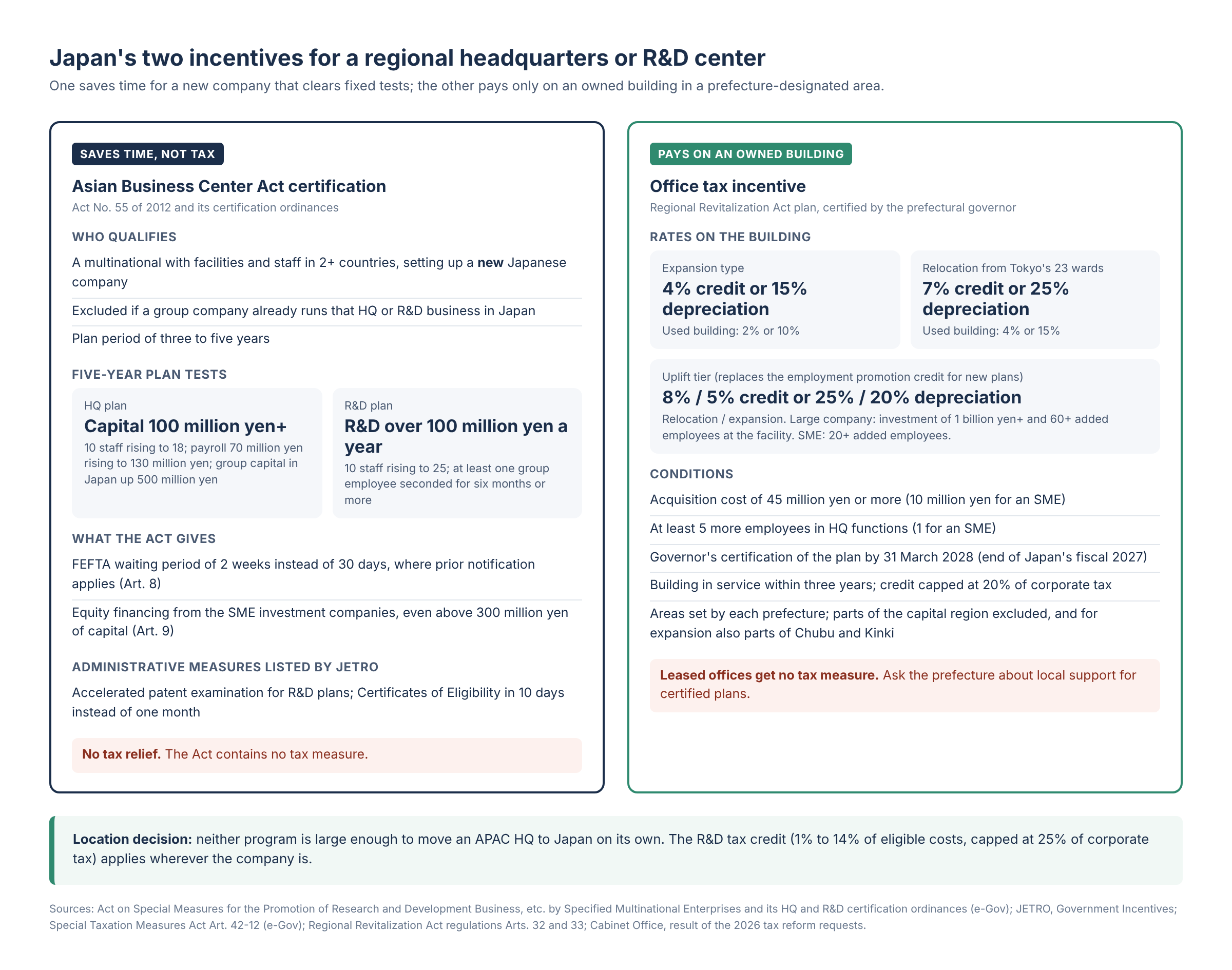
The Asian Business Center Act itself gives a certified new HQ or R&D company two measures: a shorter FEFTA waiting period and an equity financing route. JETRO lists two administrative measures on top: accelerated patent examination and faster Certificates of Eligibility.
The Act on Special Measures for the Promotion of Research and Development Business, etc. by Specified Multinational Enterprises provides:
- FEFTA waiting period. Where the share acquisition needs prior notification, Article 8 replaces the 30-day waiting period in FEFTA Article 27(2) with two weeks.
- Equity financing. Article 9 lets the Small and Medium Business Investment and Consultation companies invest in a certified company inside the Act's SME definition even above 300 million yen of capital.
The administrative measures JETRO lists:
- Patent examination. The Japan Patent Office's accelerated examination covers patent applications from a certified R&D plan.
- Certificates of Eligibility. Faster screening for foreign staff of the new company, from one month to 10 days.
Who Qualifies: The Certification Tests for an HQ or R&D Plan
Certification goes to a multinational with facilities and staff in two or more countries that sets up a new Japanese company for HQ or R&D work. The plan must meet fixed staff, payroll or spending tests over three to five years.
The group needs a substantial track record outside Japan in R&D or HQ business, including through its subsidiaries (Enforcement Regulations Art. 3). The tests below come from the ordinance on HQ plan certification and the matching R&D ordinance.
| Test | HQ plan | R&D plan |
|---|---|---|
| What the Japanese company does | Holds majorities in 2+ companies in 2+ countries and sets their business policy | Research and development of advanced industrial technology |
| Company (ordinance Art. 1) | New company with capital of 100 million yen or more | New company; no capital minimum |
| Money test (ordinance Art. 1) | Group capital in Japanese companies up 500 million yen over a five-year plan | R&D and development costs above 100 million yen every business year |
| Regular staff (ordinances) | 10, rising to 18 in the final year of a five-year plan | 10, rising to 25 in the final year of a five-year plan |
| Payroll (HQ ordinance Art. 5) | 70 million yen a year, 130 million yen in the final year | No payroll test |
| Group staff in Japan | No requirement | At least one group employee seconded for six months or more |
| Plan period | Three to five years | Three to five years |
| Excluded if | A group company already runs that HQ business in Japan | A group company already runs that R&D business in Japan |
A three-year HQ plan needs 14 staff, 100 million yen of payroll and a 300 million yen capital increase by its final year.
Why the Act's FEFTA and Financing Benefits Are Narrow
The FEFTA benefit matters only when the investment needs prior notification, and the financing route only for a company inside the Act's SME definition. Outside the designated sectors, the investor in most cases files a post-investment report, with no waiting period.
Our article on FEFTA prior notification and post-investment reports explains the split. Even then, FEFTA Article 27(2) already lets the ministries shorten the wait, and Article 27(3) lets them extend it for a national security review.
The financing route turns on the SME definition in Act Art. 2(5), set by capital or headcount for each industry. The route gives an equity investor, not a grant.
The Office Tax Incentive: Rates, Thresholds and the Certification Deadline
The office tax incentive gives a tax credit or special depreciation on an owned office, research or training building for HQ functions. The prefectural governor must certify the plan by the end of Japan's fiscal year 2027 (1 April 2027 to 31 March of the next year).
The terms come from Special Taxation Measures Act Article 42-12 and the Cabinet Office summary of the 2026 tax reform result:
- Rates. Under Article 42-12, the expansion type gets 15% special depreciation or a 4% credit; relocation from Tokyo's 23 wards 25% or 7%. Purchase or renovation of a used building gets 10% or 2% (expansion) and 15% or 4% (relocation).
- Uplift. Per the Cabinet Office summary of the Cabinet Order, a large company that invests 1 billion yen or more and adds 60 or more employees at the facility (20 for an SME) gets an 8% credit for relocation or 5% for expansion, or special depreciation of 25% or 20%. The employment promotion credit was folded into this tier.
- Size. Per the Cabinet Office summary and Article 42-12, acquisition cost must be 45 million yen or more (10 million yen for an SME), eligible cost is capped at 8 billion yen, and the credit at 20% of corporate tax for the year.
- Jobs. The plan must add at least 5 regular employees in HQ functions (1 for an SME) (Regional Revitalization Act regulations, Arts. 32 and 33), with no departures for the employer's reasons from certification to the end of the year the building enters service.
- Timing. The building must be in service within three years of certification.
Each prefecture's regional revitalization plan sets the eligible areas. The relocation type excludes part of the capital region; the expansion type excludes parts of the capital, Chubu and Kinki regions.
Beyond tax, the Cabinet Office lists local property tax reductions and regional revitalization grants for certified plans; ask the prefecture which support covers a lease. Our guide to choosing and leasing a Japan office covers the lease side.
Back-Office Consequences of Meeting the Act's Thresholds
An HQ plan sets capital, headcount and payroll targets for up to five years, which can be changed only with the ministers' approval (Act Art. 7), and adds an annual report.
- Registration tax. A KK pays 0.7% of capital on incorporation (NTA Taxation Answer No. 7191), so 100 million yen of capital costs 700,000 yen in tax. Increases are taxed the same way; see our capital increase and reduction guide.
- Corporate tax size. Any increase in stated capital takes it above 100 million yen, which ends SME corporate tax treatment, caps loss deductions at half of income and brings pro forma enterprise tax, according to JETRO's guide to Japanese corporate taxes. A subsidiary wholly owned by a company with capital of 500 million yen or more is outside SME treatment anyway.
- Audit. If a KK's capital reaches 500 million yen or more, or its liabilities 20 billion yen or more, it becomes a large company that must appoint an accounting auditor (Companies Act Arts. 2(vi) and 328). This KK rule does not apply to a GK; see which audits a Japan subsidiary faces.
- Reporting. A certified company reports progress for each business year with its financial statements, normally within three months of its year end (HQ ordinance Art. 10). Ignoring a report the ministers request, or reporting falsely, carries a fine of up to 300,000 yen (Act Arts. 12 and 14).
Do the Incentives Change the Location Decision?
For most groups, no: neither program is large enough to move an APAC HQ to Japan on its own, but both help once Japan is chosen.
The Act saves weeks, not money. The office tax incentive is real money but excludes a leased office. The decision rests on where the leadership, customers and talent are, and on the running cost of the entity, which our Japan, Singapore and Hong Kong back-office cost comparison sets out.
FAQ
Can our existing Japan subsidiary become the certified regional headquarters?
Not as it stands, because the Act certifies a plan to set up a new Japanese company. An existing Japan sales company with no HQ role should not in principle block certification, but the ministers decide whether its business is the same HQ business.
How long does certification under the Asian Business Center Act take?
The Act and ordinances set no review period. Applications go through the Ministry of Economy, Trade and Industry to the responsible ministers, so build time for questions into the incorporation plan.
Can we combine the office tax incentive with the R&D tax credit?
They cover different costs, the building and research spending, so one company can claim both if it meets each set of conditions. Each is claimed on the corporate tax return: the office credit applies only if the return attaches a statement of the building's acquisition cost and the credit calculation (Special Taxation Measures Act Art. 42-12(6)).
Working with AQ Partners. Our Tokyo team provides KK and GK incorporation, capital increase registration, monthly bookkeeping and annual tax filings for foreign companies operating in Japan. Book a consultation to review your Japan setup plan.

Yuga Koda is a founding Director at AQ Partners, supporting foreign companies, funds, and families operating in Japan. His experience operating companies in both Japan and international markets gives him a practical understanding of back office operations from both sides.