
Paid Leave, Childcare Leave, and Harassment Obligations in Japan Compared with US and UK Policies


Japan's leave and harassment obligations are the statutory minimums a Japanese employer must provide for annual paid leave, leave around childbirth and childcare, and the prevention of workplace harassment. For a multinational bringing a US or UK leave policy to its first Japan hires, the three systems start from different places: the United States sets no federal minimum for paid vacation, the United Kingdom sets a fixed 28-day minimum, and Japan sets an entitlement that grows with service and requires the employer to make sure part of it is taken. This guide compares the statutory minimums only, not company policies, and sets out what a group leave and conduct policy has to change before it can apply to employees in Japan.
Key Takeaways
- Japan's paid leave grows with service. The Labor Standards Act grants 10 days after 6 months of continuous service with at least 80% attendance, rising to 20 days after six and a half years.
- The employer must make five days happen. For every employee entitled to 10 or more days, the employer must ensure 5 days are taken each year, designating the dates itself if the employee has not taken them.
- The US and UK baselines are far apart. US federal law requires no paid vacation, while UK law sets 28 days, or 5.6 weeks, for a five-day week. A US group policy is likely to need the most change for Japan, because US federal law sets no paid leave minimum.
- Childcare leave runs to the child's first birthday and beyond. Japan guarantees childcare leave until the child turns one, extendable to two in set cases, plus up to four weeks of childcare leave at birth for fathers within eight weeks of the birth.
- Harassment prevention is a statutory duty. Japanese employers must take measures in employment management to prevent power harassment, sexual harassment, and harassment related to pregnancy and childcare, not only respond to complaints.
Annual Paid Leave in Japan Compared with US and UK Minimums
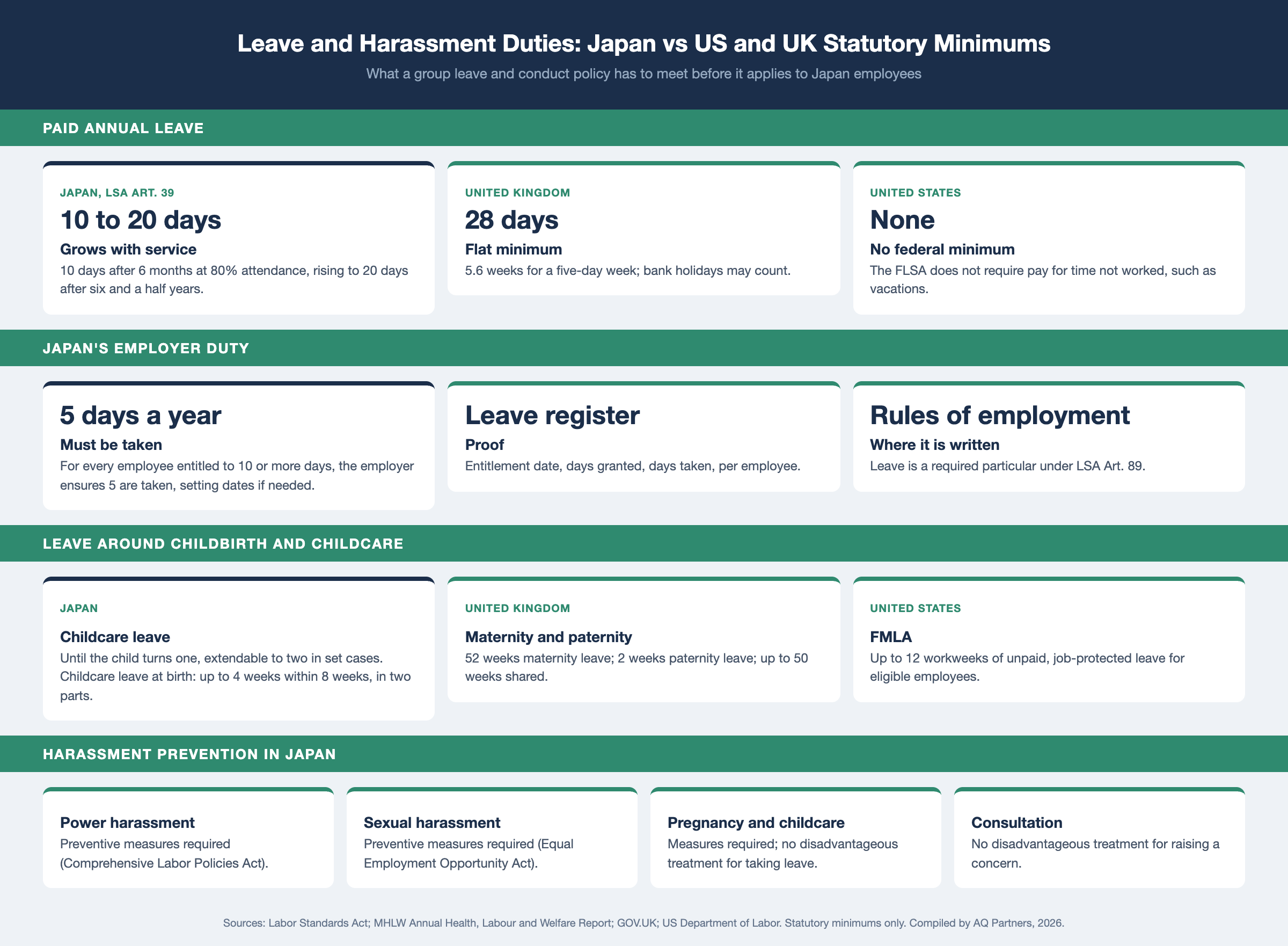
Japan grants 10 days of paid leave after 6 months at 80% attendance, rising to 20; the UK sets 28 days; US federal law sets no minimum.
Annual paid leave (年次有給休暇, nenji yukyu kyuka) is set by Article 39 of the Labor Standards Act. An employee who has worked continuously for 6 months and reported for work on at least 80% of working days must receive 10 days of paid leave. The entitlement then grows with each year of service, reaching 20 days after six and a half years. Part-time employees receive a proportional entitlement.
The United Kingdom sets a flat minimum instead. According to GOV.UK's holiday entitlement guidance, almost all workers are entitled to at least 28 days of paid annual leave a year, the equivalent of 5.6 weeks for a five-day week, and employers may count bank holidays within it. The United States has no federal equivalent: according to the US Department of Labor, the Fair Labor Standards Act does not require payment for time not worked, such as vacations, sick leave, or holidays, so paid vacation is a matter of company policy and any state or local law.
| Statutory minimum | Japan | United States (federal) | United Kingdom |
|---|---|---|---|
| Paid annual leave | 10 days after 6 months with 80% attendance | None required under the Fair Labor Standards Act | 28 days (5.6 weeks for a five-day week) |
| Growth with service | Rises to 20 days after six and a half years | Not applicable | Statutory entitlement capped at 28 days |
| Employer duty to ensure leave is taken | 5 days a year for employees entitled to 10 or more days | Not applicable | Not compared in this table |
| Leave around childbirth for the mother | 6 weeks before birth on request (14 for multiple births); no work for 8 weeks after birth, with work from 6 weeks if she requests it and a doctor approves | Up to 12 workweeks of unpaid, job-protected leave under the FMLA for eligible employees | 52 weeks of Statutory Maternity Leave, with 2 weeks compulsory after birth (4 in a factory) |
| Leave for the other parent at birth | Childcare leave at birth: up to 4 weeks within 8 weeks of the birth, in up to two parts | Within the same FMLA entitlement | 2 weeks of Paternity Leave |
| Longer parental leave | Childcare leave until the child turns one, extendable to two in set cases | Within the same FMLA entitlement | Shared Parental Leave of up to 50 weeks, with up to 37 weeks of pay |
| Who pays during childcare leave | Employment insurance benefits, not the employer's payroll | FMLA leave is unpaid | Statutory pay schemes for eligible employees |
The Employer's Duty to Make Japan Employees Take Five Days of Paid Leave
A Japanese employer must ensure each employee entitled to 10 or more days of paid leave takes 5 of them a year, setting the dates if needed.
Article 39(7) of the Labor Standards Act turns part of the paid leave entitlement into an employer obligation. For every employee who is granted 10 or more days, the employer must grant 5 days within one year of the date the entitlement arises, at timing the employer sets. Days the employee takes at their own request, or under a planned leave agreement with a workforce representative, count toward the 5. A group policy that treats unused leave purely as the employee's choice does not meet it.
Three consequences follow for a group policy. First, the subsidiary needs a leave register that shows, for each employee, the date the entitlement arose, the days granted, and the days taken, so that shortfalls are visible before the year ends. Second, the method of designating dates when an employee has not taken leave belongs in the rules of employment, because leave is one of the particulars Article 89 requires those rules to cover. Third, an "unlimited leave" policy still needs the statutory minimum written into the Japan documents. The wider set of HR record-keeping obligations is covered in HR administration in Japan: employer obligations.
Childcare Leave and Childcare Leave at Birth in Japan
Japan guarantees childcare leave until a child turns one, extendable to two in set cases, plus up to four weeks of leave at birth for fathers.
Childcare leave (育児休業, ikuji kyugyo) is set by the Child Care and Family Care Leave Act. According to the Ministry of Health, Labour and Welfare's Annual Health, Labour and Welfare Report, the Act guarantees the right to take childcare leave until the child reaches one year old, and up to two years old in certain cases, such as when the child cannot be enrolled in a nursery. Where both parents take childcare leave, it can extend to the period before the child reaches one year and two months. As a rule, the leave can be split and taken in two periods before the child's first birthday.
Childcare leave at birth (出生時育児休業, shusshoji ikuji kyugyo), introduced for fathers, is a separate right: up to four weeks within eight weeks after the birth, which can be split into two periods and taken separately from ordinary childcare leave. The same Act provides family care leave of up to 93 days per family member, in up to three periods. During childcare leave, the employer is not required to pay wages; the employee may instead receive benefits from employment insurance, described in employment insurance in Japan.
The Act also prohibits disadvantageous treatment, including dismissal, because an employee took or requested childcare leave. A group parental leave policy that offers paid weeks on top of the statutory scheme can still apply in Japan, alongside the statutory right rather than in place of it.
Harassment Prevention Duties for Employers in Japan
Japanese law requires employers to take preventive measures against power, sexual, and pregnancy or childcare harassment, not only to respond.
Three statutes set the duties. The Act on Comprehensive Promotion of Labor Policies, Articles 30-2 and 30-3, obliges employers to take the necessary employment management measures to prevent power harassment (パワーハラスメント, pawahara) in the workplace. The Equal Employment Opportunity Act, Articles 11 and 11-2, does the same for sexual harassment. The Child Care and Family Care Leave Act and the Equal Employment Opportunity Act require measures against harassment related to pregnancy, childbirth, and childcare leave. Each of these statutes also prohibits disadvantageous treatment of an employee who consults the employer about harassment, according to the same Ministry of Health, Labour and Welfare report.
A group code of conduct and a global hotline are a useful base, but the Japan entity also needs a stated policy in Japanese, a consultation point that Japan employees can actually use, a defined response process, and protection for employees who raise concerns. The Equal Employment Opportunity Act adds a specific protection: dismissal of a woman who is pregnant or within one year after childbirth is void unless the employer proves the dismissal was not because of the pregnancy or childbirth. How these duties fit the wider compliance picture for a foreign-owned employer is covered in Japan HR compliance strategies for global teams.
Localizing a Group Leave and Conduct Policy for Japan
A group leave and conduct policy works in Japan once statutory minimums, the five-day duty, and harassment measures are written into local documents.
The group policy has to be checked against the Japanese minimums and carried into the documents that bind the Japan entity: the employment contract, and the rules of employment (就業規則, shugyo kisoku), which an employer that continuously employs 10 or more workers must draw up and file under Article 89 of the Labor Standards Act. The full clause-by-clause approach for contracts, handbooks, pay, and termination is set out in localizing group employment policies for Japan, and the contract terms that must be stated in writing are covered in employment contracts and labor rules in Japan.
The checks that most often change a US or UK leave and conduct policy are these:
- Accrual and qualifying period. Replace a group accrual formula with the Japanese 6-month qualifying period, the 80% attendance condition, and the service-based scale, or confirm the group policy is more generous at every step.
- Use-it-or-lose-it rules. Remove any rule that would let the five statutory days go unused, and add the method for designating dates.
- Unlimited or discretionary leave. State the statutory minimum alongside it, with a register that proves the minimum was granted and taken.
- Parental leave. Keep group enhancements, but describe the statutory childcare leave and childcare leave at birth as rights, with the request process.
- Harassment. Add a Japanese-language policy, a local consultation point, and the protection against disadvantageous treatment.
Frequently Asked Questions
How much paid leave must a Japan employee receive?
Under Article 39 of the Labor Standards Act, an employee who has worked continuously for 6 months with at least 80% attendance must receive 10 days of paid leave. The entitlement increases with service to 20 days after six and a half years. The employer must also ensure that employees entitled to 10 or more days take at least 5 days each year.
Can a US unlimited vacation policy apply to Japan employees?
It can sit alongside Japanese law, but it cannot replace the statutory minimum. The employer still has to grant the Article 39 entitlement, ensure 5 days are taken by each employee entitled to 10 or more, and keep records that show it. The minimum and the method for designating leave dates belong in the Japan rules of employment.
Working with AQ Partners. Our Tokyo team provides back office operations for foreign companies operating in Japan, including rules of employment, employment contracts and offer letters, and payroll coordination with a licensed sharoushi, covering leave and benefit applications. Book a consultation to discuss your Japan employment documents.

Yuga Koda is a founding Director at AQ Partners, supporting foreign companies, funds, and families operating in Japan. His experience operating companies in both Japan and international markets gives him a practical understanding of back office operations from both sides.