
Employment Insurance in Japan (Koyou Hoken): Rates, Benefits & Eligibility

Employment insurance in Japan (雇用保険, koyou hoken) provides unemployment benefits, childcare and nursing care leave payments, and education training subsidies for employees who lose their jobs or take extended leave. Every employee working 20 or more hours per week with an expected employment duration of 31 days or more must be enrolled, regardless of nationality, visa type, or company size. The employer registers with the local Hello Work (公共職業安定所) office and pays a combined contribution rate of 1.35% of total payroll in general industries—split between employer (0.85%) and employee (0.5%) for FY2026. For foreign companies operating in Japan, employment insurance enrollment is a separate and parallel obligation to health insurance and pension, filed with a different agency and subject to different deadlines.
Key Takeaways
- All employees working 20+ hours per week must be enrolled—the threshold is 20 hours per week with expected employment of 31 days or more, with no exemptions based on nationality, visa status, or company size. Part-time and contract workers meeting these criteria are covered.
- The employer contribution rate is 0.85% of total payroll for general industries in FY2026—the employee pays 0.5%, bringing the combined rate to 1.35%. Construction and agriculture industries have higher rates. Contributions are calculated on actual gross payroll, not Standard Monthly Remuneration.
- Unemployment benefits replace 50–80% of daily wages for 90 to 330 days—the replacement rate is inversely related to salary level, with lower-wage workers receiving a higher percentage. Benefit duration depends on the reason for separation, age, and years of contribution.
- Childcare leave benefits pay 67% of wages for the first 180 days—employment insurance funds childcare leave benefits at 67% for six months, then 50% thereafter, while health insurance and pension contributions are fully waived during leave.
- Registration is filed with Hello Work, separate from health insurance and pension—the Employment Insurance Establishment Report is submitted to the local Hello Work office within 10 days of the first employee's start date, and individual Qualification Acquisition Notifications are due by the 10th of the following month.
Eligibility and Coverage Rules
Employment insurance covers all employees who work 20 or more hours per week and have an expected employment duration of 31 days or more. These thresholds are lower than those for health insurance and pension, meaning some part-time workers will be enrolled in employment insurance but not in the other social insurance programs.
Specific eligibility rules apply to different employment categories:
- Full-time employees: Automatically covered from the start date
- Part-time employees: Covered if working 20+ hours/week with 31+ day expected duration
- Contract employees: Covered regardless of contract length, provided the 20-hour/31-day criteria are met
- Foreign nationals: Fully eligible on the same basis as Japanese employees, including unemployment benefits (subject to visa status permitting continued stay)
- Company directors: Generally not covered—directors who also hold an employee role (兼務役員) may be covered for the employee portion of their duties
- Students: Excluded if enrolled full-time in a daytime educational program, but covered if attending evening classes or graduate school while working
The distinction between employment insurance and the other social insurance programs is important for foreign companies. Health insurance and pension are filed with the Japan Pension Service and cover directors from day one. Employment insurance is filed with Hello Work and typically excludes directors. A newly established company with only a representative director may have health insurance and pension obligations but no employment insurance obligations until the first non-director employee is hired.
Employer Registration and Employee Enrollment
Employment insurance registration is a two-step process: first the company registers as a covered establishment, then individual employees are enrolled.
Step 1: Labor Insurance Establishment and Employment Insurance Setup
When a company hires its first eligible employee, it must complete two filings within 10 days:
- Labor Insurance Relationship Establishment Report (保険関係成立届)—filed with the Labor Standards Inspection Office (労働基準監督署), establishing the company's labor insurance coverage (which includes both employment insurance and workers' accident insurance)
- Employment Insurance Establishment Report (雇用保険適用事業所設置届)—filed with the local Hello Work office, using the labor insurance number assigned by the Labor Standards Inspection Office
The employer must also file a Labor Insurance Premium Declaration (概算保険料申告書) with the Labor Standards Inspection Office within 50 days of establishment, paying estimated premiums for the first coverage period. This initial premium covers both employment insurance and workers' accident insurance contributions for the estimated annual payroll.
Step 2: Individual Employee Enrollment
For each eligible employee, the employer files an Employment Insurance Qualification Acquisition Notification (雇用保険被保険者資格取得届) with Hello Work. The deadline is the 10th of the month following the employee's start date. The notification includes the employee's name, date of birth, employment start date, weekly working hours, and wage information. According to the Ministry of Health, Labour and Welfare, employers must also report foreign employees' nationality, visa type, and visa expiration date on the qualification notification—a requirement specific to non-Japanese workers.
Contribution Rates and Calculation
Employment insurance contributions are calculated on actual gross payroll (including overtime, commuting allowances, and bonuses), not on the Standard Monthly Remuneration grades used for health insurance and pension.
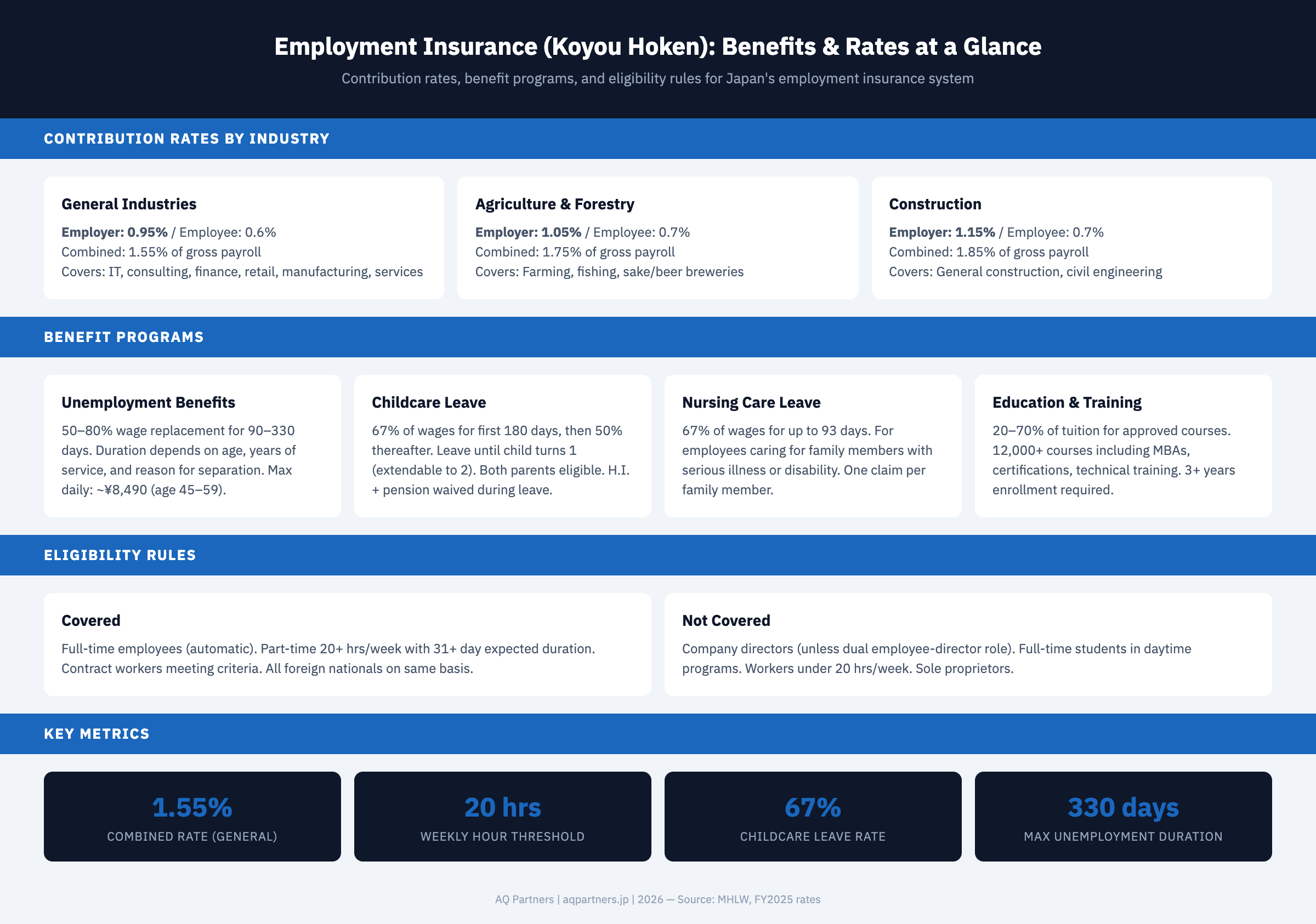
| Industry Category | Employer Rate | Employee Rate | Combined Rate | Typical Industries |
|---|---|---|---|---|
| General Industries | 0.85% | 0.5% | 1.35% | IT, consulting, finance, retail, manufacturing, services |
| Agriculture, Forestry, Fisheries, Liquor Mfg | 0.95% | 0.6% | 1.55% | Farming, fishing, sake and beer breweries |
| Construction | 1.05% | 0.6% | 1.65% | General construction, civil engineering, renovation |
Most foreign companies establishing operations in Japan fall under the General Industries category. Monthly contributions are withheld from each employee's paycheck (0.5% of gross pay) and combined with the employer's portion (0.85%) for payment. Unlike health insurance and pension, employment insurance premiums are settled annually through the Labor Insurance Premium Update (年度更新, nendo koushin), filed between June 1 and July 10 each year. This annual reconciliation compares the estimated premiums paid during the year to actual payroll, and the difference is either paid or credited.
Benefit Programs Funded by Employment Insurance
Employment insurance funds four major categories of benefits. The most significant for foreign companies are unemployment benefits and childcare leave benefits, both of which directly affect employee retention and HR planning.
Unemployment Benefits (Kihon Teate)
Employees who lose their jobs can receive unemployment benefits (基本手当) at 50–80% of their average daily wages for a period determined by their age, years of insured employment, and reason for job separation.
| Separation Type | Min. Contribution Period | Benefit Duration | Waiting Period | Replacement Rate |
|---|---|---|---|---|
| Voluntary resignation | 12 months in prior 2 years | 90–150 days | 7 days + 2–3 months restriction | 50–80% |
| Company-initiated (dismissal) | 6 months in prior 1 year | 90–330 days | 7 days only | 50–80% |
| Fixed-term contract expiry (not renewed) | 6 months in prior 1 year | 90–300 days | 7 days only | 50–80% |
| Bankruptcy / mass layoff | 6 months in prior 1 year | 90–330 days | 7 days only | 50–80% |
| Retirement (age 65+) | 6 months in prior 1 year | 30–50 days (lump sum) | 7 days only | 50–80% |
| Seasonal workers | 6 months in prior 1 year | 30–50 days | 7 days only | 50–80% |
The daily benefit amount (基本手当日額) is calculated as 50–80% of the average daily wage earned during the six months preceding job separation, with a maximum daily cap of approximately ¥8,490 for workers aged 45–59 (the highest age bracket). Lower-wage workers receive replacement rates closer to 80%, while higher-wage workers receive closer to 50%. Foreign employees on work visas may face practical limitations—if their visa does not permit job searching (e.g., an intra-company transferee visa tied to a specific employer), they may not be able to claim unemployment benefits. However, switching to a job-seeking visa or obtaining a designated activities visa can preserve eligibility.
Childcare and Nursing Care Leave Benefits
Employment insurance funds two major leave benefit programs:
- Childcare leave benefits (育児休業給付): 67% of wages for the first 180 days, then 50% thereafter. Leave can be taken until the child turns one year old (extendable to two years if daycare is unavailable). Both mothers and fathers are eligible. During childcare leave, health insurance and pension contributions are fully waived for both employer and employee.
- Nursing care leave benefits (介護休業給付): 67% of wages for up to 93 days when an employee takes leave to care for a family member with a serious illness or disability.
Education and Training Benefits
Employees enrolled for three or more years (one year for first-time users) can claim education and training benefits (教育訓練給付金) covering 20–70% of tuition costs for approved professional development courses, up to annual caps depending on the training category. According to the Ministry of Health, Labour and Welfare, over 12,000 courses are approved under this program, including professional certifications, MBA programs, and specialized technical training.
Employer Obligations When Employees Leave
When an employee separates from the company, the employer must file an Employment Insurance Qualification Loss Notification (雇用保険被保険者資格喪失届) and a Separation Certificate (離職証明書) with Hello Work within 10 days of the separation date. The Separation Certificate is critical—it documents the reason for separation and the employee's wage history, directly determining the employee's unemployment benefit eligibility and amount.
The reason for separation stated on the certificate must accurately reflect the circumstances. Misrepresenting a company-initiated dismissal as a voluntary resignation to avoid higher unemployment insurance rates is a violation of the Employment Insurance Act. Hello Work may investigate discrepancies, and false reporting can result in penalties for the employer. As part of the complete social insurance framework, employment insurance separation procedures must be coordinated with health insurance and pension qualification loss filings to the Japan Pension Service.
Employment insurance is one of five social insurance programs that every foreign employer in Japan must manage. While the contribution rates are lower than health insurance and pension, the administrative requirements—annual premium updates, separation certificates, and leave benefit applications—require careful attention. AQ Partners handles employment insurance registration, monthly contribution calculations, annual premium reconciliation, and employee separation processing as part of our comprehensive payroll and HR services. Contact us at hello@aqpartners.jp.

Yuga Koda is a founding Director at AQ Partners, supporting foreign companies, funds, and families operating in Japan. His experience operating companies in both Japan and international markets gives him a practical understanding of back office operations from both sides.