
Japan's Digital Tax & Filing Platforms: A Guide


Japan's digital tax and filing platforms are the online government systems that foreign-owned companies use to file and pay taxes, register for the invoice system, and lodge social insurance and labor procedures electronically. The core systems are e-Tax for national taxes, eLTAX for local taxes, the Common Tax Payment System for settling local liabilities in one operation, gBizID as a shared corporate login, the National Tax Agency's invoice system registration, and e-Gov for social insurance and labor filings. Together they cover almost every recurring obligation a company in Japan faces. For corporations with paid-in capital exceeding ¥100 million, electronic filing across these platforms is mandatory for fiscal years beginning on or after 1 April 2020; every other company may file voluntarily, which we strongly recommend. This guide maps how the platforms fit together and where each obligation lives.
Key Takeaways
- Six connected systems, one workflow: e-Tax (national tax), eLTAX (local tax), the Common Tax Payment System (共通納税), gBizID, invoice registration, and e-Gov cover the full compliance cycle.
- The ¥100 million threshold matters: corporations with stated capital over ¥100 million must e-file national and local tax returns, plus social and labor insurance, for fiscal years beginning on or after 1 April 2020.
- gBizID is the master key: a single gBizID Prime login now connects to e-Tax, eLTAX, e-Gov, and subsidy portals, and can substitute for an electronic certificate.
- Invoice numbers are public: registered qualified invoice issuers receive a "T" + 13-digit number and appear on the NTA's public publication site.
- Deadlines are tight: new social insurance notifications are due within 5 days and labor insurance within 10 days of an establishment or hire.
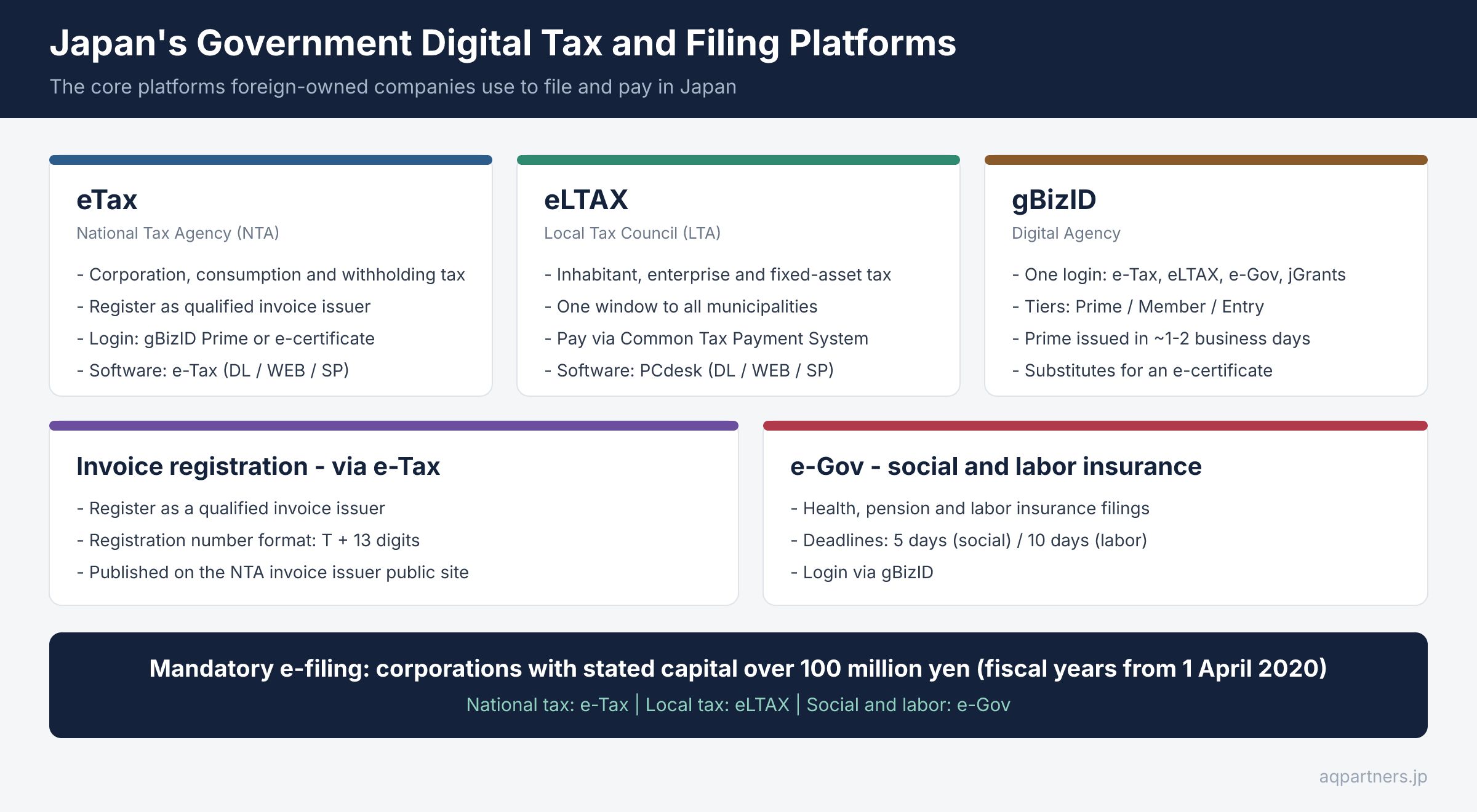
What are Japan's core digital tax and filing platforms?
Japan runs separate national and local tax systems, each with its own online portal, unified by a shared corporate login. The National Tax Agency operates e-Tax for national taxes; the Organization for Local Tax operates eLTAX for local taxes; the Digital Agency operates gBizID as the login; and social and labor insurance run through e-Gov. Understanding which obligation lives on which platform is the first step to a clean compliance calendar.
The table below summarizes the core platforms at a glance. For foreign-owned companies, the practical takeaway is that no single portal does everything: national tax, local tax, and social/labor filings each have a dedicated home, but one gBizID account can open all of them.
PlatformOperatorWhat it handlesLogine-Tax (国税)National Tax AgencyCorporation tax, local corporate tax, consumption tax, withholding tax, invoice registrationgBizID Prime or electronic certificateeLTAX (地方税)Organization for Local TaxCorporate inhabitant tax, enterprise tax, depreciable fixed-asset tax, employee inhabitant taxPCdesk with gBizID or certificateCommon Tax PaymentOrganization for Local TaxPaying local taxes owed to many municipalities in one operationVia eLTAXgBizIDDigital AgencyShared corporate login across government servicesgBizID app + My Number CardInvoice systemNational Tax AgencyQualified invoice issuer registration; T + 13-digit numberVia e-Taxe-GovDigital AgencySocial insurance and labor insurance proceduresgBizID
We compare the two tax portals in depth in our explainer on eLTAX vs eTax and what sets them apart. For the underlying rules on corporate taxation in Japan, JETRO maintains a useful English overview of corporate taxes for foreign investors.
How do these platforms fit together?
They connect through gBizID: one identity-verified corporate login now opens e-Tax, eLTAX, e-Gov, and government subsidy portals, so a company no longer needs a separate certificate for each system. The tax data itself still flows to two destinations, national and local, but the front door is increasingly shared.
In practice, a typical fiscal-year close looks like this. You prepare the corporate tax and consumption tax returns and file them through e-Tax; you file the matching local returns (inhabitant tax, enterprise tax) through eLTAX; and you settle the local liabilities through the Common Tax Payment System without visiting each municipality. Payroll-driven obligations, meanwhile, run on a monthly and event-driven cadence through e-Gov and eLTAX. Because gBizID Prime can substitute for an electronic certificate, obtaining that one account early removes the most common onboarding bottleneck for a new entity. Our guide to gBizID as one login for government services walks through the application in detail.
What does e-Tax cover for national taxes?
e-Tax is the National Tax Agency's system for filing and paying national taxes electronically, including corporation tax, local corporate tax, consumption tax, and withholding income tax. It is also where you register as a qualified invoice issuer, so most companies touch e-Tax for more than just their annual return.
Corporations with stated capital exceeding ¥100 million are required to e-file their national returns for fiscal years beginning on or after 1 April 2020. Login is via gBizID Prime or an electronic certificate such as a My Number Card or commercial certificate, and the agency offers e-Tax software as a download, a WEB version, and smartphone (SP) versions; commercial tax software also connects directly. You can read the full breakdown in our post on what eTax is and how national e-filing works, or consult the National Tax Agency's English portal directly.
What does eLTAX cover for local taxes?
eLTAX is the single online window to every Japanese prefecture and municipality for local taxes, including corporate inhabitant tax, enterprise tax, special corporate enterprise tax, depreciable fixed-asset tax, and employees' individual inhabitant tax via the salary payment report. One portal replaces dozens of separate local filings.
The free client software is called PCdesk, available in download, WEB, and smartphone versions, with a newer PCdesk Next generation. Crucially, eLTAX connects to the Common Tax Payment System (共通納税), which lets a taxpayer settle local taxes owed to many municipalities at once by direct account transfer (with no transfer fee), internet banking, Pay-easy, or credit card. eLTAX operates 8:30 to 24:00 on business days. Our detailed walkthrough covers filing and paying local taxes through eLTAX, and the official eLTAX portal hosts the software downloads.
How does invoice-system registration work?
To let your customers claim an input consumption-tax credit, you must be a registered qualified invoice issuer, and you register with the National Tax Agency, fastest through e-Tax. The invoice system (インボイス制度) has been in force since 1 October 2023.
On registration you receive a number formatted as "T" plus 13 digits (for example, T1234567890123), which must appear on every qualified invoice you issue. Filing through e-Tax typically takes a few weeks, versus roughly a couple of months by paper to the Invoice Registration Center. Registered issuers, including the number, name, and registered address for corporations, are published on the NTA's public Invoice Issuer Publication Site. For the exact mechanics, see our post on registering as a qualified invoice issuer via e-Tax.
What does e-Gov handle for payroll compliance?
e-Gov is the government's portal for administrative procedures, used to file social insurance (health insurance and employees' pension) and labor insurance (workers' accident and employment insurance) electronically. It rounds out the digital stack by covering the people side of running a company.
The statutory deadlines are tight: a new establishment must lodge its social insurance notification within 5 days, and labor insurance within 10 days of hiring. As with the tax platforms, electronic filing has been mandatory for the ¥100 million-capital class since April 2020, and login is via gBizID. See our detailed guide to e-Gov electronic filing of social insurance and labor procedures for the step-by-step. Managing these deadlines is a core part of our back-office operations service.
When are the key digital filings due?
Digital filing in Japan follows a predictable annual rhythm anchored to your fiscal year-end plus event-driven payroll deadlines. The calendar below shows the main recurring filings, the platform each lives on, and the statutory deadline to keep in view.
FilingPlatformStatutory deadlineCorporation tax & local corporate tax returne-TaxWithin 2 months of fiscal year-end (extension possible)Consumption tax returne-TaxWithin 2 months of fiscal year-endLocal inhabitant & enterprise tax returneLTAXWithin 2 months of fiscal year-endWithholding income tax paymente-TaxBy the 10th of the following month (or special due dates)Employee inhabitant tax (special collection)eLTAXBy the 10th of the following monthNew social insurance notificatione-GovWithin 5 days of establishmentLabor insurance establishmente-GovWithin 10 days of hiringQualified invoice issuer registratione-TaxBefore you need to issue compliant invoices
Because national and local returns share the same two-month window, foreign-owned companies benefit from preparing e-Tax and eLTAX filings in parallel rather than in sequence.
Frequently Asked Questions
Do foreign-owned companies have to file electronically in Japan?
It depends on capital size. Corporations (other than foreign corporations) with paid-in capital exceeding ¥100 million must e-file national tax returns via e-Tax and local tax returns via eLTAX, as well as social and labor insurance procedures via e-Gov, for fiscal years beginning on or after 1 April 2020. Companies below the threshold may file electronically voluntarily, and we strongly recommend it because the platforms reduce errors and speed up processing.
Do I need separate logins for e-Tax and eLTAX?
Not anymore, in practice. A single gBizID Prime account can open e-Tax, eLTAX, and e-Gov, and it can substitute for an electronic certificate. You can still use a My Number Card or commercial certificate if you prefer, but obtaining one gBizID Prime early is usually the smoothest path for a new entity managing multiple platforms.
What is the Common Tax Payment System?
The Common Tax Payment System (共通納税) is a function within eLTAX that lets a taxpayer settle local taxes owed to multiple municipalities and prefectures in a single operation. Payment can be made by direct account transfer, which carries no transfer fee, as well as by internet banking, Pay-easy, or credit card. It removes the need to pay each local government separately.
How long does invoice registration take?
Registering as a qualified invoice issuer through e-Tax typically takes a few weeks, compared with roughly a couple of months if you file on paper with the Invoice Registration Center. Once registered, you receive a "T" + 13-digit number that must appear on your qualified invoices, and your details are published on the NTA's public site.
Navigating six government platforms while keeping every statutory deadline is a lot for a lean finance team, especially in a second language. AQ Partners provides back-office, accounting, payroll, tax, and compliance support for foreign companies, funds, and families in Japan, and can act as your filing agent across all of these systems. To map your obligations and set up clean digital filing, contact AQ Partners at hello@aqpartners.jp.
Sources
- National Tax Agency (NTA) — e-Tax and national tax e-filing; invoice system publication site.
- Organization for Local Tax (地方税共同機構) — eLTAX and the Common Tax Payment System.
- Digital Agency (デジタル庁) — gBizID and e-Gov.
- JETRO — corporate taxes in Japan (English overview for foreign investors).

Yuga Koda is a founding Director at AQ Partners, supporting foreign companies, funds, and families operating in Japan. His experience operating companies in both Japan and international markets gives him a practical understanding of back office operations from both sides.