
What Is eLTAX? Filing & Paying Local Taxes in Japan


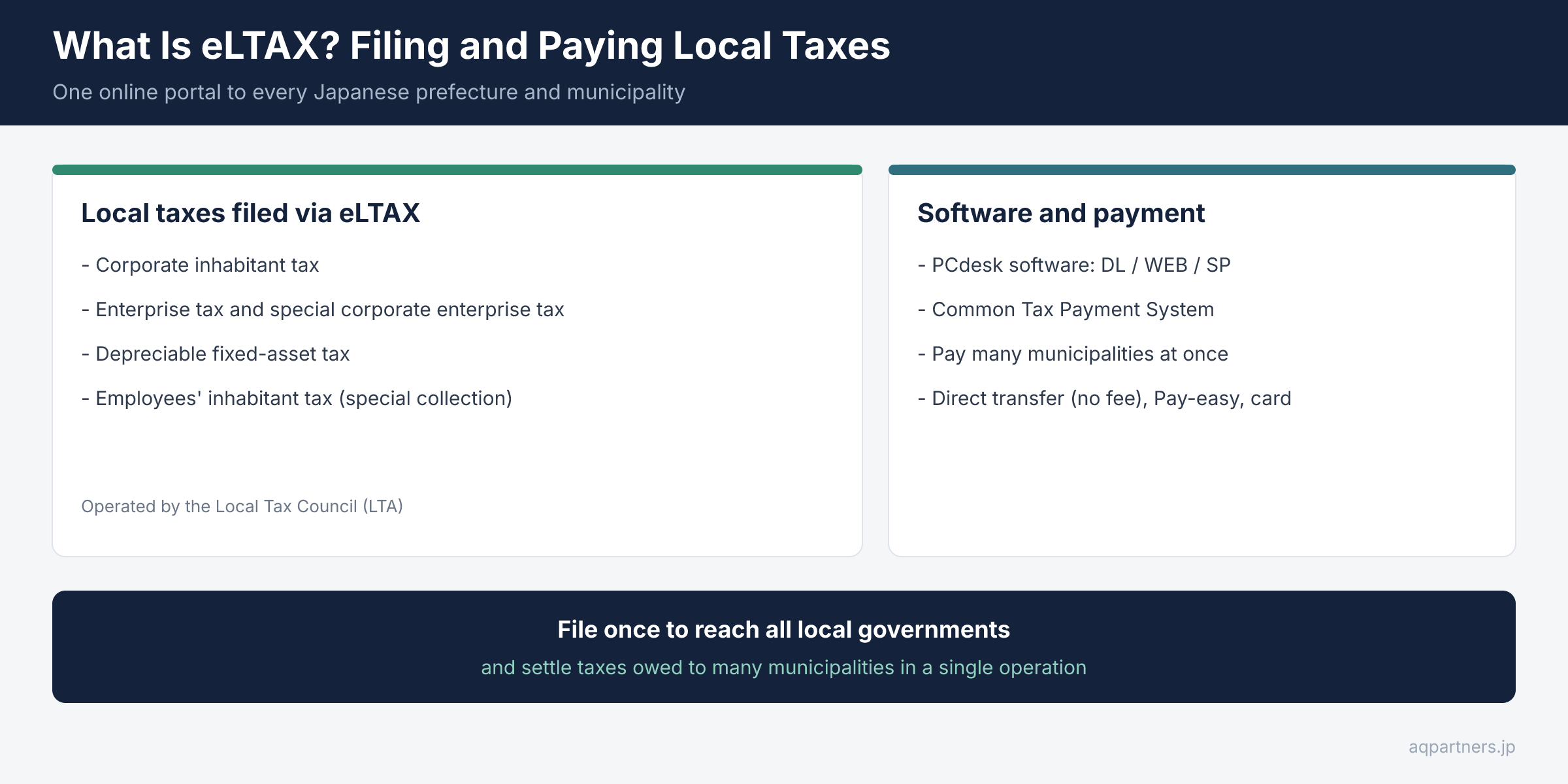
eLTAX (地方税ポータルシステム) is Japan's shared online portal for filing and paying local taxes to every prefecture and municipality through a single window. Operated by the Local Tax Council (地方税共同機構, Organization for Local Tax), it lets a company that owes taxes across dozens of jurisdictions submit returns and settle payments from one interface instead of dealing with each local government separately. For foreign-owned companies in Japan, eLTAX is the local-tax counterpart to the national-tax system: corporate inhabitant tax, enterprise tax, depreciable fixed-asset tax, and your employees' individual inhabitant tax all flow through it. This guide explains what eLTAX covers, the free PCdesk software you use to access it, and the Common Tax Payment System (共通納税) that lets you pay many municipalities at once.
Key Takeaways
- One portal for all local governments: eLTAX (地方税ポータルシステム) connects a single filer to every prefecture and municipality in Japan, run by the Local Tax Council (地方税共同機構).
- Covers the main corporate local taxes: corporate inhabitant tax (法人住民税), enterprise tax (法人事業税), special corporate enterprise tax, and depreciable fixed-asset tax (固定資産税・償却資産).
- Handles payroll filings too: employees' individual inhabitant tax via the salary payment report and special collection (給与支払報告書・特別徴収).
- Common Tax Payment System (共通納税): pay taxes owed to multiple local governments in one operation; direct account transfer carries no transfer fee.
- Mandatory for large companies: corporations with paid-in capital exceeding ¥100 million must e-file local tax returns via eLTAX for fiscal years beginning on or after 1 April 2020.
What is eLTAX and who runs it?
eLTAX is the electronic portal system for local taxes in Japan, operated by the Local Tax Council (地方税共同機構). It provides one online window through which a taxpayer can file returns and applications with all prefectures and municipalities at the same time, rather than contacting each local government individually.
Japan's tax system splits into national taxes, handled by the National Tax Agency through e-Tax, and local taxes, handled by prefectures and municipalities through eLTAX. Because a company with offices, property, or employees in several jurisdictions can owe local tax to many governments, a shared portal removes an enormous amount of duplicated paperwork. If you are weighing which system does what, our companion guide on the difference between eLTAX and eTax maps the two side by side, and the overview of Japan's digital tax and filing platforms shows where eLTAX sits in the wider landscape. eLTAX is available on business days from 8:30 to 24:00 (Source: Local Tax Council). You can review the portal directly at the eLTAX website.
Which local taxes are filed through eLTAX?
eLTAX covers the recurring local taxes that most companies operating in Japan will encounter, including corporate inhabitant tax, enterprise tax, and depreciable fixed-asset tax, plus the payroll-linked filings for employees' individual inhabitant tax.
The table below summarizes the main local taxes and filings handled through the portal.
Local tax / filingJapanese termWho it applies toCorporate inhabitant tax法人住民税Companies with a place of business in a prefecture / municipalityEnterprise tax法人事業税Companies carrying on business in a prefectureSpecial corporate enterprise tax特別法人事業税Levied alongside enterprise taxDepreciable fixed-asset tax固定資産税(償却資産)Companies owning depreciable business assetsEmployees' individual inhabitant tax個人住民税(特別徴収)Employers withholding inhabitant tax from salariesSalary payment report給与支払報告書Employers reporting annual wages to each municipality
The salary payment report (給与支払報告書) and special collection (特別徴収) filings matter for every employer, because they determine how much individual inhabitant tax is withheld from each employee's monthly salary and remitted to their municipality of residence. Managing these across a workforce spread over many cities is one of the most common reasons foreign-owned companies adopt eLTAX early.
What is PCdesk, the eLTAX software?
PCdesk is the free client software provided by the Local Tax Council for creating, submitting, and managing filings on eLTAX. It comes in several forms so you can choose the one that fits how your team works.
There are three delivery formats plus a newer generation of the tool:
- PCdesk (DL): the downloadable desktop application, with the fullest feature set for preparing and submitting returns.
- PCdesk (WEB): a browser-based version that needs no installation, useful for account administration and lighter tasks.
- PCdesk (SP): a smartphone version for on-the-go confirmation of procedures.
- PCdesk Next: the newer, modernized client that the Local Tax Council has been rolling out.
Login to eLTAX and PCdesk can use an electronic certificate or a gBizID account. Because gBizID Prime can substitute for an electronic certificate on eLTAX and e-Tax alike, many companies standardize on it; our explainer on gBizID, the single government login walks through the tiers and how to apply.
How does the Common Tax Payment System (共通納税) work?
The Common Tax Payment System (共通納税, kyōtsū nōzei) lets a taxpayer pay local taxes owed to multiple municipalities and prefectures in a single operation from within eLTAX, instead of making a separate payment to each. Direct account transfer through the system carries no transfer fee.
This is the feature that most changes day-to-day life for a company filing across many jurisdictions. Once returns are submitted, you can settle everything owed in one batch and choose from several payment methods, summarized below.
Payment methodHow it worksFee noteDirect account transfer (ダイレクト納付)Debits your registered bank account directly from eLTAXNo transfer feeInternet bankingPay from your bank's online banking servicePer your bank's termsPay-easy (ペイジー)Pay via ATM or online banking using an issued numberPer your bank's termsCredit cardPay through the Local Tax Payment SiteCard processing may applyLocal Tax Payment SiteWeb payment portal linked to eLTAXDepends on method chosen
Because direct account transfer avoids transfer fees and can settle liabilities to many local governments at once, it is the method most back offices default to. Payments through eLTAX follow the same business-day operating hours of 8:30 to 24:00 (Source: Local Tax Council).
Is eLTAX filing mandatory for our company?
Electronic filing via eLTAX is mandatory for larger corporations and strongly recommended for everyone else. Corporations (other than foreign corporations) with paid-in or stated capital exceeding ¥100 million must e-file their local tax returns through eLTAX, for fiscal years beginning on or after 1 April 2020.
The same ¥100 million capital threshold triggers mandatory national-tax e-filing via e-Tax and mandatory electronic filing of social insurance and labor procedures. If you handle payroll and social insurance in-house, our guide to e-Gov for social insurance and labor filings covers that side of the same rule. Companies below the ¥100 million threshold are not required to use eLTAX but are strongly encouraged to, because the portal removes duplicated filings and unlocks single-operation payment. For background on how local corporate taxes fit into the wider system, JETRO's overview of corporate taxes in Japan is a useful English-language reference.
Frequently Asked Questions
Do we need a separate account for each municipality on eLTAX?
No. The whole purpose of eLTAX is that a single account and a single filing reach all relevant prefectures and municipalities. You register once, identify the local governments you have obligations to, and submit through one portal. This is what distinguishes it from contacting each city or prefecture individually and is the main reason multi-location companies adopt it.
Can eLTAX handle our employees' inhabitant tax?
Yes. eLTAX processes the salary payment report (給与支払報告書) and the special collection (特別徴収) of employees' individual inhabitant tax. Employers report annual wages to each employee's municipality and then withhold and remit inhabitant tax monthly. For a company with staff living across many cities, doing this through eLTAX is far more manageable than handling each municipality by hand.
Is there a fee to pay taxes through eLTAX?
Paying by direct account transfer through the Common Tax Payment System carries no transfer fee. Other methods such as internet banking, Pay-easy, and credit card follow the terms of your bank or card processor. Because direct transfer is free and can settle many jurisdictions at once, most companies use it as their default payment route.
What software do we need to use eLTAX?
You use PCdesk, the free client software from the Local Tax Council, available as a downloadable desktop app (DL), a browser version (WEB), a smartphone version (SP), and the newer PCdesk Next. Commercial tax software also connects to eLTAX. Login uses an electronic certificate or a gBizID account, so no additional paid tooling is strictly required.
eLTAX turns dozens of separate local-tax relationships into one manageable workflow, but the setup, PCdesk configuration, and cross-jurisdiction payments still take local knowledge to run smoothly. AQ Partners provides back-office, accounting, payroll, and tax compliance support for foreign companies, funds, and families in Japan, and can act as your filing agent (代理) across eLTAX and the other government platforms. To hand off local tax filing and payment with confidence, contact AQ Partners at hello@aqpartners.jp.
Sources
- Local Tax Council (地方税共同機構) / eLTAX portal — local tax e-filing and the Common Tax Payment System
- National Tax Agency (国税庁) — mandatory e-filing threshold for large corporations
- Digital Agency (デジタル庁) — gBizID government login
- JETRO — corporate taxes in Japan

Yuga Koda is a founding Director at AQ Partners, supporting foreign companies, funds, and families operating in Japan. His experience operating companies in both Japan and international markets gives him a practical understanding of back office operations from both sides.