
e-Gov: Electronic Filing of Social Insurance & Labor Procedures

e-Gov (電子政府の総合窓口) is the Japanese government's single online portal for administrative procedures, and for employers it is the place where two families of filings are submitted electronically: social insurance (health insurance and employees' pension, administered by the Japan Pension Service) and labor insurance (労働保険 — workers' accident compensation insurance and employment insurance, administered by the Labour Bureaus and Hello Work). Instead of carrying paper forms to a pension office or labor bureau counter, a company logs in through its gBizID account, completes the relevant notification, and submits it online with an audit trail. For foreign-owned companies staffing up in Japan, e-Gov is the backbone of statutory payroll compliance: every new hire, every departure, and every change in remuneration ultimately touches a procedure that runs through this portal.
Key Takeaways
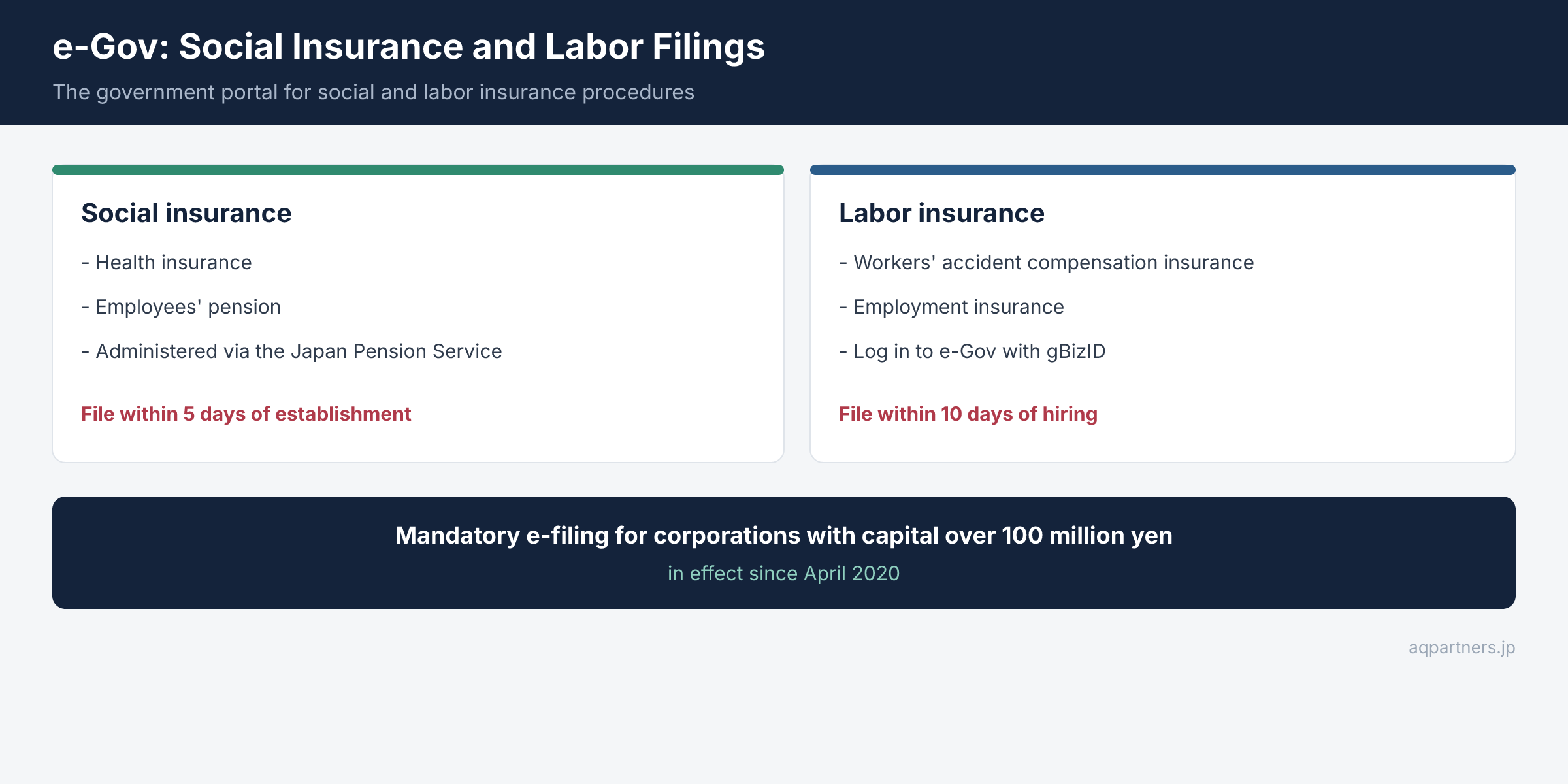
- One portal, two insurance systems (電子政府 e-Gov): e-Gov handles both social insurance (health insurance + employees' pension) and labor insurance (workers' accident + employment insurance) filings in one place.
- Five-day social insurance deadline: a newly established company must file its social insurance new-establishment notification (新規適用届) within 5 days of becoming liable.
- Ten-day labor insurance deadline: labor insurance establishment and the employment insurance acquisition notice are generally due within 10 days of hiring the first insured employee.
- Login via gBizID (ジービズアイディ): e-Gov accepts a gBizID Prime or Member account for login, so no separate electronic certificate is strictly required.
- Mandatory since April 2020: corporations with paid-in capital exceeding ¥100 million must file specified social and labor insurance procedures electronically for periods beginning on or after 1 April 2020.
What is e-Gov and what does it cover?
e-Gov is the national e-government gateway operated for administrative procedures across ministries, and for employers its core use is the electronic submission of social and labor insurance notifications. It replaces counter and postal filing with a browser-based workflow tied to your company login.
The portal covers two distinct but related systems. Social insurance (社会保険) means health insurance (健康保険) and employees' pension insurance (厚生年金保険), both administered by the Japan Pension Service (日本年金機構). Labor insurance (労働保険) is an umbrella term for workers' accident compensation insurance (労災保険) and employment insurance (雇用保険), administered through the Prefectural Labour Bureaus and, for employment insurance, Hello Work (公共職業安定所). Because these two systems sit with different authorities, e-Gov is valuable precisely because it presents them through one login and one submission channel. If you are mapping how Japan's various government portals fit together, our guide to Japan's digital tax and filing platforms shows where e-Gov sits alongside the tax systems.
Which procedures must you file, and by when?
The most consequential e-Gov filings for an employer are the establishment notices and the employee acquisition or loss notices, several of which carry statutory deadlines of just a few days. Missing them can delay an employee's health insurance card or pension enrolment.
The table below summarizes the procedures foreign-owned employers encounter most often and their statutory deadlines. Deadlines run from the triggering event, so a compliant payroll calendar starts on the employee's first day, not at month-end.
Procedure (Japanese)SystemStatutory deadlineSocial insurance new-establishment notification (新規適用届)Social insuranceWithin 5 days of becoming liableSocial insurance qualification acquisition — new hire (資格取得届)Social insuranceWithin 5 days of hiringSocial insurance qualification loss — departure (資格喪失届)Social insuranceWithin 5 days of separationLabor insurance establishment (保険関係成立届)Labor insuranceWithin 10 days of establishmentEmployment insurance qualification acquisition (雇用保険被保険者資格取得届)Employment insuranceBy the 10th of the month following hiringAnnual labor insurance premium declaration (年度更新)Labor insuranceAnnually, roughly 1 June–10 July
Two deadlines are worth committing to memory: the social insurance new-establishment notification within 5 days and labor insurance establishment within 10 days of taking on your first insured worker. Because these clocks start immediately, most employers prepare the paperwork before the hire date and file on day one.
Who handles what: procedure, authority, and platform
Different authorities own different filings, but e-Gov is the common submission platform for the electronic versions. Knowing which body ultimately processes a notice helps when you need to follow up or correct an error.
The mapping below shows, for each procedure family, the responsible authority and the platform used to file. It also clarifies where e-Gov overlaps with adjacent systems that a payroll function touches every month.
Procedure familyResponsible authorityFiling platformHealth insurance & employees' pension (social insurance)Japan Pension Service (日本年金機構)e-GovWorkers' accident insurance (労災保険)Prefectural Labour Bureau (労働局)e-GovEmployment insurance (雇用保険)Hello Work / Labour Bureaue-GovNational tax (corporate, consumption, withholding)National Tax Agency (国税庁)e-TaxLocal tax incl. residents' special collectionLocal governments via Organization for Local TaxeLTAXCross-service company loginDigital Agency (デジタル庁)gBizID
Payroll rarely lives inside e-Gov alone. When an employee is hired, their inhabitant tax is collected through the employer under special collection (特別徴収), which is administered on the local-tax side; our explainer on what eLTAX is and how local tax filing works covers that side of the payroll picture. Together, e-Gov and eLTAX cover the insurance and the tax halves of onboarding a new employee.
How do you log in and file on e-Gov?
e-Gov login is handled through gBizID, the shared corporate identity issued by the Digital Agency, so a company that already uses gBizID for other services does not need a separate electronic certificate to file. A gBizID Prime or Member account is sufficient.
In practice, the company representative first obtains a gBizID Prime account (identity-verified, typically issued in about one to two business days with a My Number Card), then issues gBizID Member accounts to the staff who will actually prepare filings. Those members sign in to e-Gov, select the procedure, complete the structured form, attach any supporting documents, and submit. The system returns a receipt and a status you can track. For the full account hierarchy and how Prime, Member, and Entry tiers differ, see our explainer on gBizID, the single login for Japan's government services. You can also review the official overview from the Digital Agency at digital.go.jp/en/policies/gbizid.
Who is required to file electronically?
Electronic filing on e-Gov is voluntary for most employers but mandatory for large corporations. Since periods beginning on or after 1 April 2020, corporations with paid-in capital exceeding ¥100 million must submit specified social and labor insurance procedures electronically.
This is the same ¥100 million-capital class that must e-file national tax via e-Tax and local tax via eLTAX. The specified procedures that must be filed electronically include the regular monthly and annual social insurance notices — for example, qualification acquisition and loss, the standard remuneration calculation (算定基礎届), and bonus payment reports — as well as the annual labor insurance premium declaration. Companies below the ¥100 million threshold are not compelled to use e-Gov, but electronic filing is strongly recommended: it removes counter visits, provides submission receipts, and shortens processing time. Foreign-owned subsidiaries frequently sit below the capital threshold yet still adopt e-Gov filing from day one because it scales cleanly as headcount grows. For general background on Japan's corporate obligations, JETRO maintains an overview at jetro.go.jp.
Frequently Asked Questions
Do I need a separate certificate, or is gBizID enough for e-Gov?
For most employer procedures, a gBizID Prime or Member account is enough to log in and submit on e-Gov, so a separate commercial electronic certificate is not strictly required. gBizID Prime is identity-verified at the company-representative level and can be used across e-Gov, subsidy portals, and the tax systems. Some specialized procedures may still accept or request a certificate, but the standard social and labor insurance filings run on gBizID. This is one reason companies set up gBizID early in their Japan operations.
What happens if I miss the 5-day or 10-day deadline?
The statutory deadlines — 5 days for social insurance and 10 days for labor insurance establishment — are legal obligations, and late filing can delay an employee's health insurance card and pension enrolment, which affects their access to care. Authorities generally accept a late filing with an explanation rather than imposing an immediate penalty for a first, minor lapse, but repeated or willful non-filing carries real compliance risk. The practical remedy is to prepare the notices before the hire date. Building the filing into your onboarding checklist prevents the deadline from ever being missed.
Is social insurance the same thing as labor insurance?
No. Social insurance (社会保険) refers to health insurance and employees' pension, administered by the Japan Pension Service, while labor insurance (労働保険) refers to workers' accident compensation insurance and employment insurance, administered by the Labour Bureaus and Hello Work. They have different enrolment thresholds, different premium calculations, and different deadlines. e-Gov is useful because it lets you file both through one portal even though the underlying authorities are separate. A new hire typically triggers filings in both systems at once.
Can a filing agent submit e-Gov procedures on our behalf?
Yes. A licensed social insurance and labor consultant (社会保険労務士) or an authorized back-office provider can file social and labor insurance procedures on your behalf as your agent, which is common for foreign-owned companies without an in-house payroll team. The agent handles the gBizID or certificate authentication, prepares the notices, and tracks submission receipts. This keeps statutory deadlines covered even when your team is small or not yet fluent in Japanese administrative processes.
Getting social insurance and labor insurance filings right from the first hire protects your employees' benefits and keeps your company clear of compliance problems as it grows. AQ Partners provides back-office, payroll, and compliance support for foreign companies, funds, and families in Japan, and can act as your filing agent across e-Gov and the tax platforms — see our back-office operations services for how we structure this. Contact AQ Partners at hello@aqpartners.jp.
Sources
- Japan Pension Service — employer social insurance procedures and deadlines (Source: 日本年金機構)
- Ministry of Health, Labour and Welfare — labor insurance establishment and employment insurance (Source: 厚生労働省)
- Digital Agency — gBizID overview (Source: デジタル庁)
- National Tax Agency — mandatory e-filing for corporations with capital over ¥100 million (Source: 国税庁)
- JETRO — setting up business and corporate obligations in Japan (Source: JETRO)

Yuga Koda is a founding Director at AQ Partners, supporting foreign companies, funds, and families operating in Japan. His experience operating companies in both Japan and international markets gives him a practical understanding of back office operations from both sides.