
eLTAX vs eTax: What's the Difference?

eLTAX and e-Tax are Japan's two official electronic tax-filing platforms, and the difference between them comes down to one thing: national tax versus local tax. e-Tax (the "National Tax Electronic Declaration and Payment System," 国税電子申告・納税システム) is operated by the National Tax Agency and handles national taxes such as corporation tax, consumption tax, and withholding income tax. eLTAX (the "Local Tax Portal System," 地方税ポータルシステム) is operated by the Organization for Local Tax and is a single window to every prefecture and municipality for local taxes such as corporate inhabitant tax and enterprise tax. Foreign-owned companies operating in Japan almost always need both: a Japanese corporation files national returns through e-Tax and local returns through eLTAX, and once paid-in capital exceeds ¥100 million, electronic filing on both platforms becomes mandatory. This guide breaks down who runs each system, what taxes they cover, how you log in, and which platform you use for which filing.
What is the core difference between eLTAX and e-Tax?
The core difference is jurisdiction: e-Tax handles national taxes collected by the central government, and eLTAX handles local taxes collected by prefectures and municipalities. They are separate systems run by separate bodies, and a filing made on one does not appear on the other. e-Tax is the National Tax Agency's channel for returns such as corporation tax (法人税), consumption tax (消費税), and withholding income tax (源泉所得税). eLTAX is a shared portal, built by the Organization for Local Tax, that connects a single filer to all of Japan's local governments at once so you do not have to submit paper returns to each prefecture and city individually.
For a foreign-owned company running a Japanese subsidiary, the practical consequence is that a single corporate tax season involves two platforms. Your corporation tax and consumption tax go to the NTA through e-Tax; your corporate inhabitant tax and enterprise tax go to the local governments through eLTAX. For a full picture of how these systems fit together with gBizID and e-Gov, see our overview of Japan's digital tax and filing platforms. For platform-specific detail, we cover what e-Tax is and how national e-filing works and how eLTAX handles local tax filing and payment in dedicated posts.
eLTAX vs e-Tax at a glance
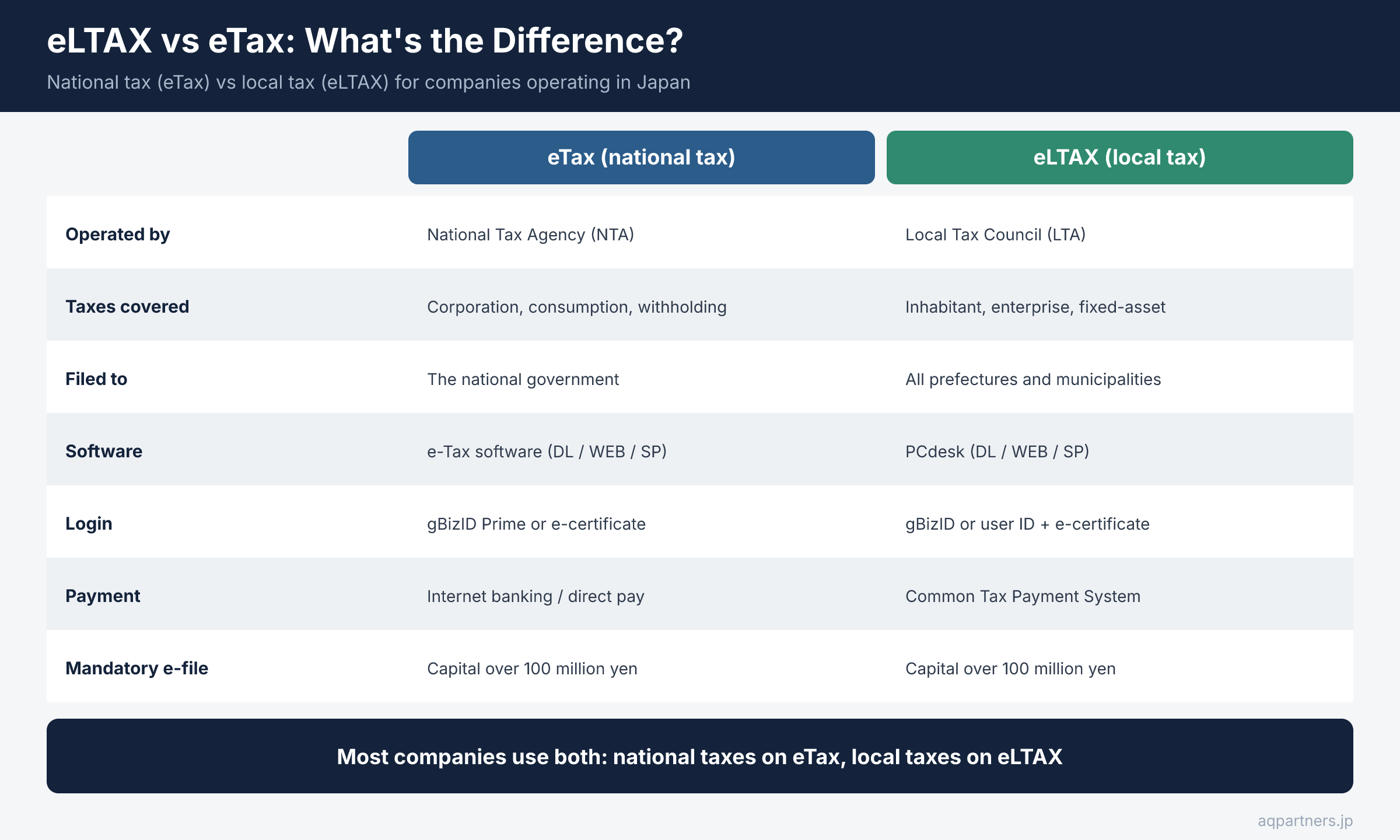
At a glance, the two platforms mirror each other structurally but never overlap in scope — one is national, one is local, each with its own operator, software, and login path. The table below sets out the key attributes side by side so you can see exactly where responsibility sits.
Attributee-Tax (国税)eLTAX (地方税)Tax levelNational taxLocal taxOperatorNational Tax Agency (NTA / 国税庁)Organization for Local Tax (地方税共同機構)Full nameNational Tax Electronic Declaration and Payment System (国税電子申告・納税システム)Local Tax Portal System (地方税ポータルシステム)Main taxesCorporation tax, local corporate tax, consumption tax, withholding income taxCorporate inhabitant tax, enterprise tax, special corporate enterprise tax, depreciable fixed-asset tax, employees' inhabitant taxFree softwaree-Tax software (DL / WEB / SP)PCdesk (DL / WEB / SP; PCdesk Next)LogingBizID Prime or electronic certificate (My Number Card / commercial certificate)gBizID Prime or electronic certificatePaymentDirect transfer, internet banking, Pay-easy, credit cardCommon Tax Payment System (共通納税) — many governments at onceInvoice registrationYes — register as a qualified invoice issuer hereNoMandatory for capital > ¥100MYes (FY from 1 April 2020)Yes (FY from 1 April 2020)
Who operates each platform, and what taxes does each cover?
Each platform belongs to a different tier of government: the National Tax Agency runs e-Tax for taxes owed to the state, and the Organization for Local Tax runs eLTAX for taxes owed to prefectures and cities. Knowing which body sits behind a filing matters because it determines where questions, corrections, and payments are directed.
e-Tax is the NTA's electronic channel. Through it a company files corporation tax, local corporate tax (a national levy despite the name), consumption tax, and withholding income tax on salaries and certain payments. It is also the single place where you register as a qualified invoice issuer to obtain a "T" + 13-digit registration number under the invoice system in force since 1 October 2023.
eLTAX, by contrast, is the shared front end for every local government. A company uses it for corporate inhabitant tax (法人住民税), enterprise tax (法人事業税), special corporate enterprise tax, and depreciable fixed-asset tax (固定資産税(償却資産)). It is also where an employer submits the annual salary payment report and manages special collection of employees' individual inhabitant tax (給与支払報告書・特別徴収). Because eLTAX reaches all prefectures and municipalities through one connection, a company with employees or offices spread across Japan avoids filing separately with each authority.
How do you log in and what software do you use?
Both platforms accept the same two login methods — a gBizID Prime account or an electronic certificate — but each uses its own free client software, so the tools are not interchangeable. Choosing your login method once, at the start, saves repeated friction across the tax year.
On e-Tax you can authenticate with an electronic certificate (a My Number Card or a commercial certificate) or with gBizID Prime, the shared corporate government login operated by the Digital Agency. The filing tools are e-Tax software in download, WEB, and smartphone (SP) versions, and most commercial tax-preparation software connects to e-Tax directly. On eLTAX the login options are the same, but the client is PCdesk, offered in DL, WEB, and SP versions, with a newer generation branded PCdesk Next. A single gBizID Prime account, once issued, can substitute for an electronic certificate on both systems, which is why many foreign companies standardise on gBizID. eLTAX operates on business days from 8:30 to 24:00, so late-evening filing is possible but not around the clock.
Filing / taskPlatformTax levelCorporation tax return (法人税)e-TaxNationalConsumption tax return (消費税)e-TaxNationalWithholding income tax (源泉所得税)e-TaxNationalQualified invoice issuer registratione-TaxNationalCorporate inhabitant tax (法人住民税)eLTAXLocalEnterprise tax (法人事業税)eLTAXLocalDepreciable fixed-asset tax (償却資産)eLTAXLocalSalary payment report / special collectioneLTAXLocal
How does payment differ, and what is the Common Tax Payment System?
Payment is where eLTAX offers something e-Tax does not: the Common Tax Payment System (共通納税, kyōtsū nōzei), which lets you settle local taxes owed to many different municipalities and prefectures in a single operation. This solves a real headache for companies with a national footprint.
On e-Tax, you pay national taxes by direct account transfer, internet banking, Pay-easy, or credit card, all directed to the single national authority. On eLTAX, because the money is owed to potentially dozens of separate local governments, the Common Tax Payment System aggregates those liabilities so you pay them together — by direct account transfer (which carries no transfer fee), internet banking, Pay-easy, credit card, or the dedicated Local Tax Payment Site. For an employer running special collection of inhabitant tax across staff who live in many different cities, this consolidation removes the need to make dozens of individual remittances each month. It is one of the strongest practical reasons the local system exists as a shared portal rather than as separate municipal websites.
The ¥100 million rule: mandatory e-filing on both platforms
The single most important shared rule is the mandatory e-filing threshold: corporations with paid-in or stated capital exceeding ¥100 million must file electronically on both e-Tax and eLTAX for fiscal years beginning on or after 1 April 2020. There is no opt-out for companies in this class, and it applies to both national and local returns simultaneously.
For a large foreign-owned subsidiary, this means corporation tax, local corporate tax, and consumption tax returns must go through e-Tax, while corporate inhabitant tax and enterprise tax returns must go through eLTAX — paper filing is no longer accepted for these obligations. The same ¥100 million-capital class must also submit social insurance and labor insurance procedures electronically via e-Gov from April 2020, so the digital mandate reaches beyond tax into payroll compliance. Companies below the ¥100 million threshold are not compelled to e-file, but doing so voluntarily is strongly recommended: it is faster, generates immediate submission receipts, and avoids the delays of paper. Japan's broader corporate-tax framework, including these thresholds, is summarised for investors by JETRO.
Which platform for which company? Decision scenarios
For most foreign-owned companies the honest answer is "both," but the emphasis shifts with size and structure: every Japanese corporation with tax liabilities touches both e-Tax and eLTAX, while the mandatory-versus-voluntary question turns on the ¥100 million capital line.
A newly established subsidiary with ¥10 million in capital and a handful of staff is not legally required to e-file, but will typically register on both platforms anyway to file corporation and consumption tax on e-Tax and inhabitant and enterprise tax on eLTAX, using gBizID Prime as a single login. A well-funded company capitalised above ¥100 million has no choice: it must e-file on both, and should also plan for electronic social insurance and labor filings. A company that only pays withholding tax on a Japanese representative's salary but has no local presence will still use e-Tax for withholding and, once it has employees, will begin using eLTAX for their inhabitant tax via the salary payment report. A business registering under the invoice system uses e-Tax specifically — eLTAX plays no role in obtaining a T-number. Full technical detail on the NTA and local systems is available at the National Tax Agency's English site and the eLTAX portal.
Frequently Asked Questions
Can one gBizID account be used for both e-Tax and eLTAX?
Yes. A gBizID Prime account — the identity-verified login for a company representative, issued by the Digital Agency — can substitute for an electronic certificate on both e-Tax and eLTAX. This lets a foreign-owned company use one corporate login across national and local filing rather than managing separate certificates. The Prime account holder can also issue gBizID Member accounts to employees who need access. Many companies adopt gBizID precisely to unify authentication across government platforms.
Do I file consumption tax on e-Tax or eLTAX?
Consumption tax (消費税) is a national tax, so it is filed on e-Tax, not eLTAX. The National Tax Agency collects consumption tax alongside corporation tax and withholding income tax. eLTAX is reserved for local taxes such as corporate inhabitant tax and enterprise tax. Mixing these up is a common early mistake for companies new to the Japanese system, which is why keeping the national/local distinction front of mind matters.
Is electronic filing mandatory for my company?
It is mandatory if your corporation's paid-in or stated capital exceeds ¥100 million, for fiscal years beginning on or after 1 April 2020 — and it applies to both e-Tax and eLTAX. Companies below that threshold are not required to e-file but may do so voluntarily, which is strongly recommended for speed and record-keeping. The same ¥100 million class must also file social insurance and labor procedures electronically. If you are unsure which class you fall into, capital shown on your registration is the figure that governs.
Can eLTAX pay taxes to more than one city at once?
Yes. That is the purpose of the Common Tax Payment System (共通納税). It lets a taxpayer settle local taxes owed to multiple municipalities and prefectures in a single operation from within eLTAX. Direct account transfer through this system carries no transfer fee. For an employer collecting inhabitant tax from staff living in many different cities, it replaces what would otherwise be dozens of separate monthly payments.
The national/local split between e-Tax and eLTAX is simple in principle but generates real administrative work in practice — two logins, two software clients, two filing calendars, and a payment system unique to the local side. AQ Partners provides back-office, accounting, payroll, and tax compliance support for foreign companies, funds, and families in Japan, and can act as your filing agent (代理) across both platforms so nothing is missed. To hand off e-Tax and eLTAX filing, or simply to check whether the ¥100 million mandate applies to you, contact AQ Partners at hello@aqpartners.jp. You can also learn more about our back-office operations services.

Yuga Koda is a founding Director at AQ Partners, supporting foreign companies, funds, and families operating in Japan. His experience operating companies in both Japan and international markets gives him a practical understanding of back office operations from both sides.