
What Is eTax? National Tax E-Filing in Japan

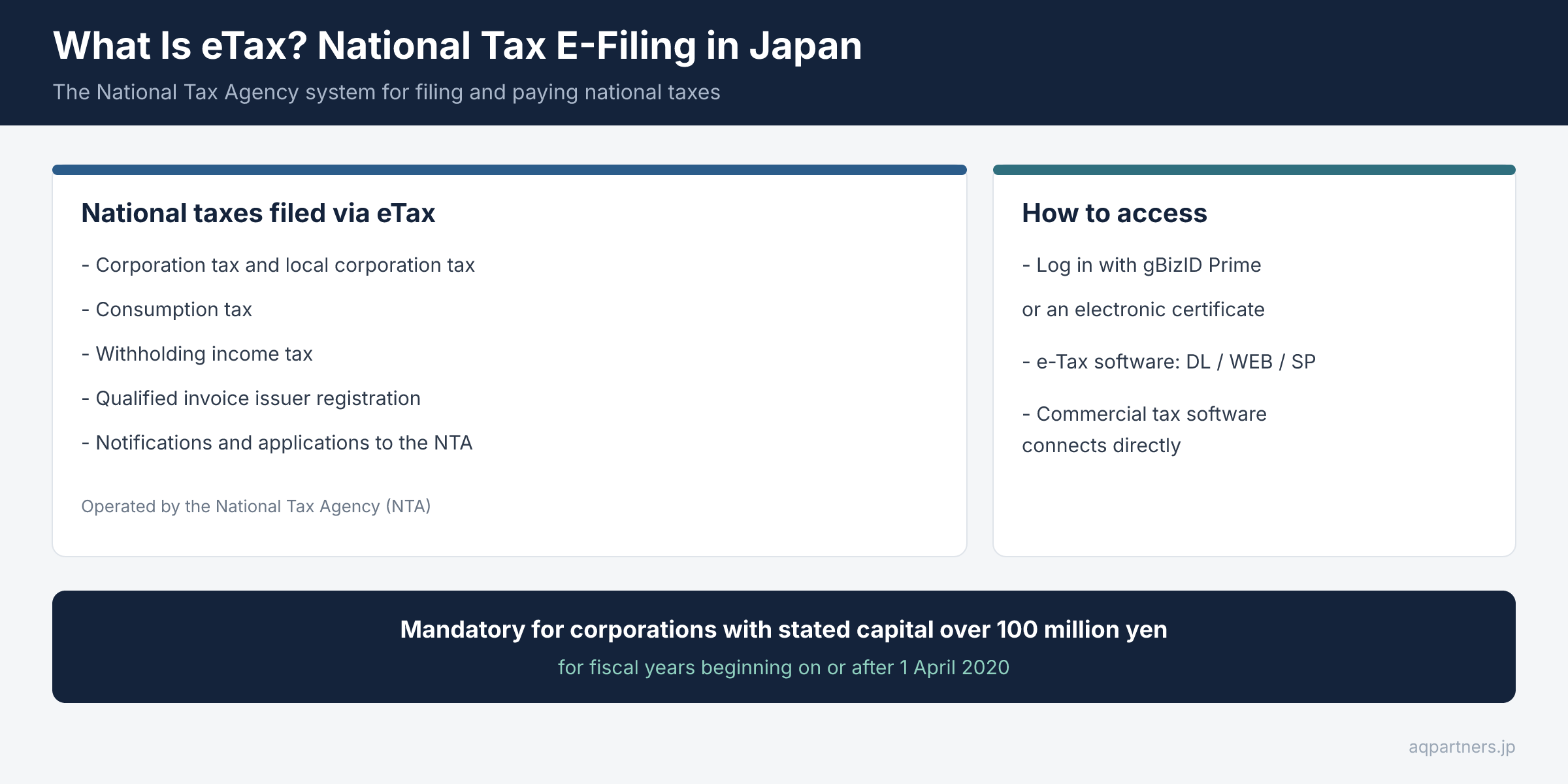
eTax (国税電子申告・納税システム) is Japan's official online system for filing and paying national taxes, operated by the National Tax Agency (NTA / 国税庁). If your company operates in Japan, eTax is where you submit corporation tax (法人税), consumption tax (消費税), and withholding income tax (源泉所得税) returns, make the related payments, and register as a qualified invoice issuer under the invoice system (インボイス制度). It is the national-tax counterpart to eLTAX, the separate portal used for local taxes. You log in with either a gBizID Prime account or an electronic certificate, then file through NTA-provided e-Tax software or a commercial tax package that connects to it. For foreign-owned companies, understanding eTax early prevents missed deadlines and keeps consumption-tax credits flowing to your customers.
Key Takeaways
- eTax is national-tax only (国税): corporation tax, local corporate tax, consumption tax (消費税) and withholding income tax (源泉所得税) go through eTax; prefectural and municipal taxes go through eLTAX instead.
- Operated by the National Tax Agency (国税庁): a single system covering filing, payment, and qualified invoice issuer registration nationwide.
- Mandatory above ¥100 million capital: corporations with paid-in/stated capital exceeding ¥100 million must e-file national tax returns via eTax for fiscal years beginning on or after 1 April 2020.
- Two ways in: log in with a gBizID Prime account or an electronic certificate (My Number Card or a commercial certificate).
- Invoice registration lives here: you obtain your T + 13-digit registration number (e.g. T1234567890123) by registering as a qualified invoice issuer through eTax.
What is eTax and who operates it?
eTax is the National Tax Agency's electronic filing and payment system for national taxes, letting companies submit returns, pay, and register for the invoice system online instead of on paper. It is run by the NTA (国税庁) and is entirely separate from eLTAX, which handles local taxes; the two are often confused, so it helps to be clear on the split from the start.
Because Japan splits taxation between national and local governments, most companies must interact with both systems each year. National taxes such as corporation tax and consumption tax are administered by the NTA through eTax, while prefectural and municipal taxes are administered through the local-government portal. If you are still deciding which system does what, our explainer on the difference between eLTAX and eTax maps the whole picture, and the wider guide to Japan's digital tax and filing platforms shows how eTax fits alongside gBizID and e-Gov. Japan's corporate tax framework is summarised for investors by JETRO.
Which taxes are filed through eTax?
eTax covers the national taxes a company owes to the central government: corporation tax, local corporate tax, consumption tax, and withholding income tax on salaries and certain payments. Local inhabitant and enterprise taxes are not filed here.
National taxWho paysNoteCorporation tax (法人税)All corporations with taxable income in JapanCore annual return; due within 2 months of fiscal year-end (extension possible)Local corporate tax (地方法人税)Corporations liable for corporation taxA national tax despite the name; filed together with corporation taxConsumption tax (消費税)Taxable enterprises above the exemption threshold, and registered invoice issuersNational portion filed via eTax; standard rate 10%Withholding income tax (源泉所得税)Employers and certain payersWithheld from salaries, dividends and some fees; remitted periodicallyQualified invoice registration (適格請求書発行事業者)Businesses wanting to issue creditable invoicesApplication processed through eTax; yields a T + 13-digit number
Enterprise tax (法人事業税) and corporate inhabitant tax (法人住民税) look similar but are local taxes handled through eLTAX, not eTax.
How do you set up and log in to eTax?
Setting up eTax means choosing an identity method and a client application: you authenticate with a gBizID Prime account or an electronic certificate, then file using NTA e-Tax software or a commercial package. Getting the login sorted first avoids delays at deadline time.
There are two authentication routes. A gBizID Prime account, issued to a company representative by the Digital Agency, can substitute for an electronic certificate on eTax and is reusable across many government services; our guide to gBizID as one login for government services explains how to obtain it. Alternatively you can use an electronic certificate, such as a My Number Card or a commercial certificate, read via a card reader. Once identity is set, you pick a client.
OptionTypeBest fore-Tax software (download)Full desktop clientCorporations filing a wide range of national tax formse-Tax software (WEB)Browser-basedCommon procedures without installing softwaree-Tax software (SP)Smartphone versionLighter, individual-oriented proceduresgBizID Prime loginIdentity methodCompanies wanting one reusable government loginElectronic certificateIdentity methodCompanies using My Number Card or a commercial certificateCommercial tax softwareThird-party clientFirms whose accounting software connects directly to eTax
Many companies let their accounting software or a filing agent connect to eTax on their behalf, which removes most of the client-setup burden.
When is eTax filing mandatory?
E-filing via eTax is mandatory for larger corporations: those with paid-in or stated capital exceeding ¥100 million must file national tax returns electronically for fiscal years beginning on or after 1 April 2020. Smaller companies may still file voluntarily, which we strongly recommend.
The ¥100 million threshold applies to corporation tax, local corporate tax, and consumption tax returns, and the same capital class must also file local taxes electronically via eLTAX and social insurance and labour procedures electronically via e-Gov. Foreign corporations are treated differently under the rule, so confirm your entity type. Even below the threshold, electronic filing shortens turnaround, provides submission receipts, and integrates cleanly with the invoice system, so most foreign-owned companies adopt eTax regardless of size (Source: National Tax Agency).
How does invoice registration work through eTax?
Qualified invoice issuer registration is completed through eTax: you apply to the NTA, and on approval you receive a registration number formatted as T + 13 digits that must appear on the invoices you issue. This is the fastest registration route.
Under the invoice system (適格請求書等保存方式), in force since 1 October 2023, your customers can only claim an input consumption-tax credit if you are a registered qualified invoice issuer. Applying via eTax typically takes a few weeks, versus a couple of months for paper applications to the Invoice Registration Center. Registered issuers, including their number, name and registered address for corporations, are published on the NTA's Invoice Issuer Publication Site. For the step-by-step mechanics and how the T-number is published, see our detailed post on registering as a qualified invoice issuer via e-Tax. You can review the NTA's own overview at the National Tax Agency.
Frequently Asked Questions
Is eTax the same as eLTAX?
No. eTax handles national taxes and is run by the National Tax Agency, while eLTAX handles local taxes and is run by the Organization for Local Tax. Most companies use both each year: eTax for corporation tax, consumption tax and withholding, and eLTAX for corporate inhabitant tax and enterprise tax. The systems are separate logins and separate software, though a gBizID account can be used with both.
Do small foreign-owned companies have to use eTax?
Only corporations with capital above ¥100 million are legally required to e-file national taxes. Companies below that threshold may still file on paper, but voluntary use of eTax is strongly recommended because it is faster, provides electronic receipts, and is required in practice for smooth invoice registration. Many foreign-owned subsidiaries adopt eTax from incorporation.
Can I use eTax without a My Number Card?
Yes. Besides an electronic certificate such as a My Number Card, you can authenticate with a gBizID Prime account issued to your company representative, which removes the need for a personal card reader. A commercial electronic certificate is a third option. Choosing gBizID Prime also gives you one reusable login across other government services.
Can AQ Partners file through eTax on our behalf?
Yes. AQ Partners can act as your filing agent (代理) on eTax, preparing and submitting corporation tax, consumption tax and withholding returns, and handling qualified invoice issuer registration. This lets foreign-owned companies meet Japanese national-tax obligations without building in-house filing capability. We coordinate national filings via eTax alongside local filings and payroll procedures.
Contact AQ Partners
eTax is the backbone of national-tax compliance in Japan, but the setup, the ¥100 million mandatory-filing rule, and invoice registration all reward getting the details right the first time. AQ Partners provides back-office, accounting, tax and compliance support for foreign companies, funds and families in Japan, and can act as your filing agent across eTax and the related platforms. Explore our back-office operations services, or contact AQ Partners at hello@aqpartners.jp to get started.
Sources
- National Tax Agency (国税庁) — e-Tax national tax e-filing and payment system
- National Tax Agency — Invoice system (適格請求書等保存方式) and qualified invoice issuer registration
- Digital Agency (デジタル庁) — gBizID login for government services
- JETRO — Corporate taxes in Japan, investment guidance

Yuga Koda is a founding Director at AQ Partners, supporting foreign companies, funds, and families operating in Japan. His experience operating companies in both Japan and international markets gives him a practical understanding of back office operations from both sides.