
Immigration Constraints on Japan Company Setup & Hiring

Key Takeaways
- Visa processing timelines of 2 to 3 months directly compress market entry schedules — the Certificate of Eligibility (COE) stage alone averages 1 to 2 months at regional immigration bureaus. According to JETRO's 2024 Invest Japan report, foreign companies that fail to account for immigration lead times frequently delay their Japan launch by 3 to 6 months beyond initial projections.
- The entity-visa chicken-and-egg problem is the single most common sequencing obstacle — a Business Manager visa requires an incorporated entity, but a Kabushiki Kaisha requires a Japan-resident representative director. Resolving this typically involves appointing an interim local director, using a startup visa program (available in Tokyo, Osaka, and Fukuoka), or choosing a Goudou Kaisha structure with more flexible residency rules.
- Every company that hires foreign nationals becomes a visa sponsor with ongoing compliance obligations — employers must notify the immigration bureau and Hello Work (public employment service) within 14 days of hiring or separating a foreign employee. The Ministry of Health, Labour and Welfare (MHLW) reported that approximately 2.05 million foreign workers were employed in Japan as of October 2024, a record high that has increased regulatory scrutiny of employer compliance.
- Visa categories restrict the job roles a company can fill with foreign workers — an Engineer/Specialist in Humanities visa holder cannot perform manual labor or unskilled work. Mismatched job duties and visa categories can result in revocation of the employee's status and penalties for the sponsoring employer.
- Employer of Record (EOR) arrangements allow companies to hire employees in Japan before completing entity incorporation — EOR providers serve as the legal employer and visa sponsor, enabling market testing with 1-5 employees while the company completes its own setup. This bridge strategy eliminates the visa-entity sequencing problem for initial hires.
How Immigration Timelines Shape Market Entry Planning
Immigration processing timelines in Japan — typically 2 to 3 months from COE application to visa issuance — function as a fixed constraint that determines the earliest possible date a foreign executive or employee can legally begin work in the country.
Foreign companies planning Japan market entry often build operational timelines around business milestones: signing a lease, incorporating the entity, opening a bank account, and beginning sales activities. Immigration, however, operates on its own schedule. The regional immigration bureau processes COE applications based on its own workload and review procedures, and the applicant has minimal ability to accelerate the process.
The practical impact is significant. A company that incorporates in January and immediately files a COE application for its founding executive may not receive approval until March, with the actual visa stamp obtained in late March or April. If the company also plans to hire two foreign engineers, those COE applications cannot be filed until the company exists as a legal entity and can demonstrate the financial capacity to pay salaries. The sequential nature of these dependencies means that a market entry timeline initially planned for Q1 can easily slip to Q2 or Q3.
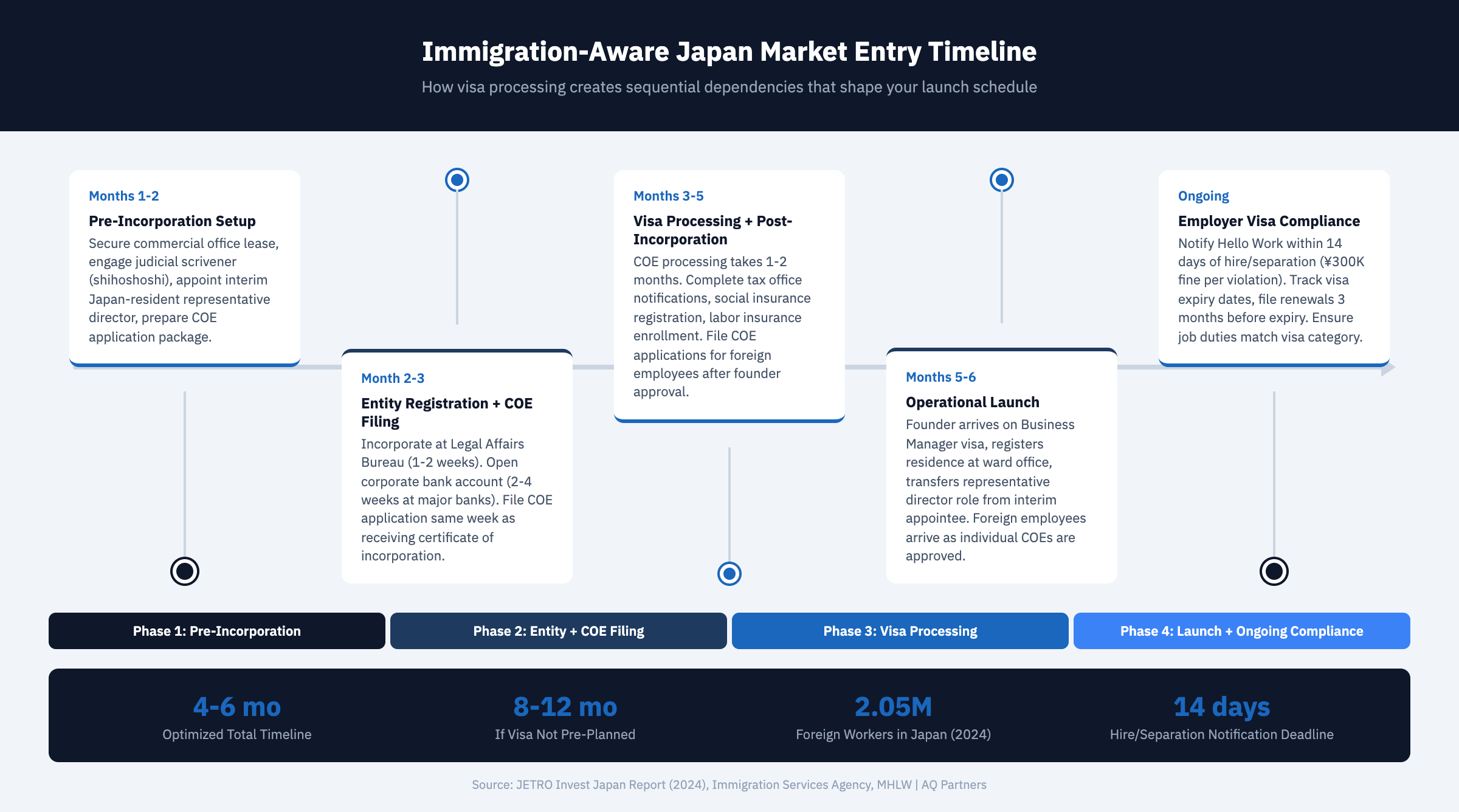
According to JETRO's business setup guide, the average total timeline from initial planning to full operational status for foreign companies entering Japan is 4 to 6 months when immigration is properly sequenced, but can extend to 8 to 12 months when visa processing is treated as an afterthought. Building immigration milestones into the project plan from day one — rather than treating them as a downstream task — is the most effective way to avoid costly delays.
The Entity-Visa Chicken-and-Egg Problem
Japan's immigration system requires an established entity to sponsor a visa, while corporate law requires a Japan-resident director to establish certain entity types — creating a circular dependency that every foreign founder must resolve before market entry.
The core dilemma operates as follows. To obtain a Business Manager visa, a foreign founder must submit proof of a registered Japanese entity (certificate of incorporation, articles of incorporation, and a commercial office lease). But to register a Kabushiki Kaisha — Japan's standard corporate form and the most common choice for foreign subsidiaries — at least one representative director must be a resident of Japan. A founder who has not yet obtained a visa cannot satisfy this residency requirement.
Five established strategies resolve this dependency:
- Interim local representative director: Appoint a trusted Japan-resident individual (a local co-founder, attorney, or professional nominee) as representative director for the incorporation phase. After the founder's visa is approved, the directorship transfers. This is the most common approach.
- Goudou Kaisha (GK) formation: The GK structure has historically had more flexible rules regarding representative member residency. Some immigration practitioners advise starting with a GK and later converting to a KK if needed. For a full comparison, see our guide to KK vs GK vs branch office structures.
- Branch office registration: A foreign company can register a branch office in Japan without incorporating a separate legal entity. The branch office can then sponsor a visa for the incoming representative. However, branch offices carry unlimited parent-company liability and face some operational limitations.
- Startup visa programs: Tokyo, Osaka, Fukuoka, and several other National Strategic Special Zone cities offer startup visas that grant a 6-month to 1-year temporary residence status for founders who are still preparing their incorporation. According to JETRO's 2024 data, these programs processed over 300 applications in FY2023.
- EOR as a bridge: An Employer of Record can serve as the legal employer and visa sponsor for the founder or initial employees while the entity incorporation proceeds in parallel. This approach is explored in detail below and in our EOR vs entity Japan hiring guide.
Visa Categories and the Roles You Can Fill
Each visa category restricts the holder to specific types of work activity — hiring a foreign national into a role that falls outside their visa's permitted activities constitutes a violation for both the employee and the sponsoring employer.
Japan's 29 residence status categories each define a scope of permitted activities. For employers, this means the visa category determines which positions a foreign hire can legally fill. A mismatch between job duties and visa category creates compliance risk for the employer, not just the employee.
| Visa Category | Permitted Job Roles | Not Permitted | Hiring Impact |
|---|---|---|---|
| Business Manager | Managing, administering, or starting a business | Manual labor, non-managerial duties | Founder/executive positions only |
| Engineer / Specialist in Humanities | Engineering, IT, finance, marketing, translation | Simple clerical work, manual labor | Most common for skilled professional hires |
| Intra-Company Transferee | Transfer within same corporate group for specialist/managerial roles | Work outside the group company | Requires 1+ year employment at parent company |
| Highly Skilled Professional (HSP) | Activities matching designated HSP category (A, B, or C) | Activities outside designated category | 5-year visa; fast-track PR; spouse can work full-time |
| Specified Skilled Worker (SSW) | Designated industry sectors (14 fields including food service, construction, manufacturing) | Work outside designated sector | Requires industry-specific skills test; newer category (2019) |
| Permanent Resident / Spouse of Japanese National | No restriction on work activities | No work restrictions | No sponsorship needed; simplest hire for employers |
For employers planning their first hires, the visa category question directly affects job descriptions, recruitment strategy, and onboarding timelines. A company that needs a bilingual operations manager can sponsor an Engineer/Specialist in Humanities visa, but a company that needs warehouse staff cannot use the same category. Understanding these restrictions before writing job postings prevents wasted recruitment effort. Our complete guide to Japan work visas provides deeper analysis of all 29 categories and their workplace implications.
Building Visa Sponsorship Infrastructure as an Employer
Any company that hires foreign nationals in Japan must establish internal processes for COE applications, status management, and mandatory government notifications — the absence of this infrastructure exposes the company to penalties and employee visa disruptions.
Visa sponsorship is not a one-time event. It creates an ongoing administrative obligation that persists throughout each foreign employee's tenure. The employer's responsibilities begin before the hire (filing the COE application), continue through onboarding (ensuring the employee registers their residence and receives a residence card), and extend through the entire employment relationship (tracking visa expiration dates, filing renewal applications, and reporting changes).
Mandatory Notification Requirements
Under the Employment Policy Act, employers must notify Hello Work (the public employment service) when hiring or separating a foreign national. This notification must be filed within 14 days and includes the employee's name, residence status, visa expiration date, and work location. Failure to file carries a fine of up to JPY 300,000 per violation. The Immigration Services Agency also requires companies to report certain changes, such as when a sponsored employee leaves the company.
The MHLW reported that approximately 2.05 million foreign workers were employed in Japan as of October 2024, representing a 12.4% year-over-year increase and a record high. This growth has prompted increased enforcement of employer notification requirements, with immigration authorities cross-referencing Hello Work filings against employer records.
Practical Sponsorship Infrastructure
Companies planning to hire foreign employees should establish the following internal processes: a visa tracking system to monitor expiration dates and trigger renewal applications 3 months before expiry; designated HR personnel familiar with COE application procedures; document management protocols for storing copies of residence cards, passports, and visa documentation; and a clear procedure for the mandatory Hello Work notifications. For broader HR compliance guidance, see our Japan HR compliance strategies for global teams.
Using EOR as a Bridge to Entity Incorporation
An Employer of Record allows foreign companies to legally hire and sponsor visas for employees in Japan without a local entity, providing a compliant bridge while the company completes its own incorporation process.
The EOR model works by inserting a Japan-licensed employer between the foreign company and its Japan-based employees. The EOR serves as the legal employer of record — handling employment contracts under Japanese labor law, processing payroll, managing social insurance enrollment, and critically, serving as the visa sponsor for foreign employees. The foreign company directs the employees' day-to-day work, but the legal employment relationship runs through the EOR.
This arrangement solves two problems simultaneously. First, it eliminates the entity-visa sequencing problem: the EOR already has the legal standing to sponsor visas, so the foreign company can hire employees before its own entity exists. Second, it allows market testing: a company can deploy 1 to 5 employees in Japan to validate product-market fit, build client relationships, or conduct pre-launch operations before committing to the cost and complexity of full incorporation.
The EOR bridge strategy has practical limits. EOR arrangements typically cost 15-25% above the employee's gross salary in management fees. For small teams (1-5 employees), this premium is often justified by the speed-to-market advantage. For larger teams or long-term operations, establishing your own entity becomes more cost-effective. Our EOR vs entity Japan hiring guide provides a detailed cost-benefit analysis and transition planning framework.
Immigration Compliance Obligations for Employers
Japanese law imposes specific compliance obligations on every employer of foreign nationals — including notification requirements, record-keeping duties, and prohibitions on facilitating unauthorized work activities.
Beyond the Hello Work notification requirement, employers must ensure that every foreign employee's work activities align with their visa category. Assigning duties outside the scope of an employee's permitted activities — even temporarily — can constitute facilitation of illegal employment. Under the Immigration Control Act, employers found to have knowingly employed a foreign national in activities not permitted by their visa face fines of up to JPY 3 million and imprisonment of up to 3 years.
| Compliance Obligation | Deadline / Frequency | Filed With | Penalty for Non-Compliance |
|---|---|---|---|
| Foreign employee hire notification | Within 14 days of hire date | Hello Work (Public Employment Service) | Fine up to JPY 300,000 per violation |
| Foreign employee separation notification | Within 14 days of separation | Hello Work (Public Employment Service) | Fine up to JPY 300,000 per violation |
| Visa status verification at hire | Before employment begins | Internal records (residence card check) | Employer liable for illegal employment facilitation |
| Visa renewal support | 3 months before visa expiry (recommended) | Regional Immigration Bureau | Employee loses work authorization if visa lapses |
| Change of employer notification (by employee) | Within 14 days of employer change | Immigration Bureau | May affect visa renewal eligibility |
| Social insurance enrollment for foreign employees | Within 5 days of hire | Japan Pension Service / Health Insurance Association | Late enrollment penalties; affects visa renewal assessment |
Companies should also be aware that immigration authorities increasingly coordinate with tax authorities and social insurance agencies. An employer that fails to enroll foreign employees in health insurance and pension — or that falls behind on corporate tax filings — may find that these compliance failures negatively impact future visa applications and renewals. For comprehensive post-incorporation compliance guidance, see our post-incorporation filing requirements guide.
Practical Planning Strategies for Immigration-Aware Market Entry
Companies that integrate immigration milestones into their market entry project plan from day one avoid the 3-6 month delays that commonly result from treating visa processing as an afterthought.
Based on the interdependencies outlined above, the following sequencing strategy minimizes total elapsed time from decision to operational status:
- Months 1-2 (pre-incorporation): Secure a commercial office lease, engage a judicial scrivener (shihoshoshi) for incorporation filings, appoint an interim Japan-resident representative director if needed, and prepare the COE application package. If using the EOR bridge strategy, engage the EOR provider and begin recruitment in parallel.
- Month 2-3 (incorporation + COE filing): Complete entity registration at the Legal Affairs Bureau (typically 1-2 weeks), open a corporate bank account (which can take 2-4 weeks at major Japanese banks), and file the COE application at the regional immigration bureau on the same day or within the same week as receiving the certificate of incorporation.
- Months 3-5 (visa processing + initial hiring): COE processing takes 1-2 months. Use this period to complete post-incorporation filings (tax office notifications, social insurance registration, labor insurance enrollment). Once the founder's COE is approved, file COE applications for any foreign employees.
- Months 5-6 (operational launch): Founder arrives on Business Manager visa, registers residence at ward office, transfers representative director role from interim appointee, and begins operations. Foreign employees arrive as their individual COEs are approved.
This 6-month timeline assumes reasonably smooth processing at each stage. Companies entering through National Strategic Special Zones with startup visa programs may compress the early stages. Companies using an EOR bridge strategy can have employees working in Japan as early as month 2-3 while the entity incorporation proceeds in parallel.
The key principle is parallel processing: tasks that do not depend on each other should run simultaneously. Entity incorporation, office setup, COE application preparation, and employee recruitment can all overlap. Tasks that have hard sequential dependencies — such as filing the COE only after incorporation is complete — should be identified early and their lead times built into the critical path. For a comprehensive view of back-office setup requirements beyond immigration, see our Japan market entry back-office guide.
Frequently Asked Questions
Can a company sponsor a visa before it has a physical office in Japan?
No. The COE application requires proof of a dedicated commercial office space, including a lease agreement in the company's name. Virtual office addresses and residential addresses are generally not accepted. The office must be secured before the visa application is filed. Some companies lease a small serviced office to meet this requirement during the initial setup phase, then move to larger premises as operations scale.
What happens if a sponsored employee leaves the company?
The employer must file a separation notification with Hello Work within 14 days. The employee's visa remains valid until its expiration date, but the individual must either find a new employer willing to sponsor their visa or change their status of residence. If the employee does not secure new sponsorship or change status within 3 months of leaving employment, the immigration bureau may revoke their residence status. Employers should include this notification obligation in their standard offboarding procedures.
How does immigration status affect the ability to open a corporate bank account?
Japanese banks require at least one authorized signatory to hold a valid residence card and be physically present in Japan. A founder waiting for a Business Manager visa cannot personally open the corporate bank account until they arrive. The interim representative director (if a Japan resident) can open the account during the incorporation phase. Banks also typically require the company to have been incorporated for at least 6 months before opening an account, though this policy varies by institution. Account opening timelines average 2-4 weeks at major banks, adding another variable to the overall market entry schedule.
Coordinating immigration timelines with entity formation, hiring, and regulatory compliance requires careful sequencing and local expertise.
Working with AQ Partners. Our Tokyo team provides KK and GK incorporation, rules of employment, employment contracts and offer letters and monthly payroll coordination with a licensed sharoushi for foreign companies operating in Japan, so the entity and payroll that support the application are in order. Book a consultation to discuss your situation.

Yuga Koda is a founding Director at AQ Partners, supporting foreign companies, funds, and families operating in Japan. His experience operating companies in both Japan and international markets gives him a practical understanding of back office operations from both sides.