
Closing a Branch Office in Japan: Steps and Filings

Closing a branch office in Japan means ending the foreign company's registration as a foreign company (外国会社, gaikoku kaisha) by retiring every representative in Japan who lives in Japan, after a creditor notice in the Official Gazette (官報, kanpo). The foreign company itself is not dissolved and stays liable for its Japanese debts.
This guide is for groups leaving Japan entirely. If the business is moving into a new Japanese subsidiary instead, the branch closes as the last step of a branch-to-subsidiary conversion.
Key Takeaways
- The branch closes through its representatives. The registration ends when every Japan-resident representative retires and the retirement is registered; there is no Japanese dissolution or liquidator.
- Creditors get at least one month. A kanpo notice and individual notices to known creditors must give an objection period of no less than one month.
- The retirement only takes effect on registration. Until the Legal Affairs Bureau registers it, the representatives remain in office for the company in Japan.
- The last branch return can fall due on closing day. A branch that stops being a permanent establishment without first notifying a tax agent must file its final corporation tax return by the day it closes, not two months later.
- Payroll and social insurance close on short clocks. The pension office expects the full-loss notice within 5 days, Hello Work the closure notice within 10 days, and the labour insurance final declaration is due within 50 days.
What closing a Japan branch means in law
A Japan branch is a registered office of a foreign company, not a separate legal person. Under the Companies Act, it closes when its Japan-resident representatives retire and that retirement is registered.
Under the Companies Act, a foreign company trading continuously in Japan must appoint representatives in Japan, at least one living in Japan (Article 817), and register before it trades (Article 818). The branch office (営業所, eigyosho) is registered as part of that foreign company registration; our guide to foreign company registration versus a subsidiary explains the status.
Article 820 adds one condition: a creditor procedure must be completed before the retirement can be registered.
Two exceptions apply. A company that closes every office but keeps a Japan-resident representative stays registered: under Article 936(2) it registers the closure at the office's location within three weeks and a foreign company registration at the representative's address within four weeks, or only the closure if that address is in the same registry district. Where a court has ordered liquidation of the company's assets in Japan under Article 822, the Article 820 creditor procedure does not apply.
Branch closure compared with liquidating a KK
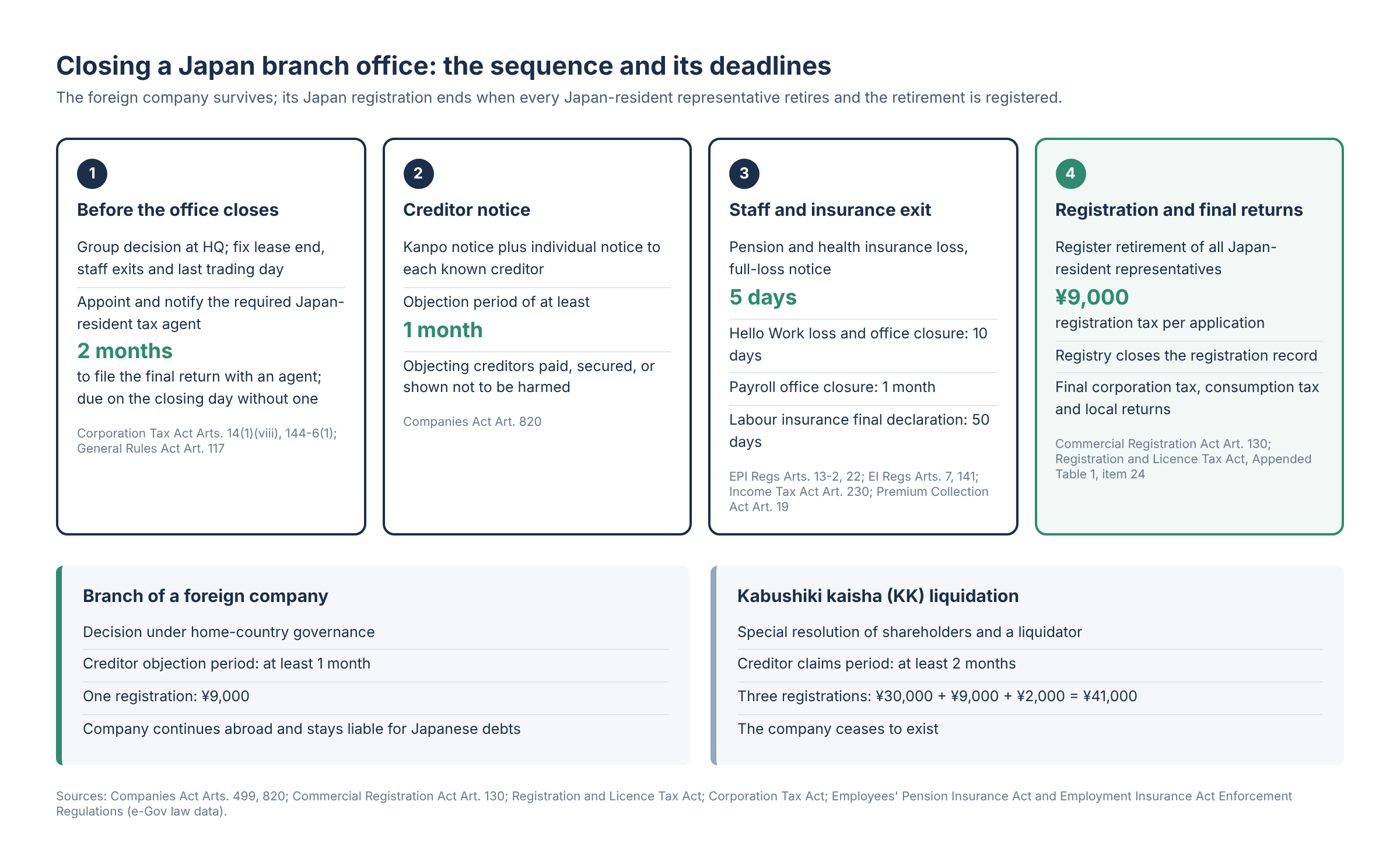
A branch exit has a shorter statutory minimum and one registration, because nothing is dissolved in Japan; a KK needs a liquidator and three registrations.
Our entity comparison covers how the two forms differ while they operate.
| Point | Branch of a foreign company | Kabushiki kaisha (KK) |
|---|---|---|
| Legal effect | Foreign company registration in Japan ends; the company continues abroad | The Japanese company is dissolved and ceases to exist |
| Decision | Taken under home-country law and the company's own governance | Special resolution of shareholders (Companies Act Articles 471 and 309(2)) |
| Who runs the exit in Japan | The representatives in Japan until their retirement is registered | A liquidator registered after dissolution |
| Creditor notice in the kanpo | Objection period of at least one month (Article 820) | Claims period of at least two months (Article 499) |
| Registrations | One: retirement of all Japan-resident representatives | Three: dissolution, liquidator, completion of liquidation |
| Registration and licence tax | ¥9,000 per application (Act, Appended Table 1, item 24(2)) | ¥30,000 + ¥9,000 + ¥2,000 = ¥41,000 (Act, Appended Table 1, item 24) |
| Corporation tax year | Ends on the day the branch stops being a permanent establishment | Ends on the dissolution date, then liquidation-period years follow |
| Liability for Japanese debts | Stays with the foreign company after the branch closes | Must be settled before residual assets go to the shareholder |
The tax figures come from item 24 of Appended Table 1 of the Registration and Licence Tax Act. Where the company is registered at more than one Legal Affairs Bureau, each registry receives its own application. A dormant subsidiary that nobody liquidates follows a different track, covered in our guide to deemed dissolution.
The creditor notice before the representatives retire
Article 820 requires a kanpo notice and individual notices to known creditors, giving at least one month to object before the retirement is registered.
The notice invites objections to the retirement of all representatives in Japan within the stated period. Known creditors include the landlord, suppliers, lenders and any employee owed wages or a retirement allowance. If a creditor objects, Article 820(2) requires the company to repay it, provide adequate security, or entrust adequate property to a trust company for its benefit, unless the retirement would not harm that creditor.
Skipping the procedure or completing the retirement in breach of it exposes the representatives to a civil fine of up to ¥1,000,000 under Article 976.
The retirement can be registered only after the stated period has passed and any objections are dealt with (Article 820(3)), so the notice goes out once the lease, contract and staff exit dates are fixed.
Registering the retirement of every representative in Japan
After the objection period, the representatives file their retirement at the Legal Affairs Bureau. It takes effect on registration, and the record is closed.
Commercial Registration Act Article 130 sets the attachments. The application carries a document proving the retirement, authenticated by the competent authority of the home country or a Japanese consul or other authorised official, plus documents proving that the kanpo notice and individual notices were made and that any objecting creditor was paid, secured or not harmed.
Article 96 of the Commercial Registration Rules sets the record closure for a foreign company with offices in Japan.
After the record is closed, the company has no registration in Japan. Article 818 bars an unregistered foreign company from transacting continuously in Japan, and anyone who does so is jointly liable with the company for the resulting debts. Contracts that must outlive the branch, such as customer warranties, need to be assigned or handled from abroad without continuous trading in Japan.
Tax office filings and the final branch return
The branch's tax year ends when it stops being a permanent establishment. The final return is due on that day unless a tax agent has been notified.
Article 14(1)(viii) of the Corporation Tax Act ends the business year of a foreign corporation on the day it ceases to have a permanent establishment in Japan. Article 144-6(1) gives two months after the year end, but only if a tax agent (納税管理人, nozei kanrinin) was notified under Article 117(2) of the Act on General Rules for National Taxes.
Article 117(1) makes appointing a Japan-resident tax agent mandatory for a foreign corporation that no longer has an office in Japan but still has national tax matters, such as the final return.
The other tax filings key off the same date:
- Consumption tax. The Consumption Tax Act uses the corporation tax business year, so the final taxable period ends on the same day and, for a taxable business, its return is due within two months under Article 45. A business abolition notification is filed promptly under Article 57(1)(iii); once it is filed, qualified invoice issuer registration lapses the day after the business ends (Article 57-2(10)).
- Foreign ordinary corporation status. The National Tax Agency notification that the company is no longer a foreign ordinary corporation is filed promptly, but only when it has no permanent establishment and also no remaining personal-services business in Japan, income from Japanese assets or real estate rent.
- Local taxes. The prefectural inhabitant tax return is due by the same deadline as the national return (Local Tax Act Article 53), and the prefecture and municipality each expect a closure notice under their own ordinance.
A company that keeps such income, for example rent from Japanese property, continues to file as a foreign corporation without a permanent establishment under Article 144-6(2). The annual cycle the branch leaves behind is set out in our guide to corporate tax obligations in Japan.
Employees, social insurance and labour insurance
Each employee's coverage ends with a loss filing, then the workplace itself is closed. Deadlines run from 5 to 50 days depending on the office.
Employment ends by agreement or by dismissal; a dismissal needs 30 days' advance notice or average wages in lieu under Labour Standards Act Article 20, and our article on dismissal rules in Japan covers the wider limits.
| Filing | Where | Deadline | Legal basis |
|---|---|---|---|
| Pension and health insurance loss of coverage, per employee | Japan Pension Service | Within 5 days of the loss | Employees' Pension Insurance Act Enforcement Regulations Article 22 |
| Full-loss notice for the workplace (全喪届, zenso todoke) | Japan Pension Service | Within 5 days of ceasing to be a covered workplace | Same regulations, Article 13-2 |
| Employment insurance loss of coverage, with separation certificate | Hello Work | Within 10 days from the day after the loss | Employment Insurance Act Enforcement Regulations Article 7 |
| Employment insurance office closure | Hello Work | Within 10 days from the day after closure | Same regulations, Article 141 |
| Labour insurance final premium declaration | Labour Standards Inspection Office or labour bureau | Within 50 days of the insurance relationship ending | Labour Insurance Premium Collection Act Article 19 |
| Payroll office closure | Tax office | Within one month | Income Tax Act Article 230 |
The Japan Pension Service accepts a copy of the employment insurance closure notice as evidence for the full-loss notice, and a copy of the tax office payroll office closure notice where that is not available. Health insurance through Kyokai Kenpo is reported on the same forms. Enrolment, the reverse of these filings, is covered in our social insurance enrolment guide.
A withdrawal sequence that respects the clocks
Order matters more than speed: tax agent and dates first, then the creditor notice, payroll and insurance exits, and the registration last.
- Group decision and dates. Approve the withdrawal at HQ and fix the lease end, staff exit dates and the last trading day.
- Tax agent. Appoint and notify the required Japan-resident tax agent before the office closes.
- Creditor notice. Publish in the kanpo and notify known creditors; settle or secure any objection.
- People and insurance. Run final payroll, file the loss notices, then the full-loss and office closure notices.
- Registration. File the retirement of all Japan-resident representatives with the Article 820 evidence; the registration record is closed.
- Final returns. File the last corporation tax, consumption tax and local returns and the labour insurance final declaration.
Keep one bank account open until any refund of tax or insurance premiums has been paid into it.
Frequently asked questions
What happens to the branch registration in Japan when the branch closes?
The record stays on file as a closed record. A certificate of closed registration matters (閉鎖事項証明書) can be obtained from the Legal Affairs Bureau and shows the date the registration ended.
Does a representative office go through the same closing procedure as a branch?
No. A representative office that never registered as a foreign company has no registration to close, so the Article 820 creditor notice does not apply. It still files loss and closure notices with any tax, pension and employment insurance offices it enrolled with.
Do employees receive a retirement allowance when the Japan branch closes?
There is no statutory retirement allowance. An employer that regularly employs 10 or more workers must have rules of employment, and if it has a retirement allowance, Labour Standards Act Article 89(iii-2) requires those rules to set out who is covered and how it is calculated; a contract or collective agreement can also create the right. Our guide to severance pay and retirement allowances covers the details.
Working with AQ Partners. Our Tokyo team provides commercial registration changes, annual tax filings and employee life-cycle filings for foreign companies operating in Japan. Book a consultation to review your Japan exit plan.

Yuga Koda is a founding Director at AQ Partners, supporting foreign companies, funds, and families operating in Japan. His experience operating companies in both Japan and international markets gives him a practical understanding of back office operations from both sides.