
Business Visa Options for Founders Expanding to Japan

Key Takeaways
- The Business Manager visa is the primary pathway for foreign founders and executives establishing operations in Japan — it requires a minimum capital investment of JPY 30 million (approximately USD 200,000) and the employment of at least one qualifying full-time employee resident in Japan, for applications filed on or after 16 October 2025. According to the Immigration Services Agency of Japan's 2024 statistics, Business Manager visa approvals reached 14,891 new grants, reflecting growing foreign entrepreneurial interest.
- Highly Skilled Professional (HSP) visas offer accelerated permanent residency for qualifying executives — executives scoring 70 points or above on the points-based system receive a 5-year visa with a path to permanent residency in as few as 1 year (80+ points) or 3 years (70+ points), compared to the standard 10-year requirement.
- At least one representative director of a Kabushiki Kaisha (KK) must be a resident of Japan — this residency requirement creates a sequencing challenge for founders who have not yet obtained their visa, often requiring interim appointment of a Japan-resident director during the incorporation process.
- Dependent visas allow spouses and children to accompany founders to Japan — dependents receive permission to stay for the same duration as the primary visa holder. Spouses can obtain work permission for up to 28 hours per week by applying for a separate activity permit at the local immigration office.
- Visa processing typically takes 1 to 3 months from Certificate of Eligibility (COE) application to visa issuance — JETRO's 2024 Invest Japan report notes that the COE stage alone averages 1 to 2 months, making early application essential for market entry timeline planning.
What Is a Business Manager Visa and Who Needs One?
A Business Manager visa is the primary residence status that Japan's Immigration Control and Refugee Recognition Act grants to foreign nationals who will manage or operate a business in Japan, including company founders, executive directors, and branch office managers.
Foreign founders and executives expanding into Japan face a fundamentally different visa question than employees transferring on an intra-company assignment. Rather than being sponsored by an existing employer, founders must demonstrate they are establishing or managing a legitimate business with sufficient capital and operational substance. The Business Manager visa (formerly called the Investor/Business Manager visa before the 2015 reclassification) is the status of residence specifically designed for this purpose.
Japan's immigration framework distinguishes between individuals who work for a company and those who run one. Even if you hold expertise in engineering or humanities, founding and directing a company in Japan requires the Business Manager designation. According to the Immigration Services Agency of Japan, this visa covers activities including starting a business, investing in a business, or managing/administering a business in Japan on behalf of foreign nationals or foreign corporations.
Business Manager Visa: Requirements and Capital Thresholds
The Business Manager visa requires a minimum JPY 30 million investment in the Japanese entity, at least one qualifying full-time employee resident in Japan, a dedicated physical office, and a viable business plan demonstrating operational sustainability. These thresholds apply for applications filed on or after 16 October 2025; the previous capital standard was JPY 5 million.
The eligibility criteria for the Business Manager visa center on three pillars: capital commitment, physical presence, and business viability. Each criterion must be satisfied at the time of application, meaning founders need to complete substantial groundwork before the immigration process begins.
Capital and Staffing Requirements
The JPY 30 million capital threshold (approximately USD 200,000) represents the minimum equity investment in the Japanese entity. This capital must be deposited into a Japan-based bank account and reflected in the company's articles of incorporation. The former alternative of employing two full-time Japanese national or permanent resident staff in place of the capital threshold was removed by the October 2025 reform. Applicants must now satisfy the capital threshold and separately employ at least one full-time employee resident in Japan who holds Japanese nationality, permanent residence, special permanent residence, or a status of residence based on personal relationship. According to JETRO's guide on visa categories, these requirements apply whether the founder establishes a new Kabushiki Kaisha (KK), a Goudou Kaisha (GK), or a branch office of a foreign corporation.
Office and Business Plan
Immigration authorities require a dedicated business office — a residential address or virtual office generally does not satisfy this requirement. The office must be a commercially zoned space with a lease agreement in the company's name. Additionally, applicants must submit a detailed business plan demonstrating the company's operational viability, including projected revenues, staffing plans, and a description of business activities.
| Requirement | Business Manager Visa Specifics | Key Notes |
|---|---|---|
| Minimum Capital | JPY 30,000,000 (approx. USD 200,000) | Must be deposited in a Japan bank account |
| Employee Requirement | At least 1 full-time employee resident in Japan | Must hold Japanese nationality, permanent residence, special permanent residence, or a status based on personal relationship |
| Physical Office | Dedicated commercial space required | Virtual offices and co-working addresses generally rejected |
| Business Plan | Detailed plan with revenue projections | Must demonstrate operational viability and sustainability |
| Visa Duration | 1 year (initial), renewable for 1, 3, or 5 years | Renewals depend on business performance and tax compliance |
| Permitted Activities | Start, invest in, manage, or administer a business | Cannot engage in manual labor or non-managerial work |
| Tax Compliance | Full personal and corporate tax obligations | Delinquent tax filings jeopardize visa renewal |
| Application Route | Certificate of Eligibility (COE) first, then visa at embassy | COE processing: 1-2 months; total timeline: 2-3 months |
Highly Skilled Professional (HSP) Visa for Executives
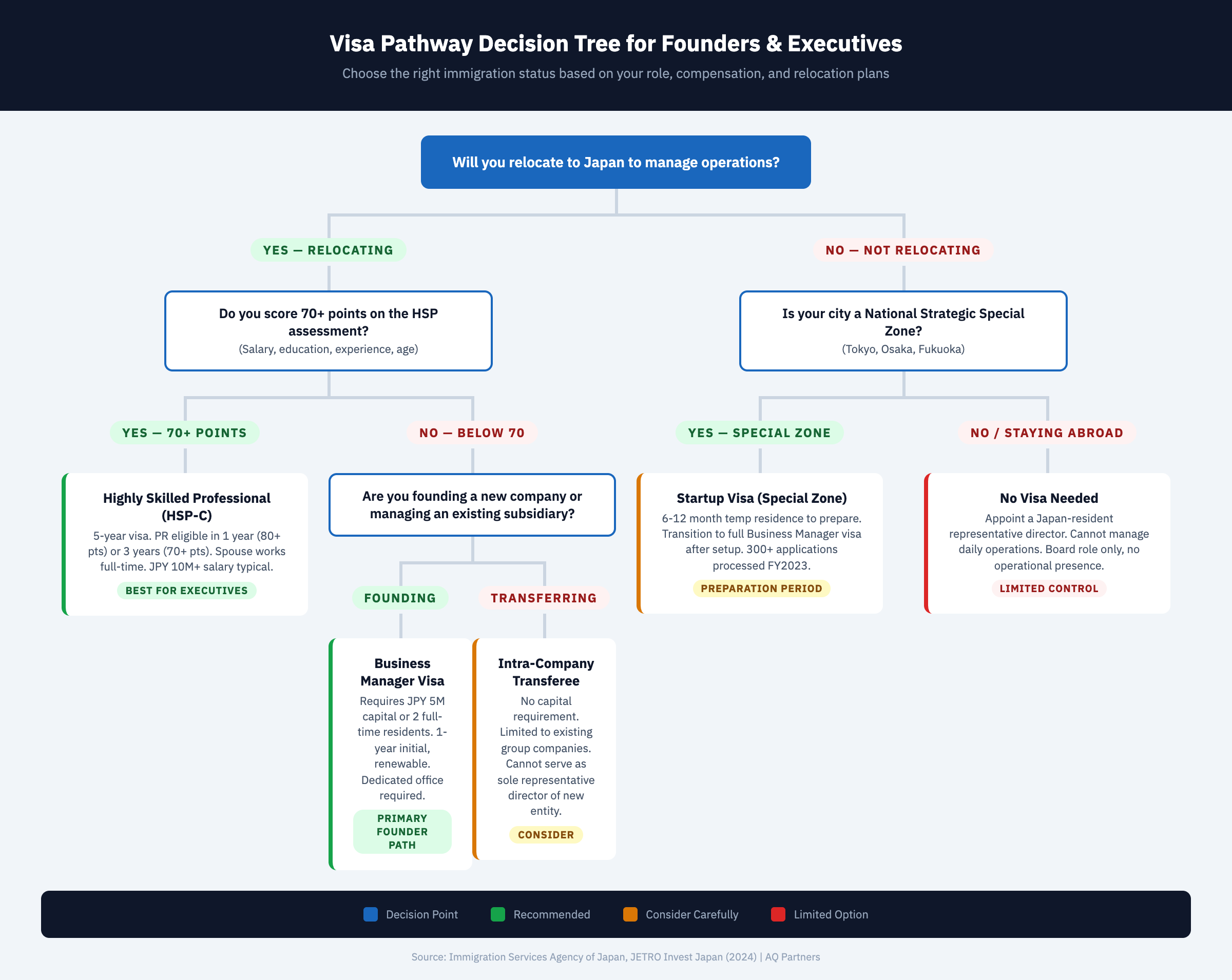
The Highly Skilled Professional visa offers qualifying executives a points-based fast track to a 5-year visa and permanent residency in as few as 1 to 3 years, compared to the standard 10-year pathway.
Japan's HSP visa system, introduced in 2012 and revised significantly in 2015, uses a points-based assessment across three categories. For founders and executives, the relevant categories are "Advanced Business Management Activities" (Category C) and, in some cases, "Advanced Academic Research Activities" or "Advanced Specialized/Technical Activities" for those with dual roles. The Immigration Services Agency's points calculator evaluates applicants on academic background, professional experience, annual salary, age, and bonus factors such as Japanese language proficiency or graduation from a top-ranked university.
Executives who score 70 points receive a 5-year visa with eligibility for permanent residency after 3 years of continuous residence. Those scoring 80 points or above can apply for permanent residency after just 1 year. According to ISA data, the number of HSP visa holders in Japan surpassed 38,000 cumulative approvals by the end of 2024, with business management activities accounting for approximately 12% of all HSP grants.
The HSP visa also confers additional benefits not available under the standard Business Manager visa: permission for a spouse to work full-time (not limited to 28 hours), the ability to bring a parent to Japan under certain conditions (such as having a child under 7), and permission to employ a domestic worker. For founders weighing their options, the HSP visa represents a strategic advantage if they can meet the points threshold. Detailed comparison of all work visa pathways is available in our complete guide to Japan work visas.
Residency Requirements for Representative Directors
Japanese corporate law requires at least one representative director of a Kabushiki Kaisha to be a resident of Japan, creating a sequencing challenge that founders must plan around before incorporation.
Under the Companies Act, a Kabushiki Kaisha (KK) — the standard corporation form chosen by most foreign companies — must have at least one representative director (daihyo torishimariyaku) who resides in Japan. This means the individual must hold a valid residence status and maintain a registered address in Japan. The requirement creates a practical dilemma for foreign founders: to obtain a Business Manager visa, you typically need an established entity, but to establish the entity, you need a Japan-resident director.
Several strategies address this sequencing challenge. Some founders appoint a trusted Japan-resident individual (such as a local partner, attorney, or compliance officer) as interim representative director during incorporation, then transfer the role once their own visa is approved. Others choose a Goudou Kaisha (GK) structure, which has historically had more flexible director residency requirements. For a comprehensive comparison of entity structures, see our guide to KK vs GK vs branch office in Japan.
Certain designated National Strategic Special Zones — including Tokyo, Osaka, and Fukuoka — offer startup visa programs that provide a temporary 6-month to 1-year residence status specifically designed to give founders time to complete incorporation and business setup before transitioning to a full Business Manager visa. According to JETRO's 2024 startup ecosystem report, these programs processed over 300 applications in FY2023, with Tokyo and Fukuoka accounting for the majority of approvals.
Comparing Visa Pathways: Which Status Fits Your Role?
The right visa depends on whether you are founding a company, managing an existing subsidiary, or serving as a technical executive — each scenario maps to a different immigration pathway with distinct requirements.
| Scenario | Recommended Visa | Key Advantage | Primary Limitation |
|---|---|---|---|
| Founding a new company in Japan | Business Manager | Direct pathway for entrepreneurs | JPY 5M capital requirement |
| High-earning executive (annual salary JPY 10M+) | Highly Skilled Professional (HSP-C) | Fast-track PR in 1-3 years | Points threshold (70+ required) |
| Executive transferring from HQ to Japan subsidiary | Intra-Company Transferee or Business Manager | No capital requirement for ICT | ICT limited to existing group companies |
| Startup founder in a Special Zone city | Startup Visa (Special Zone) | 6-12 months to prepare before full visa | Limited to designated cities only |
| Non-resident investor (no relocation) | No visa needed (appoint local representative) | No immigration process | Cannot manage daily operations from abroad |
| CTO/technical co-founder | Engineer/Specialist in Humanities or HSP-B | Suitable if role is primarily technical | Cannot serve as sole representative director |
Selecting the right visa category requires careful analysis of your specific role, compensation, and long-term plans. For detailed guidance on visa category selection for various job functions, see our guide on how to choose the right Japan work visa category.
Spouse and Dependent Visa Considerations
Dependents of Business Manager visa holders receive residence status for the same duration as the primary holder, with spouses eligible for part-time work authorization upon separate application.
Founders relocating to Japan with family can sponsor dependent visas for their spouse and unmarried children under 18. The Dependent visa (kazoku taizai) allows family members to reside in Japan for the validity period of the primary visa holder's status. The application requires proof of the family relationship (marriage certificate or birth certificate, apostilled and translated into Japanese) and evidence of financial capacity to support dependents.
Spouses holding Dependent visas may apply for a "Permission to Engage in Activities Other Than Those Permitted by the Status of Residence Previously Granted" at the local immigration bureau. This permit allows part-time employment of up to 28 hours per week. HSP visa holders benefit from more favorable dependent rules: their spouses receive unrestricted work authorization, eliminating the 28-hour weekly cap.
Children of visa holders can enroll in Japanese public schools or international schools. Japan has approximately 250 international schools across major metropolitan areas, with annual tuition ranging from JPY 1.5 million to JPY 3 million, according to JETRO's guide to living in Japan. Access to international education is a practical consideration that influences many founders' decisions about which city to establish their base.
Visa Application Process and Timeline for Founders
The founder visa process follows a two-stage workflow — Certificate of Eligibility application in Japan (1-2 months), followed by visa issuance at an embassy abroad (1-2 weeks) — with total elapsed time typically ranging from 2 to 3 months.
The Certificate of Eligibility (COE) is the critical first step. A Japan-based representative (often the appointed interim director, an immigration attorney, or an administrative scrivener known as a gyoseishoshi) files the COE application at the regional immigration bureau on the founder's behalf. Required documents include the company's certificate of incorporation, articles of incorporation, business plan, financial statements or capitalization proof, office lease agreement, and the applicant's passport copy and resume.
Once the COE is approved and mailed to the applicant abroad, the founder takes it to the nearest Japanese embassy or consulate to apply for the actual visa stamp. This second stage typically takes 5 to 10 business days. After arrival in Japan, the founder must register their residence at the municipal ward office within 14 days and apply for a residence card (zairyu card) if one was not issued at the port of entry.
Visa renewals occur before the current status expires, typically at the 1-year mark for initial Business Manager visas. Renewal applications require evidence of ongoing business operations, including tax filings, financial statements, and proof that the business continues to meet the original eligibility criteria. According to ISA guidelines, companies that fail to meet tax obligations or demonstrate business inactivity face denial of renewal.
Understanding how these immigration timelines interact with entity formation, office leasing, and hiring schedules is essential for realistic market entry planning. For a detailed analysis of these interdependencies, see our post on how immigration constraints affect company setup and hiring plans.
Frequently Asked Questions
Can I apply for a Business Manager visa without first incorporating a company?
Generally, no. The COE application requires a certificate of incorporation, articles of incorporation, and an office lease in the company's name. The entity must exist before the visa application can be filed. Some National Strategic Special Zone cities (Tokyo, Osaka, Fukuoka) offer startup visas that allow a 6-12 month preparation period, but the standard pathway requires incorporation first. Founders typically resolve this by appointing a Japan-resident interim director to complete incorporation before the visa application.
What happens to my Business Manager visa if the company becomes unprofitable?
Temporary unprofitability does not automatically result in visa revocation. Immigration authorities evaluate the overall viability and continuity of the business during renewal. However, prolonged inactivity, failure to file tax returns, or complete cessation of business operations can lead to denial of renewal. Maintaining proper corporate filings, tax compliance, and demonstrable business activity — even during periods of low revenue — protects visa status.
Can I hold both a Business Manager visa and work for another company?
The Business Manager visa permits only activities related to managing or administering the visa-sponsoring business. Engaging in work for another company requires a separate "Permission to Engage in Other Activities" from the immigration bureau. If the majority of your activities involve employment at another company rather than managing your own, immigration authorities may question the validity of the Business Manager status. Executives with dual roles should consult an immigration specialist to determine the appropriate visa category.
Navigating Japan's business visa requirements alongside entity formation, banking, and regulatory compliance involves multiple interdependent steps.
Working with AQ Partners. Our Tokyo team provides KK and GK incorporation, rules of employment, employment contracts and offer letters and monthly payroll coordination with a licensed sharoushi for foreign companies operating in Japan, so the entity and payroll that support the application are in order. Book a consultation to discuss your situation.

Yuga Koda is a founding Director at AQ Partners, supporting foreign companies, funds, and families operating in Japan. His experience operating companies in both Japan and international markets gives him a practical understanding of back office operations from both sides.