
Service Level Agreements for Japan Back-Office Services: What to Measure and What Is Unrealistic


A service level agreement (SLA) for Japan back-office services is the part of an outsourcing contract that defines what the provider must deliver, how delivery is measured, and what happens when it falls short. For a foreign-owned subsidiary, the SLA covers accounting, payroll, tax filings, social insurance, and corporate registrations, and it is the main tool headquarters has to manage a provider it rarely meets. Writing one for Japan raises a specific problem: several outcomes that matter most, such as a registration being completed, a bank account being opened, or a residence status being granted, are decided by a government office or a bank, not by the provider. This guide sets out which metrics belong in a Japan back-office SLA, how to word them, which outcomes a provider cannot promise, how statutory deadlines fit in, and how service credits, escalation, and exit terms should work.
Key Takeaways
- Measure what the provider controls. Accuracy, completeness, submission by an agreed date, and response to queries are within a provider's control. Government processing and bank decisions are not, and an SLA that promises them is unenforceable.
- Statutory deadlines are the floor, not the target. Withholding tax by the 10th of the following month, social insurance enrolment within 5 days, and the corporate tax return within 2 months of year-end are legal obligations. The SLA should require filing before them with a margin, set by the two parties.
- Word metrics as events, not feelings. "Submitted to the pension office" or "package delivered to the shared folder" can be checked; "timely" and "best efforts" cannot.
- Service credits matter less than escalation and exit. A fee reduction rarely compensates for a missed filing. A named escalation path and a defined handover on exit protect the subsidiary more.
- Someone at headquarters must read the reports. Deloitte's 2024 survey found 70% of executives say their vendor management function is not fully mature. An SLA without a reviewer is a document, not a control.
What an SLA for Japan Back-Office Services Should Cover
A Japan back-office SLA should define deliverables, measures, reporting, credits, escalation, and exit for each service the provider runs.
Outsourcing contracts often put the scope in one exhibit and the service levels in another, and the two drift apart. For a Japan subsidiary, the cleaner approach is one row per service from the scope table, with the deliverable, the measure, and the evidence on the same line. The scope itself is usually the checklist used in the provider selection; the structure of that checklist and the 30 questions that test it are set out in how to choose a back-office provider for a Japan subsidiary.
Outsourcing remains a growing commitment for most groups. According to Deloitte's Global Outsourcing Survey 2024, which polled more than 500 executives, 80% plan to maintain or increase their investment in third-party outsourcing, and 70% report that their vendor management function is not fully mature. For a small Japan entity managed from abroad, that gap is where SLAs fail: the contract defines service levels, and no one checks them until a penalty notice arrives.
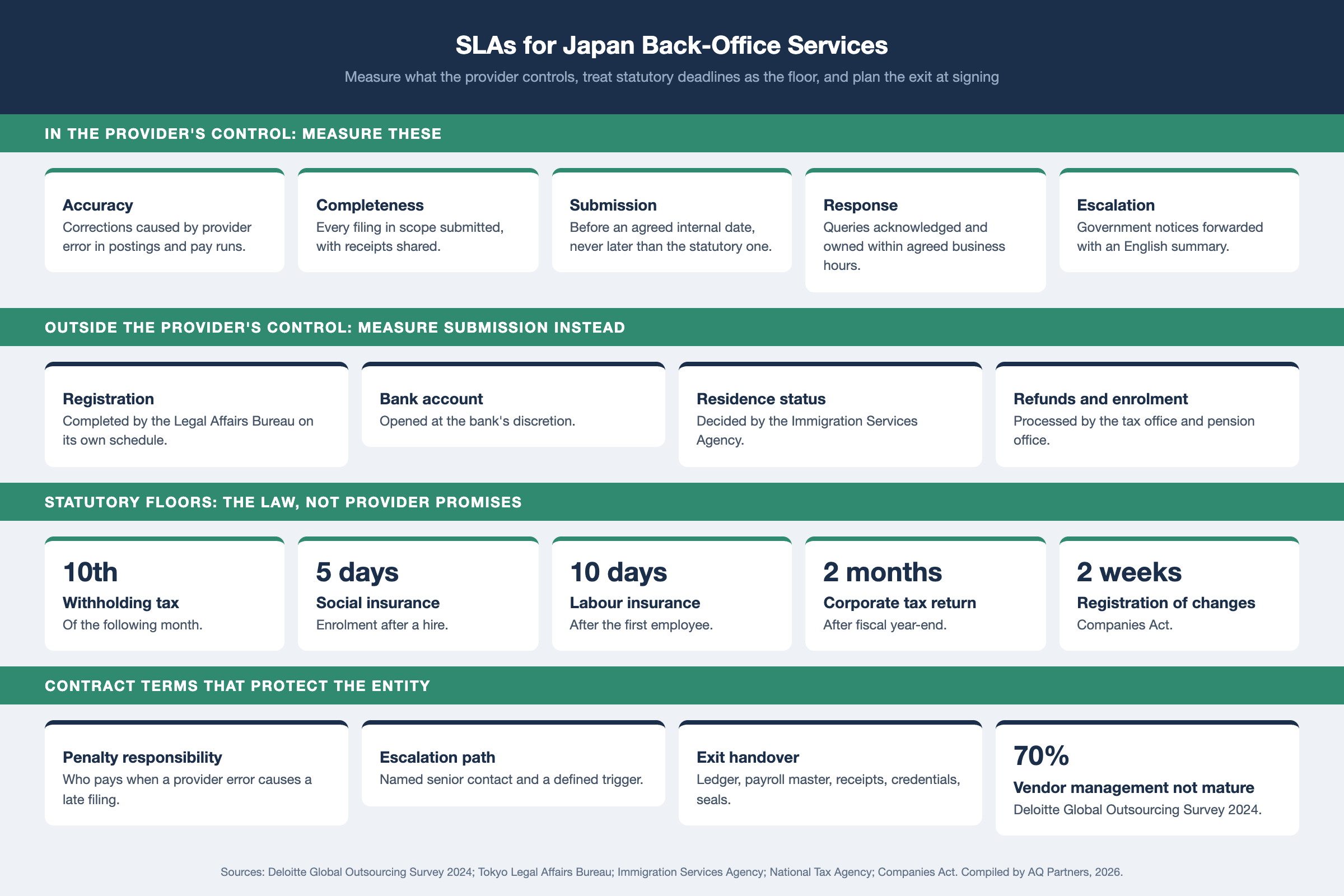
Each service row should answer four questions: what is delivered, how completion is evidenced, when it is due relative to the statutory deadline, and who at headquarters confirms receipt. Services that recur monthly, such as bookkeeping and payroll, need a measure every month. Event-driven services, such as a director change or a new hire, need a trigger: the date headquarters supplies complete information starts the provider's clock.
Metrics in a Japan Provider's Control and How to Word Them
Good Japan back-office SLA metrics measure accuracy, completeness, submission, and response, each worded as an event that can be checked.
The test for every metric is whether a third party could verify it from records alone. "Payroll is processed accurately" fails that test; "no payroll corrections caused by provider error in the period" passes it. The table below lists the metrics that tend to matter most for a small foreign-owned subsidiary, with wording that can be audited. The specific dates are for the two parties to set according to the group calendar; the important point is that each is defined.
| Service | Metric | Suggested wording | Evidence |
|---|---|---|---|
| Monthly accounting | Package delivery | Reporting package and trial balance delivered to the shared folder by the agreed working day | File timestamp |
| Monthly accounting | Accuracy | Number of post-delivery corrections caused by provider error, reported monthly | Correction log |
| Payroll | Payment accuracy | Pay runs completed without provider-caused errors in gross pay, deductions, or withholding | Payroll register and correction log |
| Payroll | Approval cut-off | Draft payroll sent for headquarters approval by the agreed date before pay day | Approval email |
| Social and labour insurance | Submission | Enrolment and loss filings submitted before the statutory deadline once complete employee data is received | Submission receipt |
| Tax filings | Submission | Returns submitted by the zeirishi before the statutory deadline, with the draft sent for approval by an agreed date | e-Tax or eLTAX receipt |
| Corporate secretarial | Deadline tracking | Director term expiries and registration deadlines listed in the shared calendar well ahead of each deadline | Calendar export |
| Queries | Response | Headquarters queries acknowledged and given an owner within an agreed number of business hours | Ticket or email log |
| Government notices | Escalation | Any notice from a tax, pension, or labour office forwarded to headquarters with an English summary within an agreed period | Forwarding record |
Two metrics are often missing and cause the most trouble. The first is the escalation of government notices, because a letter from the tax office or the pension office that sits unread is the usual start of a penalty. The second is staff continuity: naming the day-to-day contact and a backup in the contract, with notice if either changes, protects against the handover slips that tend to follow staff turnover at small providers.
What a Japan Back-Office Provider Cannot Promise
A Japan provider cannot guarantee registration completion, bank approval, or immigration decisions; an SLA should measure submission instead.
Several of the outcomes headquarters cares about most are decided by public offices or banks, on their own timetables. The Tokyo Legal Affairs Bureau, for example, publishes scheduled completion dates for registration applications according to the date each was filed, which shows the completion date depends on the bureau's queue. The Immigration Services Agency publishes average processing periods for residence applications each month, and those averages move. A provider that guarantees a completion date for either is promising something it does not control.
| Outcome | Who decides | What the SLA should measure instead |
|---|---|---|
| Commercial registration completed | Legal Affairs Bureau | Application filed by the shiho-shoshi within an agreed period of complete documents |
| Corporate bank account opened | The bank | Complete application submitted and bank queries answered within an agreed period |
| Residence status granted | Immigration Services Agency | Application filed by the authorised gyosei-shoshi or lawyer once documents are complete |
| Tax refund received | Tax office | Return and refund claim filed correctly and on time |
| Social insurance enrolment processed | Pension office | Enrolment submitted before the deadline, with the receipt shared |
| Residential tax amounts issued | Each municipality | Notices applied to payroll in the first pay run after receipt |
The same logic applies to the inputs headquarters supplies. Notarised parent documents, signed resolutions, and new-hire data are on the client's side of the line, and a fair SLA starts the provider's clock only when they arrive complete. Writing that dependency into the contract avoids disputes about which side caused a delay.
Statutory Deadlines as the Floor of a Japan SLA
Statutory deadlines are legal obligations, so a Japan back-office SLA should set internal dates before them with a margin both sides agree.
Japanese law fixes the outer limit for most recurring filings, and none of them move because a provider is busy. An SLA that simply repeats the statutory deadline leaves no room for an approval step or a correction. The better pattern is an internal date for the draft, an internal date for headquarters approval, and the statutory date as the final backstop. The deadlines a small subsidiary meets most often are:
- Withholding tax on salaries and many cross-border payments, remitted by the 10th of the following month.
- Social insurance enrolment within 5 days of a hire, submitted to the pension office.
- Labour insurance enrolment within 10 days of the first employee.
- Corporate tax return within 2 months of the fiscal year-end, with a 1 month extension available on application where the conditions are met.
- Registration of changes such as a new director within 2 weeks under the Companies Act.
These deadlines sit across three licensed professions: tax filings with a zeirishi, social and labour insurance filings with a sharoushi, and registrations with a shiho-shoshi. Where the provider coordinates partner firms, the SLA should make the provider responsible for the partner's deadline as well, so headquarters has one counterparty. Common payroll failure points are covered in payroll compliance risks for foreign companies in Japan, and the full first-year sequence is in the first-year headquarters calendar for a new Japan subsidiary.
Service Credits, Escalation, and Exit Terms
Service credits rarely offset a missed Japan filing; named escalation, penalty responsibility, and a defined exit handover protect the entity more.
Service credits, a fee reduction when a level is missed, are standard in large outsourcing contracts. For a small subsidiary they are of limited value, because the fee for one month is usually small next to the cost of a late filing penalty or the management time spent fixing an error. Three other clauses do more work:
- Penalty responsibility. Who pays a late filing or underpayment penalty when the cause is the provider's error, and how the cause is determined.
- Escalation path. A named senior contact at the provider, a defined trigger for escalation (for example, any missed statutory date or two missed service levels in a quarter), and a meeting within an agreed period.
- Exit handover. What the provider hands over on termination, in what format, and at what cost: the general ledger, payroll master data, filing receipts, e-filing credentials, and any seals or bank tokens in its custody.
The exit clause is the one most often left vague and the one that matters most if the relationship ends. A switch between providers moves items that live outside the ledger, and the handover list is easier to agree at signing than at termination. Broader trade-offs between outsourcing and building an in-house team are covered in outsourcing versus in-house back office in Japan.
Frequently Asked Questions
Should a Japan back-office SLA include turnaround times?
Include agreed internal dates for each deliverable, set between the two parties for the group's calendar, and never later than the statutory deadline. Avoid promised completion times for anything a government office or bank decides, such as registrations, bank accounts, or residence status; measure the provider's submission instead.
Who is responsible if a filing is late because headquarters sent information late?
A well-drafted SLA starts the provider's clock when complete information is received and records the date it arrived. If headquarters supplies data late, the provider's obligation is to flag the risk to the statutory deadline immediately, not to absorb the penalty. Writing that rule down at signing prevents disputes later.
Do small providers in Japan accept service credits?
Practice varies by provider, and credits tied to a small monthly fee are modest by nature. For a small subsidiary, a clear allocation of penalty responsibility, a named escalation contact, and a defined exit handover are usually worth more than a credit regime.
Working with AQ Partners. Our Tokyo team provides back office operations for foreign companies operating in Japan, from monthly bookkeeping and annual tax filings to payroll coordination with a licensed sharoushi and corporate registration changes. Book a consultation to discuss how your Japan entity is run.

Yuga Koda is a founding Director at AQ Partners, supporting foreign companies, funds, and families operating in Japan. His experience operating companies in both Japan and international markets gives him a practical understanding of back office operations from both sides.