
Notification vs Permission vs License: Japan's Business Licensing System Explained

Japan's business licensing system (営業許可制度, eigyo kyoka seido) is a multi-tier regulatory structure that draws sharp legal distinctions between notification, permission, registration, license, and authorization. Foreign companies often treat these terms as interchangeable, but each tier carries different scrutiny levels, processing times, and penalties for non-compliance. Misidentifying which tier applies to your business can mean criminal prosecution, forced closure, or months of wasted preparation.
Key Takeaways
- Japan uses five regulatory tiers—todokede, kyoka, toroku, menkyo, and ninka—ranging from same-day notification filing to national examinations with pass rates as low as 10%.
- Notification does not mean no obligations—todokede-based businesses must still comply with industry regulations, maintain records, and submit to inspections, with fines of up to ¥500,000 for failure to file.
- The 2021 Food Sanitation Act reform created a dual-track system—32 kyoka (permission) categories plus a todokede (notification) system, affecting over 3.6 million food operators nationwide.
- Penalties for misclassifying your tier are severe—up to two years imprisonment and ¥2 million in fines for food service, and up to ¥500 million in corporate fines for unauthorized financial services.
- The correct tier is determined by the specific governing statute—not by industry label. The same activity may require different tiers depending on scale and scope, making early legal consultation essential.
The Five Tiers Explained
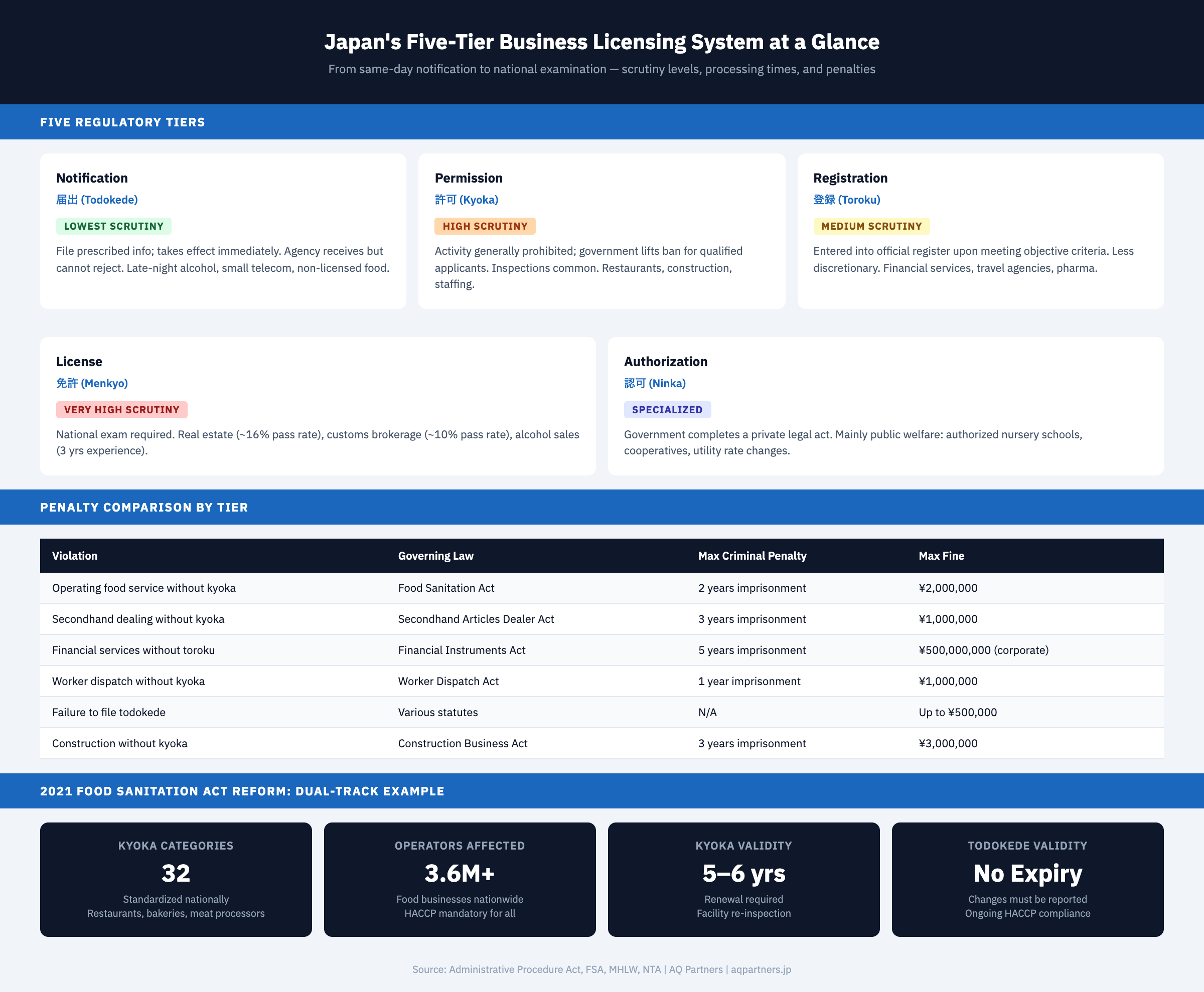
Japan's administrative law tradition assigns different oversight levels based on risk to public welfare. Each tier is defined by the specific statute governing each industry, not by a central licensing law. For foreign companies planning Japan market entry, identifying the correct tier is the first step in planning timelines and capital requirements. The comprehensive business licenses guide covers the full licensing landscape; this post focuses on the tier system itself.
Todokede (届出)—Notification
A todokede is the lowest regulatory tier. Defined under Article 2, Item 7 of Japan's Administrative Procedure Act, it requires submitting prescribed information to an administrative agency. The agency receives the notification but does not approve or reject it—the filing takes effect immediately. Examples include late-night alcohol service notifications (filed with police at least 10 days in advance), small-scale telecom operator filings with MIC, and food business notifications under the 2021 reform for operations outside the 32 licensed categories.
Important: Todokede-based businesses remain subject to ongoing compliance—record-keeping, hygiene standards, HACCP principles (for food), and government inspections. "Notification" does not mean "unregulated."
Kyoka (許可)—Permission
Under kyoka, a business activity is generally prohibited by law, and the government lifts that prohibition for applicants meeting prescribed standards. The agency reviews documentation, may inspect facilities, and issues an explicit approval or denial. Processing takes two weeks to three months. Examples: restaurant permits (飲食店営業許可) from the public health center, construction permits for projects exceeding ¥5 million, worker dispatch permits requiring ¥20 million in net assets, and secondhand goods dealer permits (approximately 40 business days to process).
Toroku (登録)—Registration
Toroku sits between notification and permission. The agency verifies the applicant against objective criteria and enters them into an official register. Unlike kyoka, there is less discretionary judgment—meeting the criteria should result in registration. The Financial Services Agency's registration system is a key example: Type 1 financial instruments business requires ¥50 million minimum capital and a 120%+ capital adequacy ratio. Travel agency registration (Type 1) requires ¥70 million in security deposits. Processing ranges from one to six months.
Menkyo (免許)—License
Menkyo is the highest tier, literally meaning "exemption from prohibition." It typically requires passing national examinations and demonstrating years of experience. The real estate transaction specialist exam (takken-shi) has a pass rate of approximately 15–16% among roughly 210,000 annual examinees. The customs broker exam passes only about 10% of applicants. Alcohol sales licenses from the National Tax Agency require three years of industry experience and a ¥90,000 registration fee.
Ninka (認可)—Authorization
Ninka is a specialized tier where government authorization supplements a private legal act. Less common in commercial licensing, it appears primarily in public welfare sectors—most notably ninka hoikuen (認可保育園), government-authorized nursery schools meeting MHLW standards. It also applies to cooperative associations and public utility rate changes.
Side-by-Side Comparison
| Tier | Japanese | Legal Mechanism | Government Role | Processing Time | Examples |
|---|---|---|---|---|---|
| Notification | 届出 | Informing the agency of prescribed facts | Receives info; cannot approve or reject | Immediate to 10 days | Late-night alcohol service, non-licensed food businesses |
| Permission | 許可 | Lifting a general prohibition for qualified applicants | Reviews, inspects, approves or denies | 2 weeks to 3 months | Restaurants, construction, worker dispatch |
| Registration | 登録 | Verification against objective criteria; entry into register | Verifies criteria; less discretionary | 1 to 6 months | Financial instruments, travel agencies |
| License | 免許 | Qualification via national examination | Issues license after stringent review | 2 to 6 months + exam | Alcohol sales, real estate, customs brokerage |
| Authorization | 認可 | Government completes a private legal act | Supplements private action with approval | Varies by sector | Nursery schools, cooperatives, utility rates |
| The governing statute for each industry determines which tier applies. A single business may require multiple tiers simultaneously. | |||||
Determining Which Tier Applies
There is no universal lookup table. The tier is set by the statute governing your specific activity. The most common mistake is applying a general industry label—"we are in food"—without analyzing the precise activity. A food manufacturer needs kyoka; a packaged food retailer may only need todokede; a company doing both needs both. The step-by-step application guide covers the filing process once you have identified your tier.
| Step | Action | Where to Check |
|---|---|---|
| 1 | Define your specific business activities precisely | Internal business plan |
| 2 | Identify the governing statute for each activity | Administrative scrivener; JETRO guides |
| 3 | Check whether the statute uses todokede, kyoka, toroku, or menkyo | Japanese Law Translation database; legal counsel |
| 4 | Assess whether scale or geography changes the tier level | Governing statute; prefectural regulations |
| 5 | Pre-consult with the issuing authority | Public health center, prefectural office, or ministry bureau |
| 6 | Confirm whether multiple tiers apply to your operations | Administrative scrivener review |
Case Study: The 2021 Food Sanitation Act Reform
The June 2021 revision of Japan's Food Sanitation Act is the clearest illustration of the tier system in action. Before the reform, food business licensing categories varied by municipality, creating inconsistency across prefectures. The revision standardized the system nationally into two parallel tracks:
- 32 kyoka categories—restaurants, confectionery manufacturing, meat processing, dairy, fish processing, and other high-risk food activities require explicit permission from the local public health center.
- Todokede system—food businesses outside the 32 categories (packaged food retail, food warehousing, temperature-controlled transport) file a notification that takes effect upon submission.
A company opening a restaurant must obtain kyoka—appointing a food sanitation manager, passing a facility inspection, and maintaining HACCP-based hygiene plans. A packaged food retailer files todokede but must still comply with HACCP requirements (mandatory for all food operators since June 2021) and food labeling rules.
| Factor | Kyoka (32 Categories) | Todokede (Notification) |
|---|---|---|
| Pre-operation requirement | Must obtain permit before operating | Must file notification before operating |
| Government review | Application review + facility inspection | Document receipt only; no approval process |
| Facility standards | Prescribed requirements must be met | General hygiene standards apply |
| HACCP compliance | Mandatory (full or simplified) | Mandatory (full or simplified) |
| Validity period | 5–6 years (renewal required) | No expiration (changes must be reported) |
| Penalty for non-compliance | Up to 2 years imprisonment / ¥2M fine | Up to ¥500,000 fine |
| Examples | Restaurants, bakeries, meat processors | Packaged food retail, food warehousing |
Common Misconceptions
"Notification means no government interaction." Incorrect. A todokede must be filed before operations begin. While the agency cannot reject it, operating without filing is a regulatory violation.
"Permission and license are the same thing." Kyoka (permission) involves lifting a prohibition after application review. Menkyo (license) goes further—requiring national examinations or years of experience. A restaurant kyoka needs a food sanitation manager who completes a one-day course; a real estate menkyo requires staff who passed an exam with a 15–16% pass rate.
"Registration is just a formality." The toroku system for regulated industries in Japan can require ¥50 million minimum capital, detailed compliance infrastructure, and five to six months of processing.
"One license covers everything." Many businesses need multiple tiers. A restaurant selling alcohol needs both a food service kyoka (health center) and an alcohol sales menkyo (tax office). A staffing firm placing workers internationally needs a worker dispatch kyoka plus immigration compliance.
Penalties for Misclassification
Operating under the wrong tier carries criminal consequences. Under the Food Sanitation Act, running a restaurant without kyoka means up to two years imprisonment or ¥2 million in fines. The Secondhand Articles Dealer Act prescribes up to three years imprisonment or ¥1 million in fines for operating without a kobutsusho kyoka. The Financial Instruments and Exchange Act imposes up to five years imprisonment and corporate fines of up to ¥500 million for conducting securities business without toroku registration.
Beyond criminal penalties, Business Manager Visa holders whose companies lack proper authorization face visa non-renewal. License revocation triggers disqualification periods of three to five years. Changes to registered business details must be reported within 30 to 60 days depending on the statute—failure to do so is itself a finable offense.
Frequently Asked Questions
Can a todokede-based business be upgraded to kyoka if operations expand?
Yes, and it is often required. A packaged food retailer operating under todokede who begins preparing and serving food on-site must obtain restaurant kyoka before commencing those activities. Operating in a kyoka category under only a todokede filing is treated as unlicensed operation with full penalties.
Do licensing tiers differ between prefectures?
The tier classification is set by national statutes and is consistent across Japan. However, facility standards, forms, and processing practices may vary by municipality. The 2021 Food Sanitation Act reform specifically standardized the 32 kyoka categories nationally to reduce this variation.
How do I know if my business needs no license at all?
General consulting, IT services, marketing, design, and most professional services require no industry-specific license beyond standard company registration. You still need basic tax notifications (opening of business notification to the tax office within one month). An administrative scrivener (gyosei shoshi, 行政書士) can confirm whether your activities trigger any sector-specific requirements.
Getting Your Licensing Tier Right
Japan's multi-tier system is more nuanced than a simple "apply for a license" process. The distinction between todokede, kyoka, toroku, menkyo, and ninka determines your timeline, budget, and compliance obligations—and getting it wrong carries real consequences.
Working with AQ Partners. Our Tokyo team provides KK and GK incorporation, corporate bank account application and monthly bookkeeping for foreign companies operating in Japan, so the entity behind the application is in order. Book a consultation to discuss your situation.

Yuga Koda is a founding Director at AQ Partners, supporting foreign companies, funds, and families operating in Japan. His experience operating companies in both Japan and international markets gives him a practical understanding of back office operations from both sides.