
How to Apply for a Business License in Japan: Step-by-Step Guide

Applying for a business license in Japan (事業許可申請, jigyō kyoka shinsei) is a multi-stage process that requires foreign companies to navigate Japanese-language documentation, industry-specific regulations, and pre-consultation protocols with government authorities. According to JETRO's business setup resources, licensing is one of the most frequently cited barriers for foreign firms entering the Japanese market—yet companies that follow a structured approach consistently achieve faster approvals and fewer rejections.
Key Takeaways
- Pre-consultation with the issuing authority is the single most important step—most Japanese government agencies offer informal preliminary reviews of draft applications, and skipping this step is the leading cause of preventable rejections.
- An administrative scrivener (gyosei shoshi / 行政書士) is essential for foreign applicants—these nationally licensed professionals handle Japanese-language filings, liaise with authorities, and typically charge ¥100,000 to ¥500,000 depending on license complexity.
- Document preparation accounts for 60–70% of the total timeline—gathering certified translations, obtaining a company registry extract (tojibo), registering a corporate seal (inkan), and securing qualified personnel must all happen before filing.
- Common rejection reasons are almost entirely preventable—incomplete documentation, mismatched company names across filings, and failure to list the licensed activity in the articles of incorporation account for the majority of initial rejections.
- Post-approval obligations are ongoing and enforceable—most licenses require periodic renewal (every 3–6 years), prompt notification of changes to directors or office locations, and continuous record-keeping compliance.
Step 1: Pre-Application Research and License Identification
Before any documents are prepared, foreign companies must identify exactly which licenses apply to their intended business activities. Japan's licensing system is decentralized—different industries are regulated by different national ministries, prefectural governments, and municipal authorities. The comprehensive guide to business licenses in Japan for foreign companies covers the full landscape of regulated industries and the four-tier licensing framework—notification (todokede), permission (kyoka), registration (toroku), and license (menkyo).
During this phase, companies should confirm whether the intended activity requires a license at all (IT services, consulting, and marketing do not); which specific authority issues the license; and whether the articles of incorporation (teikan / 定款) already list the licensed activity as a business purpose. According to SmartStart Japan's licensing guide, failure to include the licensed activity in the teikan is one of the most common oversights—correcting it requires a formal amendment through the Legal Affairs Bureau before the license application can proceed.
Step 2: Choosing an Administrative Scrivener (Gyosei Shoshi)
An administrative scrivener (gyosei shoshi / 行政書士) is a nationally licensed professional authorized to prepare and file applications with government agencies on behalf of businesses. Engaging a gyosei shoshi is not legally required but is the standard practice for foreign applicants. When selecting one, prioritize industry specialization, bilingual capability, and membership in the Japan Federation of Administrative Scriveners (日本行政書士会連合会).
| License Type | Typical Gyosei Shoshi Fee | What the Fee Covers | Preparation Timeline |
|---|---|---|---|
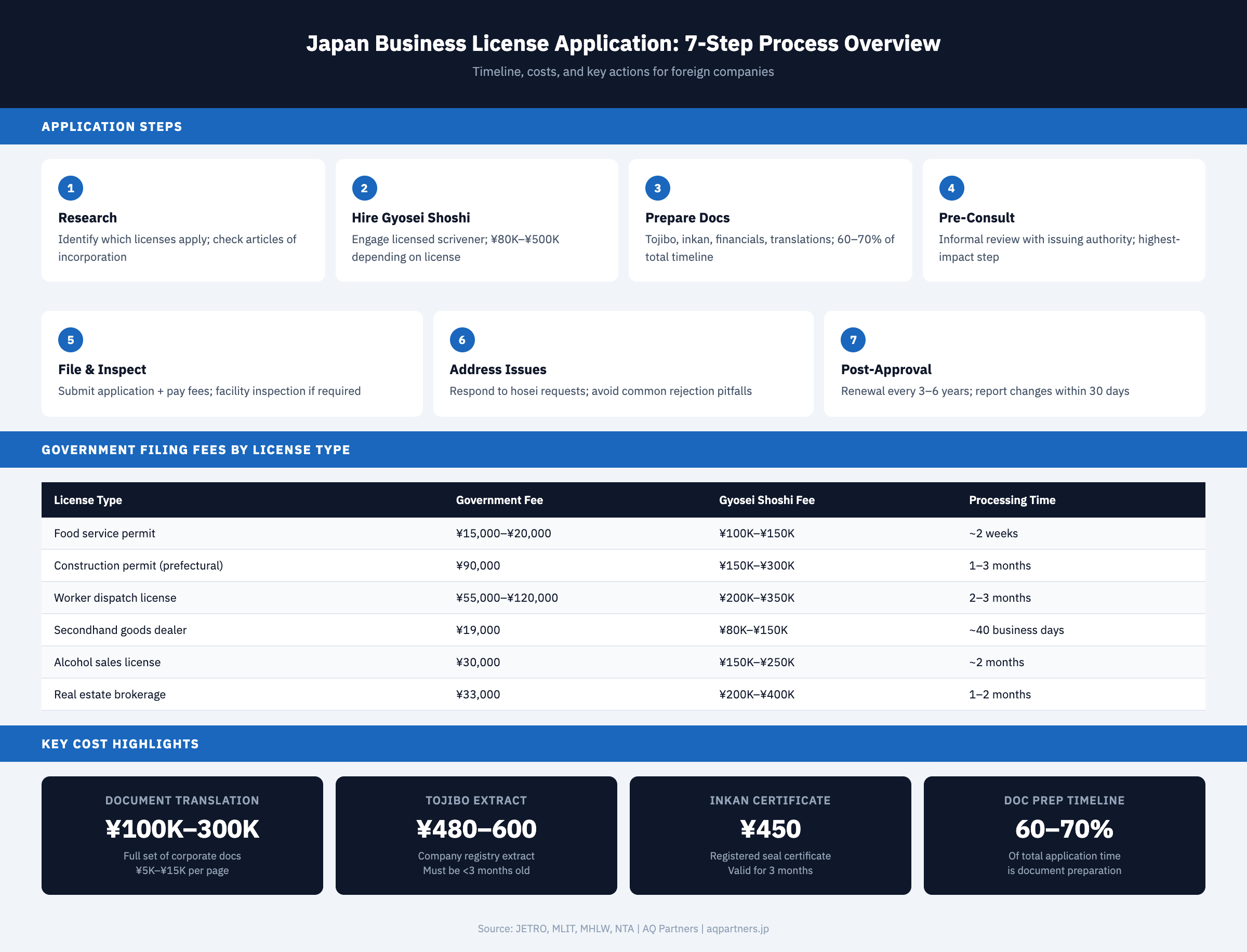
| Food service permit | ¥100,000–¥150,000 | Application drafting, health center liaison, inspection coordination | 2–4 weeks |
| Construction business permit | ¥150,000–¥300,000 | Document preparation, engineer qualification verification, pre-consultation | 1–2 months |
| Secondhand goods dealer permit | ¥80,000–¥150,000 | Filing with Public Safety Commission, background check support | 2–3 weeks |
| Worker dispatch license | ¥200,000–¥350,000 | MHLW application, financial documentation, office space verification | 1–2 months |
| Alcohol sales license | ¥150,000–¥250,000 | Tax office filing, experience documentation, premises verification | 3–6 weeks |
| Real estate brokerage license | ¥200,000–¥400,000 | MLIT or prefectural filing, specialist qualification verification | 1–2 months |
Note: Gyosei shoshi fees are separate from government application fees and do not include translation costs. Always request a written fee estimate (見積書 / mitsumorisho) before engagement, and confirm whether the fee includes post-filing follow-up and responses to authority queries.
Step 3: Preparing Required Documents
Document preparation is the most time-consuming phase, typically accounting for 60–70% of the total timeline. While specific requirements vary by license type, foreign companies should expect to assemble the following core documents.
| Document | Japanese Name | Where to Obtain | Notes for Foreign Companies |
|---|---|---|---|
| Application form | 申請書 (shinseisho) | Issuing authority website or counter | Must be completed in Japanese; format varies by authority |
| Company registry extract | 登記簿謄本 (tojibo tohon) | Legal Affairs Bureau; fee ¥480–¥600 | Must be issued within 3 months of filing; anyone can request |
| Registered seal certificate | 印鑑証明書 (inkan shomeisho) | Legal Affairs Bureau; fee ¥450 | Requires prior inkan registration; valid 3 months |
| Articles of incorporation | 定款 (teikan) | Company records | Must list the licensed activity as a business purpose |
| Financial statements | 決算書 (kessansho) | Company records / tax accountant | Most recent fiscal year; new companies may submit opening balance sheet |
| Office lease agreement and floor plans | 賃貸借契約書 / 図面 | Landlord / architect | Some licenses specify minimum office size (e.g., 20m² for worker dispatch) |
| Director resumes | 役員略歴 (yakuin ryakureki) | Self-prepared | Foreign credentials may need notarized translation |
Foreign companies face additional documentation steps. Corporate documents from the home country—certificates of incorporation, board resolutions, director identification—must be translated into Japanese by a certified translator and, in some cases, apostilled. Translation costs typically range from ¥5,000 to ¥15,000 per page, with a full set of translated corporate documents costing ¥100,000 to ¥300,000. The corporate seal (inkan) system requires the company to have registered its official seal during incorporation—if not yet registered, this must be resolved before filing.
Step 4: Pre-Consultation with the Issuing Authority
Pre-consultation (事前相談 / jizen sodan) is an informal but critically important step. Most issuing authorities—including prefectural government offices, public health centers, MLIT, and local tax offices—offer preliminary review sessions where applicants or their gyosei shoshi can present draft applications and receive guidance before formal filing. This is where the Japanese process diverges from many Western countries: authorities prefer to work with applicants toward a successful outcome rather than simply approve or reject blind submissions.
Note: Applications that go through pre-consultation have substantially higher first-submission approval rates. For complex licenses such as construction, financial services, and worker dispatch, multiple sessions may be necessary. Your gyosei shoshi will typically attend on your behalf.
Step 5: Filing, Inspection, and Review
Once pre-consultation issues are resolved, the formal application is filed with the issuing authority. Government application fees (手数料 / tesuryo) are paid at filing and are non-refundable regardless of outcome.
| License Type | Government Fee | Filing Method | Processing Time |
|---|---|---|---|
| Food service permit | ¥15,000–¥20,000 | In-person at local public health center | ~2 weeks |
| Construction permit (prefectural) | ¥90,000 | Prefectural government office | 1–3 months |
| Construction permit (national / MLIT) | ¥150,000 | MLIT regional bureau | 2–4 months |
| Secondhand goods dealer permit | ¥19,000 | Public Safety Commission via local police | ~40 business days |
| Worker dispatch license | ¥55,000–¥120,000 | MHLW or prefectural labor bureau | 2–3 months |
| Alcohol sales license (retail) | ¥30,000 | Local tax office (NTA) | ~2 months |
| Real estate brokerage license | ¥33,000 | MLIT or prefectural government | 1–2 months |
After filing, many license types include a physical inspection or background verification phase. Food service permits require a public health officer to inspect kitchen facilities, ventilation, and HACCP compliance—mandatory for all food operators since June 2021. Construction license reviews verify engineer qualifications, financial documentation, and minimum net asset requirements (¥5 million for ordinary licenses). Secondhand goods dealer permits involve police background checks on directors that typically consume the full 40 business days of the processing period. During review, applicants may receive supplementary requests (補正 / hosei) for additional documentation—responding promptly is critical, as delays can reset the processing clock.
Step 6: Common Rejection Reasons and How to Avoid Them
Based on practitioner experience and industry guidance from Company Formation Japan, the most common rejection reasons are largely preventable.
| Rejection Reason | Frequency | How to Prevent |
|---|---|---|
| Incomplete or missing documents | Very common | Use the authority's checklist; complete pre-consultation; engage a gyosei shoshi |
| Licensed activity not in articles of incorporation | Very common | Verify teikan business purpose list before filing; amend if necessary |
| Mismatched company names across documents | Common | Ensure exact name consistency between tojibo, application, and lease |
| Expired certificates (tojibo or inkan older than 3 months) | Common | Obtain fresh copies within 1–2 weeks of filing |
| Inadequate office space or facilities | Common | Confirm space requirements before signing lease; ensure lease permits business use |
| Insufficient capital or financial documentation | Moderate | Verify minimum capital thresholds; prepare audited financials if required |
| Lack of qualified personnel | Moderate | Hire certified professionals before filing; confirm Japan-recognized qualifications |
| Director disqualification (criminal record or bankruptcy) | Rare but fatal | Review disqualification criteria before appointing directors |
The single most effective prevention strategy is thorough pre-consultation (Step 4). Authorities that have reviewed a draft application are far less likely to reject the formal submission.
Step 7: Post-Approval Obligations
Japanese licensing authorities impose ongoing compliance obligations. Construction business permits must be renewed every five years, worker dispatch licenses every three years, and real estate brokerage licenses every five years. Renewal applications must typically be filed 30 to 90 days before expiration. Change notifications (変更届 / henko todoke) are required within 30 days whenever directors change, office locations move, or the company name is amended. These ongoing obligations should be integrated into the company's broader post-incorporation compliance framework.
Cost Breakdown: Budget Planning
According to JETRO's cost estimation models, the administrative costs of licensing are consistently underestimated by foreign companies. While government fees are modest (¥15,000 to ¥150,000), professional and translation fees frequently exceed them by a factor of three to five. For a mid-complexity license such as construction, budget approximately ¥350,000 to ¥600,000 in administrative costs plus the ¥5 million minimum net asset requirement. For simpler licenses like food service, total administrative costs fall between ¥150,000 and ¥300,000. Companies pursuing multiple licenses can reuse some documents (tojibo, inkan certificates, translated corporate records) across applications, as discussed in our entity structuring strategy guide.
Frequently Asked Questions
Can I start the license application before my company is registered in Japan?
No. Nearly all license applications require a tojibo and inkan shomeisho, which are only available after company registration. However, pre-consultation with the issuing authority can begin before incorporation, allowing companies to identify requirements in parallel with the registration process.
How long should I plan for the entire process?
For most standard licenses, plan two to four months from the start of document preparation to license issuance. Complex licenses such as financial services registrations can take six to twelve months end-to-end. The preparation phase is almost always longer than the government processing time.
What happens if my application is rejected?
Rejected applications can typically be corrected and resubmitted. Most authorities issue written explanations of rejection reasons. However, government application fees are non-refundable, meaning each resubmission incurs an additional fee—another reason pre-consultation is critical.
Japan's business licensing process rewards thorough preparation, professional guidance, and proactive communication with issuing authorities. Foreign companies that invest in proper pre-consultation, engage an experienced gyosei shoshi, and build realistic timelines into their market entry planning consistently achieve smoother approvals.
Working with AQ Partners. Our Tokyo team provides KK and GK incorporation, corporate bank account application and monthly bookkeeping for foreign companies operating in Japan, so the entity behind the application is in order. Book a consultation to discuss your situation.

Yuga Koda is a founding Director at AQ Partners, supporting foreign companies, funds, and families operating in Japan. His experience operating companies in both Japan and international markets gives him a practical understanding of back office operations from both sides.