
Opening a Restaurant in Japan: Food Service Permits & Licensing Guide

Food service licensing (飲食店営業許可, inshokuten eigyō kyoka) is the mandatory government permit required before any restaurant, cafe, bar, or food establishment can legally operate in Japan. Governed by the Food Sanitation Act—which underwent a major revision effective June 1, 2021—the licensing process involves appointing a qualified food sanitation manager, building a facility that meets public health center standards, passing an on-site inspection, and implementing HACCP-based food safety management. This guide covers every permit, inspection, and notification required to open a restaurant in Japan.
Key Takeaways
- The 2021 Food Sanitation Act revision created 32 licensed business categories and a separate notification system—restaurants require explicit permission (kyoka) from the local public health center before opening.
- Every food establishment must appoint a food sanitation manager (食品衛生責任者) before applying—qualification requires either a professional license or completing a six-hour training course (~¥12,000).
- HACCP compliance is mandatory for all food businesses since June 2021—operators with fewer than 50 employees may follow simplified guidelines, but no operator is exempt.
- The permit application fee is ¥15,000–¥20,000 with ~2 weeks processing—but facility buildout and qualification steps mean realistic end-to-end timelines are one to three months.
- Serving alcohol after midnight or selling it for takeaway requires separate authorizations—a police notification for late-night service and a National Tax Agency liquor license (¥30,000) for retail sales.
The 2021 Food Sanitation Act Reform
The Food Sanitation Act (食品衛生法, shokuhin eisei hō) was amended in 2018, with changes taking effect on June 1, 2021. The Ministry of Health, Labour and Welfare replaced the previous 34 municipality-defined permit categories with a nationally standardized system of 32 licensed categories plus a notification (todokede) track for lower-risk food activities. Restaurants serving prepared meals on-premises require a licensed permit (kyoka)—meaning formal application, facility inspection, and explicit approval from the local public health center. Businesses outside the 32 categories, such as sellers of pre-packaged foods, may use the simpler notification system.
Other key changes included mandatory HACCP for all food operators, a positive list system for food contact materials, and harmonized facility standards across all 47 prefectures—eliminating the previous variation between municipalities.
All Permits and Notifications at a Glance
Opening a restaurant involves authorizations from multiple agencies. The table below summarizes the full set.
| Permit / Notification | Issuing Authority | When Required | Fee | Processing Time |
|---|---|---|---|---|
| Food service permit (飲食店営業許可) | Public health center (hokenjo) | All restaurants, cafes, bars | ¥15,000–¥20,000 | ~2 weeks |
| Fire safety notification (防火対象物使用開始届) | Local fire department | All commercial premises | Free | 7–10 days |
| Late-night alcohol notification (深夜酒類提供飲食店届出) | Police / public safety commission | Alcohol service midnight–6 AM | Free | 10+ days before opening |
| Liquor retail license (酒類小売業免許) | Tax office (National Tax Agency) | Selling sealed bottles for takeaway | ¥30,000 | ~2 months |
| Building use notification | Ward / municipal office | Change of building use to restaurant | Free | Varies |
| Business commencement notification (開業届) | Tax office | All new sole proprietorships | Free | Same day |
Note: Restaurants serving alcohol on-premises do not need a separate liquor license—that is covered by the food service permit. The liquor retail license applies only to sealed-bottle takeaway or delivery sales.
Food Sanitation Manager (食品衛生責任者)
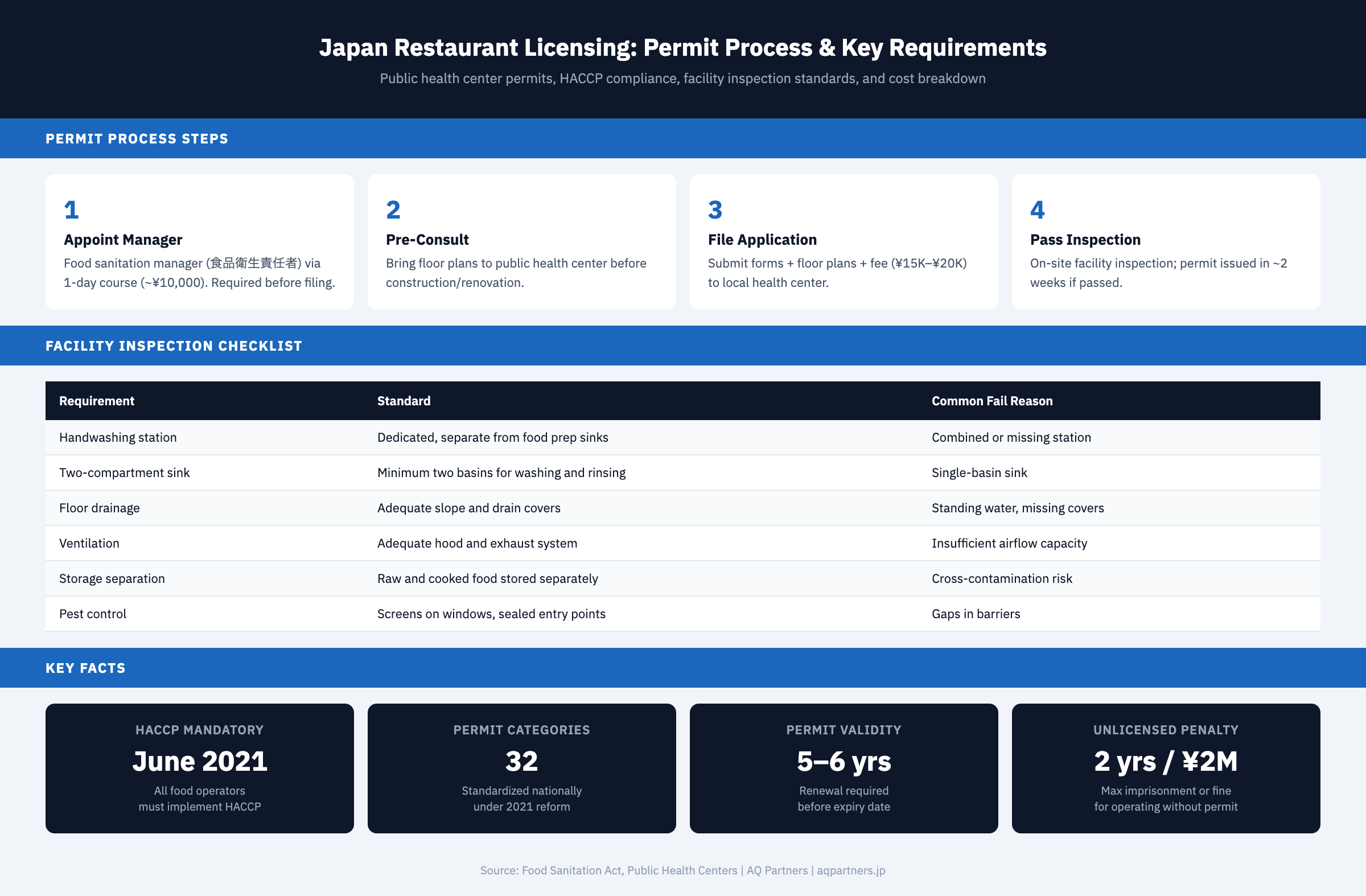
Every food establishment must appoint a food sanitation manager (食品衛生責任者, shokuhin eisei sekininsha) before filing the permit application. This person oversees daily hygiene practices, manages the HACCP plan, and is the primary contact for health center inspectors.
| Qualification Pathway | Who Qualifies | Time | Cost |
|---|---|---|---|
| Professional license | Cook (調理師), nutritionist (栄養士), confectionery hygienist, pharmacist, veterinarian | Already qualified | None |
| Training course (養成講習会) | Anyone 17+ with a residence card or special permanent resident status | ~6 hours (1 day in-person; up to 30 days e-learning) | ¥12,000 |
The training course is administered by local food hygiene associations and conducted entirely in Japanese—participants must read, write, and speak Japanese. Foreign nationals must hold a valid residence card. The qualification is transferable between employers, valid nationwide, and does not expire, though holders must attend periodic refresher training.
Facility Standards and the Health Center Inspection
The permit application is filed with the public health center (保健所, hokenjo) that covers the restaurant's location. The Tokyo Metropolitan Government's food business guide strongly recommends consulting the hokenjo before construction to confirm your floor plan meets standards—preventing costly rebuilds after a failed inspection.
Key facility standards that inspectors verify include: a dedicated handwash sink (separate from food prep sinks) with hands-free operation and hot/cold water; at least two sink compartments for washing and rinsing; water-resistant, non-absorbent flooring; kitchen area enclosed or partitioned from customer seating; adequate ventilation and exhaust; screens or air curtains on all windows and openings for pest control; commercial refrigerators with built-in thermometers maintaining 10°C or below; covered waste containers in a designated area; and restrooms that do not open directly into the kitchen.
The inspector must find every element compliant. If any standard is not met, the permit is denied and the applicant must correct the deficiency before re-inspection. Permits are valid for five to eight years and must be displayed on the premises.
HACCP Compliance
Since June 1, 2021, all food business operators must implement HACCP-based safety management. According to the Tokyo Metropolitan Government, approximately 2.6 million food business operators across Japan are subject to this requirement. The system uses two tiers: operators with 50 or more employees must implement full Codex-based HACCP (the complete seven-principle plan), while small-scale operators with fewer than 50 employees—including most restaurants—follow simplified industry-specific guidelines published by MHLW. Both tiers require documented procedures and records available for inspector review.
Fire Safety and Late-Night Alcohol
A fire safety notification must be filed with the local fire department at least seven days before opening. Under the Fire Service Act (消防法), inspectors verify emergency exits, extinguisher placement, alarm systems, emergency lighting, and evacuation signage. Restaurants face heightened scrutiny due to open flames and cooking equipment. The notification and inspection are free, but equipment installation is at the operator's expense.
Bars and restaurants serving alcohol between midnight and 6:00 AM must file a late-night alcohol service notification (深夜酒類提供飲食店届出) with the police at least 10 days before commencing service. This is a notification (todokede), not a permit—the police receive it but do not issue an approval. The filing must include floor plans and lighting specifications, and venues must maintain minimum lighting levels and comply with noise regulations. Operating past midnight without this notification carries fines of up to ¥500,000. Separately, if your restaurant sells sealed bottles for takeaway or retail, you need a liquor retail license (¥30,000, ~2 months processing) from the National Tax Agency.
Application Timeline
| Step | Action | Timeline |
|---|---|---|
| 1 | Pre-consultation with hokenjo (bring floor plans) | Before construction |
| 2 | Obtain food sanitation manager qualification | 1 day (in-person) or up to 30 days (e-learning) |
| 3 | Complete kitchen and facility buildout | 2–8 weeks |
| 4 | File fire safety notification | 7+ days before opening |
| 5 | Submit food service permit application with HACCP plan | After facility is complete |
| 6 | Health center facility inspection (operator must attend) | Scheduled within days of application |
| 7 | Receive food service business permit | ~2 weeks from application |
| 8 | File late-night alcohol notification (if applicable) | 10+ days before late-night service |
The permit itself processes in about two weeks, but the full journey from planning to opening day—including pre-consultation, qualification, buildout, and inspections—realistically spans one to three months. For a step-by-step walkthrough, see our guide on how to apply for a business license in Japan.
Common Rejection Reasons
Health center inspections are pass-or-fail. The most frequent rejection reasons are: no dedicated handwashing station separate from food prep sinks (the single most common failure point); missing or unqualified food sanitation manager at time of application; insufficient separation between kitchen and dining areas; inadequate pest control measures on windows and openings; no documented HACCP procedures (mandatory since 2021); and water quality issues for establishments using well water rather than municipal supply. Pre-consultation with the hokenjo before construction is free and prevents the majority of facility-related rejections.
Foreign Owner Considerations
Foreign nationals face the same licensing requirements as Japanese citizens, with additional practical barriers. For a broader view, see our guide to business licenses for foreign companies.
Foreign owners typically need a Business Manager Visa (経営・管理ビザ). As of October 2025, minimum capital requirements increased from ¥5 million to ¥30 million, applicants must hire at least one full-time Japanese resident employee, and either the owner or an employee must hold JLPT N2-level Japanese proficiency. A three-year transitional period runs until October 2028 for existing visa holders.
All applications are filed in Japanese. The food sanitation manager course is conducted entirely in Japanese—if you cannot complete it yourself, you must employ someone who can. An administrative scrivener (行政書士, gyōsei shoshi) can prepare and submit filings on your behalf. Foreign owners typically operate through a KK or GK; the permit is issued to the entity, and a change of ownership requires a new application.
Frequently Asked Questions
How much does it cost in total to get the permits to open a restaurant?
The core food service permit costs ¥15,000–¥20,000. Adding the food sanitation manager course (¥12,000), direct costs total approximately ¥27,000–¥32,000. The late-night alcohol notification is free. If you add a liquor retail license for takeaway sales, that is another ¥30,000. These figures exclude facility buildout, fire safety equipment, and professional fees for administrative scriveners.
Can I open a restaurant in Japan without speaking Japanese?
You can own and invest in a restaurant without speaking Japanese, but the food sanitation manager course is conducted only in Japanese—you must either complete it yourself or employ a qualified person. Applications are filed in Japanese (an administrative scrivener can handle this). Since October 2025, Business Manager Visa applicants must also demonstrate JLPT N2 proficiency for the applicant or a designated employee.
What happens if my restaurant fails the health center inspection?
A failed inspection is not a permanent denial. The health center specifies which standards were not met, you correct the deficiencies, and you schedule a re-inspection at no additional fee. However, you cannot operate until the permit is issued, so failure directly delays your opening. Consulting the hokenjo before construction prevents most failures.
Do I need to renew my food service business permit?
Yes. Permits are valid for five to eight years. Renewal requires a new application and facility inspection before the expiration date. Operating with an expired permit carries fines of up to ¥2 million and an immediate closure order.
Opening a restaurant in Japan means coordinating permits across multiple agencies—but with proper preparation and pre-consultation, the process is predictable.
Working with AQ Partners. Our Tokyo team provides KK and GK incorporation, corporate bank account application and monthly bookkeeping for foreign companies operating in Japan, so the entity behind the application is in order. Book a consultation to discuss your situation.

Yuga Koda is a founding Director at AQ Partners, supporting foreign companies, funds, and families operating in Japan. His experience operating companies in both Japan and international markets gives him a practical understanding of back office operations from both sides.