
Managing Employees in Japan: Practical HR Guide
Key Takeaways
- Management style expectations in Japan emphasize consensus-building (nemawashi), indirect communication, and group harmony over individual performance metrics — foreign managers who apply direct, confrontational feedback styles common in Western organizations risk damaging team cohesion and may trigger power harassment claims. According to a 2023 survey by the Japan Institute for Labour Policy and Training (JILPT), over 35% of workplace dispute consultations at labor bureaus involved communication-related issues between managers and subordinates.
- Performance management in Japan should combine regular developmental feedback with structured annual reviews rather than stack ranking or forced distribution — the lifetime employment culture's residual influence means that employees expect investment in development rather than rapid performance-based termination. Companies using performance improvement plans (PIPs) must document extensively, as Japanese courts require proof of adequate opportunity before accepting performance as grounds for dismissal.
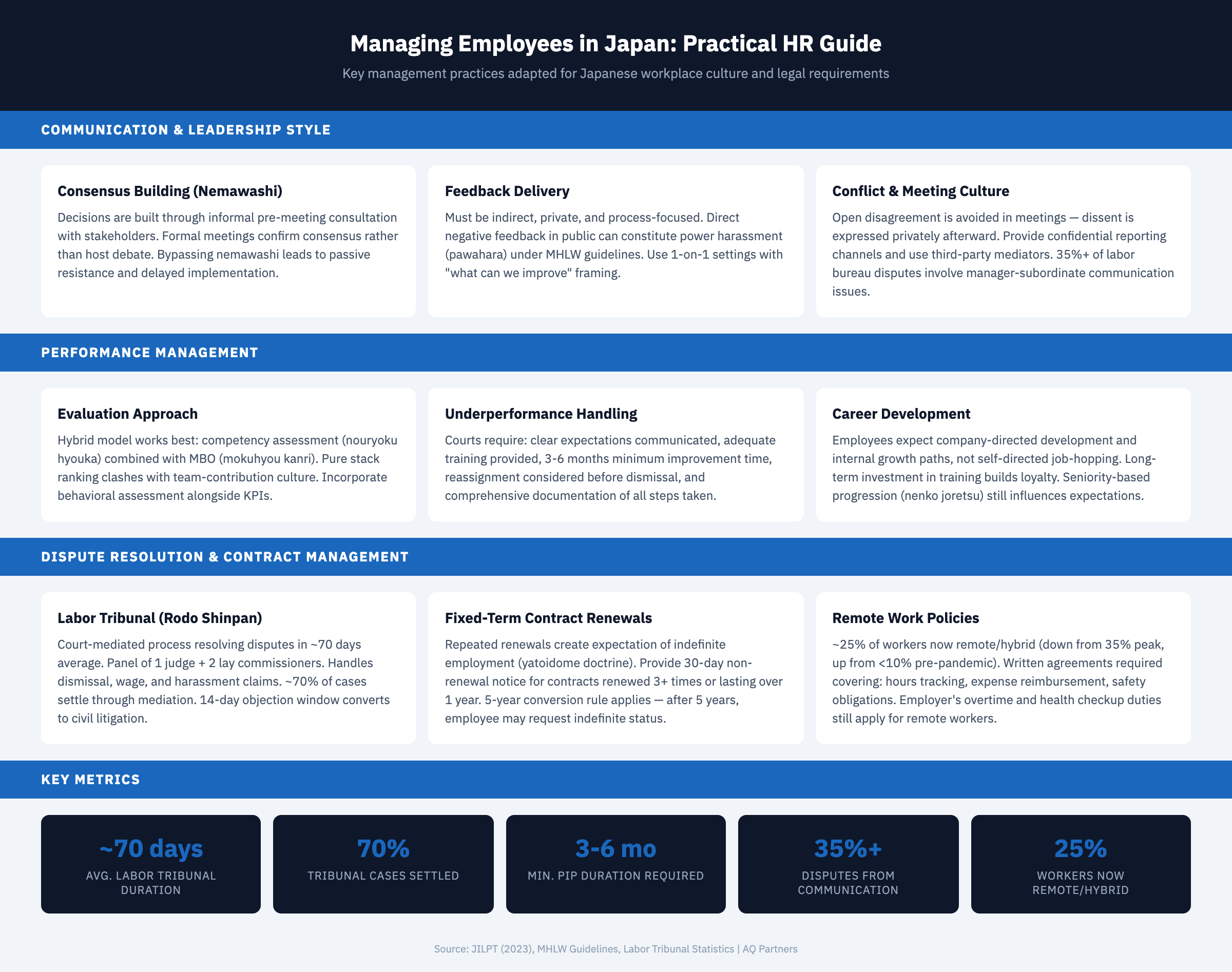
- The labor tribunal system (rodo shinpan) resolves individual employment disputes in approximately 70 days on average — this court-mediated process handles dismissal challenges, wage disputes, and workplace harassment claims through a panel of one judge and two lay commissioners. Approximately 70% of labor tribunal cases reach settlement, making this a practical and common dispute resolution mechanism that foreign companies must plan for.
- Remote work policies require written agreements covering working hours tracking, expense reimbursement, and safety obligations — the MHLW published remote work guidelines specifying that employers remain responsible for overtime management, health checkups, and ergonomic working conditions even for employees working from home. Approximately 25% of Japanese workers now engage in some form of remote work, down from the 2020 peak of 35% but well above pre-pandemic levels of under 10%.
- Fixed-term contract renewals must be managed proactively to avoid the "yatoidome" doctrine — if an employer repeatedly renews a fixed-term contract, creating a reasonable employee expectation of continued employment, courts may treat the contract as effectively indefinite and block non-renewal. Employers should decide renewal intentions early and communicate clearly before each contract period ends.
What Makes Managing Employees in Japan Different?
Managing employees in Japan involves navigating a workplace culture shaped by consensus-oriented decision-making, strong dismissal protections, communication norms that prioritize indirectness and group harmony, and statutory employer obligations that extend well beyond the employment contract. For foreign managers and company leaders, the gap between their home-country management instincts and Japanese workplace expectations is often the most underestimated challenge of operating in Japan.
Japan's employment environment reflects decades of institutional practices — the seniority-based wage system (nenko joretsu), the expectation of long-term employment, the central role of the group over the individual, and the extensive regulatory framework governing every aspect of the employer-employee relationship. While younger companies and multinational employers are shifting toward performance-based systems, the legal and cultural infrastructure still favors stability, development, and gradual progression. Understanding these dynamics is essential for any foreign company building a team in Japan. For the regulatory framework underlying these practices, see our Japan HR compliance strategies guide.
How Should Foreign Managers Approach Communication and Leadership?
Effective management communication in Japan relies on indirect feedback, consensus-building (nemawashi), and respect for hierarchical relationships — approaches that differ substantially from the direct, individualistic management styles common in North American and European organizations.
The concept of nemawashi — informal consensus-building before formal meetings — is critical to understand. Decisions in Japanese organizations are rarely made in meetings themselves. Instead, the person proposing an initiative consults stakeholders individually beforehand, gathering input and building agreement so that the formal meeting serves as confirmation rather than debate. Foreign managers who bypass this process by making unilateral announcements or pushing for immediate decisions in meetings often encounter passive resistance or delayed implementation.
Feedback practices require particular adjustment. Direct negative feedback delivered publicly or individually in a confrontational manner can be perceived as power harassment under Japanese law. The MHLW's power harassment guidelines identify "psychological attacks" — including excessive criticism, public humiliation, and threatening language — as a recognized harassment category. Effective feedback in Japanese workplaces typically uses indirect language, focuses on processes rather than personal attributes, and is delivered privately with emphasis on future improvement rather than past failure. The "sandwich" approach (positive-constructive-positive) is widely used.
Reporting structures in Japanese organizations tend to be more hierarchical than in flat-structured startups common in the U.S. or Europe. Employees typically report through their direct manager (jikizoku no joshi) and may be reluctant to raise issues to skip-level leadership or cross-functional teams without explicit encouragement. Foreign companies implementing matrix management structures should provide clear guidance on reporting relationships and decision authority to avoid confusion.
What Performance Management Approaches Work in Japan?
Performance management in Japan works best when it combines regular developmental conversations with structured annual or semi-annual reviews — pure metrics-based evaluation and stack ranking systems often clash with the cultural emphasis on team contribution and long-term development.
The traditional Japanese performance management approach centers on "competency assessment" (nouryoku hyouka) — evaluating an employee's skills, knowledge, and behavioral competencies rather than purely output-based metrics. Many Japanese companies are adopting a hybrid model that incorporates management by objectives (MBO/mokuhyou kanri) alongside competency assessment, allowing for both goal-based evaluation and behavioral development tracking.
For foreign companies implementing performance improvement plans (PIPs) in Japan, documentation is critical. Japanese courts evaluating dismissal-for-poor-performance cases examine whether the employer: (1) clearly communicated performance expectations; (2) provided adequate training and support; (3) gave reasonable time for improvement (typically 3-6 months minimum); (4) considered reassignment to a more suitable role before resorting to dismissal; and (5) documented all steps comprehensively. Companies that skip these steps and move directly to termination after a brief PIP period face a high probability of court-ordered reinstatement.
| Management Practice | Home Country Norm (Western) | Japan Workplace Norm | Practical Adjustment |
|---|---|---|---|
| Feedback delivery | Direct, candid, public OK | Indirect, private, process-focused | Use 1-on-1s; focus on "what can we improve" vs "what went wrong" |
| Decision-making | Top-down, meeting-decided | Consensus (nemawashi) before meetings | Pre-align stakeholders; use meetings for confirmation |
| Performance evaluation | Output/results-focused, stack ranking | Competency + MBO hybrid, team contribution | Incorporate behavioral assessment alongside KPIs |
| Underperformance | Short PIP → termination | Extended development → reassignment → last resort | Document 3-6 months of support; consider role change before termination |
| Career development | Self-directed, job-hopping normal | Company-directed rotation, long-term path | Offer clear internal growth paths; invest in training |
| Conflict resolution | Address directly, escalate formally | Avoid open conflict; mediate through intermediaries | Provide confidential reporting channels; use third-party mediators |
| Overtime expectations | Efficiency = finish early | Presence and effort valued; leaving early can seem disengaged | Explicitly communicate that efficiency is valued; lead by example |
| Meeting culture | Debate and challenge welcome | Harmony-preserving; disagreement expressed privately after | Create safe channels for dissent; solicit input 1-on-1 |
How Does the Labor Tribunal System Work?
The labor tribunal (rodo shinpan) is a court-mediated dispute resolution process that resolves individual employment disputes — including wrongful dismissal, unpaid wages, and harassment claims — in an average of approximately 70 days through up to three hearings before a panel of one judge and two lay commissioners.
Established in 2006, the labor tribunal system provides a faster, less formal alternative to full civil litigation, as outlined in the MHLW's labor standards overview. Either party — employer or employee — can file a petition with the district court. The panel includes one professional judge and two labor-management commissioners (one representing employer interests, one representing employee interests), creating a balanced decision-making body. The process is designed to reach resolution through mediation (chotei), and approximately 70% of cases settle during the tribunal process without proceeding to a formal adjudication order.
If the tribunal issues an adjudication order (shinpan) and either party objects within two weeks, the case automatically converts to regular civil litigation. This escalation mechanism provides a safety valve while still encouraging settlement. For foreign companies, the key practical implication is that employee disputes in Japan are resolved through an institutional process, not informal negotiation — having legal counsel familiar with the labor tribunal system is essential when disputes arise. Understanding the employment contract framework that underlies most tribunal disputes helps companies prevent issues proactively.
What Remote Work Policies Are Required?
Remote work arrangements in Japan require formal written agreements covering working hours management, expense reimbursement, communication protocols, and employer safety obligations — the MHLW has issued specific guidelines clarifying that all statutory employer obligations continue to apply regardless of work location.
Post-pandemic, approximately 25% of Japanese workers engage in some form of remote or hybrid work, according to MHLW surveys — down from the 2020 peak of approximately 35% but substantially above the pre-pandemic baseline of under 10%. This shift has created a new category of HR administration requirements for employers.
Key policy elements that employers must address include: (1) tracking working hours for remote employees (the employer's obligation to manage overtime does not diminish for remote workers); (2) defining which expenses the company reimburses (internet, utilities, equipment) — the MHLW remote work guidelines specify that employers should not impose unreasonable cost burdens on remote workers; (3) establishing communication and availability expectations; (4) addressing information security and data protection; and (5) maintaining the employer's health and safety obligations, including ergonomic working conditions and regular health checkups.
Companies that allow remote work but fail to formalize policies face several risks: untracked overtime creates wage claim exposure, unclear expense policies create disputes, and lack of safety protocols may increase employer liability for work-from-home injuries. Including remote work provisions in the work rules (shuugyo kisoku) and individual employment contracts is recommended.
How Should Companies Manage Fixed-Term Contract Renewals and Secondments?
Fixed-term contract renewals require deliberate management to avoid inadvertently creating an expectation of indefinite employment — and secondments (shukkou) between parent and subsidiary companies must comply with specific Japanese rules governing transferred employment relationships.
The yatoidome doctrine requires employers who have repeatedly renewed a fixed-term contract to demonstrate a legitimate reason for non-renewal. Courts examine the number of prior renewals, the employee's role relative to permanent staff, any statements or actions suggesting continued employment, and the employer's established renewal practices. Companies should establish clear non-renewal communication procedures: provide notice at least 30 days before expiry (required by MHLW guidelines for contracts renewed 3 or more times or lasting over 1 year), document the business rationale, and avoid language suggesting automatic continuation. For detailed guidance on the 5-year conversion rule and contract structures, see our article on employment contracts and labor rules.
Secondments involve temporarily transferring an employee from one entity (the "sending company") to another (the "receiving company") while maintaining the original employment relationship. In the context of foreign companies, secondments commonly occur when the parent company sends expatriate staff to the Japanese subsidiary or when employees are transferred between group companies. The sending company typically remains the employer for social insurance purposes, though the receiving company directs daily work activities. Secondment arrangements must be documented and should not be confused with worker dispatch (hakenshain), which is subject to the Worker Dispatch Act's licensing requirements and time limitations.
Frequently Asked Questions
Can we implement a Western-style performance review system in Japan?
Western-style performance review systems can be implemented but should be adapted. Pure output-based evaluation, stack ranking, and forced distribution methods often clash with Japanese workplace norms that value team contribution, effort, and developmental growth. A hybrid approach combining management by objectives (MBO) with competency assessment tends to work best. Any system used to justify adverse employment decisions (such as demotion or dismissal) must produce thorough documentation, as Japanese courts will examine the evaluation process closely in any subsequent dispute.
What should we do if an employee files a labor tribunal claim?
Engage a labor attorney immediately. The tribunal process moves quickly — typically three hearings within approximately 70 days — and the first hearing date is usually set within 40 days of filing. Prepare all employment documentation including contracts, work rules, performance records, and relevant communications. Approximately 70% of cases settle through mediation, so prepare a realistic settlement range early. If you receive an adjudication order you disagree with, you have 14 days to object and convert to civil litigation.
Do we need to provide Japanese-language management for our Japan team?
While not a legal requirement, having at least one senior team member who communicates in Japanese is strongly recommended. Government filings, labor inspections, and most HR documentation must be in Japanese. Employee communication in Japanese builds trust and reduces misunderstandings that can escalate to formal disputes. Companies without Japanese-speaking management should partner with a local HR administration provider to bridge the language gap for compliance and employee relations matters.
Managing employees in Japan requires adapting management practices to a regulatory and cultural environment that prioritizes stability, development, and group harmony. AQ Partners provides HR administration and advisory services for foreign companies navigating day-to-day people management in Japan. Contact us to discuss how we can support your Japan team.


Yuga Koda is a founding Director at AQ Partners, supporting foreign companies, funds, and families operating in Japan. His experience operating companies in both Japan and international markets gives him a practical understanding of back office operations from both sides.