
What HQ Should Expect from Monthly Reporting on a Japan Subsidiary: Package Contents, Review, and Red Flags

A Japan subsidiary monthly reporting package is the set of financial statements, reconciliations, and commentary that the subsidiary's accounting provider sends headquarters after each month-end close (月次決算, getsuji kessan). For a foreign-owned KK or GK without its own finance team, the package is the main way the parent sees what is happening in Japan: results against budget, cash, balances owed to and from the group, payroll cost, and whether statutory payments and filings were made. A good package lets a controller at headquarters review the entity quickly and know which questions to ask. A weak one arrives as an unexplained trial balance. This guide sets out what the package should contain, the statutory status report most packages leave out, how headquarters should review it, what to measure about the provider's reporting, and the red flags that justify escalation.
Key Takeaways
- Define the package in writing. List every component, the format, the language, and the currency in the engagement. A package that is not specified tends to shrink to whatever the provider's software exports.
- Ask for a statutory status report. A one-page table of tax and social insurance payments made, filings due, and notices received tells headquarters more about compliance risk than the financial statements do.
- Review against the prior month and the budget. Tie the trial balance to the statements, check cash to the bank, confirm intercompany balances, and read the variance commentary before asking questions.
- Measure quality, not only delivery. Track adjustments after submission, unreconciled balances, and the age of open items. These show whether the books are under control.
- Escalate patterns, not single misses. One late item is noise. Recurring restatements, growing suspense balances, or commentary that never explains a movement are reasons to raise the issue before year-end.
What a Japan Subsidiary Monthly Reporting Package Should Contain
A Japan monthly package should hold statements, reconciliations, intercompany, payroll, statutory status, and English commentary in one file.
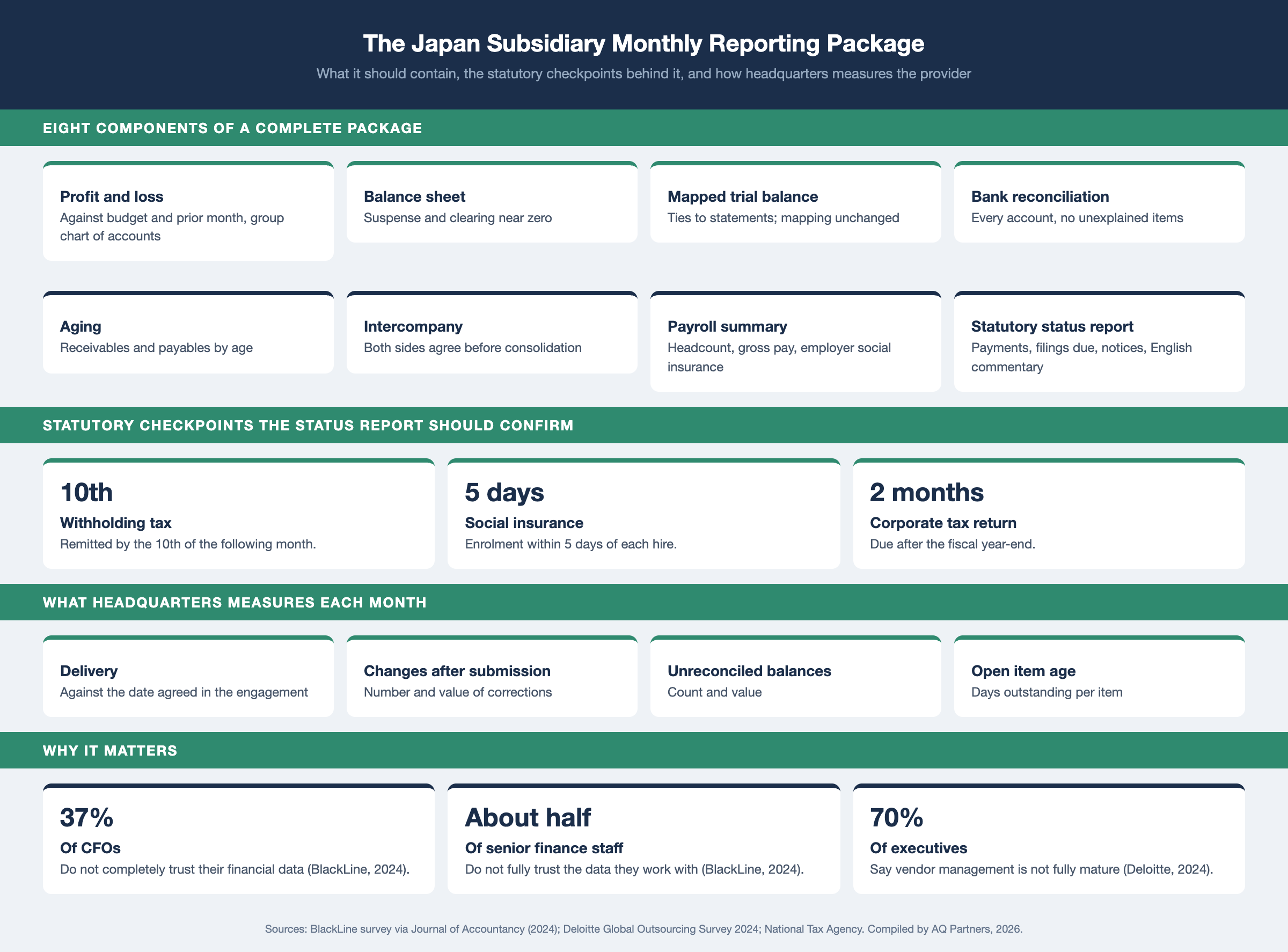
The package should be the same file every month, built from the subsidiary's Japanese GAAP books kept under standards set by the Accounting Standards Board of Japan and mapped to the group chart of accounts. Headquarters should be able to load the trial balance (試算表, shisanhyo) into its consolidation tool without rework and read the rest without opening the ledger. The table below lists the components most foreign-owned subsidiaries need and what the reviewer at headquarters checks in each.
| Component | What it shows | What headquarters checks |
|---|---|---|
| Profit and loss | Month and year to date against budget and prior month, on the group chart of accounts | Movements above the agreed threshold have commentary |
| Balance sheet | Closing balances with prior month comparison | Suspense and clearing accounts are near zero |
| Mapped trial balance | Local accounts with the group mapping applied | Totals tie to the statements and the mapping has not changed |
| Bank reconciliation | Book balance against the bank statement for every account | No unexplained reconciling items carried forward |
| Receivables and payables aging | Open customer and vendor balances by age | Old receivables and unpaid vendor invoices are explained |
| Intercompany confirmation | Balances with each group entity, in yen and the counterparty currency | Both sides agree before consolidation |
| Payroll summary | Headcount, gross pay, employer social insurance, and joiners and leavers | Headcount matches HR records and cost matches the budget |
| Statutory status report | Tax and social insurance payments made, filings due, notices received | Nothing overdue and every notice has an owner |
| Commentary in English | Explanation of key movements, accrual changes, and open items | Each explanation names a cause, not only the amount |
The package format belongs in the scope of the engagement, alongside the other back-office services the subsidiary buys. How to write that scope and compare providers on it is covered in how to choose a back-office provider for your Japan subsidiary.
The Statutory Status Report Most Japan Packages Leave Out
A statutory status report lists the month's tax and social insurance payments, upcoming filings, and official notices, each with an owner.
Financial statements show results, but they do not show whether the subsidiary met its obligations to the Japanese authorities. A missed withholding remittance or an unanswered notice from the pension office can sit unnoticed in an otherwise clean set of accounts. A one-page status report closes that gap. It should cover, at minimum:
- Withholding tax. Income tax withheld from salaries and from payments such as fees to individuals (源泉徴収, gensen choshu) and the date it was remitted. The general deadline is the 10th of the following month; the rules are explained in the guide to withholding tax in Japan.
- Social insurance and labour insurance. Premiums paid, new enrolments made within 5 days of each hire, and any change notifications filed.
- Consumption tax and corporate tax. Interim payments made and the next return date. The corporate tax return is due 2 months after the fiscal year-end, as set out on the National Tax Agency's corporation tax pages.
- Notices received. Any letter or message from the tax office, the local tax office, the pension office, Hello Work, or the Labour Standards Inspection Office, with the action taken.
- Corporate events. Director terms ending, registration changes in progress, and the annual shareholder resolution.
Where the payroll filings are made by a licensed sharoushi working with the provider, the status report should say so and confirm the submissions were made. The payroll and social insurance cycle behind those filings is covered in the guide to Japan payroll compliance and year-end adjustment.
How Headquarters Should Review a Japan Monthly Package
Headquarters should tie the package to the trial balance, cash, and intercompany, then read the commentary before raising questions with the provider.
A consistent review order makes the package faster to check and makes gaps obvious. The reviewer should be named, and the review should leave a record, even a short email, so that the group auditor can see that headquarters exercised oversight of an outsourced function. A practical sequence is:
- Confirm the trial balance totals agree to the profit and loss and the balance sheet, and that the account mapping has not changed.
- Agree the closing cash balance to the bank statements and check that every reconciling item has an explanation.
- Agree each intercompany balance to the counterparty's records.
- Compare the profit and loss to budget and the prior month, and read the commentary for every movement above the agreed threshold.
- Scan the balance sheet for suspense, clearing, and other balances that should be close to zero.
- Read the statutory status report for anything overdue or unanswered.
- Send one consolidated list of questions to the provider and track each to closure.
Japanese bookkeeping conventions sometimes explain a variance that looks odd from headquarters, for example how consumption tax codes are applied to transactions. The common differences are summarised in how Japanese accounting differs from global standards.
What to Measure About the Provider's Monthly Reporting
Measure reporting quality with a few indicators tracked every month: delivery against the agreed date, post-submission changes, and open item age.
Trust in reported numbers is a wider problem than Japan. According to the Journal of Accountancy's 2024 report on a BlackLine survey of more than 1,300 finance professionals in seven countries, 37% of CFOs do not completely trust the accuracy of their organization's financial data, about half of senior finance and accounting professionals do not fully trust the data they work with, and 27% of those who distrust their data cite reliance on spreadsheets. For an outsourced subsidiary, simple indicators turn that concern into something headquarters can manage.
| Indicator | How to measure it | What a worsening trend suggests |
|---|---|---|
| Delivery against the agreed date | Date received compared with the date set in the engagement | Capacity problems or late inputs from headquarters |
| Changes after submission | Number and value of corrections to a package already sent | Review at the provider is not catching errors |
| Unreconciled balances | Count and value of accounts without a reconciliation | Books are drifting away from source documents |
| Open item age | Days each open question or reconciling item has been outstanding | Issues are being carried rather than resolved |
| Commentary coverage | Share of movements above threshold that have an explanation | The provider is reporting numbers without understanding them |
| Statutory items on time | Payments and filings made by their due dates | Compliance risk building behind clean-looking statements |
| Query response | Time from headquarters question to a complete answer | Thin staffing or a single point of failure on the account |
The delivery date itself should be agreed between headquarters and the provider based on the group calendar and the inputs each side controls. What matters for oversight is that it is written down and measured.
Red Flags in a Japan Subsidiary's Monthly Reporting
Recurring restatements, growing suspense balances, unexplained variances, and unanswered official notices are the main red flags in a Japan package.
Single slips happen in any outsourced function. Patterns are different, and they tend to surface first in the monthly package. Vendor management is a known weak point: Deloitte's Global Outsourcing Survey 2024 found that 70% of executives report their vendor management function is not fully mature. The signs worth escalating are:
- Restatements. Prior months are corrected more than occasionally, or corrections arrive without explanation.
- Growing suspense balances. Amounts sit in suspense or clearing accounts and increase month after month.
- Commentary that restates numbers. Explanations describe the amount of a movement but never its cause.
- Intercompany differences that persist. The same mismatch appears at each month-end.
- Silence on statutory items. The status report is missing, or notices from the authorities appear only when headquarters asks.
- A changing contact. Questions are answered by a different person each month, with no handover of open items.
Raising these in a quarterly review with the provider, before the year-end close and the corporate tax return, gives time to fix the process. If the pattern continues, the transition steps for changing providers are in the provider selection guide.
Frequently Asked Questions
What should a Japan subsidiary monthly reporting package include?
A complete package includes the profit and loss against budget and prior month, the balance sheet, a trial balance mapped to the group chart of accounts, bank reconciliations, receivables and payables aging, intercompany confirmations, a payroll summary, a statutory status report, and English commentary on key movements and open items.
Should the package be in English or Japanese?
Commentary and headings should be in English for headquarters, with account names shown in both languages where the local chart of accounts uses Japanese. The underlying Japanese GAAP books and the statutory filings remain in Japanese, so the mapping between the two should be maintained by the provider and approved by headquarters.
How should headquarters agree the delivery date for the package?
Agree it in the engagement, based on the group reporting calendar and the inputs each side controls, such as intercompany charges from headquarters and vendor invoices in Japan. Then measure delivery against that date each month alongside quality indicators such as corrections after submission and the age of open items.
Working with AQ Partners. Our Tokyo team provides back office operations for foreign companies operating in Japan, including monthly bookkeeping and reporting, payroll coordination with a licensed sharoushi, and annual tax filings. Book a consultation to discuss your Japan reporting needs.

Yuga Koda is a founding Director at AQ Partners, supporting foreign companies, funds, and families operating in Japan. His experience operating companies in both Japan and international markets gives him a practical understanding of back office operations from both sides.