
Japan Worker Dispatch License: Requirements for Foreign Staffing Firms

The Worker Dispatch Act (労働者派遣法, Roudousha Haken Hou) is Japan's primary legislation governing temporary staffing agencies and the dispatch of workers to client companies. For foreign recruitment firms, obtaining a Worker Dispatch Business License from the Ministry of Health, Labour and Welfare (MHLW) is a mandatory prerequisite—and among the most demanding of any business license category in Japan. This guide covers the financial thresholds, office standards, manager qualifications, prohibited categories, and compliance obligations foreign staffing companies must satisfy.
Key Takeaways
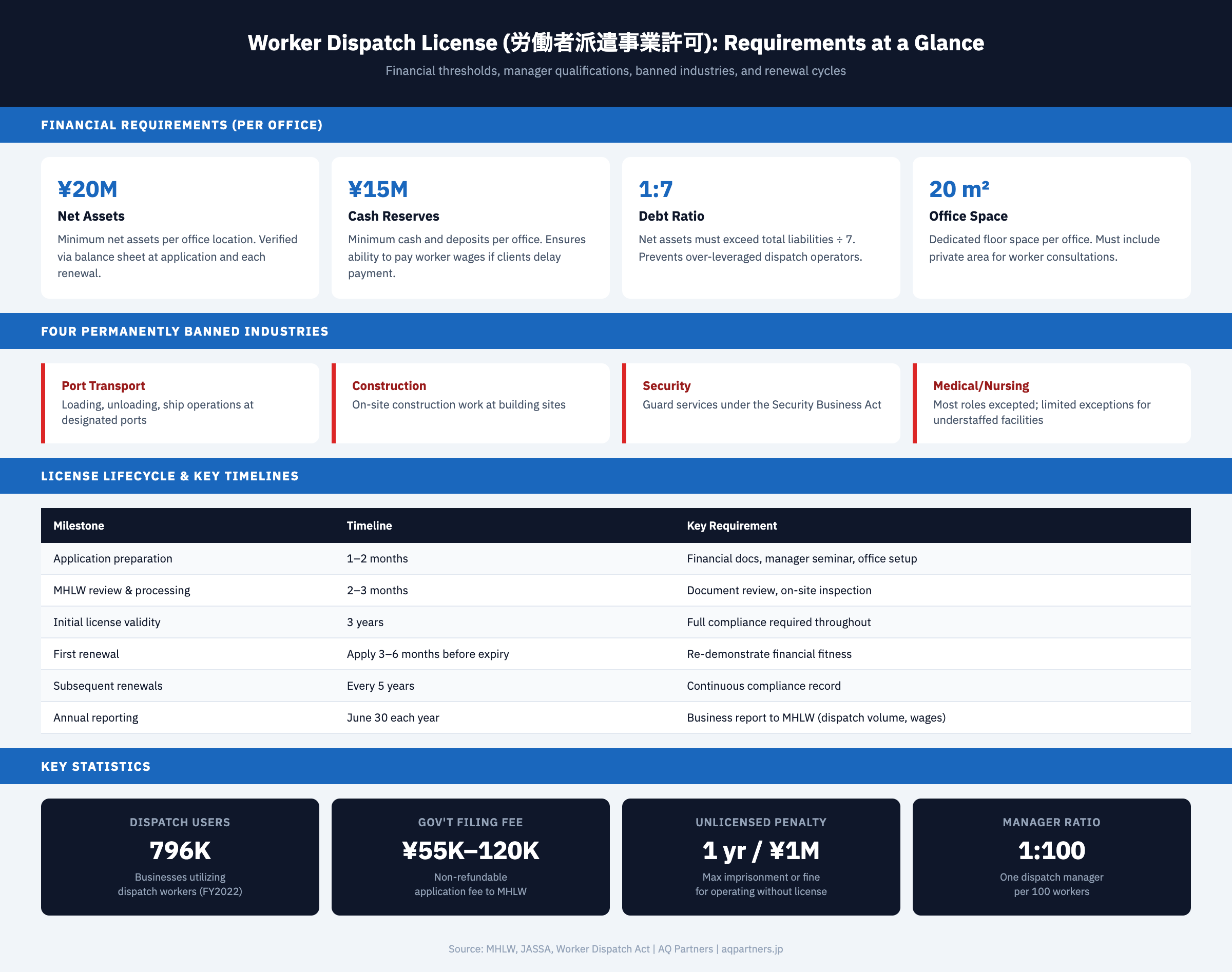
- Financial thresholds are substantial—a minimum of ¥20 million in net assets and ¥15 million in cash per office location, plus a debt-to-asset ratio requirement.
- Each office needs a qualified dispatch manager—three years of HR experience and completion of the Dispatch Business Manager Seminar (派遣元責任者講習) are required.
- Four industry categories are permanently banned—port transport, construction, security, and most medical/nursing roles, with limited healthcare exceptions.
- Licenses must be renewed every three years initially, then every five—renewal requires re-demonstrating financial fitness and ongoing compliance.
- Operating without a license carries criminal penalties—up to one year imprisonment or ¥1 million in fines, with civil liability for both dispatching and receiving entities.
What the Worker Dispatch Act Covers and Who Needs a License
Any business that employs workers and dispatches them to perform work under the direction of a separate client company must hold a valid Worker Dispatch Business License issued by the MHLW.
Enacted in 1986 with major revisions in 2004, 2012, 2015, and 2020, the law governs haken (派遣) arrangements—a triangular relationship where the staffing agency is the legal employer but the worker performs duties under a client company's supervision. MHLW data shows approximately 796,000 businesses utilized dispatch workers as of fiscal year 2022.
Foreign companies must first establish a legal entity—a KK, GK, or registered branch office—before applying. Identical standards apply regardless of shareholder nationality, as detailed in the official English translation of the Worker Dispatch Act.
Types of Worker Dispatch Licenses
Since the 2015 amendment, Japan unified its dispatch licensing regime into a single general license category, replacing the former dual-track system of general and specified dispatch.
Previously, Japan had two license types: General Worker Dispatch (一般労働者派遣事業), requiring MHLW permission, and Specified Worker Dispatch (特定労働者派遣事業), requiring only notification. The 2015 amendment abolished the specified category, consolidating all operations under a single permission-based license effective September 30, 2018. Every dispatch operation now requires the full MHLW license, as documented by the Japan Staffing Services Association (JASSA).
| Requirement Category | Pre-2015 General Dispatch | Pre-2015 Specified Dispatch | Post-2015 Unified License |
|---|---|---|---|
| Authorization type | MHLW permission | Notification only | MHLW permission |
| Net assets requirement | ¥20M per office | None | ¥20M per office |
| Cash reserves | ¥15M per office | None | ¥15M per office |
| Office space minimum | 20 m² | Not specified | 20 m² |
| Worker types covered | Registered / on-demand | Permanent employees only | All dispatch workers |
| License validity | 3 years (initial) | Indefinite | 3 years (initial), 5 years (renewal) |
Financial Requirements for the Worker Dispatch License
The financial bar is intentionally high—the MHLW requires proof that dispatch companies have sufficient capital to guarantee timely wage payments to all dispatched workers, even if client companies delay payment.
Financial fitness is the most common reason foreign staffing companies fail their initial application. Requirements are applied per office location—two offices means double the thresholds. According to Venture Japan's guide to starting a dispatch business, the three core criteria are:
| Financial Criterion | Minimum Threshold (Per Office) | Verification Method |
|---|---|---|
| Net assets (基準資産額) | ¥20,000,000 | Balance sheet / audited financials |
| Cash and deposits (現金・預金) | ¥15,000,000 | Bank statements / balance sheet |
| Debt-to-asset ratio | Net assets > total liabilities ÷ 7 | Balance sheet calculation |
| Two offices | ¥40M net assets / ¥30M cash | Multiplied per location |
| Three offices | ¥60M net assets / ¥45M cash | Multiplied per location |
| Timing of assessment | At application and each renewal | Most recent fiscal year-end financials |
Note: For newly incorporated companies without a completed fiscal year, the MHLW assesses financial fitness based on the opening balance sheet. Plan initial capitalization carefully to meet thresholds from day one.
Office and Facility Requirements
The MHLW mandates that each dispatch office must occupy a minimum of 20 square meters of dedicated floor space, be located in an appropriate business district, and maintain privacy protections for worker consultations.
The MHLW conducts onsite inspections to verify offices meet these conditions:
- Minimum 20 m² of usable floor space dedicated to dispatch operations, exclusive of shared hallways or bathrooms.
- Location restrictions—offices cannot be in districts dominated by adult entertainment businesses (風俗営業).
- Privacy provisions—a private area for confidential worker consultations and career guidance is required.
- Residential office limitations—home offices qualify only if the lease permits commercial use, the space meets 20 m², and living and business areas are clearly separated.
- Personal information management—documented procedures for protecting dispatched workers' personal data must be in place.
Dispatch Manager (派遣元責任者) Qualifications
Every dispatch office must appoint at least one Dispatch Business Manager who satisfies specific experience and training requirements set by the MHLW.
This role covers dispatch operations management, worker welfare, complaint handling, and communication with client companies. It cannot be delegated or outsourced. The manager must meet these criteria:
- Minimum three years of relevant experience in HR management, labor management, or staffing operations within the most recent five years.
- Completion of the Dispatch Business Manager Seminar (派遣元責任者講習)—a government-designated one-day course completed within the three years preceding application or renewal.
- No disqualifying record—individuals with certain criminal convictions or prior license revocations are barred.
- Dedicated to the role—the manager must be a full-time employee at the office and cannot serve at another location simultaneously.
The manager does not need to be a Japanese national but must have legal work authorization and the ability to communicate with Japanese labor authorities. Many foreign firms appoint a bilingual Japanese national to this role.
Prohibited Dispatch Categories
Japanese law permanently prohibits worker dispatch in four specific industry categories, and violations carry severe penalties including license revocation.
Article 4 of the Worker Dispatch Act designates the following work categories as permanently off-limits for dispatched workers, as confirmed by JASSA's regulatory overview:
| Prohibited Category | Japanese Term | Scope and Exceptions |
|---|---|---|
| Port transport work | 港湾運送業務 | Loading, unloading, and cargo handling at ports. No exceptions. |
| Construction work | 建設業務 | All civil engineering, building construction, renovation, demolition, and related onsite work. No exceptions. |
| Security services | 警備業務 | Facility guarding, patrol, crowd control, and personal protection. No exceptions. |
| Medical and nursing care | 医療関連業務 | Doctors, nurses, and medical staff at hospitals and clinics. Limited exceptions: maternity leave replacements, temporary-to-permanent placements, and doctors in designated remote areas. |
| Lawyers and licensed professionals | 士業 | Attorneys, certified public accountants, social insurance labor consultants, and similar nationally licensed professionals. |
| Building management at specific sites | 特定業務 | Other work designated by Cabinet Order as inappropriate for dispatched workers, assessed on a case-by-case basis. |
Dispatching workers into a prohibited category—even inadvertently—is treated as a serious violation and can result in immediate license revocation.
License Validity, Renewal, and the 3-Year Cycle
Initial Worker Dispatch licenses are valid for three years, with subsequent renewals extending validity to five years, provided the company continues to meet all MHLW criteria.
The application process typically takes two to three months from submission to approval. Once granted, the initial license is valid for three years; at renewal, validity extends to five years. The renewal process requires:
- Updated financial statements showing continued compliance with ¥20M net asset and ¥15M cash thresholds.
- Confirmation that the Dispatch Business Manager has completed a refresher seminar within the preceding three years.
- An updated business plan including career development measures for dispatched workers.
- Notification of any changes to directors, addresses, or business scope (must be reported within 30 days of occurring).
Continuing to dispatch workers on an expired license is treated identically to operating without a license.
Paid Employment Placement License—A Separate Requirement
Foreign staffing firms that also introduce candidates directly to employers for permanent or contract positions need a separate Fee-Charging Employment Placement Business License (有料職業紹介事業許可) under the Employment Security Act.
In Japan, dispatch and permanent placement are two legally distinct activities requiring separate licenses. The Paid Employment Placement License is governed by the Employment Security Act. According to JETRO's guide to labor contracts and employment services, key differences include:
- Lower financial threshold—the base capital requirement is ¥5 million in net assets (compared to ¥20M for dispatch).
- Manager training—the designated Recruitment Business Manager must complete a separate seven-hour training course, at a cost of approximately ¥10,000.
- License validity—initial validity is three years, with five-year renewals (same structure as the dispatch license).
- Office inspection—government officials conduct an onsite inspection similar to the dispatch license process.
Companies offering both services should budget accordingly—the combined capital requirement for a single office is ¥25 million in net assets (¥20M dispatch plus ¥5M placement). For a detailed walkthrough, see our guide on how to apply for a business license in Japan.
Recent Reforms and Compliance Trends
The 2020 equal pay reforms and ongoing MHLW enforcement campaigns have significantly increased compliance obligations for dispatch companies, particularly around wage transparency and career development.
Key regulatory changes include:
Equal pay for equal work (同一労働同一賃金): Since April 2020, dispatched workers must receive wages comparable to regular employees doing equivalent work. Companies choose between the "dispatch-destination comparison method" or the "labor-management agreement method." According to Littler's analysis, most firms opt for the agreement method due to difficulty obtaining client salary data.
Career development and social insurance: Since 2015, dispatch companies must implement career development programs with designated consultants—evaluated at each renewal. All qualifying workers must also be enrolled in social insurance, an area where MHLW audits have intensified. See our article on HR compliance strategies for global teams in Japan for additional context.
Penalties for Unlicensed Dispatch Operations
Both the dispatching company and the receiving client face serious legal consequences when workers are dispatched without a valid license, including criminal prosecution and mandatory direct-hire obligations.
The Worker Dispatch Act and Employment Security Act impose overlapping penalties for unlicensed operations. For a broader view, see our guide on Japan labor compliance risks.
| Violation Type | Penalty for Dispatch Company | Penalty for Receiving Company |
|---|---|---|
| Operating without a license | Up to 1 year imprisonment or ¥1M fine | Administrative guidance; potential direct-hire order |
| Dispatching to prohibited categories | License revocation; criminal charges | Administrative correction order |
| Exceeding the 3-year dispatch period limit | Administrative correction order | Deemed direct employment offer obligation |
| Failure to implement equal pay | Administrative guidance; public naming | Joint liability for wage disparities |
| Failure to enroll workers in social insurance | Back-payment of premiums; penalties | Potential co-liability in enforcement actions |
| Failure to report or renew license | Up to ¥300,000 fine; license suspension | N/A |
Note: Under the "deemed direct employment" provision (2012 amendment), if a client company knowingly receives workers from an unlicensed operator or uses them beyond three years, the law deems the client to have made a direct employment offer on the same terms—effectively forcing direct hire.
Frequently Asked Questions
Can a foreign company apply for a Worker Dispatch License without incorporating in Japan?
No. The applicant must be a Japanese legal entity—a KK, GK, or registered branch office. The ¥20 million net asset requirement must be satisfied on the Japanese balance sheet, not consolidated global financials. For guidance on entity types, see our comprehensive guide to business licenses for foreign companies in Japan.
How long does it take to obtain a Worker Dispatch License?
MHLW processing takes two to three months from complete application. However, preparation—entity incorporation, capital injection, office lease, manager seminar, and documents—adds two to four months. Plan for a total of four to six months from initial planning to license issuance.
What happens if our company's net assets fall below ¥20 million during the license period?
Financial fitness is reassessed at each renewal. If net assets fall below the threshold, the MHLW will decline renewal and the company must cease dispatch operations. In cases of significant deterioration, the MHLW may issue a business improvement order (事業改善命令) requiring corrective action.
Is it possible to dispatch workers to medical facilities under any circumstances?
Limited exceptions exist: maternity or parental leave replacements, temporary-to-permanent arrangements where the facility intends to directly hire, and doctors in designated remote areas with shortages as specified by Cabinet Order. Outside these narrow cases, all medical dispatch is prohibited.
Next Steps for Foreign Recruitment Firms
Securing a Worker Dispatch License requires substantial upfront investment—but it opens access to one of the world's largest temporary staffing markets. Begin by confirming your entity structure and capitalization, appointing a qualified dispatch manager, and engaging a licensed labor consultant (sharoushi, 社会保険労務士) to guide the application.
Working with AQ Partners. Our Tokyo team provides KK and GK incorporation, corporate bank account application and monthly bookkeeping for foreign companies operating in Japan, so the entity behind the application is in order. Book a consultation to discuss your situation.

Yuga Koda is a founding Director at AQ Partners, supporting foreign companies, funds, and families operating in Japan. His experience operating companies in both Japan and international markets gives him a practical understanding of back office operations from both sides.