
Back Office Complexity: Speed & Cost Impact in Japan

Key Takeaways
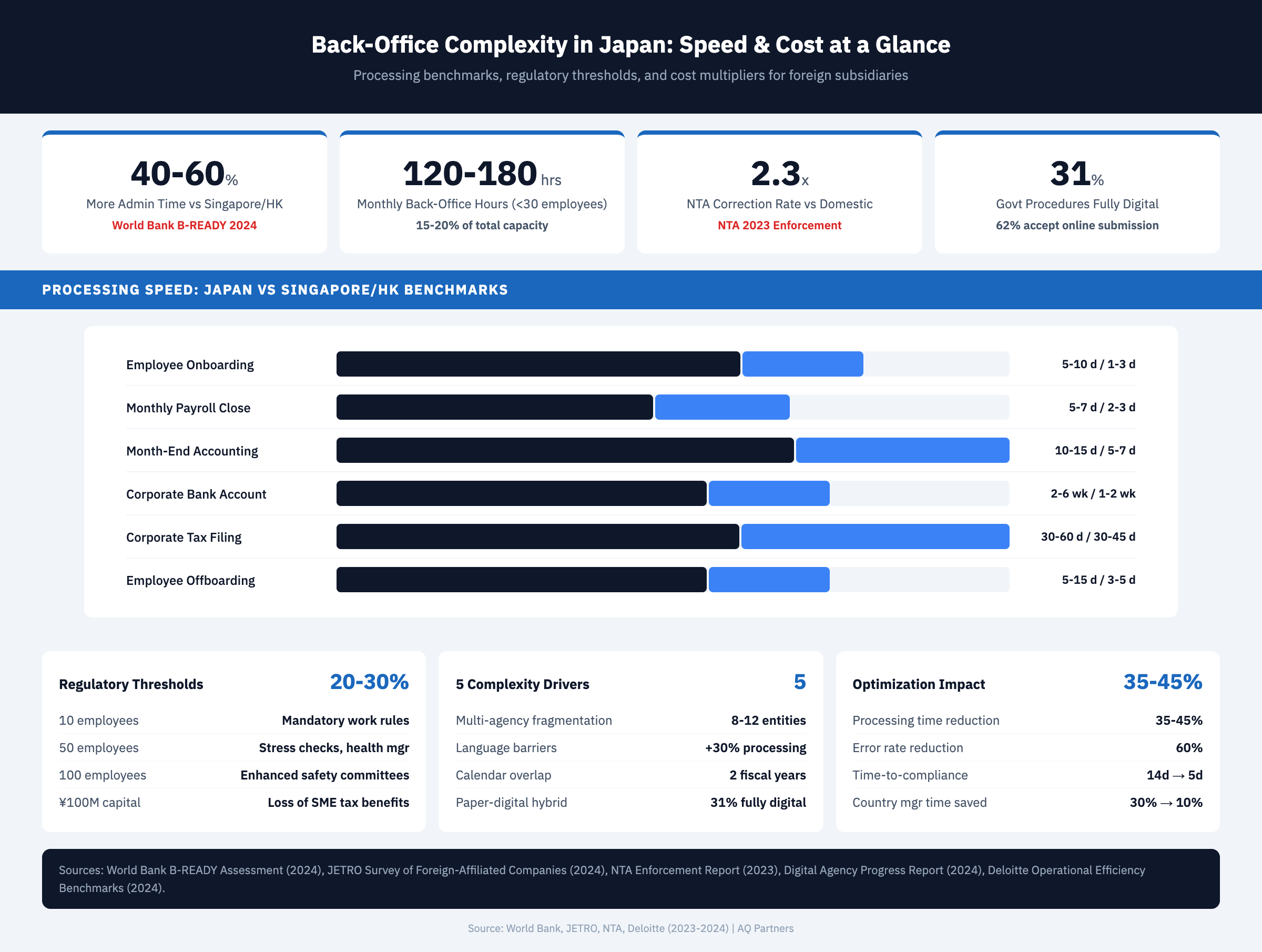
- Back-office complexity in Japan adds 40-60% more administrative time compared to equivalent operations in Singapore or Hong Kong — according to the World Bank's 2024 Business Ready (B-READY) assessment, Japan ranks below both jurisdictions on administrative efficiency metrics, driven by multi-agency filing requirements, Japanese-language documentation, and paper-based processes that persist alongside digital systems.
- The average foreign subsidiary spends 120-180 staff hours per month on back-office compliance — a 2024 JETRO survey of foreign-affiliated companies found that administrative burden consumes 15-20% of total operational capacity at companies with fewer than 30 employees, diverting leadership attention from revenue-generating activities during critical growth phases.
- Compliance errors caused by complexity cost foreign companies ¥2-5 million per incident in penalties and remediation — the National Tax Agency's 2023 enforcement report showed that foreign-affiliated entities received correction notices at 2.3 times the rate of domestic companies, with the most common issues being withholding tax calculation errors and late social insurance filings.
- Each regulatory threshold (10, 50, 100 employees) triggers step-function increases in back-office requirements — crossing these thresholds adds new compliance obligations without corresponding efficiency gains, creating "complexity cliffs" where administrative costs jump 20-30% despite only marginal headcount growth.
- Companies that proactively design for complexity — through integrated providers, automated systems, and compliance calendars — reduce back-office processing time by 35-45% — Deloitte's 2024 operational efficiency benchmarks for Japan show that structured back-office operations cut error rates by 60% and reduce time-to-compliance from an average of 14 days to 5 days per filing cycle.
How Complexity Becomes a Cost Multiplier in Japan
Back-office complexity in Japan acts as a cost multiplier — each additional compliance requirement does not simply add a fixed incremental cost but compounds with existing obligations, creating exponential rather than linear cost growth as companies scale.
In most markets, adding one employee to the payroll is a straightforward calculation: salary plus benefits plus a proportional share of administrative overhead. In Japan, adding that same employee triggers notifications to the Japan Pension Service (health insurance and pension enrollment), Hello Work (employment insurance), the Labor Standards Inspection Office (if it changes working hour calculations or threshold obligations), and potentially multiple municipal tax offices (residence tax special collection registration). Each notification requires Japanese-language forms, supporting documentation, and often manual submission.
Understanding what back office truly means in Japan reveals why this complexity exists. Japan's administrative framework distributes oversight across multiple independent agencies, each with its own forms, deadlines, and verification processes. These agencies do not coordinate with each other — a company must independently notify each one of the same personnel change, often using different forms and different submission methods.
The World Bank's 2024 Business Ready (B-READY) assessment, which replaced the former Doing Business rankings, found that Japan's regulatory compliance processes require an average of 40-60% more administrative time than comparable procedures in Singapore or Hong Kong. This gap exists not because Japan's regulations are inherently more burdensome in substance, but because the delivery mechanism — multiple agencies, Japanese-language requirements, paper-and-digital hybrid processes — multiplies the effort required for each individual obligation.
The Five Drivers of Back-Office Complexity
Japan's back-office complexity stems from five structural drivers — multi-agency fragmentation, language barriers, calendar overlap, paper persistence, and threshold-based regulation — each amplifying the others to create a system that is greater than the sum of its parts.
Driver 1: Multi-agency fragmentation. A single payroll run in Japan involves coordination with the NTA (income tax withholding), the Japan Pension Service (health insurance and pension premiums), municipal tax offices (residence tax collection), and potentially the Labor Bureau (employment insurance premiums). Each agency calculates its obligations using different bases, different rate structures, and different payment schedules. A company operating in three municipalities has three separate residence tax collection relationships, each requiring individual communication and payment tracking.
Driver 2: Language as a processing bottleneck. Government forms, official notices, and regulatory correspondence arrive in Japanese. Responding requires Japanese-language preparation. For foreign companies whose management operates in English, every government interaction requires either bilingual staff or translation services — adding processing time and error risk at each step. According to JETRO's 2024 survey of foreign-affiliated companies, language barriers add an average of 30% to back-office processing time compared to domestic companies performing identical tasks.
Driver 3: Overlapping compliance calendars. Japan operates on two parallel fiscal calendars. Corporate tax follows the company's chosen fiscal year (which can be any 12-month period). Social insurance and labor filings follow the government's April-to-March fiscal year. These calendars overlap differently depending on the company's fiscal year choice, creating unique compliance rhythms. A company with a December fiscal year-end faces peak back-office workload in January-March (year-end adjustment completion, withholding summaries, and corporate tax preparation) coinciding with the government fiscal year's busiest period for social insurance adjustments.
Driver 4: Paper-digital hybrid processes. Japan has invested significantly in digital government services through the Digital Agency, yet many processes exist in a hybrid state where digital submission is available but paper backup, physical stamps, or in-person verification remain required. The Digital Agency's 2024 progress report found that while 62% of government procedures now accept online submissions, only 31% can be completed entirely without paper documents at any stage. This hybrid state creates dual-processing requirements — companies must maintain both digital and paper workflows rather than fully migrating to one system.
Driver 5: Threshold-based regulation. Japanese labor and tax law imposes new obligations at specific employee counts and revenue levels — 10 employees (mandatory work rules), 50 employees (stress checks, health manager appointment), 100 employees (enhanced safety committees). Each threshold adds administrative requirements without proportional efficiency tools, creating sudden jumps in compliance burden.
Quantifying the Speed Impact: How Complexity Slows Operations
Back-office complexity directly reduces operational speed — from the time it takes to onboard a new employee to the delay between earning revenue and completing month-end close, every process runs slower in Japan than in comparable markets.
| Process | Japan Timeline | Singapore/HK Benchmark | Complexity Driver |
|---|---|---|---|
| Employee Onboarding | 5-10 business days | 1-3 business days | Multi-agency enrollment (pension, health, employment insurance) |
| Monthly Payroll Close | 5-7 business days | 2-3 business days | Commuting allowances, grade-based SI premiums, overtime calculations |
| Month-End Accounting Close | 10-15 business days | 5-7 business days | J-GAAP + IFRS dual reporting, consumption tax reconciliation |
| Corporate Bank Account Opening | 2-6 weeks | 1-2 weeks | In-person interviews, extensive documentation, AML verification |
| Corporate Tax Filing | 30-60 days post FY-end | 30-45 days | National + prefectural + municipal filings (3 separate returns) |
| Year-End Adjustment | 6-8 weeks (Nov-Jan) | N/A (individual filing) | Employer-administered tax reconciliation for all employees |
| Employee Offboarding | 5-15 business days | 3-5 business days | SI deregistration, unused leave payout, loss certificate issuance |
| Visa Status Change | 1-3 months | 2-4 weeks | Immigration Bureau processing, document preparation in Japanese |
The speed impact compounds across functions. When employee onboarding takes 5-10 days instead of 1-3, new hires cannot be added to payroll immediately, which delays social insurance enrollment, which pushes back the first salary payment, which affects employee satisfaction and retention. Each individual delay is manageable, but the cascade across interconnected back-office functions creates systemic slowdowns.
According to a 2024 JETRO survey, foreign-affiliated companies with fewer than 30 employees spend 120-180 staff hours per month on back-office compliance — representing 15-20% of their total operational capacity. For a company trying to build its Japan business, this means that one-fifth of available working time goes to administrative functions rather than sales, product development, or client engagement.
The month-end accounting close illustrates the complexity-to-speed relationship particularly well. A Japan subsidiary must reconcile its books under J-GAAP for local statutory requirements while simultaneously preparing consolidation packages in IFRS or US GAAP for the parent company. Each framework treats revenue recognition, lease accounting, and certain provisions differently, requiring parallel calculations and reconciliation entries. The differences between Japanese and international accounting standards create a dual-reporting workload that does not exist in single-framework jurisdictions.
Cost Escalation at Regulatory Thresholds
Japan's regulatory framework creates "complexity cliffs" at specific employee counts and revenue levels — crossing these thresholds triggers new compliance obligations that increase annual back-office costs by 20-30% without corresponding revenue growth.
| Threshold | New Obligations Triggered | Estimated Annual Cost Impact | Administrative Hours Added |
|---|---|---|---|
| 10 Employees | Mandatory work rules (shugyo kisoku) filing with Labor Standards Inspection Office | ¥200K-500K (one-time drafting) + ¥50K-100K/year maintenance | 20-40 hours initial + 10 hours/year |
| ¥10M Taxable Sales | Consumption tax registration and quarterly/annual filing obligations | ¥300K-800K/year (tax preparation + filing fees) | 40-80 hours/year |
| 50 Employees | Annual stress checks, health manager (eisei kanrisha) appointment, detailed work-hour reports | ¥500K-1.5M/year | 80-120 hours/year |
| 100 Employees | Enhanced health and safety committees, general health manager, additional reporting | ¥800K-2M/year | 100-160 hours/year |
| ¥100M Capital | Loss of SME tax benefits (reduced rate on first ¥8M, simplified consumption tax) | ¥1-3M/year in lost tax benefits | Varies by transaction volume |
| 300 Employees | Action plan for promoting women's participation (Women's Active Participation Act) | ¥200K-500K/year (planning + reporting) | 40-60 hours/year |
The 50-employee threshold is particularly consequential. Under the Industrial Safety and Health Act, companies reaching 50 employees must appoint a health manager (eisei kanrisha), conduct annual stress checks for all employees with follow-up physician consultations for those flagged, and submit detailed reports to the Labor Standards Inspection Office. The MHLW's labor standards framework treats this threshold as a major step-up in employer obligations, reflecting Japan's increasing focus on workplace mental health following the 2015 introduction of mandatory stress checks.
Companies approaching these thresholds should plan for the compliance increase 6-12 months in advance. Hiring the 10th, 50th, or 100th employee without budgeting for the corresponding back-office cost increase creates financial surprises that strain both the administrative team and the company's profitability model. The decision of whether to outsource or handle these functions in-house becomes particularly important at each threshold crossing.
The Hidden Cost: Leadership Time Diverted from Growth
The most significant cost of back-office complexity is not measured in yen — it is the diversion of leadership attention from business development, client relationships, and strategic planning toward administrative problem-solving.
For foreign subsidiaries in their first 3-5 years, the Japan country manager or representative director typically becomes the de facto back-office escalation point. When payroll questions arise, when the tax accountant needs information, when the Japan Pension Service sends a notice, or when the bank requires additional documentation, these issues flow to the most senior English-speaking person in the office. According to JETRO's 2024 survey, country managers at foreign-affiliated companies with fewer than 20 employees spend an average of 25-30% of their working time on back-office coordination rather than business development activities.
This diversion creates an opportunity cost that compounds over time. A country manager earning ¥15-20 million annually who spends 30% of their time on back-office matters is effectively allocating ¥4.5-6 million in leadership compensation to administrative functions — often more than the cost of outsourcing those functions entirely to a specialized provider.
The problem is particularly acute during peak compliance periods. The January withholding tax summary deadline, May corporate tax filing deadline, and July social insurance annual review create three periods each year where back-office demands can consume the majority of available administrative bandwidth. Companies that have not structured their tax filing and compliance processes effectively find leadership attention pulled away from business operations during these critical periods.
Strategies to Reduce Complexity Impact
Reducing back-office complexity impact requires a three-pronged approach — process integration, technology deployment, and proactive compliance planning — that addresses the root causes of slowdowns and cost escalation rather than their symptoms.
Strategy 1: Integrated provider model. Rather than engaging separate firms for accounting, tax, payroll, and social insurance, use a single integrated provider that handles all functions under one relationship. This eliminates inter-provider coordination overhead, reduces information requests (the same data serves multiple functions), and creates a single point of accountability. According to PwC's Japan tax summary, integrated compliance management reduces the risk of errors caused by information gaps between separate advisors.
Strategy 2: Japanese cloud platform adoption. Platforms like freee and MoneyForward Cloud integrate accounting, payroll, and expense management with direct connections to Japan's e-tax filing system and social insurance electronic applications. Companies using integrated cloud platforms reduce monthly bookkeeping time by an estimated 40-50% compared to manual or spreadsheet-based approaches, according to freee's 2024 SME efficiency report.
Strategy 3: Proactive compliance calendar. Building an annual compliance calendar with preparation milestones — not just filing deadlines — prevents the crisis-mode processing that creates errors. Each deadline should have a preparation trigger 30-45 days in advance, a data collection deadline 14-21 days in advance, and a review checkpoint 7 days before filing. This structured approach, covering the full scope of Japan's back-office requirements, transforms compliance from a reactive burden into a predictable operational rhythm.
Strategy 4: Threshold-aware growth planning. Map your company's growth trajectory against known regulatory thresholds (10, 50, 100 employees; ¥10 million taxable sales; ¥100 million capital). Budget for the compliance cost increase 6-12 months before crossing each threshold. In some cases, strategic decisions about entity structure (e.g., keeping capital below ¥100 million to retain SME benefits) can significantly reduce complexity. AQ Partners' entity structuring advisory addresses these considerations as part of market entry planning.
Strategy 5: Bilingual documentation standards. Maintain all internal back-office documentation in both English and Japanese from the start. This dual-language approach seems like additional work initially but pays dividends when HQ requests financial data, when auditors require English-language support, or when key bilingual staff depart. It also enables headquarters leadership to meaningfully review Japan operations rather than relying entirely on local interpretation.
Frequently Asked Questions
Why is Japan's back office more complex than other Asian markets?
Japan's complexity stems from structural factors: multi-agency regulatory fragmentation (8-12 government entities for a single company), mandatory Japanese-language documentation, a paper-digital hybrid environment where only 31% of government procedures are fully digital, and threshold-based regulations that add new obligations at specific employee counts. Markets like Singapore and Hong Kong consolidated more regulatory functions into single agencies and digitized earlier, creating streamlined processes that Japan's distributed system has not yet matched.
How can we reduce the time our country manager spends on back-office issues?
The most effective approach is engaging an integrated back-office provider who serves as the single point of contact for all compliance matters, reducing the country manager's role to occasional approvals rather than active coordination. JETRO's survey data shows that country managers at companies with integrated outsourced back offices spend approximately 10% of their time on administrative matters versus 25-30% at companies managing multiple individual providers or in-house staff.
At what company size does back-office complexity become unmanageable without professional support?
The critical inflection point is around 5-10 employees. Below 5 employees, a diligent country manager with a basic accounting relationship can manage most requirements — though risks accumulate. At 10 employees, the mandatory work rules filing and increasing payroll complexity require professional support. At 20+ employees, the volume of social insurance changes, payroll variations, and compliance filings makes professional back-office support essential rather than optional. Companies that wait until 20+ employees to engage professional help typically face 3-6 months of catch-up work to remediate accumulated compliance gaps.
Back-office complexity in Japan is a structural reality, not a problem that disappears with experience or technology alone. The companies that manage it most effectively treat their back office as core operational infrastructure — investing in the right providers, systems, and processes from the start rather than reacting to problems as they emerge. AQ Partners helps foreign companies design and operate back-office infrastructure that handles Japan's complexity without consuming leadership attention or creating compliance risk. Contact us for a consultation to assess your current back-office setup and identify opportunities to reduce complexity-driven costs.

Yuga Koda is a founding Director at AQ Partners, supporting foreign companies, funds, and families operating in Japan. His experience operating companies in both Japan and international markets gives him a practical understanding of back office operations from both sides.