
Tax Equalization in Japan: Expatriate Payroll Mechanics
Tax equalization is a group mobility policy that leaves an assignee no better and no worse off on tax than if they had stayed at home. The employer withholds a hypothetical tax, an estimate of the home-country tax the employee would have paid, and in return pays the actual host-country tax.
Japanese law sees only the salary paid, the benefits provided and the Japanese tax the employer bears. Below is how each element is treated for income tax and social insurance, with a yen example.
Key Takeaways
- Hypothetical tax is invisible to Japan. It is a retention under the group policy, not a Japanese tax, so it earns no credit on the Japanese return.
- Employer-paid Japanese tax is itself salary. Tax borne for the employee is taxable income, so payroll grosses it up; in the 40% bracket each yen of net benefit costs about 1.69 yen.
- Company housing has two values. Income tax uses the National Tax Agency formula; social insurance uses a ministry value per square metre.
- Relocation fares sit outside both bases. Ordinary transfer travel is non-taxable under the Income Tax Act and is not remuneration for social insurance.
- High earners file their own return. Salary over 20 million yen is excluded from year-end adjustment, and a grossed-up package can pass that line quickly.
How Tax Equalization Works in a Japan Payroll
In Japan, tax equalization means paying an agreed net salary and treating Japanese tax the employer bears as extra taxable salary.
Home gross salary, less a hypothetical income tax and often a hypothetical social security charge, gives a stay-at-home net. The Japan entity pays that net and covers the actual Japanese tax. The hypothetical deduction is a retention by the employer; it never reaches the tax office.
The Japanese side follows from one rule. Where a payment is agreed on a net-of-tax (手取り, tedori) basis, the National Tax Agency's basic circular 181-223 common-4 requires withholding on the grossed-up amount. Tax the employer pays for the employee is part of what the employee receives, so taxable salary is net pay plus Japanese tax borne plus taxable benefits.
What the Japanese Payroll Records for Each Package Item
Each line of an equalized package has its own Japanese income tax treatment under the Income Tax Act and NTA guidance.
| Package item | Japanese income tax treatment | Basis |
|---|---|---|
| Net salary paid in Japan | Taxable employment income, withheld monthly from the withholding tables | Income Tax Act Art. 28 and 183 |
| Hypothetical income tax retained | Not a Japanese tax; no credit on the Japanese return | Policy retention, outside Japanese law |
| Japanese income tax borne by the employer | Added to salary and grossed up so the net is preserved | NTA basic circular 181-223 common-4 |
| Company housing, employee who is not an officer | No taxable benefit if the employee pays at least 50% of the statutory rental value; below 50%, the whole gap between the rental value and the rent paid is salary | NTA Tax Answer No. 2597 |
| Company-leased housing, officer, not small housing | Rental value is the higher of 50% of the rent the company pays and the asset-value formula | NTA Tax Answer No. 2600 |
| Luxury housing for an officer | Over 240 m², luxury status is judged on acquisition cost, rent and fittings together; 240 m² or less can also be luxury with facilities such as a pool. If luxury, the rental value is the normal market rent | NTA Tax Answer No. 2600 |
| Cash housing allowance, or a lease the employee signs | Fully taxable salary; not company housing | NTA Tax Answer No. 2597 |
| Relocation travel on transfer | Non-taxable to the extent normally necessary for the move | Income Tax Act Art. 9(1)(iv) |
| Home-leave fares for a foreign employee | Non-taxable where a foreign national working in Japan for a long continuous period takes home leave granted under the work rules after roughly each year or more of service; covers round-trip fares to, in principle, the country of nationality or citizenship (of the employee or spouse) by the most economical and reasonable ordinary route, for the employee and the spouse and relatives sharing their livelihood | NTA individual circular of 16 January 1975 |
According to NTA Tax Answer No. 2597, the monthly rental value for employees is 0.2% of the building's fixed asset tax value, plus 12 yen per 3.3 m² of floor area, plus 0.22% of the land value.
For officers, NTA Tax Answer No. 2600 defines small housing as 132 m² or less, or 99 m² or less where the building's statutory useful life exceeds 30 years. A seconded representative director is an officer, so for a leased flat above that size, half the actual rent sets the floor. Allowance design is covered in our guide to Japan salary structure, allowances and bonuses.
The Gross-Up: A Worked Yen Example
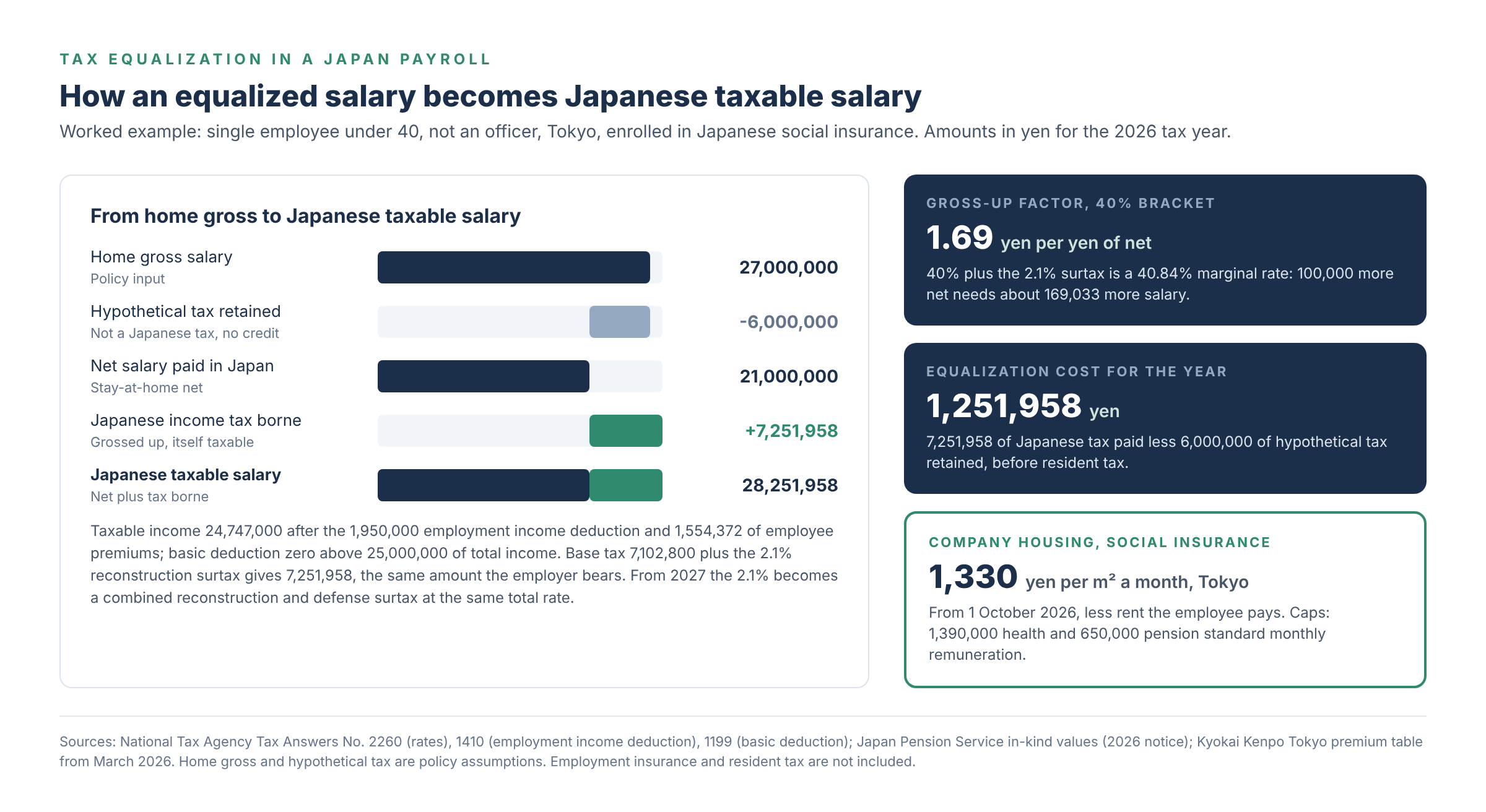
Employer-paid Japanese tax is taxed again, so in the 40% bracket each yen of net benefit costs about 1.69 yen of salary.
The factor comes from the NTA income tax rate table. For the 2026 tax year, in the 40% bracket (taxable income of 18,000,000 to 39,999,000 yen), the statutory reconstruction surtax adds 2.1% of the base tax, so the combined national marginal rate is 40.84%.
NTA Tax Answer No. 2260 notes that under the 2026 tax reform, effective from 2027, the reconstruction surtax is lowered and a defense special income tax is added, with the combined rate unchanged. Per the NTA rates, delivering 100,000 yen more after tax needs about 169,033 yen of extra salary, before resident tax.
The example assumes a single employee under 40 who is not an officer, works in Tokyo and is enrolled in Japanese social insurance; the home-country inputs come from the policy. The example is a full 2026 tax year at the premium rates in force from April 2026. Under NTA Tax Answer No. 1410, the employment income deduction is capped at 1,950,000 yen for salary over 8,500,000 yen. Per the NTA, the basic deduction is zero because total income exceeds 25,000,000 yen.
| Line | Amount (yen) | How it is set |
|---|---|---|
| Home gross salary | 27,000,000 | Policy input (assumption) |
| Hypothetical income tax retained | 6,000,000 | Policy input under home-country rules (assumption) |
| Net salary paid through Japan payroll | 21,000,000 | Home gross less hypothetical tax |
| Japanese income tax borne by the employer | 7,251,958 | Solved so the tax on the total equals the tax paid |
| Japanese taxable salary | 28,251,958 | Net salary plus tax borne |
| Employment income | 26,301,958 | Less the 1,950,000 employment income deduction |
| Employee social insurance premiums | 1,554,372 | 129,531 a month at the Tokyo caps (health, child-care levy, pension) for twelve months; employment insurance left out |
| Taxable income | 24,747,000 | Rounded down to the nearest 1,000 |
| Base income tax | 7,102,800 | Statutory 40% bracket, less the 2,796,000 bracket deduction |
| Income tax with reconstruction surtax | 7,251,958 | Base tax plus the statutory 2.1%, fractions of a yen dropped |
The tax on the grossed-up salary equals the tax the employer bears, which shows the iteration has closed. Under the policy the employer retains 6,000,000 yen of hypothetical tax and pays 7,251,958 yen of Japanese income tax, a net equalization cost of 1,251,958 yen before resident tax.
According to the Ministry of Internal Affairs and Communications, resident tax is levied on the previous calendar year's income at a standard income-based rate of 10%, so year-one income drives a year-two bill; deduction mechanics are in our guide to resident tax payroll deduction.
Company Housing: Tax Value and Social Insurance Value
Company housing is valued twice: income tax uses the NTA formula, social insurance a per-square-metre value set for each prefecture.
For health insurance and pension, housing provided in kind (現物給与, genbutsu kyuyo) is converted to cash at the ministry's notified value and added to remuneration, according to the Japan Pension Service. From 1 October 2026 the Tokyo value is 1,330 yen per square metre of total floor area per month, replacing 2,830 yen per tatami of living rooms.
Rent the employee pays is subtracted, and the value is generally that of the prefecture of the work location, not of the flat.
Take a 70 m² Tokyo flat for which the employee pays 30,000 yen a month. Under the Japan Pension Service values the flat is worth 93,100 yen a month, so 63,100 yen is added to monthly remuneration whatever the actual rent. Whether premiums change depends on the caps in the Kyokai Kenpo Tokyo premium table: 1,390,000 yen of standard monthly remuneration for health insurance and 650,000 yen for pension.
| Monthly cash pay (yen) | Housing added (yen) | Standard monthly remuneration, health / pension (yen) | Employee premiums a month, before rounding (yen) |
|---|---|---|---|
| 600,000, no company housing | 0 | 590,000 / 590,000 | 83,721 |
| 600,000 with the 70 m² flat | 63,100 | 650,000 / 650,000 | 92,235 |
| 2,000,000, no company housing | 0 | 1,390,000 / 650,000 | 129,531 |
| 2,000,000 with the 70 m² flat | 63,100 | 1,390,000 / 650,000 | 129,531 |
The premiums are the employee half-shares of health insurance, the Kyokai Kenpo 0.23% child-care support levy and pension, for an employee under 40; the employer pays a matching half. A change in the housing value counts as a fixed-wage change and can trigger a filing, as our post on standard monthly remuneration and the getsuhen explains.
Relocation and Allowances in Social Insurance
Social insurance counts everything paid for work, whatever its name, so regular allowances are remuneration and relocation travel is not.
The Japan Pension Service's guidance, drawn from the ministry's 2023 casebook, sorts items by substance rather than label.
| Item | Remuneration for health insurance and pension? | Reason given in the guidance |
|---|---|---|
| Base salary and incentives | Yes | Paid regularly as consideration for work |
| Commuting allowance | Yes | Listed by name as remuneration |
| Family allowance | Yes | Paid regularly under the pay rules |
| Cash housing allowance | Yes | A fixed allowance; changes to it are fixed-wage changes |
| Company housing provided in kind | Yes, at the ministry's value less rent paid | In-kind pay under the employment contract |
| Relocation travel (赴任旅費, funin ryohi) | No | Reimbursement of a cost the employer should bear |
| Business travel expenses | No | Reimbursement of a cost the employer should bear |
| Wedding gifts and sympathy payments | No, unless paid regularly under an agreement | Discretionary welfare payments |
Assignees holding a home-country certificate under a social security agreement may be exempt from Japanese coverage for the period the agreement allows; our post on Japan pension for expats and totalization covers that route.
Split Payroll, Non-Permanent Residents and the Final Return
When part of the package is paid abroad, the Japan entity in principle withholds only on what it pays; the rest goes on a final return.
NTA Tax Answer No. 1900, the list of salaried people who must file, includes anyone with annual salary over 20 million yen and anyone paid by a payer with no withholding obligation. Year-end adjustment cannot settle these employees, so the equalization settlement waits for the final return; our year-end adjustment runbook sets out who stays inside the December process.
NTA Tax Answer No. 2010 defines a non-permanent resident (非永住者, hi-eijusha) as a non-Japanese national with a domicile or residence in Japan for 5 years or less in total within the past 10 years. A non-permanent resident is taxed on income other than foreign-source income, plus foreign-source income paid in or remitted to Japan. That matters when the hypothetical tax assumes worldwide taxation.
Frequently Asked Questions
Are bonuses subject to social insurance premiums in Japan?
Yes. According to Kyokai Kenpo, premiums are charged on the standard bonus amount, the bonus rounded down to the nearest 1,000 yen, capped at 5.73 million yen a year for health insurance (April to March) and 1.5 million yen per month for pension. Withholding on bonuses uses its own table, explained in our post on bonus withholding tax.
What is the employment insurance rate in Japan?
According to the Ministry of Health, Labour and Welfare, for general businesses from 1 April 2026 the employee pays 0.5% of wages and the employer 0.85%, of which 0.35% is the employer-only two-services levy. These rates apply to the fiscal year that started on 1 April 2026; employment insurance rates are set for each fiscal year, so payroll should confirm them before each April pay run.
Does social insurance apply to foreign employees on a Japan payroll?
Yes. Enrolment follows the employment relationship with the Japan entity, not nationality, so a foreign assignee employed and paid there is enrolled on the same terms as Japanese staff, unless a certificate under a social security agreement exempts them. Our guide to Japan payroll for foreign employees covers the enrolment steps.
Working with AQ Partners. Our Tokyo team provides monthly payroll coordination with a licensed sharoushi, year-end adjustment and social and labour insurance enrolment for foreign companies operating in Japan, so an equalized assignee's pay, housing values and premiums are recorded correctly each month. Book a consultation to discuss your situation.


Yuga Koda is a founding Director at AQ Partners, supporting foreign companies, funds, and families operating in Japan. His experience operating companies in both Japan and international markets gives him a practical understanding of back office operations from both sides.