
Secondhand Goods Dealer License in Japan: Guide for E-Commerce Businesses


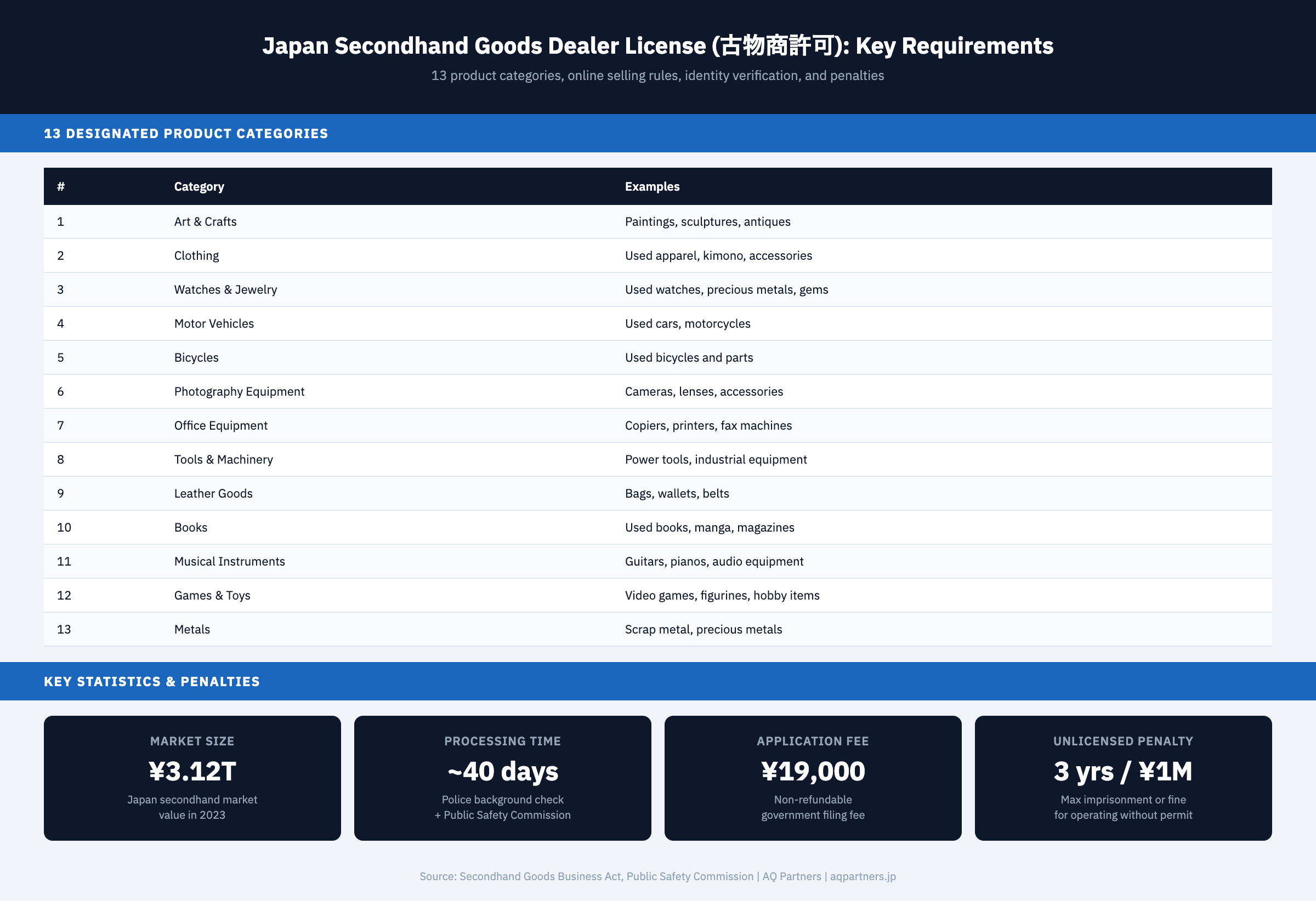
The Secondhand Goods Dealer License (古物商許可, kobutsushō kyoka) is a mandatory permit under the Secondhand Goods Business Act (古物営業法) authorizing individuals and businesses to buy, sell, exchange, or broker used goods in Japan. Originally enacted to prevent the circulation of stolen property, the law now serves as the primary regulatory framework for Japan's secondhand economy—a market that reached ¥3.12 trillion in 2023 and is projected to exceed ¥3.2 trillion in 2025. Whether you operate a vintage shop, resell on e-commerce platforms, or export pre-owned goods overseas, operating without this license carries penalties of up to 3 years’ imprisonment and a ¥1,000,000 fine.
Key Takeaways
- Any business buying and reselling secondhand goods in Japan requires a kobutsushō license—this includes online resellers, auction sellers, sedori (retail arbitrage) operators, and import-for-export businesses. Japan's reuse market grew at a CAGR of 12.7% between 2020 and 2024, with 44.1% of citizens purchasing secondhand goods in 2024.
- The license covers 13 legally defined categories of secondhand goods—from art and clothing to automobiles and books. Applicants can select multiple categories on a single application without additional fees.
- Applications are filed at the local police station and processed by the Prefectural Public Safety Commission—the fee is ¥19,000, processing takes approximately 40 working days, and applicants must designate a physical business office and appoint a qualified administrator (kanrisha).
- E-commerce sellers face additional URL notification requirements—if you sell through your own website, you must register the URL with the police. Marketplace sellers on Mercari or Yahoo Auctions must also hold a license when purchasing goods for resale.
- Record-keeping obligations are strict and actively enforced—dealers must maintain a transaction ledger (古物台帳) recording purchase details, item descriptions, and seller identity verification for a minimum of 3 years, with penalties of up to 6 months’ imprisonment for non-compliance.
What Is the Secondhand Goods Business Act?
The Secondhand Goods Business Act (古物営業法) was enacted in 1949 to prevent the trade of stolen goods by requiring dealers to verify seller identities and maintain transaction records. According to RSM Japan Shiodome's analysis, the Act's definition of "secondhand goods dealer" (古物商) is deliberately broad—it captures brick-and-mortar dealers, online resellers, consignment shops, auction intermediaries, and businesses purchasing used goods in Japan for export. With the market projected to reach ¥4 trillion by 2030, the regulatory framework touches an increasingly significant segment of Japan's economy.
The 13 Categories of Secondhand Goods
The Act classifies regulated articles into 13 specific categories. When applying, applicants must designate which categories they intend to trade in—selecting all 13 does not increase the ¥19,000 fee.
| No. | Category (English) | Japanese | Examples |
|---|---|---|---|
| 1 | Art & Crafts | 美術品類 | Paintings, sculptures, antique ceramics |
| 2 | Clothing | 衣類 | Apparel, kimono, shoes, vintage fashion |
| 3 | Watches & Jewelry | 時計・宝飾品類 | Wristwatches, gemstones, precious metals |
| 4 | Automobiles | 自動車 | Cars, trucks, vehicle parts |
| 5 | Motorcycles & Motorized Bicycles | 自動二輪車・原動機付自転車 | Motorcycles, scooters, motorbike parts |
| 6 | Bicycles | 自転車類 | Bicycles, frames, components |
| 7 | Photography & Optical Equipment | 写真機類 | Cameras, lenses, binoculars |
| 8 | Office Equipment | 事務機器類 | Computers, printers, copiers, phones |
| 9 | Machinery & Tools | 機械工具類 | Power tools, appliances, game consoles |
| 10 | Furniture & Furnishings | 道具類 | Furniture, sporting goods, musical instruments, CDs/DVDs |
| 11 | Leather & Rubber Products | 皮革・ゴム製品類 | Bags, wallets, belts, branded leather goods |
| 12 | Books | 書籍 | Used books, manga, magazines |
| 13 | Tickets & Vouchers | 金券類 | Gift cards, travel vouchers, event tickets |
Category 10 (道具類, "Furniture & Furnishings") is the broadest classification and functions as a catch-all for items that do not fit the other 12 categories. Many online resellers dealing in mixed merchandise select this alongside more specific categories.
Who Needs a License?
The license requirement applies to anyone who engages in the business of buying secondhand goods for resale. The legal trigger is the combination of purchasing used items and reselling for profit, regardless of the sales channel. According to Monolith Law Office's analysis, the following activities all require a kobutsushō license:
- Physical retail—operating a secondhand shop, vintage store, or pawn shop
- Online reselling—purchasing used goods and reselling through your own website
- Marketplace selling—buying items for resale on Mercari, Yahoo Auctions, Amazon, or Rakuten
- Sedori (retail arbitrage)—purchasing underpriced goods for resale at a markup
- Import-for-export—purchasing used goods in Japan for resale to overseas buyers
- Brokerage and consignment—acting as an intermediary for buyers and sellers
When a license is NOT required: Selling your own personal belongings (items you originally purchased new for personal use) does not require a license. Receiving used goods for free and selling them also does not trigger the requirement. Businesses selling only new goods purchased directly from manufacturers are exempt. The obligation targets the act of purchasing secondhand goods from others for commercial resale.
Application Process
The kobutsushō license is issued by the Prefectural Public Safety Commission (公安委員会), but applications are submitted through the local police station with jurisdiction over the applicant's designated business office. The process follows the standard Japanese business licensing framework with requirements specific to secondhand goods regulation.
| Step | Action | Details | Estimated Time |
|---|---|---|---|
| 1 | Pre-consultation at police station | Visit the anti-crime division (防犯課) to confirm requirements and obtain forms | 1–2 days |
| 2 | Prepare required documents | Residence certificate, criminal record absence certificate, lease agreement, sworn statement, administrator designation | 1–3 weeks |
| 3 | Submit application | File completed application with all supporting documents; pay ¥19,000 fee (prefectural revenue stamps) | 1 day |
| 4 | Review and site inspection | Public Safety Commission reviews application; police may inspect the designated business office | ~40 working days |
| 5 | License issuance | Collect license certificate (古物商許可証) in person at the police station | 1 day |
| 6 | URL notification (if applicable) | Submit URL notification to police if selling via your own website | 1–3 days |
Key Application Requirements
Individual applicants must submit the application form (古物商許可申請書), a sworn statement (誓約書), residence certificate (住民票) issued within 3 months, certificate of absence of criminal record (身分証明書), certificate of no adult guardianship registration, lease agreement for the business office, and a floor plan. Corporate applicants must additionally file articles of incorporation and a registry extract, plus documents for each officer and administrator. Foreign nationals without a Japanese family register submit a substitute pledge document in place of the criminal record certificate.
Business Office and Administrator
Every licensee must designate at least one physical business office (営業所) with a valid commercial-use lease—residential-only leases, virtual offices, and PO boxes do not qualify. Each office requires a designated administrator (管理者, kanrisha) who oversees transactions at that location. The administrator needs no specific certifications but must not be a minor and must not fall under any disqualification grounds.
Foreign Applicant Considerations
Foreign nationals can obtain a kobutsushō license but must hold an eligible residence status. Qualifying visas include Business Manager (経営・管理), Permanent Resident (永住者), Spouse of Japanese National (日本人の配偶者等), Spouse of Permanent Resident, Long-Term Resident (定住者), and certain Designated Activities visas. Standard work visas such as Engineer/Specialist in Humanities do not permit independent business operations and do not qualify.
The entire application process is conducted in Japanese. While no formal proficiency test is required, police officers typically verify that the applicant can communicate in Japanese. Engaging an administrative scrivener (行政書士, gyōsei shoshi) is standard practice for foreign applicants navigating the business licensing process in Japan.
Record-Keeping and Identity Verification
Licensed dealers must maintain a transaction ledger (古物台帳, kobutsu daichō) recording the date, item description, quantity, price, and seller identity verification for every acquisition of secondhand goods. Ledgers must be retained for a minimum of 3 years at the designated business office. Electronic records are permitted if immediately displayable in written form upon police request.
When purchasing goods valued at ¥10,000 or above (lower thresholds apply for game software, CDs/DVDs, books, and bicycles), the dealer must verify the seller's identity using a government-issued photo ID. For online transactions, electronic verification methods including ID document upload with delivery confirmation are accepted.
E-Commerce and Online Selling Requirements
Japan's secondhand goods regulations apply with equal force to online transactions. With Japan's recommerce market projected to reach USD 8.5 billion by 2029, online compliance is a critical consideration.
URL Notification
Dealers selling through their own website must submit a URL notification (URL届出) to the police, including the website address and domain ownership documentation (WHOIS record or hosting certificate). The police maintain a publicly searchable database of licensed dealers and registered URLs, allowing consumers to verify online sellers.
Marketplace and Cross-Border Sellers
Sellers on platforms such as Mercari, Yahoo Auctions, or Amazon are not exempt simply because they use a third-party platform—the kobutsushō license is required whenever goods are purchased for resale. URL notification does not apply to marketplace sellers (they use the platform's URL), but licensed sellers must display their license number on their profile. According to SME Japan's licensing guide, foreign businesses purchasing secondhand goods in Japan for overseas resale must hold a license—the requirement is triggered by where goods are acquired, not where they are sold.
Penalties and Compliance
The Act imposes criminal penalties for violations, applying equally to Japanese and foreign nationals, and to offline and online operations.
| Violation | Max Imprisonment | Max Fine | Additional Consequences |
|---|---|---|---|
| Operating without a license | 3 years | ¥1,000,000 | Goods confiscated; 5-year application ban |
| Fraudulent license application | 3 years | ¥1,000,000 | License revocation; 5-year ban |
| Failure to maintain transaction records | 6 months | ¥300,000 | License suspension or revocation |
| Failure to verify seller identity | 6 months | ¥300,000 | Civil liability for stolen goods |
| Failure to report URL | — | ¥100,000 | Administrative guidance |
| Refusing police inspection | 6 months | ¥300,000 | Immediate license suspension |
For foreign nationals, a criminal conviction under the Act creates additional immigration consequences—even a suspended sentence can trigger visa non-renewal or deportation. Business Manager Visa holders are particularly vulnerable, as their visa renewal depends on demonstrating lawful business operations.
Ongoing compliance requires displaying the license at each business office (and license number on websites), cooperating with police hold orders on suspected stolen goods (up to 30 days), and reporting changes to business details within 14 days. Notably, the kobutsushō license does not expire and requires no periodic renewal—a significant advantage over many other Japanese business licenses. However, the Public Safety Commission can revoke it at any time for material violations.
Frequently Asked Questions
Do I need a license to sell used items on Mercari or Yahoo Auctions?
It depends on your activity. Selling your own personal belongings does not require a license. However, if you purchase secondhand goods from others—at flea markets, thrift stores, or online—for the purpose of reselling them on any platform, a kobutsushō license is legally required. The determining factor is whether you are buying used goods for commercial resale, not the platform you use.
Can I select all 13 categories on my application?
Yes. The application fee remains ¥19,000 regardless of how many categories you select. According to Kreston ProWorks' licensing guide, many dealers select broad category coverage from the outset, as adding categories later requires a separate change notification filing.
What disqualifies someone from obtaining the license?
Article 4 of the Act lists specific disqualification grounds: criminal convictions with imprisonment (5-year waiting period after sentence completion), prior license revocation (5-year ban), undischarged bankruptcy, no fixed address in Japan, adult wardship, being a minor without qualified legal representation, and association with organized crime groups. For corporate applicants, these grounds apply to every director, auditor, and designated administrator—if even one officer is disqualified, the entire application will be rejected.
Can I operate a secondhand goods business from my home?
Potentially, if your residence has a lease permitting business use (or you own the property) and you can designate a specific area as the business office. Many residential leases in Japan prohibit commercial activity, and police will verify the premises have adequate space for storing goods and receiving inspections. A residential-only lease will not be accepted.
Japan's secondhand goods market presents significant opportunities, but compliant operation requires proper licensing from day one. The ¥19,000 application fee is modest, but documentation requirements, Japanese-language filings, and ongoing compliance obligations warrant professional guidance—particularly for foreign nationals.
Working with AQ Partners. Our Tokyo team provides KK and GK incorporation, corporate bank account application and monthly bookkeeping for foreign companies operating in Japan, so the entity behind the application is in order. Book a consultation to discuss your situation.

Yuga Koda is a founding Director at AQ Partners, supporting foreign companies, funds, and families operating in Japan. His experience operating companies in both Japan and international markets gives him a practical understanding of back office operations from both sides.