
Mutual Separation Agreements in Japan (Taisyoku Kanshou)

Mutual separation agreements in Japan (合意退職, gōi taishoku) are the most practical and legally safe method for ending an employment relationship when the employer has determined that continued employment is not viable. Because unilateral dismissal in Japan requires meeting a high legal standard—objectively reasonable grounds considered socially appropriate—experienced employers overwhelmingly prefer to negotiate voluntary departures through a process called 退職勧奨 (taisyoku kanshou, "retirement recommendation"). When executed properly, this approach achieves the employer's operational goal while avoiding the legal risks, reputational damage, and financial exposure of a contested dismissal.
Key Takeaways
- Mutual separation avoids the abusive dismissal standard entirely—because the employee agrees to departure voluntarily, the employer does not need to prove the "objectively reasonable grounds" required for unilateral dismissal under Labor Contract Act Article 16. This eliminates the primary litigation risk.
- Typical settlement packages range from 3 to 6 months' salary—the package amount depends on the employee's tenure, position, the employer's legal exposure, and market norms. Senior employees with long tenure may negotiate 6–12 months, while newer employees may accept 2–3 months.
- The conversation must be voluntary—coercion invalidates the agreement—if an employee can demonstrate that the employer used threats, intimidation, persistent pressure, isolation, or workplace harassment to force resignation, a court may reclassify the "voluntary" departure as a constructive dismissal and apply the full abusive dismissal standard.
- Company-initiated classification gives employees immediate unemployment benefits—when the separation is classified as company-initiated (会社都合退職) for employment insurance purposes, the departing employee receives unemployment benefits without the standard 2–3 month waiting period that applies to voluntary resignations, making the overall package more attractive.
- A written separation agreement with mutual release of claims is essential—the agreement should include the effective departure date, severance terms, classification (company-initiated), confidentiality provisions, return of company property, and a mutual waiver of further claims, signed by both parties.
When to Use Mutual Separation
Mutual separation is appropriate in most situations where the employer wants to end the employment relationship outside of clear disciplinary dismissal scenarios. Common situations include:
- Performance-related issues: When an employee is not meeting expectations but the documentation trail for ordinary dismissal is insufficient or the improvement process has been inconclusive
- Position elimination: When restructuring, office closure, or organizational changes make a role redundant
- Cultural mismatch: When an employee and the organization are not a good fit but there is no specific performance or conduct issue that would justify dismissal
- Senior management changes: When leadership transitions require new team composition
- Voluntary early retirement programs: When a company offers enhanced severance to employees who voluntarily depart during a restructuring period
The employee termination guide explains why unilateral dismissal is legally risky in Japan and why mutual separation is the preferred alternative.
Structuring the Conversation
The 退職勧奨 conversation is the most sensitive step in the process. How it is conducted determines whether the resulting separation is genuinely voluntary (and legally secure) or potentially challengeable as coerced resignation.
| Practice | Acceptable | Problematic / Coercive |
|---|---|---|
| Number of meetings | 1–3 meetings over 1–4 weeks | Daily or near-daily meetings, prolonged campaign |
| Meeting duration | 30–60 minutes | Multi-hour sessions without breaks |
| Tone | Respectful, explaining the situation and offering support | Threatening, belittling, or expressing anger |
| Response to "no" | Accept the response, may ask employee to reconsider after interval | Immediately repeating the request, refusing to take no for an answer |
| Work conditions during process | Normal duties continue | Removing responsibilities, isolating employee, reassigning to menial tasks |
| Attendees | Direct supervisor + HR (2 people from employer side) | Large group confronting the employee |
| Employee's right to consult | Employee may take time to consider, consult family/lawyer | Demanding immediate signature, denying time to consider |
| Consequences stated | Factual: explaining the business situation and what the package offers | Threatening disciplinary dismissal without grounds, blacklisting |
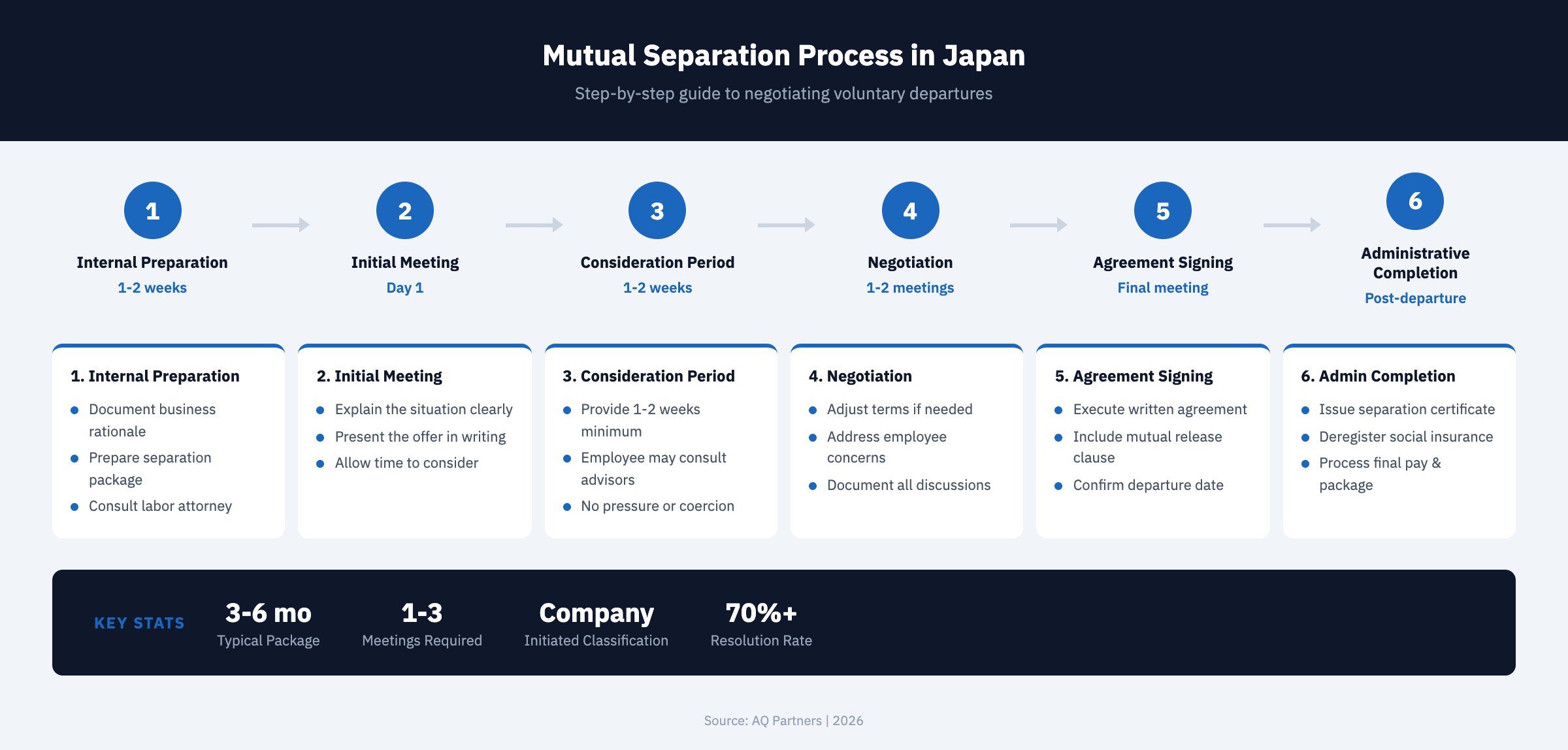
A well-conducted 退職勧奨 conversation typically follows this structure:
- Opening: Explain that the company is proposing a mutual separation, clearly stating it is a proposal and the employee has the right to decline
- Context: Provide the business rationale (restructuring, role changes, performance concerns) without personalizing or assigning blame
- Package presentation: Detail the severance offer, notice period, benefits continuation, and any additional support (outplacement, reference letters)
- Time to consider: Give the employee at least several days (ideally 1–2 weeks) to review the offer, consult with family or advisors, and respond
- Follow-up: If the employee declines, respect the decision. A second conversation after an appropriate interval (1–2 weeks) may be attempted with an improved offer, but persistent pressure risks crossing into coercion
Settlement Package Components
| Component | Typical Range | Tax Treatment |
|---|---|---|
| Standard retirement allowance (if applicable) | Per work rules formula | Retirement income (favorable deduction) |
| Additional separation payment | 3–6 months' salary (standard), 6–12 months (senior/long tenure) | Retirement income (favorable deduction) |
| Notice period (garden leave) | 30 days paid | Regular employment income |
| Accrued paid leave payout | Remaining days | Regular employment income |
| Outplacement support | ¥200,000–¥1,000,000 (if provided) | Not employee income (company expense) |
| Extended health insurance guidance | Information on continuation options | N/A |
| Reference letter / recommendation | Standard positive reference | N/A |
| Non-compete period (if requested) | 6–12 months with additional compensation | Varies |
The separation payment receives favorable retirement income tax treatment when paid as a lump sum at departure, which increases the net value to the employee. The severance pay guide explains the calculation of the retirement income deduction and effective tax rates.
Employment Insurance Classification
How the separation is classified for employment insurance (雇用保険) purposes directly affects the employee's access to unemployment benefits:
- Company-initiated (会社都合退職): The employee can receive unemployment benefits (失業給付) starting 7 days after registration at Hello Work, with no additional waiting period. Benefit duration is typically longer (90–330 days depending on age and tenure). This classification is generally preferred by employees and can be a significant negotiation point.
- Voluntary resignation (自己都合退職): The employee faces a 2–3 month waiting period before benefits begin, and benefit duration is shorter (90–150 days). If the separation was truly mutual with the company proposing departure, classifying it as voluntary would be inaccurate and unfair to the employee.
In a genuine mutual separation initiated by the employer, classifying the departure as company-initiated is both accurate and expected. This classification does affect the company's employment insurance premium rate (higher rates for companies with more company-initiated departures), but the premium impact is typically modest and far outweighed by the benefit of reaching a smooth agreement.
The Separation Agreement Document
A properly drafted separation agreement (退職合意書) should include:
- Effective departure date: The last day of employment, typically 2–4 weeks after signing to allow for handover
- Severance terms: Total amount, payment date, and confirmation that the amount includes all retirement allowances owed
- Departure classification: Explicitly stating whether the separation is classified as company-initiated for employment insurance purposes
- Mutual release of claims: Both parties waive further claims arising from the employment relationship, including wrongful dismissal, unpaid wages, harassment, and other potential causes of action
- Confidentiality: Agreement not to disclose the terms of the separation to third parties (with exceptions for legal and tax advisors)
- Return of company property: Laptop, access cards, documents, and other company assets
- Restrictive covenants: Non-compete, non-solicitation, and confidentiality obligations, if applicable (these must be reasonable in scope and duration to be enforceable)
- Cooperation clause: Agreement to cooperate with reasonable handover requests during the transition period
The agreement should be written in Japanese (the legally binding version in Japan) with an English translation provided for non-Japanese-speaking employees. Both parties should sign and retain copies. Having the employee initial each page reduces the risk of later claims that specific provisions were not reviewed.
What to Do If the Employee Declines
When an employee declines the mutual separation offer, the employer has several options:
- Improve the offer: A higher severance amount, extended notice period, or additional support may change the employee's calculation
- Wait and re-approach: After a reasonable interval (2–4 weeks), the employer may make one additional approach, particularly if circumstances have changed
- Accept the outcome: If the employee firmly declines, the employer must accept the decision and continue the employment relationship. At this point, the only remaining option for separation is unilateral dismissal, which requires meeting the full legal standard
- Do not retaliate: Reducing the employee's responsibilities, isolating them socially, denying promotions, or creating a hostile work environment after they decline a separation offer can constitute workplace harassment (パワハラ) and creates significant legal exposure
Documentation Checklist
To support a legally sound mutual separation, employers should maintain:
- Written record of the business rationale for proposing separation
- Notes from each meeting with the employee (date, duration, attendees, topics discussed)
- Copy of the written offer provided to the employee
- Employee's signed acknowledgment of receiving the offer and having time to consider it
- Signed separation agreement
- Completed離職票 (separation certificate) correctly reflecting the departure reason
- Final paycheck calculation including accrued leave, prorated bonuses, and severance
- Social insurance deregistration documentation
Mutual separation agreements represent the intersection of Japanese employment law, negotiation psychology, and practical HR management. When handled skillfully, they allow employers to manage workforce changes while treating departing employees with respect and financial consideration—outcomes that protect both the company's legal position and its reputation as an employer.
Working with AQ Partners. Our Tokyo team provides rules of employment, employment contracts and offer letters, social and labour insurance enrolment and monthly payroll coordination with a licensed sharoushi for foreign companies operating in Japan, so the employment documents and payroll behind any decision are in order. Book a consultation to discuss your situation.

Yuga Koda is a founding Director at AQ Partners, supporting foreign companies, funds, and families operating in Japan. His experience operating companies in both Japan and international markets gives him a practical understanding of back office operations from both sides.