
Japan Construction Business License: Requirements for Foreign Companies

The Japan construction business license (建設業許可, kensetsu-gyō kyoka) is a mandatory government authorization required under the Construction Business Act (Act No. 100 of 1949) for any company or individual performing construction work above a specified value threshold. Japan's construction industry—one of the largest in Asia with approximately 475,000 licensed businesses—operates under a tightly regulated system administered by the Ministry of Land, Infrastructure, Transport and Tourism (MLIT) and prefectural governors. For foreign companies entering the Japanese construction market, understanding the 29 license categories, the distinction between ordinary and special licenses, and the personnel and financial requirements is essential to avoid criminal penalties that can reach ¥100 million in corporate fines.
Key Takeaways
- Construction work above ¥5 million (¥15 million for building work) requires a license—the small works exemption only applies below these thresholds, and unlicensed operations above them carry penalties of up to 3 years imprisonment for individuals and ¥100 million in fines for corporations.
- The 29 license categories cover 2 general and 27 specialist construction types—companies must obtain a separate license for each category of work they perform, ranging from civil engineering and building to specialized trades like electrical, plumbing, and telecommunications.
- Ordinary (ippan) vs. Special (tokutei) licenses depend on subcontracting value—principal contractors who subcontract ¥50 million or more (¥80 million for building work) must hold the more stringent Special license, which requires a supervising engineer rather than a chief engineer.
- Financial and personnel requirements are non-negotiable—applicants need ¥5 million in net assets (ordinary license), a full-time qualified engineer at each office, and a Person Responsible for Management and Operation (PRMO) with at least 5 years of management experience.
- Processing takes 30–45 days for prefectural licenses and approximately 120 days for MLIT national licenses—but document preparation, personnel qualification verification, and pre-consultation typically add 1–3 months before an application can even be filed.
What Is the Construction Business License?
The Construction Business Act requires any person or company intending to operate a construction business in Japan to obtain a construction business license from either the prefectural governor or the Minister of Land, Infrastructure, Transport and Tourism (MLIT). This obligation applies equally to domestic and foreign-owned companies. According to MLIT's construction license system overview, approximately 475,000 businesses currently hold active construction licenses across Japan, with the number increasing for four consecutive years as of the most recent reporting period.
The license system serves two purposes: ensuring construction quality and safety by verifying that operators meet minimum technical and financial standards, and protecting subcontractors and project owners from unqualified firms. Companies entering Japan's construction market should review the comprehensive guide to business licenses for foreign companies in Japan for context on where construction licensing fits within the broader regulatory framework.
Small Works Exemption: When a License Is Not Required
Not every construction project requires a license. The Construction Business Act provides a small works exemption (軽微な工事, keibina koji) for projects below specific value thresholds.
Small works thresholds: Construction work with a contract value under ¥5 million (approximately USD 33,000) does not require a license. For building work (建築一式工事), the threshold is higher at ¥15 million, or alternatively, wooden residential structures under 150 square meters. These thresholds include materials costs supplied by the project owner.
Companies that perform only work below these thresholds may operate without a construction business license. However, any single contract that exceeds the threshold—even by ¥1—triggers the full licensing requirement. Splitting contracts to circumvent the threshold is explicitly prohibited and constitutes a violation.
The 29 Categories of Construction Business
Japan's construction business license system classifies construction work into 29 categories: 2 general categories (一式工事, isshiki koji) and 27 specialist categories (専門工事, senmon koji). A company must obtain a license for each specific category in which it intends to operate. The official English translation of the Construction Business Act lists all 29 categories in its annexed schedule.
| Category | Japanese | Type | Scope |
|---|---|---|---|
| Civil Engineering | 土木一式工事 | General | Comprehensive civil engineering projects (roads, bridges, dams) |
| Building | 建築一式工事 | General | Comprehensive building construction and renovation |
| Carpentry | 大工工事 | Specialist | Wooden structure construction and framing |
| Scaffolding, Earthwork & Concrete | とび・土工・コンクリート工事 | Specialist | Foundation, excavation, scaffolding, concrete placement |
| Masonry | 石工事 | Specialist | Stone cutting, installation, and finishing |
| Roofing | 屋根工事 | Specialist | Roof construction with tiles, metal, slate, or other materials |
| Electrical | 電気工事 | Specialist | Electrical wiring, power supply, lighting systems |
| Plumbing | 管工事 | Specialist | Piping for water, gas, HVAC, and drainage systems |
| Tile, Brick & Block | タイル・れんが・ブロック工事 | Specialist | Tile, brick, and concrete block installation |
| Steel Structure | 鋼構造物工事 | Specialist | Steel frame fabrication and erection |
| Reinforcing Steel | 鉄筋工事 | Specialist | Rebar assembly and placement for concrete structures |
| Paving | 舗装工事 | Specialist | Road and surface paving with asphalt or concrete |
| Dredging | しゅんせつ工事 | Specialist | River, harbor, and canal dredging operations |
| Plastering | 左官工事 | Specialist | Wall and ceiling plaster application |
| Sheet Metal | 板金工事 | Specialist | Metal sheet cutting, bending, and installation |
| Glazing | ガラス工事 | Specialist | Glass cutting, installation, and window fitting |
| Painting | 塗装工事 | Specialist | Surface painting and coating application |
| Waterproofing | 防水工事 | Specialist | Waterproof membrane and sealing installation |
| Interior Finishing | 内装仕上工事 | Specialist | Flooring, wall finishing, ceiling work, partitioning |
| Machine & Equipment Installation | 機械器具設置工事 | Specialist | Assembly and installation of machinery and plant equipment |
| Heat Insulation | 熱絶縁工事 | Specialist | Thermal insulation for piping, equipment, and structures |
| Telecommunications | 電気通信工事 | Specialist | Network cabling, antenna installation, communications systems |
| Landscaping | 造園工事 | Specialist | Garden and park construction, planting, irrigation |
| Well Drilling | さく井工事 | Specialist | Drilling for water wells and geothermal systems |
| Fittings | 建具工事 | Specialist | Doors, windows, shutters, and other building fittings |
| Water & Sewerage Facilities | 水道施設工事 | Specialist | Public water supply and sewerage infrastructure |
| Fire Protection Facilities | 消防施設工事 | Specialist | Fire alarm, sprinkler, and extinguishing systems |
| Sanitation Facilities | 清掃施設工事 | Specialist | Waste treatment and incineration facility construction |
| Demolition | 解体工事 | Specialist | Building and structure demolition (added 2016) |
A company may hold licenses in multiple categories simultaneously. For example, a general contractor performing comprehensive building work might hold the Building (general) license alongside specialist licenses for Electrical, Plumbing, and Interior Finishing to cover the scope of work it self-performs rather than subcontracts.
Ordinary (Ippan) vs. Special (Tokutei) License
Within each of the 29 categories, the Construction Business Act distinguishes between two license tiers based on the value of subcontracting arrangements. This distinction applies only to principal contractors (元請, motouke) who are directly engaged by the project owner—subcontractors themselves only need the ordinary license regardless of the contract value they receive.
| Criteria | Ordinary License (一般建設業) | Special License (特定建設業) |
|---|---|---|
| Japanese term | Ippan kensetsu-gyō | Tokutei kensetsu-gyō |
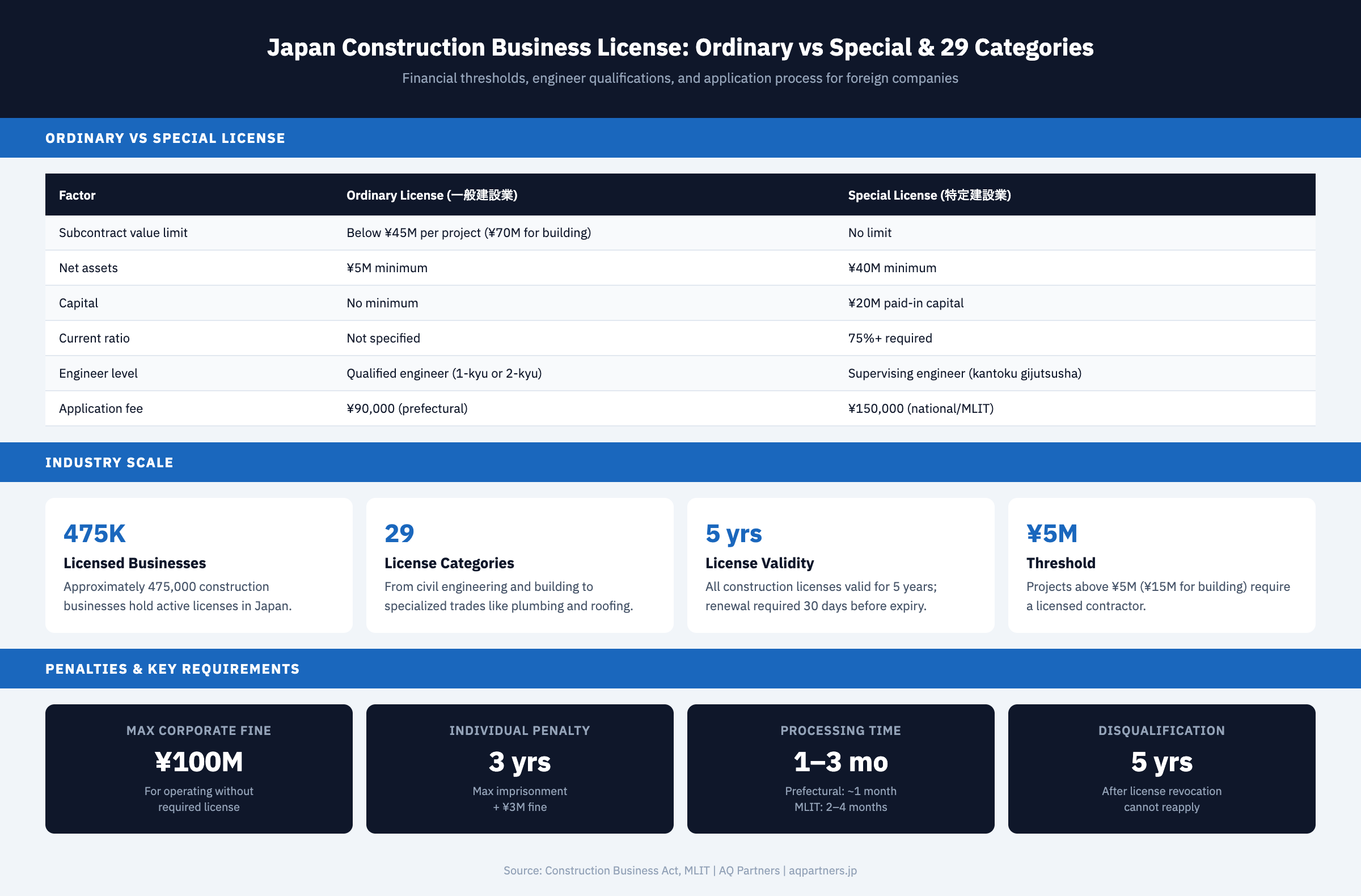
| Subcontract threshold (general) | Below ¥50 million total subcontracted value | ¥50 million or more in total subcontracted value |
| Subcontract threshold (building) | Below ¥80 million total subcontracted value | ¥80 million or more in total subcontracted value |
| Financial requirement | ¥5 million in net assets | ¥40 million in capital + ¥40 million in retained earnings + capital-to-debt ratio of 20%+ |
| Engineer requirement | Chief engineer (主任技術者) | Supervising engineer (監理技術者) for projects ¥45M+ |
| Who needs it | All construction businesses (default tier) | Only principal contractors subcontracting above thresholds |
| Application fee | ¥90,000 (prefectural) / ¥150,000 (MLIT) | ¥90,000 (prefectural) / ¥150,000 (MLIT) |
The subcontract thresholds refer to the total combined value of all subcontracts that a principal contractor issues for a single project—not the value of any individual subcontract. A principal contractor who directly employs workers to perform the work and does not subcontract above the thresholds only needs the ordinary license, even on large-value projects.
Prefectural Governor License vs. MLIT National License
The licensing authority depends on the geographic scope of a company's operations, specifically the location of its offices—not where the construction work is performed.
Key distinction: A company with offices in only one prefecture applies to the prefectural governor. A company with offices (営業所, eigyōsho) in two or more prefectures must apply to MLIT for a national license. A company holding a prefectural license may still perform construction work in other prefectures—the license scope is determined by office locations, not project locations.
According to DLA Piper's analysis of Japan's construction market, the vast majority of Japan's approximately 475,000 licensed construction businesses hold prefectural licenses, reflecting the predominantly local nature of small and mid-sized construction firms. MLIT national licenses are held primarily by larger general contractors operating across multiple regions.
License Requirements: Personnel, Financial, and Management
The Construction Business Act defines four affirmative requirements (Article 7) and a set of disqualification criteria (Article 8) that all applicants must satisfy. These requirements apply identically to both domestic and foreign-owned applicants.
Person Responsible for Management and Operation (PRMO)
Every applicant must designate a Person Responsible for Management and Operation (経営業務の管理責任者, keiei gyomu no kanri sekininsha)—commonly abbreviated as PRMO. This individual must be a full-time director or executive officer of the company and must have at least 5 years of experience in a management or executive role within the construction industry. According to DLA Piper's summary of the 2025 Construction Business Act amendments, the experience requirement was broadened in recent revisions to accept management experience in any construction category, rather than requiring experience in the specific category being applied for.
Full-Time Qualified Engineer
Each office (eigyōsho) must have at least one full-time engineer (専任技術者, sennin gijutsusha) who meets the qualification requirements for the specific license category. Qualification can be demonstrated through one of three paths:
- National qualification—holding a relevant Japanese national qualification (国家資格), such as a first-class or second-class construction management engineer (施工管理技士)
- Educational background plus practical experience—graduation from a designated educational program in a relevant field plus 3–5 years of practical experience
- Practical experience only—at least 10 years of practical experience in the relevant construction category
The full-time engineer must work exclusively at the designated office and generally cannot hold concurrent positions at other companies. For foreign companies, this is often the most challenging requirement to satisfy, as Japanese national qualifications are required and foreign credentials must be individually verified for equivalency by MLIT or the relevant regional authority.
Financial Standing
For the ordinary license, the applicant must demonstrate net assets (自己資本) of at least ¥5 million, or alternatively, a bank balance certificate showing ¥5 million or more in available funds. The special license imposes significantly stricter financial requirements: ¥40 million in stated capital, ¥40 million in retained earnings (利益剰余金), and a capital-to-total-liabilities ratio of 20% or more.
Disqualification Criteria
Applicants are disqualified if any director, officer, or controlling shareholder has been sentenced to imprisonment (whether or not suspended) within the preceding 5 years for violations of the Construction Business Act, criminal code offenses, or certain other laws. Companies whose previous construction license was revoked are barred from reapplying for 5 years from the date of revocation.
Foreign Company Requirements
Foreign companies applying for a construction business license face the same substantive requirements as domestic firms. There are no additional legal barriers or foreign-specific restrictions. However, practical complexity is significantly higher for foreign applicants across several dimensions. For a step-by-step overview of the general process, see our guide to applying for business licenses in Japan.
- Entity establishment—a foreign company must first establish a legal presence in Japan, typically as a Kabushiki Kaisha (KK), Godo Kaisha (GK), or registered branch office, before applying for a construction license
- PRMO qualification verification—the management experience of the PRMO must be documented with evidence from the foreign parent company, which may require authenticated and translated corporate records from the home country
- Engineer credential equivalency—foreign engineering qualifications must be verified individually by MLIT for equivalency to Japanese national qualifications, a process that can add weeks or months to the timeline
- Japanese-language filings—all application documents must be submitted in Japanese, and interactions with the licensing authority are conducted in Japanese
- Registered seal (inkan)—the company's registered seal certificate is required as part of the application documentation
Many foreign companies find it more practical to hire a PRMO and full-time engineer from the Japanese labor market rather than attempting to qualify existing personnel from the parent company. The Japan market entry back office guide covers the broader administrative infrastructure foreign companies need to establish alongside licensing.
Application Process and Timeline
The construction business license application follows a structured process with distinct phases for preparation, submission, review, and issuance.
| Phase | Activities | Typical Duration |
|---|---|---|
| 1. Pre-consultation | Meet with the licensing authority (prefectural office or MLIT) to confirm category selection, review personnel qualifications, and identify documentation requirements | 1–2 weeks |
| 2. Document preparation | Assemble application forms, financial statements, personnel qualification certificates, company registration documents, PRMO experience evidence, engineer credentials | 2–8 weeks |
| 3. Application submission | Submit completed application to prefectural office or MLIT regional bureau; pay application fee (¥90,000 prefectural / ¥150,000 MLIT) | 1 day |
| 4. Review period | Authority reviews documentation, verifies personnel qualifications, checks disqualification criteria, may request supplementary documents | 30–45 days (prefectural) / ~120 days (MLIT) |
| 5. License issuance | License certificate issued; valid for 5 years from date of issuance | Issued upon approval |
| Total (end-to-end) | From initial consultation to license in hand | 1–3 months (prefectural) / 3–6 months (MLIT) |
Engaging an administrative scrivener (行政書士, gyōsei shoshi) is standard practice, particularly for foreign companies. These nationally licensed professionals specialize in preparing and filing license applications with government authorities and can handle the Japanese-language documentation and procedural navigation on behalf of the applicant. Working with a qualified scrivener significantly reduces the risk of rejected or incomplete applications.
Validity, Renewal, and Ongoing Obligations
A construction business license is valid for 5 years from the date of issuance. Renewal applications must be filed at least 30 days before the expiration date to ensure continuity of operations. If a license expires without renewal, the company must cease all licensed construction activities immediately and apply for a new license from scratch.
Licensed companies also have ongoing reporting obligations. An annual business report (事業年度終了届, jigyō nendo shūryō todoke) must be filed within 4 months of the end of each fiscal year, disclosing financial statements, construction project details, and personnel changes. Failure to file these reports does not immediately revoke the license but may result in administrative guidance and can cause complications during the renewal process.
Changes to key personnel—the PRMO or full-time engineer—must be reported within 2 weeks. If the PRMO resigns and a qualified successor is not appointed, the license will be revoked for failure to satisfy licensing conditions. This makes succession planning for key personnel a critical ongoing management concern.
Penalties for Non-Compliance
The Construction Business Act imposes severe criminal and administrative penalties for operating without a license or violating license conditions. Article 47 of the Act establishes the primary penalty framework.
Penalty framework: Individuals who operate a construction business without a license face up to 3 years of imprisonment or a fine of up to ¥3 million. Corporate entities face fines of up to ¥100 million under the dual penalty provision (両罰規定, ryōbatsu kitei). Additionally, a conviction triggers a 5-year disqualification period during which the individual or company cannot apply for a new license.
Beyond criminal penalties, MLIT and prefectural authorities have administrative enforcement tools including suspension of business operations (営業停止, eigyō teishi) for up to one year and license revocation (許可取消, kyoka torikeshi). According to the DLA Piper RealWorld construction law summary for Japan, enforcement actions are publicly disclosed, which can cause significant reputational damage in addition to the legal consequences. For foreign companies, license revocation can also affect visa status for Business Manager Visa holders associated with the company.
Frequently Asked Questions
Can a foreign company obtain a construction business license in Japan?
Yes. Foreign companies face the same substantive licensing requirements as domestic firms—there are no foreign-ownership restrictions or additional legal barriers. However, the practical process is more complex. A foreign company must first establish a Japanese legal entity (KK, GK, or branch office), and meeting the personnel requirements—particularly the PRMO with 5 years of construction management experience and a full-time engineer with Japanese qualifications—often requires hiring from the Japanese labor market. All documentation must be submitted in Japanese, and foreign credentials require individual equivalency verification by MLIT.
What happens if my PRMO or full-time engineer leaves the company?
If the PRMO or full-time engineer resigns or otherwise ceases to fulfill their role, the company must appoint a qualified successor and report the change to the licensing authority within 2 weeks. If a replacement cannot be found and the position remains vacant, the company no longer satisfies the licensing conditions, and the license will be revoked. Companies should maintain succession planning for these critical roles to avoid operational disruption.
Do I need a separate license for each type of construction work?
Yes. The construction business license is category-specific. A company performing electrical work and plumbing work must hold licenses for both the Electrical (電気工事) and Plumbing (管工事) categories. Holding a general license (Civil Engineering or Building) does not automatically cover specialist categories. However, a single application can include multiple categories, and the application fee covers all categories included in one submission.
What is the difference between a prefectural license and an MLIT national license?
The distinction is based on where the company has offices, not where it performs construction work. A company with offices in a single prefecture applies to the prefectural governor and receives a prefectural license. A company with offices in two or more prefectures must apply to MLIT for a national license. Both licenses authorize work anywhere in Japan—a prefectural licensee is not restricted to performing work only within that prefecture. The main practical differences are processing time (30–45 days vs. approximately 120 days) and application fees (¥90,000 vs. ¥150,000).
Japan's construction business license system is detailed and demanding, but the requirements are well-defined and consistently applied. With proper planning—particularly around personnel qualifications and financial documentation—foreign companies can successfully navigate the process and establish compliant construction operations.
Working with AQ Partners. Our Tokyo team provides KK and GK incorporation, corporate bank account application and monthly bookkeeping for foreign companies operating in Japan, so the entity behind the application is in order. Book a consultation to discuss your situation.

Yuga Koda is a founding Director at AQ Partners, supporting foreign companies, funds, and families operating in Japan. His experience operating companies in both Japan and international markets gives him a practical understanding of back office operations from both sides.