
Import & Export Licenses in Japan: Trade Compliance Guide

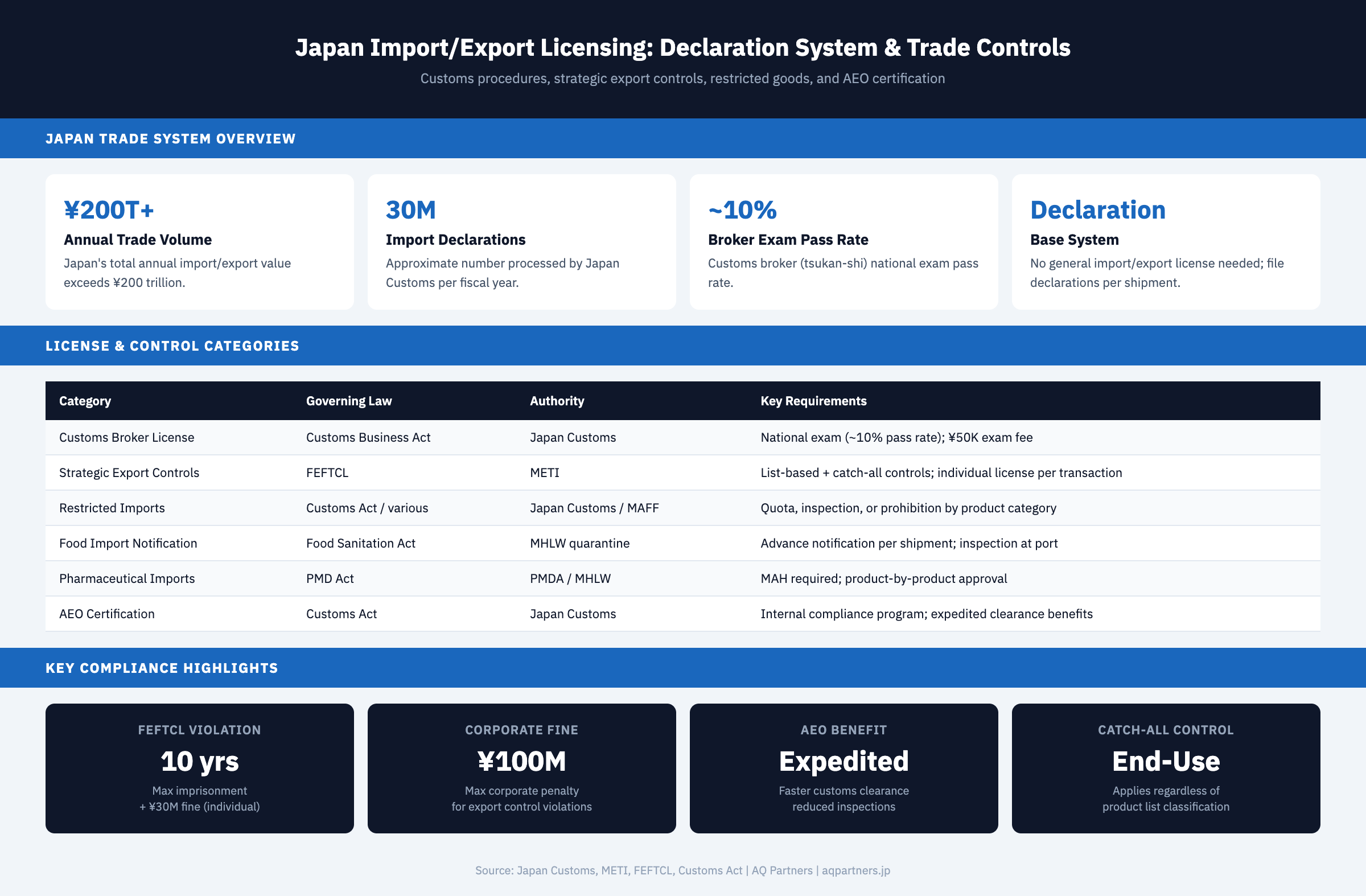
Import and export licensing in Japan (輸出入許可, yushutsunyu kyoka) encompasses the regulatory framework governing international trade through Japanese ports and airports. Unlike many countries that require a general import/export license, Japan operates on a declaration-based system—most goods can be imported or exported by filing a declaration with Japan Customs. However, specific product categories, brokerage activities, and strategic export controls introduce licensing requirements that foreign businesses must navigate carefully. Japan’s annual trade volume exceeds ¥200 trillion, with approximately 30 million import declarations processed each fiscal year.
Key Takeaways
- No general import/export license is required—Japan uses a per-shipment declaration system, though the Importer of Record must hold legal “right of disposal” over the goods and non-resident companies must appoint an Attorney for Customs Procedures (ACP).
- Customs brokerage requires one of Japan’s hardest professional exams—the Registered Customs Specialist exam (通関士試験) has a pass rate of approximately 10%, with roughly 9,000 specialists licensed nationwide.
- METI export controls impose strict licensing for dual-use goods—under the Foreign Exchange and Foreign Trade Act, “list controls” and “catch-all controls” require pre-shipment licenses, with October 2025 amendments expanding due diligence even for exports to allied nations.
- Industry-specific imports face additional regulatory layers—food products require notification under the Food Sanitation Act, pharmaceuticals and medical devices need Marketing Authorization Holder registration under the PMD Act, and restricted goods carry criminal penalties.
- Japan’s FTA network covers over 80% of total trade—RCEP, CPTPP, and the Japan-EU EPA provide preferential tariffs, but accessing benefits requires proper certificates of origin and HS code classification at customs clearance.
How Japan’s Import and Export System Works
Japan’s trade system does not require a standing business license for importing or exporting goods. Each shipment is processed individually through Japan Customs via NACCS (Nippon Automated Cargo and Port Consolidated System), the electronic customs platform. Importers file a declaration, undergo documentary and physical examination, pay duties and consumption tax, and receive an import permit. Exporters declare goods to the Director-General of Customs and obtain an export permit after examination.
Certain goods require prior approval from other ministries—notably METI for controlled technologies and MHLW for food and pharmaceuticals—before the customs declaration can proceed.
Important for non-resident businesses: Japan Customs prohibits “nominal” importers. The Importer of Record must have legal “right of disposal” over the goods. Companies without a Japanese office must appoint an Attorney for Customs Procedures (ACP)—a Japan-resident entity acting as legal representative at customs. ACP setup typically takes 2–4 weeks and must be completed before the first shipment arrives.
Customs Brokerage License
While any company can file its own customs declarations, acting as a customs broker on behalf of third parties requires a customs brokerage license (通関業免許, tsūkangyō menkyo) from the Director-General of Regional Customs. Brokerage firms must employ Registered Customs Specialists (通関士, tsūkanshi)—professionals who have passed a national qualifying examination administered annually since 1967.
| Requirement | Details |
|---|---|
| License type | Customs Brokerage License (通関業免許) |
| Issuing authority | Director-General of Regional Customs |
| Key personnel | Registered Customs Specialist at each office |
| National exam pass rate | ~10% (approximately 760 of 7,500 applicants) |
| Active specialists nationwide | Approximately 9,000 |
| Exam subjects | Customs Act, Tariff Act, customs valuation, trade-related tax law |
| Exam language | Japanese only |
| Exam frequency | Once per year (since 1967) |
For most foreign businesses, establishing an in-house brokerage operation is impractical. The standard approach is to engage a licensed customs broker—Japan has hundreds of brokerage firms, many affiliated with major logistics providers. The quality and compliance record of your broker directly affects clearance speed and audit risk. For a broader view of how customs brokerage fits into Japan’s licensing framework, see our guide to business licenses for foreign companies.
METI Export Controls: Dual-Use Goods and Catch-All Regulations
Japan’s export control regime, administered by the Ministry of Economy, Trade and Industry (METI), operates under the Foreign Exchange and Foreign Trade Act (外為法). Exporters must obtain a METI license when shipping controlled goods or transferring controlled technologies abroad. The system uses two mechanisms: list controls covering 16 categories aligned with international regimes (Wassenaar Arrangement, Nuclear Suppliers Group, Australia Group, MTCR), and catch-all controls for unlisted items that could be diverted to weapons development.
The October 2025 amendments significantly expanded catch-all obligations—introducing a “core items” category, broadening due diligence requirements, and imposing mandatory licensing based on exporter intent or METI notifications even for exports to friendly nations. Violations carry penalties of up to 10 years imprisonment and corporate fines of ¥1 billion.
| Control Type | Scope | License Trigger | Max Penalty |
|---|---|---|---|
| List Control (Items 1–15) | Weapons, nuclear, chemical/bio, missiles, electronics | Always—regardless of destination | 10 yrs / ¥1B corporate |
| List Control (Item 16) | Conventional weapons-related items | Exports to UN-embargoed destinations | 7 yrs / ¥20M individual |
| Catch-All (WMD) | Non-listed goods with WMD end-use risk | Knowledge of end-use or METI notification | 10 yrs / ¥1B corporate |
| Catch-All (post-Oct 2025) | Non-listed goods with military end-use risk | Expanded due diligence; METI notification | Export ban up to 3 yrs |
| Technology Transfers | Technical data, software, know-how | Deemed export rules for non-residents in Japan | Same as goods controls |
| Sanctions Controls | All goods to sanctioned entities (North Korea, etc.) | Blanket prohibition or METI case-by-case | Criminal + trade suspension |
Note: METI’s “deemed export” rules mean that transferring controlled technology to a non-resident individual within Japan—such as sharing technical specifications with a foreign employee—can trigger export license requirements. Companies with multinational workforces must screen internal technology transfers.
AEO Certification
Japan’s Authorized Economic Operator (AEO) program grants qualified businesses streamlined customs procedures in recognition of strong compliance and security records. AEO-certified operators benefit from reduced inspections, simplified documentation, and faster clearance. The certification process typically spans 2–2.5 years, requiring a comprehensive Compliance Program, multiple customs audits, clean violation history, NACCS capability, and sound financial standing. Post-authorization, annual internal audits are mandatory.
Japan has mutual recognition arrangements with the United States (C-TPAT), the EU, New Zealand, Canada, South Korea, and Chinese Taipei—meaning AEO-certified operators in partner countries receive preferential treatment at Japanese customs.
Industry-Specific Import Requirements
Several product categories require regulatory clearance beyond the standard customs declaration.
Food imports: Under Article 27 of the Food Sanitation Act (食品衛生法), anyone importing food, food additives, or food containers for business use must file an Import Notification with the MHLW quarantine station at the port of entry before customs clearance. Inspectors examine compliance with Japan’s standards for additives, pesticide residues, contaminants, and labeling. Products failing inspection face destruction, return, or re-processing at the importer’s expense.
Pharmaceuticals and medical devices: The PMD Act (医薬品医療機器等法) requires prior marketing authorization from the MHLW, with review by the PMDA. Foreign manufacturers must obtain Foreign Manufacturer Registration (approximately 30 days; valid five years). A Japan-based Marketing Authorization Holder (MAH) must be appointed—foreign companies without a Japanese entity cannot hold marketing authorization directly.
Restricted and prohibited goods: Japan prohibits import of narcotics, firearms, counterfeit goods, and IP-infringing products. CITES-regulated animals and plants require permits. Precursor chemicals and weapons parts need ministry-specific authorization.
Documentation and Customs Clearance
Missing or inconsistent documents are the most common cause of clearance delays. The standard documentation package for customs clearance includes:
| Document | Purpose | Notes |
|---|---|---|
| Commercial Invoice | Declares value, quantity, and description | Must match HS code classification |
| Packing List | Contents, weight, packaging per unit | Must correspond to commercial invoice |
| Bill of Lading / Air Waybill | Transport document and shipment proof | Original signed B/L for ocean freight |
| Certificate of Origin | Country of manufacture for tariff claims | Format varies by FTA (RCEP, CPTPP, EPA) |
| Food Import Notification | MHLW food safety compliance | Filed before customs clearance |
| METI Export License | Authorization for controlled exports | Required before export declaration |
| Insurance Certificate | Cargo insurance for CIF valuation | Used in customs duty calculation |
| Phytosanitary / Health Certificate | Animal/plant health compliance | Issued by exporting country’s authority |
As of October 2025, Japan Customs added new declaration fields including post-import cargo destination, mail-order goods identification, and e-commerce platform names—reflecting tighter oversight of cross-border online sales.
Import Duties and Consumption Tax
Japan assesses customs duties on the CIF value using ad valorem, specific, or combined rates. The effective duty rate depends on HS code classification and the applicable tariff schedule. In addition, consumption tax of 10% (standard) or 8% (reduced rate for food and non-alcoholic beverages) is levied on the CIF value plus duties. Japan Customs requires document retention for seven years.
2026 Tax Reform: Japan will apply consumption tax to cross-border mail-order goods valued at ¥10,000 or less—previously exempt under the de minimis rule. Sellers may register to assume the tax liability. This takes effect April 1, 2028.
Free Trade Agreements and Preferential Tariffs
Japan’s EPA/FTA coverage ratio has reached approximately 80.4% of total trade value. For foreign businesses exporting to Japan, these agreements offer significant tariff reductions on qualifying goods—but only with proper documentation filed at customs clearance.
| Agreement | Members | In Force | Key Benefits |
|---|---|---|---|
| RCEP | 15 countries (ASEAN + Japan, China, Korea, Australia, NZ) | Jan 2022 | Unified rules of origin; cumulation |
| CPTPP | 11 countries (Japan, Canada, Australia, Mexico, Vietnam, etc.) | Dec 2018 | High-standard liberalization; IP protections |
| Japan-EU EPA | Japan + 27 EU member states | Feb 2019 | EU eliminates 99% of tariffs; Japan 94% |
| Japan-UK CEPA | Japan + United Kingdom | Jan 2021 | Maintains EU EPA-level preferences |
| Japan-US Agreement | Japan + United States | Jan 2020 | Limited scope: agriculture + digital trade |
| Bilateral EPAs | ASEAN nations, India, Switzerland, others | Various | Product-specific; may overlap with RCEP/CPTPP |
Accessing preferential rates requires a valid Certificate of Origin in the format specified by each agreement. Under RCEP, exporters may self-certify; under the Japan-EU EPA, registered exporters use the “statement on origin” approach. Incorrect HS classification or missing documentation means paying the higher WTO/MFN or general rate. Companies considering how to apply for business licenses in Japan should factor trade compliance into overall market entry planning, and those handling goods alongside services should understand how trade operations integrate with back-office setup.
Frequently Asked Questions
Do I need a license to import goods into Japan?
No general import license is required. Japan uses a per-shipment declaration system through Japan Customs. However, you must have a registered entity that can serve as the Importer of Record with legal right of disposal. Non-resident companies must appoint an ACP. Specific product categories—food, pharmaceuticals, chemicals, controlled items—require additional notifications or approvals from the relevant ministries before clearance.
What are the penalties for violating Japan’s export controls?
Violations of the Foreign Exchange and Foreign Trade Act carry up to 10 years imprisonment, fines of ¥30 million for individuals or ¥1 billion for corporations, and suspension of export privileges for up to three years. METI publicly discloses enforcement actions. The October 2025 catch-all amendments expanded the scope of conduct that triggers these penalties.
How can my company benefit from Japan’s free trade agreements?
Present a valid Certificate of Origin in the format required by the specific agreement (RCEP, CPTPP, Japan-EU EPA, or bilateral) at the time of import declaration. This requires proper HS code classification, verification that goods meet rules of origin, and timely documentation. An experienced customs broker familiar with FTA utilization can significantly reduce duty costs.
What is the difference between an ACP and a customs broker?
An ACP (Attorney for Customs Procedures) is a Japan-resident entity that acts as the legal representative of a non-resident importer, enabling the foreign company to be the Importer of Record. A customs broker (通関業者) is a licensed company that prepares and files customs declarations on behalf of importers and exporters. Non-resident companies often need both: an ACP for legal standing and a customs broker for declaration filing.
Japan’s trade compliance landscape is evolving—with the October 2025 export control amendments, new declaration requirements, and upcoming 2028 consumption tax changes adding complexity.
Working with AQ Partners. Our Tokyo team provides KK and GK incorporation, corporate bank account application and monthly bookkeeping for foreign companies operating in Japan, so the entity behind the application is in order. Book a consultation to discuss your situation.

Yuga Koda is a founding Director at AQ Partners, supporting foreign companies, funds, and families operating in Japan. His experience operating companies in both Japan and international markets gives him a practical understanding of back office operations from both sides.