
Financial Services Licenses in Japan: FSA Registration Guide for Foreign Firms

Financial services licenses in Japan (金融商品取引業登録, kin'yuu shouhin torihiki-gyou touroku) are registrations issued under the Financial Instruments and Exchange Act (FIEA) that authorize firms to conduct securities dealing, investment advisory, fund management, and related activities. The Financial Services Agency (FSA) administers this registration system—and since 2021, the FSA's dedicated Financial Market Entry Office has offered foreign firms an all-English, one-stop channel covering pre-application consultation through post-registration supervision. For foreign financial firms evaluating Japan market entry, understanding the four registration categories, their capital thresholds, and the 2025 Simplified Type 1 reform is essential to building a realistic timeline and compliance plan.
Key Takeaways
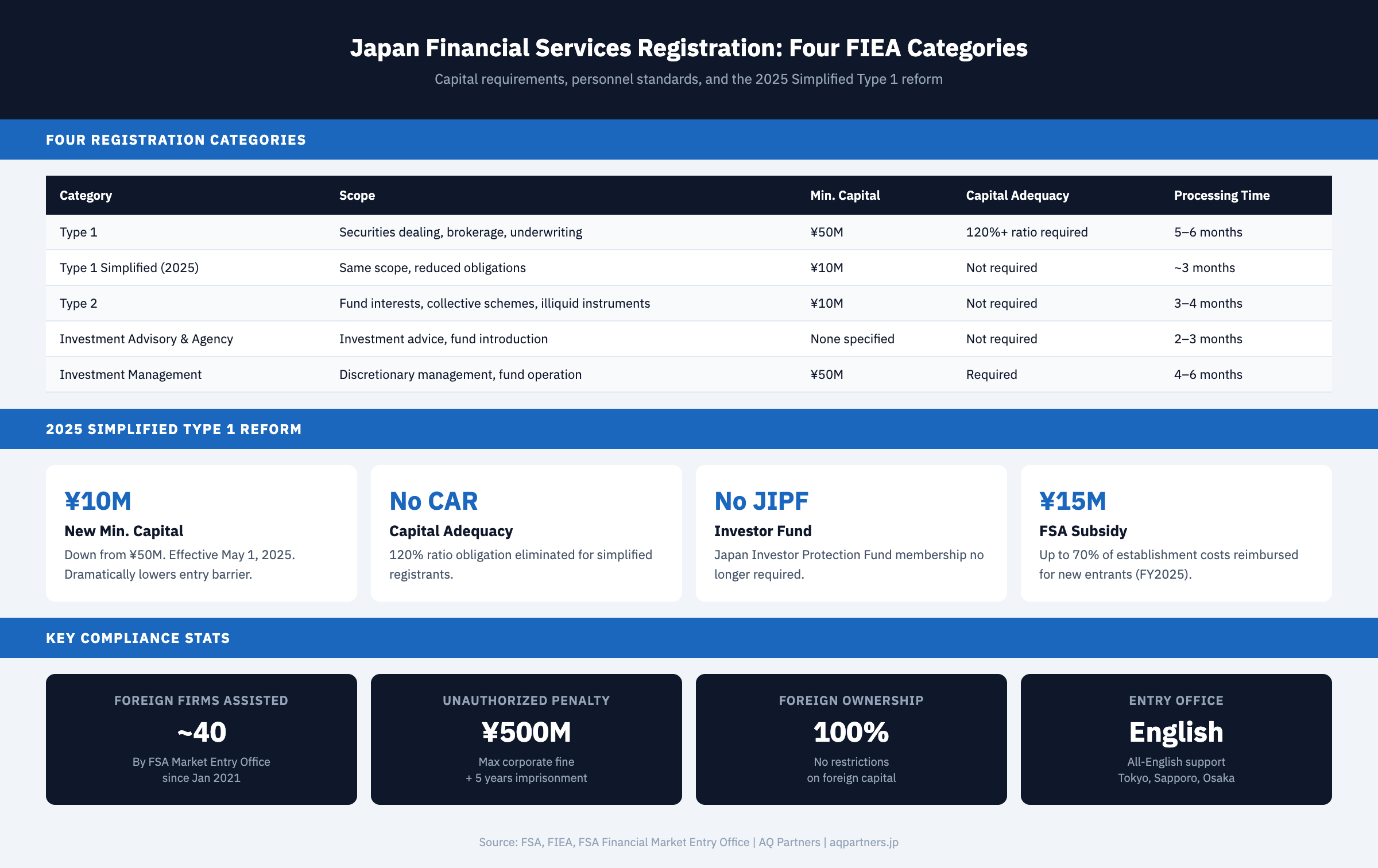
- Japan's FIEA establishes four registration categories for financial instruments businesses—Type 1 (securities), Type 2 (fund interests and illiquid instruments), Investment Advisory & Agency, and Investment Management—each with distinct capital, personnel, and compliance requirements.
- The FSA's Financial Market Entry Office provides full English-language support—established January 2021, this one-stop service has assisted approximately 40 foreign firms through registration as of mid-2024, with regional branches opened in Sapporo and Osaka in April 2025.
- The 2025 Simplified Type 1 license significantly lowers barriers—effective May 1, 2025, this new category reduces the minimum capital requirement from ¥50 million to ¥10 million, eliminates the capital adequacy ratio obligation, and removes the Japan Investor Protection Fund membership requirement.
- Japan imposes no foreign capital restrictions on financial services registration—100% foreign-owned entities are fully eligible, and the FSA offers subsidies reimbursing up to ¥15 million (70% of establishment costs) for new market entrants in FY2025.
- Unauthorized financial instruments business carries severe penalties—up to 5 years imprisonment for individuals and corporate fines reaching ¥500 million, making proper registration essential before commencing operations.
The FSA: Japan's Financial Services Regulator
The Financial Services Agency (金融庁, Kin'yuu-chou) is the primary regulator overseeing securities markets, banking, and insurance in Japan. Under the FIEA, any entity that conducts financial instruments business—including securities dealing, fund distribution, investment advisory, and asset management—must register with the FSA through the relevant Local Finance Bureau (財務局, zaimu-kyoku).
Japan uses a registration (登録, toroku) system rather than a discretionary licensing model—applicants meeting prescribed statutory criteria are entered into the official register. The FSA maintains a publicly accessible list of all registered financial institutions, enabling investors to verify any operator's status. For a broader overview of how financial services licensing fits within Japan's overall regulatory landscape, see our guide to business licenses for foreign companies in Japan.
Four Categories of Financial Instruments Business Registration
The FIEA classifies financial instruments businesses into four categories, each governing different activities and carrying different regulatory burdens. The category an applicant must register under depends on the specific financial activities the firm intends to conduct in Japan.
Type 1 Financial Instruments Business (第一種金融商品取引業)
Type 1 registration is required for firms dealing in or brokering listed securities, government bonds, corporate bonds, and investment trust shares. This is the most heavily regulated category, applying to securities companies, forex brokers, and firms conducting public offerings. The traditional Type 1 registration requires minimum stated capital of ¥50 million and net assets of ¥50 million or more, a capital adequacy ratio of at least 120% (approximately 200% in practice), mandatory membership in the Japan Investor Protection Fund (JIPF), and Securities Sales Agents registered with the Japan Securities Dealers Association (JSDA).
Type 2 Financial Instruments Business (第二種金融商品取引業)
Type 2 registration covers solicitation, distribution, and brokerage of less liquid financial instruments—beneficial interests in trusts, anonymous partnership interests (tokumei kumiai), and rights in investment limited partnerships (LPS). This category is commonly used by firms distributing interests in private equity, real estate, and venture capital funds. The minimum capital requirement is ¥10 million, personnel requirements can be satisfied with as few as two qualified individuals in Japan, and there is no capital adequacy ratio requirement or JIPF membership obligation.
Investment Advisory and Agency Business (投資助言・代理業)
This category covers firms providing investment advice on a contractual basis without exercising discretionary authority over client assets. It has the lowest regulatory threshold—individuals can register, and there is no minimum capital requirement—making it the most accessible entry point for foreign advisory firms. Firms wishing to manage client assets directly must register under Investment Management.
Investment Management Business (投資運用業)
Required for firms exercising discretionary authority over client assets, managing investment trusts, or managing partnership-type funds. The minimum capital requirement is ¥50 million, though firms serving only Qualified Investors may register with ¥10 million capital and a ¥20 billion asset cap. The applicant must be a joint stock company (KK) with a board of directors, or an equivalent foreign entity with an office in Japan.
Comparison of FIEA Registration Types
| Requirement | Type 1 | Simplified Type 1 | Type 2 | Investment Advisory | Investment Management |
|---|---|---|---|---|---|
| Minimum Capital | ¥50M | ¥10M | ¥10M | None | ¥50M |
| Capital Adequacy Ratio | 120%+ required | Not required | Not required | Not required | Not required |
| JIPF Membership | Mandatory | Not required | Not required | Not required | Not required |
| Entity Type | Corporation (KK) | Corporation (KK) | Corporation or individual | Corporation or individual | Corporation (KK) with board |
| Permitted Activities | All securities dealing, brokerage, public offerings | Unlisted securities to professional investors only | Fund interests, illiquid instruments, LPS | Investment advice only; no asset management | Discretionary management, investment trusts, fund management |
| Personnel Requirements | Multiple qualified staff; JSDA registration | Reduced requirements | Minimum 2 persons in Japan | Minimal; individual registration permitted | Experienced investment management professionals |
| Typical Processing Time | 5–6 months total | 3–4 months total | 3–4 months total | 2–3 months total | 5–6 months total |
| Foreign Ownership | 100% permitted | 100% permitted | 100% permitted | 100% permitted | 100% permitted |
The FSA's Financial Market Entry Office
The FSA established the Financial Market Entry Office (FMEO) on January 12, 2021, as part of Japan's broader initiative to position Tokyo as an international financial center. The FMEO serves as a single point of contact where all communications—from initial consultation through post-registration supervision—can be conducted entirely in English.
Since its establishment, the FMEO has assisted approximately 40 foreign firms through the registration process as of mid-2024. In April 2025, regional branches were opened in Sapporo and Osaka to extend support beyond Tokyo. As of May 1, 2025, applications for registration can be submitted entirely in English—a significant change from the previous requirement of Japanese-language filings.
Services cover regulatory applicability screening, viability assessment of business schemes under Japanese law, guidance on registration documentation, and ongoing supervision. Consultations are available via online video conferencing weekdays from 9:30 a.m. to 6:15 p.m. JST.
Note: The FSA also offers a subsidy program for new market entrants. For fiscal year 2025, applicants can be reimbursed for up to ¥15 million, representing 70% of establishment, start-up, and registration costs. This applies to all registration categories including the new Simplified Type 1 license.
Application Timeline and Process
The registration process follows a structured sequence. The FSA emphasizes that applicants should determine their business description, personnel structure, and internal control systems early to facilitate smooth processing.
| Phase | Duration | Key Activities |
|---|---|---|
| Pre-application consultation | 3–4 months | Regulatory screening, business scheme assessment, entity formation, personnel recruitment, internal controls design |
| Document preparation | Concurrent with consultation | Registration application forms, business plans, organizational charts, compliance manuals, personnel CVs |
| Formal application submission | 1 day | Filing with Local Finance Bureau or FMEO; JIPF membership application (if Type 1) |
| FSA review and examination | ~2 months | Document review, Q&A exchanges, potential interviews with key personnel, on-site inspection (if applicable) |
| Registration issuance | Upon approval | Entry into official register; public listing on FSA website |
| Post-registration obligations | Ongoing | Periodic reporting, compliance monitoring, capital adequacy maintenance (Type 1), business conduct rules |
The total timeline is typically 5 to 6 months for Type 1 and Investment Management, and 3 to 4 months for Type 2 and Investment Advisory registrations—assuming a well-prepared applicant. For a detailed walkthrough, see our step-by-step license application guide.
The 2025 Simplified Type 1 License Reform
On May 15, 2024, the Japanese Diet passed FIEA amendments introducing a Simplified Type 1 FIBO category, effective May 1, 2025. This parallel registration pathway lowers barriers for firms distributing unlisted securities to professional investors, reflecting the government's December 2023 "Policy Plan for Promoting Japan as a Leading Asset Management Center."
| Requirement | Traditional Type 1 | Simplified Type 1 (May 2025) |
|---|---|---|
| Minimum Capital | ¥50 million | ¥10 million |
| Capital Adequacy Ratio | 120% minimum (200% in practice) | Exempt |
| JIPF Membership | Required | Not required |
| Transaction Liability Reserves | Required | Exempt |
| Permitted Securities | All securities types | Unlisted securities only |
| Eligible Investors | All investor types | Professional investors only |
| Secondary Market Activity | Full brokerage permitted | Intermediary only; purchaser must be professional investor |
The Simplified Type 1 license is particularly relevant for foreign fund managers distributing their own fund interests to institutional investors in Japan. By reducing the capital requirement by 80% and removing ongoing ratio obligations, the reform makes it viable for boutique asset management firms to establish a direct presence rather than relying on delegation arrangements or Article 63 exemptions.
No Foreign Capital Restrictions
Japan imposes no foreign ownership restrictions on financial instruments business registration. A 100% foreign-owned Kabushiki Kaisha (KK) is fully eligible for all four registration categories, with no requirement for Japanese shareholders or joint venture partners. The FSA evaluates applications based on objective criteria—capital, personnel, internal controls, and compliance systems—without regard to shareholder nationality. Foreign branches of overseas financial institutions can also register, though the KK structure is more common. For guidance on entity structure, see our Japan market entry and back-office guide.
Penalties for Unauthorized Operations
Operating a financial instruments business in Japan without proper registration is a criminal offense under the FIEA. The penalties are severe and apply to both individuals and corporate entities.
An individual who conducts financial instruments business without registration is liable to imprisonment of up to 5 years, a fine of up to ¥5 million, or both (FIEA Article 197-2). For corporate violations, FIEA Article 207 imposes fines up to ¥500 million. False statements in securities registration documents carry even higher penalties: up to 10 years imprisonment and corporate fines up to ¥700 million.
Note: The FSA's Securities and Exchange Surveillance Commission (SESC) actively investigates unauthorized operations, including cross-border solicitation targeting Japanese residents. Foreign firms soliciting Japanese investors from overseas without an exemption or registration are subject to enforcement action.
Beyond criminal penalties, unregistered operators face business cessation orders, asset seizure, and permanent disqualification from future registration. For foreign companies, unauthorized operations also jeopardize the immigration status of directors holding Business Manager visas.
Exemptions and Alternative Structures
Not every foreign financial firm needs full FIEA registration. Several exemptions exist: the Article 63 Exemption allows fund management via notification-only if investors include at least one Qualified Institutional Investor (QII); a full delegation structure lets foreign managers delegate all authority to a registered Japanese FIBO; the offshore fund exemption applies where less than one-third of fund assets are acquired by professional investors in Japan; and a sub-threshold exemption may apply if less than 50% of managed assets consist of securities and derivatives. These exemptions are narrowly defined—improper reliance can itself constitute unauthorized operation, so professional legal advice is essential.
Frequently Asked Questions
Can a foreign firm apply for FSA registration without establishing a Japanese entity first?
For most categories, the applicant must be a Japanese corporation (KK) or a foreign corporation with a registered office in Japan. Investment Advisory permits individual registration, but establishing a Japanese entity is standard practice. The FMEO advises on entity structure during consultation, and our step-by-step license application guide covers entity formation in detail.
How long does FSA registration take from first contact to approval?
Typically 5 to 6 months for Type 1 and Investment Management (3–4 months consultation plus approximately 2 months FSA review), and 3 to 4 months for Type 2 and Investment Advisory. Using the FMEO's English-language process does not add processing time.
What is the difference between the Simplified Type 1 license and a Type 2 registration?
The Simplified Type 1 license permits distribution of unlisted securities (Paragraph 1 Securities) to professional investors, while Type 2 covers Paragraph 2 Securities including anonymous partnership interests. The choice depends on the legal characterization of the securities being distributed—in some fund structures, both categories may be relevant.
Are there ongoing compliance obligations after registration?
Yes. Registered FIBOs are subject to ongoing FSA supervision including periodic reporting, maintenance of internal controls, annual business reports, and business conduct rules. Type 1 registrants must maintain the 120% capital adequacy ratio and submit monthly reports. The FSA may conduct on-site inspections at any time.
Japan's financial services registration framework is rigorous but navigable—particularly with the FSA's expanded English-language support and the new Simplified Type 1 pathway.
Working with AQ Partners. Our Tokyo team provides KK and GK incorporation, corporate bank account application and monthly bookkeeping for foreign companies operating in Japan, so the entity behind the application is in order. Book a consultation to discuss your situation.

Yuga Koda is a founding Director at AQ Partners, supporting foreign companies, funds, and families operating in Japan. His experience operating companies in both Japan and international markets gives him a practical understanding of back office operations from both sides.