
Withholding Tax in Japan: Employment, Dividends & Royalties
Key Takeaways
- Japan's withholding tax system requires payers to deduct tax at source on employment income, dividends, interest, royalties, and service fees — employers use monthly tax tables issued by the NTA to calculate withholding on salaries, with a year-end adjustment (nenmatsu chosei) reconciling the total annual liability each December.
- Non-residents face a flat 20.42% withholding rate on most Japan-sourced income — this includes the 2.1% reconstruction surtax and applies to compensation, dividends, royalties, and interest unless reduced by an applicable tax treaty.
- Japan maintains 87 tax conventions covering 156 jurisdictions — treaty rates commonly reduce dividend withholding to 5-10%, interest to 0-10%, and royalties to 0-10%, but claiming reduced rates requires filing treaty application forms (such as Form 17) before payment.
- Employment withholding follows progressive brackets from 5% to 45% for residents — employers must remit withheld tax by the 10th of the following month, with small businesses (fewer than 10 employees) eligible for semi-annual remittance.
- Late remittance penalties of 10% apply to overdue withholding tax payments — foreign companies operating in Japan frequently make errors around treaty application timing, non-resident classification, and year-end adjustment obligations, creating avoidable compliance exposure.
How Withholding Tax Works in Japan
Withholding tax in Japan (gensen choshu) is a pay-as-you-earn mechanism requiring the payer of certain types of income to deduct tax at the point of payment and remit it directly to the tax office on behalf of the recipient. The system covers employment income, dividends, interest, royalties, retirement allowances, and professional fees, among other payment categories.
The National Tax Agency (NTA) designates any entity or individual making these payments as a "withholding agent" (gensen choshugisha), legally responsible for calculating, deducting, and remitting the correct amount. Failure to withhold creates joint liability — the payer becomes responsible for the tax that should have been deducted, plus penalties and interest.
Japan's withholding system serves two distinct functions: for residents, it operates as a prepayment mechanism credited against final annual tax liability; for non-residents and foreign corporations without a permanent establishment, it often represents the final tax obligation on Japan-sourced income. According to PwC's 2026 Worldwide Tax Summaries, Japan maintains 87 tax conventions with 156 jurisdictions that modify standard withholding rates for cross-border payments.
Employment Income Withholding
Employers in Japan must withhold income tax from every salary and bonus payment using monthly withholding tax tables published annually by the NTA, then reconcile the total through a year-end adjustment process each December.
Resident employees are subject to progressive national income tax rates ranging from 5% to 45%, plus a 2.1% reconstruction surtax on the national tax amount. Employers calculate monthly withholding based on the employee's gross salary, number of dependents, and the applicable tax table (monthly, daily, or bonus). The NTA publishes two tables: Table A (ko-ran) for employees who have submitted a dependent deduction declaration, and Table B (otsu-ran) for those who have not, which applies higher flat rates.
| Taxable Income Bracket | National Tax Rate | Cumulative Tax at Bracket Ceiling | Effective Rate at Ceiling |
|---|---|---|---|
| Up to ¥1,950,000 | 5% | ¥97,500 | 5.0% |
| ¥1,950,001 - ¥3,300,000 | 10% | ¥232,500 | 7.0% |
| ¥3,300,001 - ¥6,950,000 | 20% | ¥962,500 | 13.8% |
| ¥6,950,001 - ¥9,000,000 | 23% | ¥1,434,000 | 15.9% |
| ¥9,000,001 - ¥18,000,000 | 33% | ¥4,404,000 | 24.5% |
| ¥18,000,001 - ¥40,000,000 | 40% | ¥13,204,000 | 33.0% |
| Over ¥40,000,000 | 45% | — | Up to 45% |
In addition to national income tax, employees pay a flat 10% local inhabitants tax (住民税), which is withheld from salaries in 12 equal monthly installments from June through the following May. This local tax is calculated by the employee's municipality based on the prior year's income and deducted through the employer's payroll system (special collection method).
Non-resident employees — individuals who have maintained neither a domicile nor a residence in Japan for one year or more — face a flat withholding rate of 20.42% on gross compensation with no deductions available, as specified by the NTA's non-resident taxation guidelines. This rate includes the 2.1% reconstruction surtax applied to the base 20% rate.
Dividends, Royalties, and Interest: Cross-Border Withholding
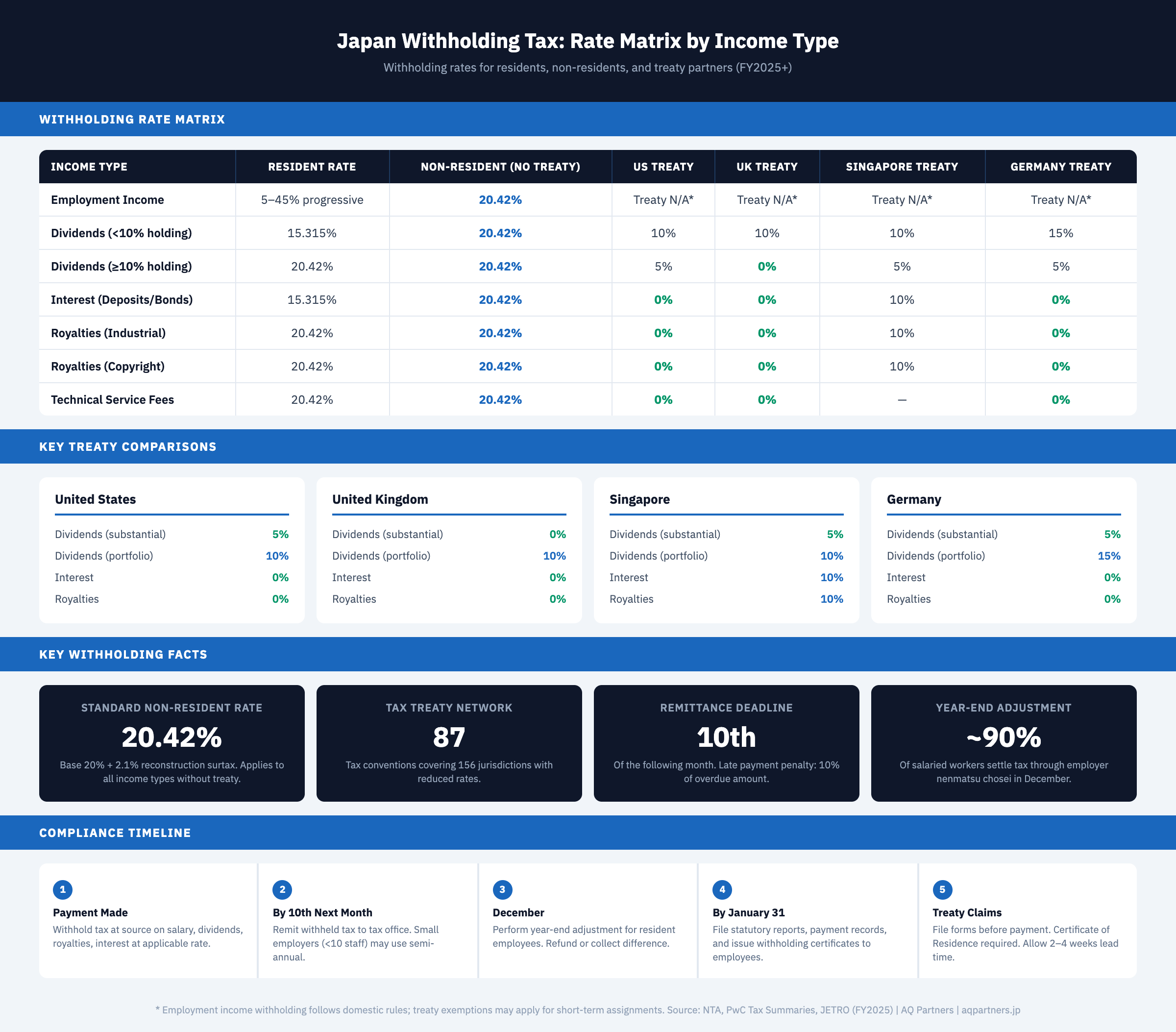
Cross-border payments of dividends, interest, and royalties from Japan are subject to withholding at 20.42% for non-residents unless reduced by a tax treaty, making treaty planning essential for foreign parent companies receiving income from Japanese subsidiaries.
| Income Type | Domestic / Resident Rate | Non-Resident Rate (No Treaty) | US Treaty Rate | UK Treaty Rate | Singapore Treaty Rate |
|---|---|---|---|---|---|
| Dividends (Listed, <3% holding) | 15.315% | 15.315% | 10% | 10% | 10% |
| Dividends (Substantial holding, ≥10%) | 20.42% | 20.42% | 5% | 0% | 5% |
| Interest (Bank deposits) | 15.315% | 20.42% | 0% | 0% | 10% |
| Interest (Corporate bonds) | 15.315% | 20.42% | 0% | 0% | 10% |
| Royalties (Industrial) | 20.42% | 20.42% | 0% | 0% | 10% |
| Royalties (Copyright) | 20.42% | 20.42% | 0% | 0% | 10% |
| Technical Service Fees | 20.42% | 20.42% | 0% | 0% | Not covered |
| Rental Income (Real Property) | 20.42% | 20.42% | 20.42% | 20.42% | 20.42% |
Dividend withholding for domestic shareholders of listed companies is 15.315% (including the reconstruction surtax), while distributions to non-residents without treaty protection are withheld at 20.42%. For parent companies holding 10% or more of a Japanese subsidiary's shares, many treaties reduce the rate to 0-5% — the Japan-UK treaty, for example, eliminates withholding entirely on dividends paid to a parent holding 10% or more of voting shares.
Royalty payments to non-residents — covering patent licensing, trademark usage, copyright fees, and technical assistance — are withheld at 20.42%. The Japan-US treaty eliminates withholding on royalties entirely, while the Japan-Singapore treaty caps it at 10%. Companies structuring intellectual property licensing arrangements should model the withholding cost under applicable treaty rates, as the difference between 0% and 20.42% significantly affects the economics of IP-heavy business models.
Interest payments on loans, bonds, and deposits paid to non-resident recipients face the standard 20.42% withholding, reduced to 0% under several major treaties including those with the US, UK, and Germany. According to JETRO's business setup guide, foreign corporations without a permanent establishment in Japan are subject to withholding at source only on these income categories — no further corporate tax filing is required on this income.
Tax Treaty Benefits and Reduced Rates
Japan's network of 87 tax conventions covering 156 jurisdictions provides reduced withholding rates that can eliminate or substantially lower the tax cost of repatriating income from Japan, but benefits must be claimed proactively through proper documentation filed before payment.
Treaty benefits do not apply automatically. The withholding agent (the Japanese payer) must file a treaty application form with the local tax office before making the payment. The most commonly used forms include Form 17 (for dividends), Form 3 (for interest), and Form 1 (for royalties). Each form requires a Certificate of Residence issued by the recipient's home country tax authority, confirming that the recipient is a tax resident of the treaty partner jurisdiction.
Processing timelines for treaty applications vary, but companies should allow at least two to four weeks before the planned payment date. If treaty documentation is not filed in advance, the withholding agent must apply the full domestic rate (20.42%) and the recipient must seek a refund through the tax office — a process that can take three to six months. Foreign companies should establish standing treaty documentation procedures for recurring payments such as quarterly dividends, monthly royalties, and periodic interest.
Beneficial ownership requirements apply across all treaties. The recipient must be the beneficial owner of the income, not merely a conduit or nominee. Japan's tax authorities actively scrutinize arrangements where income flows through intermediate holding companies in treaty jurisdictions, particularly when the intermediary lacks economic substance.
Year-End Adjustment (Nenmatsu Chosei)
The year-end adjustment (nenmatsu chosei/年末調整) is a mandatory employer-administered process that reconciles the total income tax withheld during the calendar year against the employee's actual annual tax liability, eliminating the need for most salaried employees to file individual tax returns.
Employers perform nenmatsu chosei in December for all resident employees who earned ¥20 million or less in annual salary and who remain employed at year-end. The process accounts for personal exemptions, dependent deductions, insurance premium deductions (life, earthquake), housing loan credits, and other adjustments that were not fully reflected in monthly withholding calculations. Approximately 90% of Japan's salaried workers settle their entire income tax obligation through this employer-administered process rather than individual filing.
Employees must submit declaration forms to their employer by early December, including the Dependent Deduction Declaration (扶養控除等申告書), Insurance Premium Deduction Declaration (保険料控除申告書), and Basic Deduction Declaration (基礎控除申告書). The employer recalculates the annual tax, compares it to the cumulative withholding, and either refunds the overpayment through the December or January payroll or collects the shortfall.
Employees earning over ¥20 million, those with significant non-employment income (rental, investment, freelance), or those claiming certain deductions (medical expenses, first-year housing loan credit) must file individual tax returns (kakutei shinkoku) by March 15 of the following year. Foreign companies with employees in Japan must understand which staff qualify for year-end adjustment and which require individual filing guidance.
Filing Deadlines and Payment Procedures
Withholding agents must remit withheld tax to the tax office by the 10th of the month following payment, with special semi-annual remittance available for small employers.
The standard remittance cycle requires employers to deposit withheld income tax at a bank or tax office by the 10th of each month for taxes withheld during the preceding month. For example, tax withheld from January salaries paid on January 25 must be remitted by February 10. Employers use a prescribed payment slip (納付書/gensen choshu nofusho) and can pay at designated financial institutions or through e-Tax electronic filing.
Small employers with fewer than 10 employees can apply for semi-annual remittance (納期の特例), consolidating six months of withholding into two payments: January-June withholding due by July 10, and July-December withholding due by January 20. This reduces administrative burden significantly for small foreign-affiliated offices. The application (源泉所得税の納期の特例の承認に関する申請書) must be filed with the local tax office.
Withholding agents must also file annual reports by January 31 of the following year. The three key filings are: the Statutory Report of Payment (法定調書合計表), summarizing all payments subject to withholding; individual payment records (支払調書) for each recipient exceeding reporting thresholds; and withholding tax certificates (源泉徴収票) provided to each employee for their records.
Late payment triggers an additional tax of 10% on the overdue amount (reduced to 5% if paid within one month of the due date). Persistent non-compliance can result in the NTA estimating the withholding liability and issuing a determination, plus criminal penalties in extreme cases of willful non-remittance.
Common Withholding Mistakes for Foreign Companies
Foreign companies operating in Japan make several recurring withholding tax errors that create compliance exposure, back-tax assessments, and penalty charges — most of which are avoidable with proper initial setup.
- Failing to apply treaty rates proactively: Many foreign companies assume treaty benefits apply automatically. Without filing the required treaty application forms before payment, the full 20.42% rate applies and the recipient must pursue a refund. Establishing a treaty documentation calendar for recurring payments prevents this.
- Misclassifying resident and non-resident employees: Residency status determines whether progressive rates or the flat 20.42% rate applies. Employees transitioning between resident and non-resident status (arriving in or departing from Japan) require withholding adjustments at the transition point. Companies frequently continue applying the wrong rate after a status change.
- Missing the year-end adjustment for eligible employees: Some foreign employers, unfamiliar with the nenmatsu chosei system, skip the year-end adjustment entirely, leaving employees overtaxed. This creates employee dissatisfaction and potential penalties for the employer's failure to fulfill its obligations as a withholding agent under Japanese HR compliance rules.
- Overlooking withholding on service fees to non-residents: Payments for consulting, technical services, and management fees to non-resident individuals and companies may be subject to 20.42% withholding even when the services are performed outside Japan, if they qualify as "domestic source income" under Japanese tax law.
- Late remittance due to unfamiliarity with monthly deadlines: The 10th-of-the-following-month deadline is rigid. Companies accustomed to quarterly tax remittance in other jurisdictions sometimes miss monthly deadlines, triggering the 10% late payment penalty.
- Insufficient documentation for treaty claims: The NTA requires Certificates of Residence issued by foreign tax authorities to validate treaty claims. Expired or improperly issued certificates invalidate the treaty rate, and the withholding agent bears liability for the shortfall.
Foreign companies establishing operations in Japan should implement withholding tax procedures from day one — including treaty documentation workflows, monthly remittance calendars, and year-end adjustment checklists. Errors discovered during NTA audits typically result in back-tax assessments covering up to five years of underpayment plus penalties.
Frequently Asked Questions
What is the standard withholding tax rate for non-residents in Japan?
The standard withholding tax rate for non-residents in Japan is 20.42% on most types of Japan-sourced income, including employment compensation, dividends, interest, royalties, and service fees. This rate comprises a base 20% income tax plus a 2.1% reconstruction surtax. Tax treaties with 156 jurisdictions may reduce this rate, but treaty benefits must be claimed through proper documentation filed before payment.
How does the year-end adjustment (nenmatsu chosei) work?
Year-end adjustment is an employer-administered process performed each December that reconciles total income tax withheld during the year against the employee's actual annual liability. Employers factor in personal exemptions, dependent deductions, insurance premiums, and housing loan credits, then refund overpayments or collect underpayments through the December or January payroll. Approximately 90% of salaried workers in Japan complete their tax obligations through this process without filing individual returns.
Do tax treaty benefits apply automatically in Japan?
No. Treaty benefits require proactive application. The withholding agent must file a treaty application form (Form 17 for dividends, Form 3 for interest, Form 1 for royalties) with the local tax office before making the payment. Each application requires a Certificate of Residence from the recipient's home country tax authority. Without advance filing, the full 20.42% domestic rate applies and the recipient must apply for a refund — a process that typically takes three to six months.
When must employers remit withheld tax in Japan?
Employers must remit withheld income tax by the 10th of the month following the payment. Small employers with fewer than 10 employees can apply for semi-annual remittance: January-June withholding due by July 10, and July-December withholding due by January 20. Late remittance triggers a penalty of 10% on the overdue amount, reduced to 5% if paid within one month of the due date.
Working with AQ Partners. Our Tokyo team provides annual tax filings, including the withholding tax statements, and monthly payroll coordination for foreign companies operating in Japan. Book a consultation to discuss your situation.


Yuga Koda is a founding Director at AQ Partners, supporting foreign companies, funds, and families operating in Japan. His experience operating companies in both Japan and international markets gives him a practical understanding of back office operations from both sides.