
Corporate Credit Cards & Expense Management in Japan

Corporate credit cards and expense management in Japan present unique challenges for foreign companies, primarily because Japanese card issuers require established business credit history that new market entrants lack. Most corporate card applications from newly incorporated KK or GK entities are rejected during the first 6–12 months, forcing companies to use alternative payment methods—prepaid cards, debit cards, or founder personal cards with reimbursement—until creditworthiness is established. Pairing available card products with cloud-based expense management tools creates a compliant, auditable expense workflow that satisfies both Japanese tax retention requirements and headquarters reporting standards.
Key Takeaways
- Most corporate card applications are rejected during the first year of operations—Japanese card issuers (JCB, Visa/SMBC, MUFG AMEX) evaluate corporate creditworthiness based on financial statements and operating history, and newly incorporated entities with no tax filing history are routinely declined.
- Prepaid and debit corporate cards are available from day one—GMO Aozora's Visa debit card and Kyash Business prepaid cards do not require credit checks and can be issued immediately after opening the linked bank account, providing card-based payment capability while building credit history.
- Representative directors often must provide personal guarantees—even after the first year, many Japanese corporate card issuers require the daihyō torishimariyaku to personally guarantee the card balance, creating personal liability that foreign executives should understand before signing.
- Receipt retention rules require 7 years of original or electronic records—Japan's Consumption Tax Act and Corporation Tax Act require businesses to retain receipts and invoices for 7 years (9 years for certain large corporations), with electronic storage permitted under the Electronic Books Preservation Act (電子帳簿保存法) if requirements are met.
- Cloud expense tools like freee and Money Forward integrate directly with Japanese card feeds—these platforms import credit card and bank transactions automatically, match them to photographed receipts via OCR, and generate consumption tax-compliant expense records without manual data entry.
Corporate Card Availability for New Entities
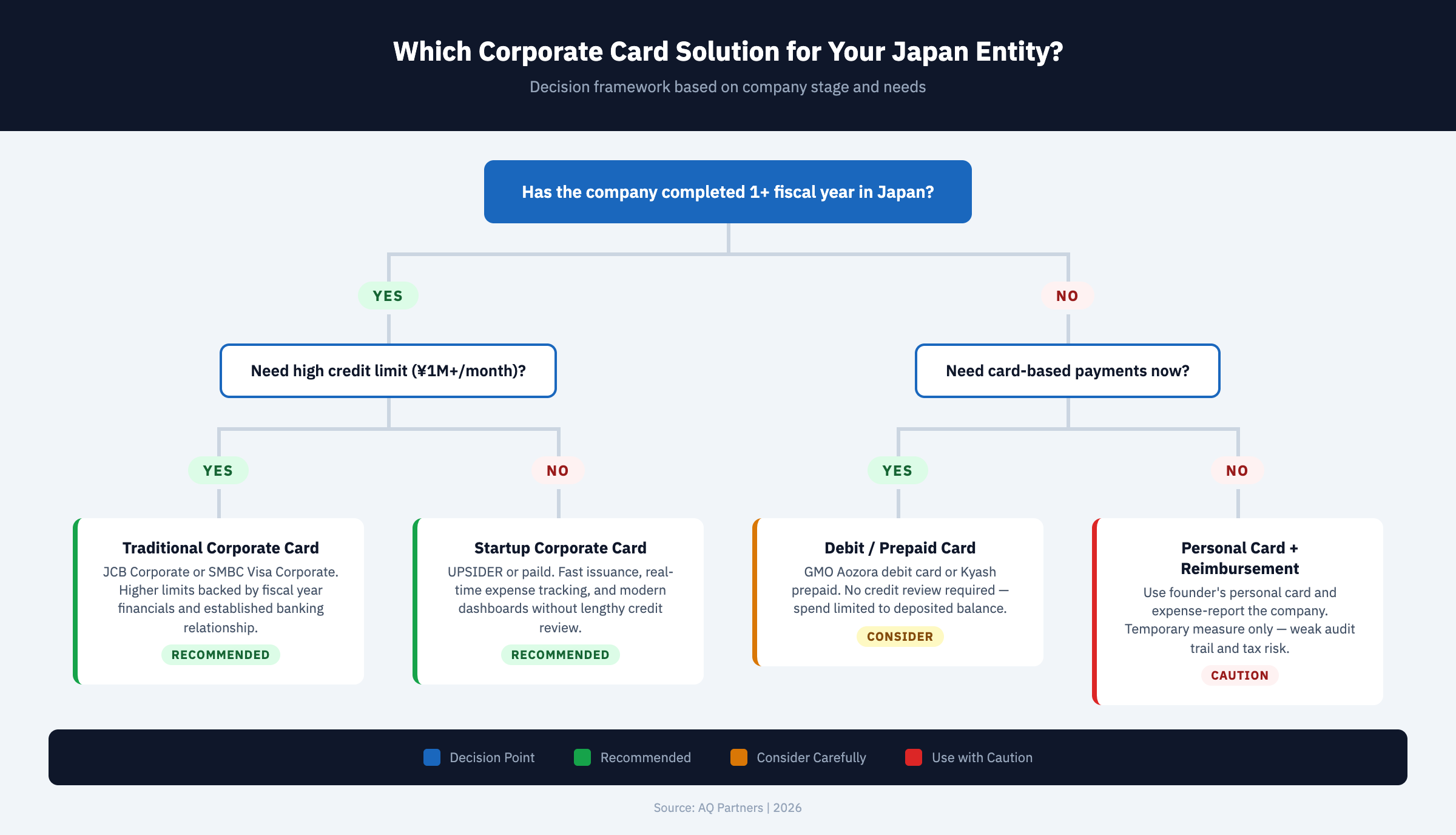
The fundamental challenge for foreign companies entering Japan is that corporate credit card issuance depends on established creditworthiness—which new entities by definition lack. Japanese card issuers evaluate applications based on:
- Years of operation (決算期数)—at least 1–2 completed fiscal years preferred
- Filed financial statements showing positive operating results
- Capital adequacy and current account balance
- Representative director's personal credit history in Japan
For a newly incorporated KK or GK with a foreign representative who has no Japanese personal credit history, these requirements create a near-certain rejection. Most companies must operate for 6–12 months using alternative payment methods before successfully obtaining a corporate credit card.
| Card Type | Provider Examples | Credit Check | Personal Guarantee | Available to New Entity | Monthly Limit |
|---|---|---|---|---|---|
| Corporate credit card | JCB Corporate, SMBC Visa Corporate, MUFG AMEX Business | Full corporate + personal | Required | Unlikely (need 1+ fiscal years) | ¥500K–¥5M+ |
| Startup-friendly credit card | UPSIDER, paild, バクラクビジネスカード | Simplified (bank balance based) | Not required | Yes (with sufficient bank balance) | ¥100K–¥10M+ (deposit based) |
| Corporate debit card | GMO Aozora Visa Debit, Rakuten Bank Debit | None | Not required | Yes (with bank account) | Account balance |
| Prepaid corporate card | Kyash Business, Payn | None | Not required | Yes | Loaded balance |
| Personal card (reimbursement) | Founder's existing Visa/Mastercard | N/A (personal) | N/A | Yes | Personal limit |
| Virtual card | UPSIDER, paild (virtual issuance) | Simplified | Not required | Yes | Per-card limits set by admin |
| International card (HQ-issued) | Parent company Visa/Mastercard/AMEX | N/A (foreign issuer) | N/A | Yes (but FX fees apply) | Parent company limit |
| ETC corporate card | ETC Corporate Card (NEXCO) | Deposit-based | Not required | Yes (with deposit) | Varies |
The recommended approach for most foreign companies is to start with a debit card (GMO Aozora Visa Debit, issued automatically with the corporate account) or a startup-friendly card (UPSIDER or paild, which evaluate based on bank balance rather than credit history), and apply for a traditional corporate credit card after the first tax filing. The corporate bank account opening guide covers GMO Aozora account setup, which includes the debit card.
Personal Guarantee Requirements
A distinctive feature of Japanese corporate credit cards is the personal guarantee (連帯保証, rentai hoshō) requirement. Most traditional card issuers require the representative director (daihyō torishimariyaku) to personally guarantee the corporate card balance, meaning the individual is jointly and severally liable for all charges.
This has specific implications for foreign executives:
- The guarantee creates personal liability that persists even if the executive leaves the company, until formally released by the card issuer
- The guarantor's personal credit history in Japan is evaluated as part of the application—foreign nationals without Japanese credit history may need to build it first
- Card limits are often set based on the guarantor's personal financial capacity rather than the company's revenue
Startup-focused card providers like UPSIDER and paild have differentiated themselves by eliminating the personal guarantee requirement entirely, instead using deposit-based or bank-balance-based credit determination. This makes them significantly more practical for foreign companies where the representative director may rotate or prefers not to assume personal liability for corporate expenses.
Receipt Retention and Electronic Storage Rules
Japan's receipt retention requirements directly affect how companies manage expense documentation. Under the Corporation Tax Act and Consumption Tax Act, businesses must retain transaction records including receipts, invoices, and payment evidence for 7 years from the filing deadline of the relevant fiscal year. Large corporations (capital exceeding ¥100 million) must retain records for 9 years in certain cases.
The Electronic Books Preservation Act (電子帳簿保存法, Denshichōbo Hozonhō), significantly amended effective January 2024, governs electronic storage of accounting records. Key requirements include:
- Electronic transaction data must be stored electronically—transactions conducted via email, web, or electronic payment can no longer be printed and stored as paper; they must be retained in their original electronic format with searchable metadata (date, amount, counterparty)
- Scanned receipt storage is permitted if the scan meets resolution requirements (200 dpi or higher), includes a timestamp within approximately 2 months of receipt, and the system maintains version control and search functionality
- Qualified Invoice System (インボイス制度) compliance requires that retained invoices include the seller's registration number, tax rate breakdown, and consumption tax amount—cloud expense tools that capture and validate these fields reduce compliance burden
Cloud Expense Management Platforms
Japanese cloud accounting and expense management platforms automate the capture, categorization, and storage of business expenses in compliance with domestic tax requirements.
| Platform | Receipt OCR | Card Feed Integration | Invoice Validation | English Support | Monthly Cost |
|---|---|---|---|---|---|
| freee経費精算 | Yes (AI-powered) | Major banks + cards | Qualified invoice check | Partial English | From ¥1,980/user |
| Money Forward クラウド経費 | Yes | Major banks + cards | Qualified invoice check | Limited | From ¥2,980/month (base) |
| Concur | Yes | Global card networks | Configurable | Full English | From ~$8/user |
| TOKIUM経費精算 | Yes + operator review | Major banks + cards | Qualified invoice check | Limited | Custom pricing |
| Rakumo経費精算 | Yes | Limited | Basic | Limited | From ¥300/user |
| UPSIDER (built-in) | Yes | Native (own card) | Qualified invoice check | Partial | Included with card |
| paild | Yes | Native (own card) | Qualified invoice check | Limited | Included with card |
| バクラク経費精算 | Yes (AI-powered) | Major banks + own card | Qualified invoice check | Limited | Custom pricing |
For foreign companies, the choice typically narrows to freee (best English support, integrates with the most common accounting setup) or Concur (full English, familiar to multinational HQ finance teams). Companies using UPSIDER or paild cards benefit from native expense management features built into the card platform, eliminating the need for a separate expense tool. The online banking and fintech guide covers how these platforms integrate with corporate bank accounts.
Tax-Deductible Entertainment and Business Expenses
Japan applies specific rules to entertainment expenses (交際費, kōsaihi) that differ from most Western jurisdictions. Under the Corporation Tax Act, entertainment expenses are subject to deductibility limits based on company size.
- SMEs (capital ≤ ¥100 million): Up to ¥8 million per year in entertainment expenses are deductible. Alternatively, 50% of dining expenses qualifying as entertainment are deductible with no cap. Companies choose whichever method produces the larger deduction.
- Large corporations (capital > ¥100 million): Only 50% of qualifying dining entertainment expenses are deductible. Other entertainment expenses are fully non-deductible.
- Per-person dining threshold: Business meals costing ¥10,000 or less per person (increased from ¥5,000 in the FY2024 tax reform) are excluded from the entertainment expense category entirely and treated as fully deductible meeting expenses (会議費), provided the company records the date, attendee names and affiliations, number of participants, amount, and restaurant name.
Proper categorization of dining expenses as either entertainment (交際費, limited deductibility) or meeting expenses (会議費, fully deductible) has a direct tax impact. Expense management systems that prompt users to enter attendee count and names at the time of receipt capture help ensure correct classification.
Recommended Expense Workflow for Foreign Companies
Based on the constraints and available tools, the practical expense management workflow for a foreign company in Japan typically follows this pattern:
- Months 1–6: Use GMO Aozora debit card for online purchases and subscriptions, founder's personal card for other expenses (with monthly reimbursement), and bank transfers for large vendor payments. Capture all receipts using freee's mobile app.
- Months 6–12: Apply for UPSIDER or paild corporate card (no personal guarantee, bank-balance-based approval). Issue virtual cards per employee or per expense category. Continue using freee or the card platform's built-in expense management.
- Year 2+: Apply for traditional corporate credit card (JCB, SMBC Visa) after first tax filing for higher limits and broader acceptance. Maintain the startup card for employee expenses with per-card spending limits and approval workflows.
This phased approach ensures the company has card-based payment capability from day one while building the credit history needed for traditional corporate card approval.
Corporate expense management is one of the operational areas where Japan's specific requirements—personal guarantees, electronic storage mandates, entertainment expense categorization—create friction for foreign companies accustomed to different systems. Setting up the right combination of card products and expense tools during the first months prevents compliance gaps and reduces administrative overhead as the company grows. AQ Partners configures corporate card applications, expense management workflows, and receipt retention systems as part of our back office setup for foreign companies in Japan. Contact us at hello@aqpartners.jp.

Yuga Koda is a founding Director at AQ Partners, supporting foreign companies, funds, and families operating in Japan. His experience operating companies in both Japan and international markets gives him a practical understanding of back office operations from both sides.