
Tax Calendar for Foreign Companies in Japan: All Deadlines


Key Takeaways
- Foreign subsidiaries face unique first-year deadlines — prorated fiscal years, consumption tax registration elections, and Blue Form applications that must be filed within three months of incorporation create a compressed compliance window that catches many new entrants off guard.
- PE determinations trigger retroactive filing obligations — if the NTA determines a foreign company created a PE before formally incorporating, back-dated returns with penalties may be required, making early PE risk assessment essential.
- Fiscal year-end alignment creates interim payment timing issues — choosing December 31 to match foreign parents shifts all Japanese tax deadlines away from the domestic March 31 norm, requiring a customized calendar.
- Tax treaty benefits require advance filing before payment — reduced withholding rates under Japan's 80+ treaties are not automatic; Form 1-17 notifications must be submitted to the district tax office before or at the time of payment.
- Consumption tax registration timing is a strategic first-year decision — subsidiaries with capital of ¥10 million or more are automatically taxable, while those below must decide whether voluntary registration to reclaim input tax on setup costs outweighs the compliance burden.
What Foreign Companies Need to Know About Japan's Tax Calendar
A tax calendar for foreign companies in Japan is the structured schedule of filing deadlines, payment dates, and compliance milestones that apply specifically to foreign-capitalized subsidiaries, branches, and entities with permanent establishment exposure under Japanese tax law. Foreign entities face additional complexity beyond the general corporate calendar: first-year prorated periods, PE determination timelines, tax treaty notification requirements, fiscal year alignment decisions, and consumption tax registration elections that domestic companies rarely encounter.
According to the National Tax Agency (NTA), approximately 35,000 foreign-affiliated companies file corporate tax returns in Japan annually, with non-compliance rates among first- and second-year foreign entities running roughly three times higher than the domestic average. The Ministry of Finance reports that foreign companies account for a disproportionate share of late-filing penalties due to unfamiliarity with Japan-specific deadlines. This guide maps every critical deadline foreign companies face, from pre-incorporation PE risk through steady-state annual compliance.
First-Year Tax Obligations for New Foreign Subsidiaries
The first fiscal year is the most deadline-intensive period for any foreign subsidiary entering Japan, with multiple overlapping filings compressed into a short window that differs significantly from ongoing annual compliance.
When a foreign company incorporates a Japanese subsidiary (KK or GK), the first fiscal year runs from the date of registration to the chosen fiscal year-end. If a company incorporates on July 15 with a December 31 fiscal year-end, the first fiscal year is only 5.5 months. All tax obligations are prorated to this shortened period, but deadlines remain fixed at two months after year-end. The compressed timeline means the subsidiary must establish tax accounting systems, obtain a corporate number (hojin bango), register with the NTA and local tax offices, and apply for Blue Form filing status — all before the first return is due.
| Obligation | Deadline | Filed With | Foreign Company Consideration |
|---|---|---|---|
| Corporate establishment notification (hojin setsuritsu todoke) | Within 2 months of incorporation | District tax office + prefectural/municipal offices | Requires registered seal (inkan); branch offices file branch establishment notice instead |
| Blue Form application (ao-iro shinkoku) | Within 3 months of incorporation OR before first FY-end (whichever is earlier) | District tax office | Missing this deadline means White Form filing for the entire first year — no loss carryforward |
| Payroll withholding agent registration | Within 1 month of first salary payment | District tax office | Applies even if only one employee; triggers monthly withholding obligations |
| Consumption tax taxable entity notification | Promptly after incorporation (if capital >= ¥10M) | District tax office | Entities with capital of ¥10M+ are automatically taxable; no election needed but notification required |
| Voluntary consumption tax registration election | Before the start of the period you wish to become taxable | District tax office | Useful for sub-¥10M capital entities wanting input tax refunds on setup costs |
| First corporate tax return (prorated FY) | Within 2 months of first FY-end | NTA (e-Tax) + local offices | Prorated period may be as short as 1 month; still requires full return preparation |
| First consumption tax return | Within 2 months of first FY-end | NTA (e-Tax) | Input tax credits on incorporation costs (legal fees, office setup) can be significant |
| Depreciable asset declaration | January 31 following incorporation year | Municipal tax office | Often overlooked by foreign companies; required even for leased office improvements |
According to PwC's tax administration summary for Japan, approximately 40% of foreign subsidiaries miss the Blue Form application deadline in their first year, forfeiting loss carryforward benefits worth an average of ¥12–15 million in deferred tax savings over subsequent profitable years. The Blue Form deadline is particularly problematic for companies incorporating late in the fiscal year, where the three-month window from incorporation overlaps with the first-year return deadline.
Permanent Establishment Risk and Retroactive Deadlines
Before a foreign company formally incorporates in Japan, pre-incorporation activities can create permanent establishment (PE) exposure that triggers tax filing obligations retroactively — a risk unique to foreign entities that domestic companies never face.
Under Japan's domestic tax law and its network of over 80 bilateral tax treaties, a PE is created when a foreign company maintains a fixed place of business, employs a dependent agent who habitually concludes contracts, or conducts construction or service projects exceeding treaty-specified duration thresholds (typically 6-12 months). The NTA has intensified PE audits in recent years, assessing PE-related additional taxes averaging ¥180 million per case.
If PE is determined to have existed before formal incorporation, retroactive filing requirements apply for all PE periods. Corporate tax, consumption tax, and withholding tax obligations become due immediately, with late-filing penalties of 15-20% and interest from the original due dates. Companies should conduct PE risk assessments before sending employees, signing leases, or engaging Japanese agents.
Fiscal Year Alignment: Choosing the Right Year-End
Foreign subsidiaries in Japan can select any month-end as their fiscal year-end, and this single decision cascades through every subsequent tax deadline, interim payment schedule, and reporting obligation for the life of the entity.
Approximately 70% of domestic Japanese companies use March 31 as their fiscal year-end, but foreign subsidiaries commonly choose December 31 to align with parent company reporting. According to JETRO's business setup guide, roughly 60% of foreign-affiliated companies in Japan use a December 31 fiscal year-end. While alignment simplifies consolidation, it shifts all Japanese tax deadlines away from the domestic norm.
| Deadline Type | March 31 FY-End | December 31 FY-End | Impact for Foreign Subsidiaries |
|---|---|---|---|
| Annual corporate tax return | May 31 | February 28/29 | Feb deadline overlaps with global year-end close and parent audit season |
| Filing extension deadline (if applied) | June 30 | March 31 | Extension adds breathing room but estimated payment still due at original date |
| Interim corporate tax payment | November 30 | August 31 | Aug payment overlaps with Obon holiday period; resource availability drops |
| Annual consumption tax return | May 31 | February 28/29 | Same compressed deadline as corporate tax return |
| Enterprise tax and inhabitants tax return | May 31 | February 28/29 | Filed simultaneously with corporate tax return |
| Depreciable asset declaration | January 31 (fixed calendar date) | January 31 (fixed calendar date) | Same for all companies; falls during December FY-end close crunch |
| Year-end tax adjustment (employee withholding) | December (fixed calendar) | December (fixed calendar) | Unaffected by FY choice; always a calendar-year obligation |
| Transfer pricing documentation readiness | May 31 (with return) | February 28/29 (with return) | Shorter preparation window if parent provides data on calendar-year schedule |
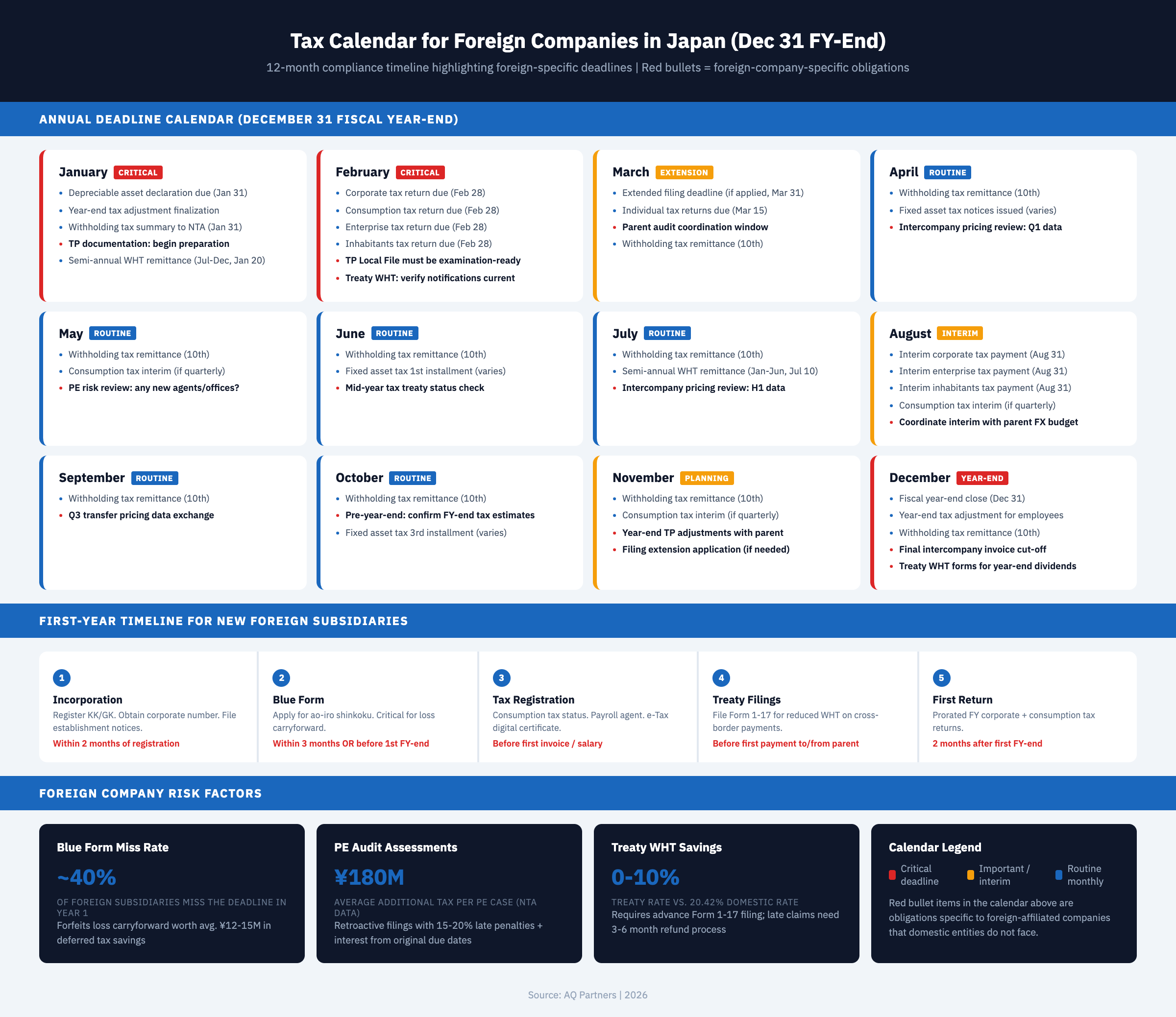
The December 31 fiscal year creates a February filing deadline that coincides with the parent company's own audit and consolidation cycle, often creating resource conflicts. Companies should consider whether a January 31 or February 28 fiscal year-end might better balance alignment needs with practical filing capacity. Once selected, changing the fiscal year-end requires shareholder approval and NTA notification, with transitional prorated periods that create additional compliance complexity. For context on how these deadlines fit within Japan's broader corporate filing framework, see our Japan tax filing schedule guide.
Tax Treaty Notifications and Withholding Tax Deadlines
Japan's 80+ bilateral tax treaties can reduce withholding tax rates on cross-border payments from the domestic 20.42% to as low as 0%, but treaty benefits require affirmative notification filings before or at the time of each relevant payment — they are never applied automatically.
Foreign parent companies receiving dividends, interest, or royalty payments from their Japanese subsidiaries must file treaty notification forms (Form 1 through Form 17, depending on income type) with the payer's district tax office before or at the time of the first relevant payment. Late notifications mean the full 20.42% domestic rate applies, with overpaid tax recovered through a refund process taking 3-6 months.
Treaty notifications remain valid as long as underlying facts are unchanged, but any change in residency, beneficial ownership, or payment nature requires a new filing. The PwC withholding tax summary notes that treaty rates on dividends from substantial shareholdings (25%+ ownership) range from 0% to 10%, with the Japan-US treaty providing 0% for qualifying 50%+ parent companies. Managing these filings is closely related to broader withholding tax compliance in Japan.
Consumption Tax Registration Timing for New Entrants
Consumption tax (shohi zei) registration is one of the most consequential first-year decisions for foreign companies entering Japan, with the timing of registration directly affecting cash flow during the capital-intensive setup phase.
New subsidiaries with paid-in capital of ¥10 million or more are automatically taxable from their first fiscal year. Subsidiaries with capital below ¥10 million are generally exempt during their first two fiscal years, though entities with taxable sales and payroll each exceeding ¥10 million in the first six months may lose their exemption from the second year onward.
For exempt-eligible companies, voluntary registration can be strategic. Setup-phase consumption tax on office leases, equipment, legal fees, and IT infrastructure (all at 10%) can be reclaimed through input tax credits, potentially generating a net refund. The election must be filed before the start of the fiscal year in which the company wishes to become taxable, and once elected, the company must remain registered for at least two years. For a deeper understanding of consumption tax obligations, see our comprehensive tax filing guide.
Annual Compliance Calendar for Steady-State Foreign Subsidiaries
Once past setup, foreign subsidiaries settle into an annual compliance rhythm that mirrors domestic companies but retains foreign-specific overlays: transfer pricing documentation, treaty renewal monitoring, and parent company reporting coordination.
For a December 31 fiscal year-end subsidiary: January covers year-end tax adjustment finalization and depreciable asset declarations. February is critical, with corporate tax, consumption tax, enterprise tax, and inhabitants tax returns all due by February 28/29. Interim tax payments fall in August. Monthly withholding remittances are due by the 10th.
Foreign subsidiaries must maintain contemporaneous transfer pricing documentation ready for NTA examination by the return filing date and coordinate intercompany pricing adjustments before year-end.
Frequently Asked Questions
What happens if a foreign company misses the Blue Form application deadline?
The company must file as a White Form filer for that entire fiscal year, forfeiting loss carryforward. First-year operating losses cannot offset future taxable income. The company can apply for Blue Form status for the following fiscal year by submitting the application before that year begins.
Can a foreign subsidiary change its fiscal year-end after incorporation?
Yes, but it requires a shareholder resolution amending the articles of incorporation, followed by notification to the district tax office. The transition creates a prorated fiscal year with its own full set of filing obligations.
How does PE determination affect the tax calendar?
If the NTA determines that a PE existed before formal incorporation, corporate tax, consumption tax, and withholding tax returns are due retroactively for the PE period with late-filing penalties of 15-20% and interest from the original due dates.
For expert guidance on managing Japan's tax calendar as a foreign company — from first-year setup through steady-state compliance — explore our tax compliance resources or contact AQ Partners for a consultation tailored to your entity structure and home-country alignment needs.

Yuga Koda is a founding Director at AQ Partners, supporting foreign companies, funds, and families operating in Japan. His experience operating companies in both Japan and international markets gives him a practical understanding of back office operations from both sides.