
Japanese Business Culture Guide for Foreign Companies


Japanese business culture operates on principles of relationship building, consensus-driven decision-making, and indirect communication that differ substantially from Western business norms. For foreign companies entering the Japanese market, cultural missteps—rushing to close deals, bypassing hierarchical protocols, or misreading indirect refusals—can derail partnerships and client relationships regardless of the quality of the product or service being offered. This guide covers the practical cultural conventions that directly affect business operations, from initial meetings through long-term relationship management.
Key Takeaways
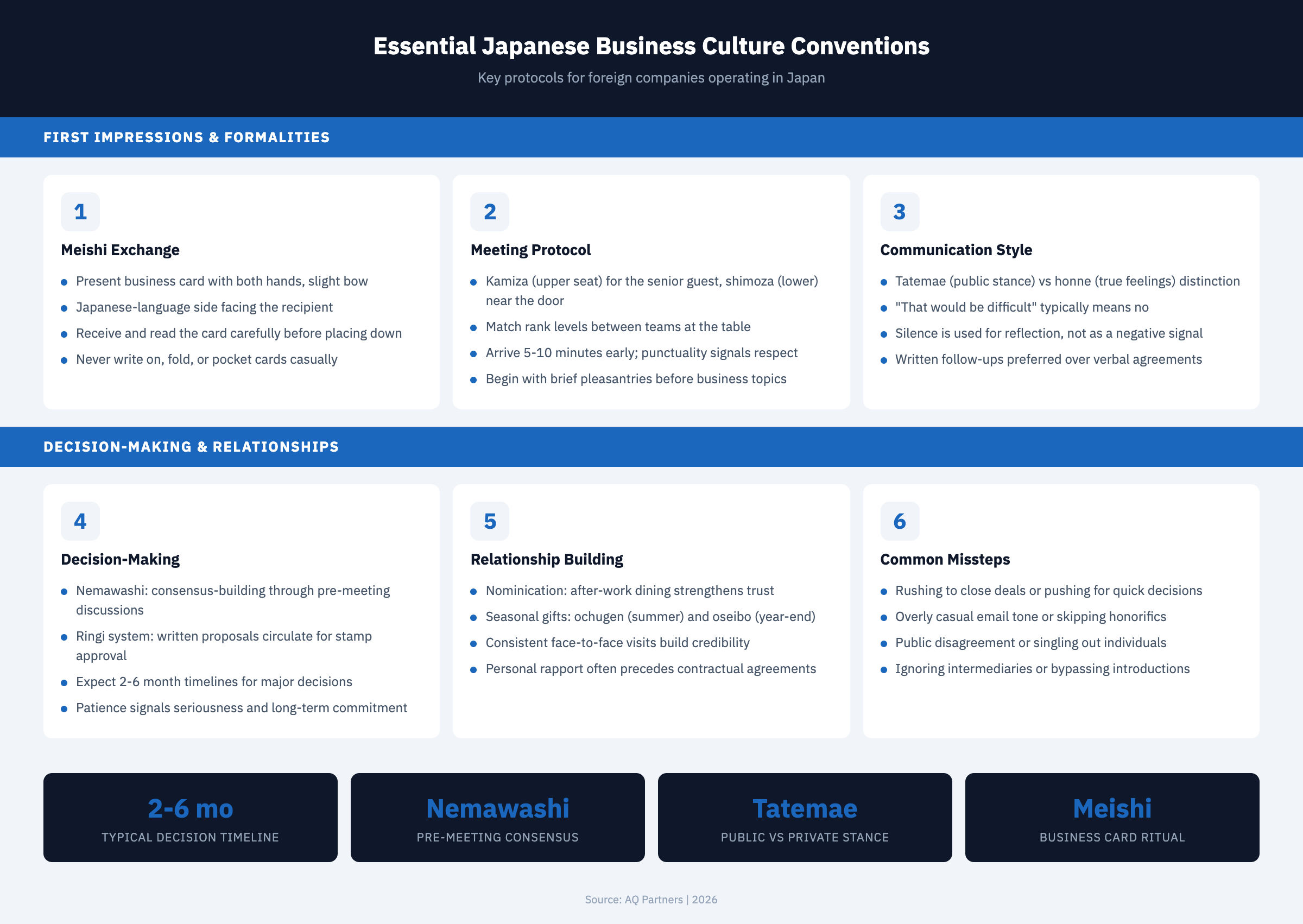
- Business card (meishi) exchange follows a specific protocol that signals respect—cards are presented with both hands, Japanese side facing the recipient, and received with both hands. Cards should never be written on, placed in a back pocket, or casually stacked during a meeting. During the meeting, received cards are placed on the table in order of seniority.
- Decision-making follows a consensus process (nemawashi/ringi) that takes weeks or months—Japanese organizations build agreement through informal pre-consultation (根回し, nemawashi) before formal proposals reach decision-makers. The ringi (稟議) system requires written proposals to circulate through multiple approval layers, meaning a single point of contact cannot typically commit to decisions independently.
- Indirect communication means "that would be difficult" often means "no"—Japanese business communication prioritizes harmony (和, wa) and avoids direct confrontation. Phrases like "ちょっと難しい" (a little difficult), "前向きに検討します" (we'll consider it positively), and long pauses or topic changes are commonly used to decline without explicit refusal.
- Hierarchical protocols affect who speaks, sits, and decides in meetings—seating arrangements follow a specific order (上座/下座, kamiza/shimoza) based on seniority, the most senior person is addressed and deferred to in conversation, and sending a junior representative to meet a senior counterpart can be perceived as disrespectful.
- After-work socializing (飲みニケーション, nominication) remains important for relationship building—while declining in frequency, informal dinners and drinks after business hours remain a significant channel for building trust and having candid conversations outside the formal office hierarchy, particularly with clients and partners.
Business Card Exchange (名刺交換)
The meishi exchange remains the formal opening of virtually every business relationship in Japan. For foreign companies, this is not merely a contact information swap—it establishes identity, hierarchy, and the nature of the professional relationship.
Practical rules for meishi exchange:
- Prepare bilingual cards (Japanese on one side, English on the other) printed on quality card stock. Budget ¥3,000–¥10,000 per batch from services like Printpac or local print shops.
- Always carry more cards than you expect to need. Running out of meishi signals poor preparation.
- Present your card Japanese side up, facing the recipient, with both hands. If exchanging simultaneously (common), hold your card in the right hand and receive theirs with the left.
- When receiving, take a moment to read the card carefully—name, title, company. This shows respect. Commenting on the person's title or company demonstrates attentiveness.
- During the meeting, place received cards on the table in front of you, arranged by seating position. The most senior person's card should be placed on your card holder. Never write on a card during the meeting.
- After the meeting, store cards in a dedicated card holder (名刺入れ), not in a wallet or pocket.
Meeting Etiquette and Protocol
Seating arrangement (上座・下座): In Japanese meeting rooms, the seat farthest from the door is the position of honor (上座, kamiza), reserved for the most senior person or the guest. The seat closest to the door is the lowest position (下座, shimoza), typically occupied by the most junior team member or the meeting organizer. Visitors are always directed to kamiza.
Rank matching: Japanese organizations expect counterpart meetings to involve participants of equivalent rank. Sending a director-level representative to meet a department head (部長, buchō) is appropriate; sending an entry-level employee creates an imbalance that may be interpreted as the foreign company not valuing the relationship.
Meeting structure: Japanese business meetings typically follow a predictable pattern:
- Formal greetings and meishi exchange (5–10 minutes)
- Introduction of attendees by the most senior person on each side
- Purpose and agenda statement
- Presentation or discussion (often with detailed written materials distributed in advance)
- Questions and discussion—often more reserved than Western meetings, with participants directing comments to the most senior person
- Summary and next steps—often vague by Western standards ("we'll review internally and be in touch")
Punctuality: Being late to a business meeting in Japan is a serious breach of protocol. Arriving 5–10 minutes early is standard. If running late due to unavoidable circumstances, calling ahead (not just texting or emailing) is expected.
Communication Styles
Understanding the distinction between tatemae (建前, public stance/official position) and honne (本音, true feeling/real intention) is essential for interpreting Japanese business communication accurately.
| Japanese Expression | Literal Translation | Actual Meaning | Appropriate Response |
|---|---|---|---|
| ちょっと難しいですね | It's a little difficult | No / we cannot do this | Accept the refusal gracefully, explore alternatives |
| 前向きに検討します | We'll consider it positively | Polite acknowledgement, not a commitment | Follow up in 1–2 weeks, expect possible decline |
| 持ち帰って検討します | We'll take it back and consider | Internal review needed—genuine consideration | Provide written materials to support internal discussion |
| ご検討いただけますか | Could you please consider? | We'd like you to do this | Treat as a polite request, not a casual suggestion |
| 善処します | We'll do our best | Unlikely but we acknowledge your request | Don't expect action; prepare a fallback |
| 考えさせてください | Please let me think about it | Not ready to commit, may be leaning no | Give space, follow up in 1 week |
| 大丈夫です | It's fine / no thank you | Context-dependent: can mean yes or no | Clarify with a specific follow-up question |
| 結構です | That's enough / that's fine | Polite decline or acceptance depending on tone | Read the context and body language |
The practical implication for foreign companies: silence and ambiguity are information. If a Japanese counterpart is not giving a clear affirmative answer, they are likely signaling reluctance or a need for internal alignment. Pushing for an immediate decision in this situation is counterproductive.
Decision-Making: Nemawashi and Ringi
Nemawashi (根回し, literally "going around the roots") refers to the practice of building informal consensus before a formal proposal is made. In practice, this means the person championing a project within a Japanese organization will privately discuss it with all relevant stakeholders before the idea ever reaches a formal meeting or written proposal.
For foreign companies, this has direct implications:
- A positive response from your primary contact does not mean the deal is done—they may still need to build internal consensus
- Providing detailed written materials (in Japanese) that your contact can share internally accelerates the nemawashi process
- Multiple meetings with different stakeholders within the same organization is a positive sign, not a stalling tactic
- Decision timelines of 2–6 months for significant commitments are normal, not a sign of disinterest
The ringi (稟議) system formalizes this consensus into a document (稟議書) that circulates through approval layers, collecting stamps (判子) from each approver. Until all required stamps are collected, the organization has not formally decided. Understanding this process prevents the common foreign company mistake of treating verbal agreement as a binding commitment.
Relationship Building and Socializing
Business relationships in Japan are built on trust developed over time through personal interaction, not just transactional competence. Several conventions govern professional relationship building:
After-work dining and drinking (飲みニケーション): While declining among younger Japanese professionals, post-work socializing remains important in client and partner relationships. These settings allow for more candid conversation outside the formal hierarchy. Practical points:
- The invitation typically comes from the Japanese side—accepting demonstrates commitment to the relationship
- The person who initiates typically pays (おごり). For ongoing client relationships, foreign companies should plan to host dinners periodically
- Alcohol is common but not required—it is perfectly acceptable to decline drinks without explanation
- Business discussions happen naturally but should not dominate—the purpose is relationship building, not deal closing
Gift-giving (お中元・お歳暮): Seasonal gift exchanges in mid-year (お中元, July) and year-end (お歳暮, December) are standard in ongoing business relationships. Typical corporate gifts cost ¥3,000–¥10,000 per recipient. Gifts should be wrapped appropriately (department stores offer のし wrapping service), and the value should not be so high as to create a sense of obligation or suggestion of bribery. Avoid gifts in sets of four (四, the number associated with death) or nine (苦, associated with suffering).
Common Cultural Missteps by Foreign Companies
- Rushing to close: Attempting to finalize agreements in a single meeting or applying pressure for fast decisions. Japanese business culture values thoroughness and consensus over speed.
- Casual email tone: Using first names, informal greetings, or overly casual language in written communication. Japanese business email follows strict formatting with formal honorifics (〇〇様), set phrases for opening/closing, and deferential language. Many Japanese professionals will not address a business contact by first name regardless of how long they've known each other.
- Ignoring intermediaries: Going directly to senior executives without working through established channels. Introductions through mutual connections (紹介, shōkai) carry significant weight and are often necessary for establishing new business relationships.
- Public criticism or disagreement: Openly challenging a counterpart's position in front of colleagues causes loss of face (面子, mentsu). Disagreements should be raised privately or framed as questions rather than direct contradictions.
- Undervaluing process documentation: Japanese organizations expect detailed written proposals, meeting minutes (議事録, gijiroku), and follow-up summaries. Relying on verbal agreements without documentation creates misalignment and signals unprofessionalism.
Cultural competence in Japan is not about adopting every convention—foreign companies are expected to be foreign—but about demonstrating awareness and respect for how Japanese organizations operate. The companies that succeed in Japan long-term are those that invest in understanding their partners' and clients' communication styles, decision-making processes, and relationship expectations. AQ Partners helps foreign companies navigate Japanese business culture as part of our market entry and ongoing operations support. Contact us at hello@aqpartners.jp.

Yuga Koda is a founding Director at AQ Partners, supporting foreign companies, funds, and families operating in Japan. His experience operating companies in both Japan and international markets gives him a practical understanding of back office operations from both sides.