
Global vs. Domestic Accounting Software in Japan: Pros & Cons

Key Takeaways
- Japan's regulatory environment is uniquely demanding — J-GAAP standards, a dual-rate consumption tax, and the mandatory Qualified Invoice System create compliance requirements that most global software does not handle natively.
- Global software excels at consolidation but struggles locally — Platforms like SAP, Oracle NetSuite, and Xero require costly Japan localization modules and may still leave compliance gaps for domestic filings.
- Domestic software is built for Japan compliance out of the box — Tools like freee and MoneyForward Cloud natively support J-GAAP, qualified invoices, and consumption tax calculations, but offer limited English-language interfaces.
- Many foreign subsidiaries run a hybrid model — Using domestic software for day-to-day bookkeeping and a global ERP for group consolidation is a practical compromise that serves both local and headquarters requirements.
- Your company's size, structure, and reporting obligations determine the right fit — A small representative office has very different needs from a fully incorporated subsidiary filing consolidated financial statements with a foreign parent.
The Core Challenge: Accounting Software for Japan Operations
Choosing accounting software for Japan operations means navigating a fundamental tension: global platforms built for international standards versus domestic platforms built exclusively for Japan's rules.
When a foreign company establishes operations in Japan — whether as a branch office, a kabushiki kaisha (KK), or a godo kaisha (GK) — it immediately inherits a set of accounting and tax obligations that differ significantly from those in most Western markets. The choice of accounting software is not merely a technical decision. It is a compliance decision, an operational decision, and in many cases a decision that determines how smoothly the Japan entity can communicate financial data back to its global headquarters.
This post examines the real-world pros and cons of global versus domestic accounting software for Japan, the specific features that matter most in the Japanese regulatory context, and a framework for determining which approach — or which combination — is right for your organisation.
For a broader overview of accounting software options in Japan, see our complete guide to accounting software in Japan.
Why Japan's Accounting Environment Is Unique
Japan's accounting rules combine domestic GAAP, a complex multi-rate consumption tax, and mandatory digital invoice compliance into a regulatory environment that most global software vendors have not fully addressed.
Foreign operators frequently underestimate just how different Japan's accounting environment is from that of the United States, the United Kingdom, the European Union, or Australia. The differences are not cosmetic — they affect how transactions are recorded, how taxes are calculated and remitted, how invoices must be formatted and retained, and how financial statements are prepared and filed.
J-GAAP: Japan's Domestic Accounting Standards
Japan Generally Accepted Accounting Principles (J-GAAP) govern the financial reporting of most Japanese entities. While Japan has made progress toward IFRS convergence, the majority of domestic companies — and most small-to-medium foreign subsidiaries — continue to report under J-GAAP. The standards diverge from IFRS and US GAAP in meaningful areas including lease accounting, revenue recognition timing, and the treatment of certain deferred tax items. For a detailed comparison, see our post on IFRS vs. J-GAAP in Japan.
Consumption Tax: Two Rates, Strict Rules
Japan's consumption tax (消費税) operates at a standard rate of 10% and a reduced rate of 8% applied to food and non-alcoholic beverages for home consumption, and to newspaper subscriptions meeting certain criteria. Software must correctly classify every transaction by applicable rate, calculate tax separately, and produce compliant output for both bookkeeping and tax return filing. PwC's Japan tax summary provides a current reference for consumption tax requirements and thresholds.
The Qualified Invoice System (適格請求書等保存方式)
Japan's Qualified Invoice System became mandatory in October 2023. Under this system, only registered businesses can issue qualified invoices (適格請求書), and input tax credits can only be claimed on purchases supported by a qualified invoice from a registered supplier. Every invoice must display the supplier's registration number, applicable tax rates, and tax amounts broken out by rate. Software that does not support this system creates immediate compliance risk. Our dedicated post on the Qualified Invoice System and accounting software covers the operational requirements in full.
Other Japan-Specific Requirements
Beyond consumption tax and J-GAAP, Japan entities must manage enterprise tax, inhabitants tax, the blue form tax return (青色申告), My Number for payroll and certain tax filings, and fiscal year reporting rules that may differ from a foreign parent company's fiscal calendar. Japanese-language documentation is the regulatory standard — the National Tax Agency provides official guidance via the NTA English portal.
Global Accounting Software in Japan: Pros and Cons
Global platforms offer strong consolidation and familiar interfaces but typically require expensive Japan localisation modules and may still fall short on domestic compliance requirements.
The major global accounting and ERP platforms used by foreign companies entering Japan include SAP S/4HANA, Oracle NetSuite, QuickBooks Online, and Xero. Each was designed with international or US/UK standards as the default. Their performance in the Japan context reflects that origin.
Advantages of Global Software
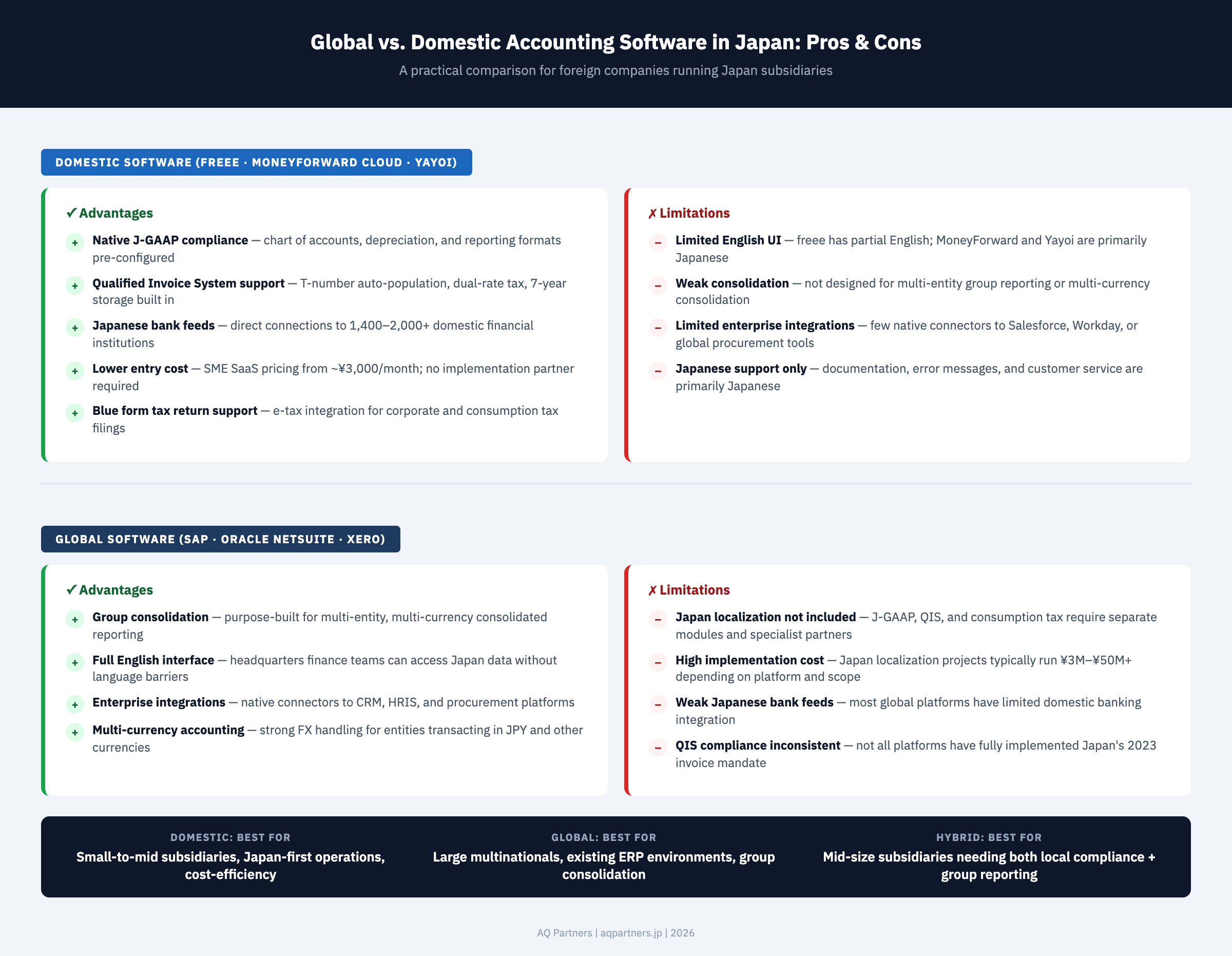
- Group consolidation: If your headquarters already uses SAP, NetSuite, or a similar ERP, keeping the Japan entity on the same platform simplifies intercompany eliminations, consolidation reporting, and currency translation.
- English-language interface: Finance staff at headquarters can access Japan entity data without language barriers. Reporting, dashboards, and workflows operate in the language your team already uses.
- Multi-currency support: Global platforms are generally strong on foreign currency accounting, which matters for Japan entities that transact in both JPY and other currencies.
- Integration with global tools: CRM, HRIS, procurement, and other enterprise systems are more likely to have native integrations with SAP or NetSuite than with freee or Yayoi.
Disadvantages of Global Software
- Japan localisation is rarely included: SAP Japan requires a separate Japan localisation pack with additional licensing costs. NetSuite's Japan localisation module similarly adds cost and requires configuration by a specialist.
- Consumption tax handling may be incomplete: Many global platforms require configuration or customisation to handle Japan's dual-rate consumption tax correctly.
- Qualified Invoice System support is inconsistent: Not all global platforms have fully updated their invoice templates and input tax credit workflows to reflect Japan's October 2023 requirements.
- Bank feed connectivity is limited: Japanese banks use proprietary data formats, and global platforms typically have weaker connections to domestic banking institutions than domestic software.
Domestic Accounting Software in Japan: Pros and Cons
Japan's domestic platforms are purpose-built for local compliance but offer limited English support and minimal integration with global ERP systems used at headquarters.
The leading domestic options are freee, which has approximately 2.6 million registered users as of 2025 and offers a notably strong English-language interface for a domestic product; MoneyForward Cloud Accounting, which is particularly strong on bank feed integration and qualified invoice compliance; and Yayoi, a desktop-first platform with approximately 3.4 million users that dominates the SME bookkeeping market. According to JETRO's 2024 data, approximately 60% of Japan SMEs use accounting software, with domestic platforms holding the majority of that market share.
Advantages of Domestic Software
- Native J-GAAP compliance: Chart of accounts, financial statement formats, and reporting flows are pre-configured for J-GAAP. No localisation modules are required.
- Consumption tax built in: Both the 10% standard rate and 8% reduced rate are handled automatically, with correct treatment for mixed transactions.
- Qualified Invoice System support: freee and MoneyForward Cloud are both fully compliant with the Qualified Invoice System, including registration number display, rate-segregated tax amounts, and input tax credit validation.
- Strong Japanese bank feeds: Domestic platforms maintain direct connections to most major Japanese banks and credit card networks, automating transaction import in a way that global software rarely matches.
- Lower cost at entry level: Domestic SaaS plans are priced for the Japanese SME market, making them accessible for small subsidiaries or representative offices.
Disadvantages of Domestic Software
- Limited English-language support: Yayoi is entirely Japanese-language. MoneyForward Cloud is primarily Japanese. freee is the exception, with meaningful English UI coverage, but even freee's documentation and support are predominantly Japanese.
- Weak global consolidation capability: Domestic platforms are not designed for multi-entity, multi-currency group consolidation. Exporting data to a global ERP requires manual mapping or custom integration.
- Limited integration with global enterprise systems: Native connectors to Salesforce, Workday, or global procurement platforms are limited compared to SAP or NetSuite.
Global vs. Domestic: Side-by-Side Comparison
| Factor | Global Software (SAP, NetSuite, Xero) | Domestic Software (freee, MoneyForward, Yayoi) |
|---|---|---|
| Interface Language | Full English (primary) | Japanese primary; freee has partial English UI |
| J-GAAP Compliance | Requires Japan localisation module; additional cost | Native, pre-configured out of the box |
| Consumption Tax (10%/8%) | Varies; often requires custom configuration | Fully supported with dual-rate handling |
| Qualified Invoice System | Inconsistent; may require customisation | Fully supported (freee, MoneyForward); Yayoi updated |
| Japanese Bank Feeds | Limited; most major Japanese banks not natively supported | Strong; direct connections to most domestic banks |
| Group Consolidation | Excellent; purpose-built for multi-entity reporting | Weak; limited multi-entity or multi-currency capability |
| Integration with Global Systems | Strong; native connectors to major enterprise platforms | Limited; API available but few native integrations |
| Cost at Entry Level | High; licensing plus localisation plus implementation | Low to moderate; SME-oriented SaaS pricing |
| Blue Form Tax Return Support | Not typically supported; requires separate filing workflow | Supported; some platforms link to e-tax systems |
| Local Vendor Support in Japan | Available via implementation partners; quality varies | Strong domestic support; primarily in Japanese |
The Hybrid Approach: When Companies Use Both
Many foreign subsidiaries in Japan use domestic software for daily bookkeeping and a global ERP for group consolidation — a practical model that addresses both local compliance and headquarters reporting requirements.
The hybrid model has become the de facto standard for mid-sized foreign subsidiaries with active Japan operations. In practice, the Japan entity uses freee or MoneyForward Cloud as the primary bookkeeping and tax compliance tool. At month-end, a mapped extract of the Japan trial balance is uploaded into the parent company's ERP — whether SAP, NetSuite, or another system — for consolidation and group reporting.
This approach avoids the most common failure modes on both sides. The Japan entity maintains full local compliance without relying on an imperfectly localised global platform. Headquarters receives consolidated data in the format their finance team expects, without needing to understand the mechanics of J-GAAP or the Qualified Invoice System at the transaction level.
For context on the accounting standards underlying this challenge, see our post on Japanese vs. international accounting standards.
The JETRO setting up in Japan guide is a useful reference for understanding the accounting and reporting obligations that a newly incorporated Japan entity inherits from the moment of establishment.
Which Should You Choose?
The right choice depends on your entity type, reporting obligations, staff language capability, and the size and complexity of your Japan operations.
Choose Domestic Software If:
- Your Japan entity is a standalone operation with no immediate group consolidation requirement
- Your finance team in Japan includes Japanese-speaking staff who will manage day-to-day bookkeeping
- You are a small-to-medium subsidiary or a startup establishing a first Japan presence
- Cost efficiency at entry level is a priority
- Your primary obligation is domestic tax filing accuracy — consumption tax, corporate tax, and qualified invoice compliance
Choose Global Software (with Localisation) If:
- Your parent company's finance team requires real-time or near-real-time access to Japan entity data in a shared ERP
- You have a dedicated implementation budget and can engage a Japan-specialist implementation partner
- Your Japan entity is large enough that the localisation investment is proportionate — typically operations with annual Japan revenue exceeding ¥500 million
- Group consolidation, intercompany transaction management, and multi-currency reporting are central requirements
Choose a Hybrid Model If:
- You have a meaningful Japan operation that must report into a global ERP while also maintaining full local compliance
- The cost and complexity of fully localising a global ERP for Japan is not justified by the size of the Japan entity
- You want to preserve optionality — starting with a domestic platform and adding global ERP integration as the Japan operation scales
For a more granular comparison of specific domestic platforms — including freee, MoneyForward Cloud, and Yayoi — see our post on the best accounting software in Japan.
How AQ Partners Can Help
AQ Partners provides back-office services for foreign companies operating in Japan. For companies navigating the global versus domestic software decision, we offer a structured approach that removes the guesswork and eliminates the compliance risk that comes from choosing the wrong platform or configuring it incorrectly.
Our accounting and back-office services include software selection advisory, domestic software setup and configuration, month-end bookkeeping and reconciliation, headquarters reporting packages, and tax filing coordination. If you are evaluating accounting software for a Japan entity or looking to bring structure to an existing setup, we would welcome a conversation.
Contact the AQ Partners team at aqpartners.jp/contact to discuss your Japan back-office requirements.

Yuga Koda is a founding Director at AQ Partners, supporting foreign companies, funds, and families operating in Japan. His experience operating companies in both Japan and international markets gives him a practical understanding of back office operations from both sides.