
Fixed-Term Contracts in Japan: Renewal, Conversion & Non-Renewal Rules

Fixed-term employment contracts in Japan (有期労働契約, yūki rōdō keiyaku) provide flexibility for project-based work, seasonal positions, and initial employment arrangements, but they come with specific legal constraints that foreign employers must understand. The 2013 amendments to the Labor Contract Act introduced the automatic conversion rule (無期転換ルール, muki tenkan), which grants fixed-term employees the right to convert to indefinite-term employment after 5 years of continuous service. Combined with the judicially developed yatoidome doctrine that restricts non-renewal when employees have a reasonable expectation of continued employment, fixed-term contracts in Japan require more careful management than in many other jurisdictions.
Key Takeaways
- Maximum term is 3 years (5 years for certified specialists)—the Labor Standards Act limits individual fixed-term contracts to 3 years. Employees with advanced specialized knowledge (specified by MHLW criteria, including certain professional qualifications and high-income specialists) may be contracted for up to 5 years.
- After 5 cumulative years, employees have the right to convert to indefinite-term—when a fixed-term employee's total contract duration exceeds 5 years through renewals, the employee gains the legal right to request conversion to an indefinite-term contract. Once the employee makes this request, the employer must accept it—there is no discretion to refuse.
- Non-renewal is restricted when employees reasonably expect continuation—the yatoidome (雇止め) doctrine, codified in Labor Contract Act Article 19, prevents employers from simply letting contracts expire when: (a) the employment is functionally equivalent to indefinite-term work, or (b) the employee has a reasonable expectation of renewal based on the employer's words, conduct, or renewal history.
- 30 days' advance notice is required for non-renewal—employers must notify fixed-term employees at least 30 days before the contract end date if they intend not to renew, provided the employee has been employed for 1 year or more or the contract has been renewed 3 or more times.
- A 6-month cooling period can reset the 5-year clock—if there is a gap of 6 months or more between the end of one contract and the start of the next (called a cooling period or クーリング期間), the prior contract period does not count toward the 5-year conversion threshold. However, using cooling periods primarily to avoid conversion obligations may be challenged as abusive.
Contract Duration Rules
| Employee Category | Maximum Single Contract Term | Conversion Right Trigger | Examples |
|---|---|---|---|
| General employees | 3 years | After 5 cumulative years | Office staff, factory workers, retail employees |
| Certified specialists | 5 years | After 5 cumulative years | Doctors, CPAs, PhD holders, high-income professionals (¥10.75M+) |
| Employees aged 60+ (post-retirement rehire) | 1–3 years (typically 1) | Special exception: may be exempt | Rehired retirees under continued employment obligation |
| Project-based (completion-defined) | 3 years (or project end) | After 5 cumulative years | Construction project managers, R&D researchers |
| University researchers | 5 years (special provision) | After 10 cumulative years | University faculty, researchers on fixed-term appointments |
The 5-Year Conversion Rule (無期転換ルール)
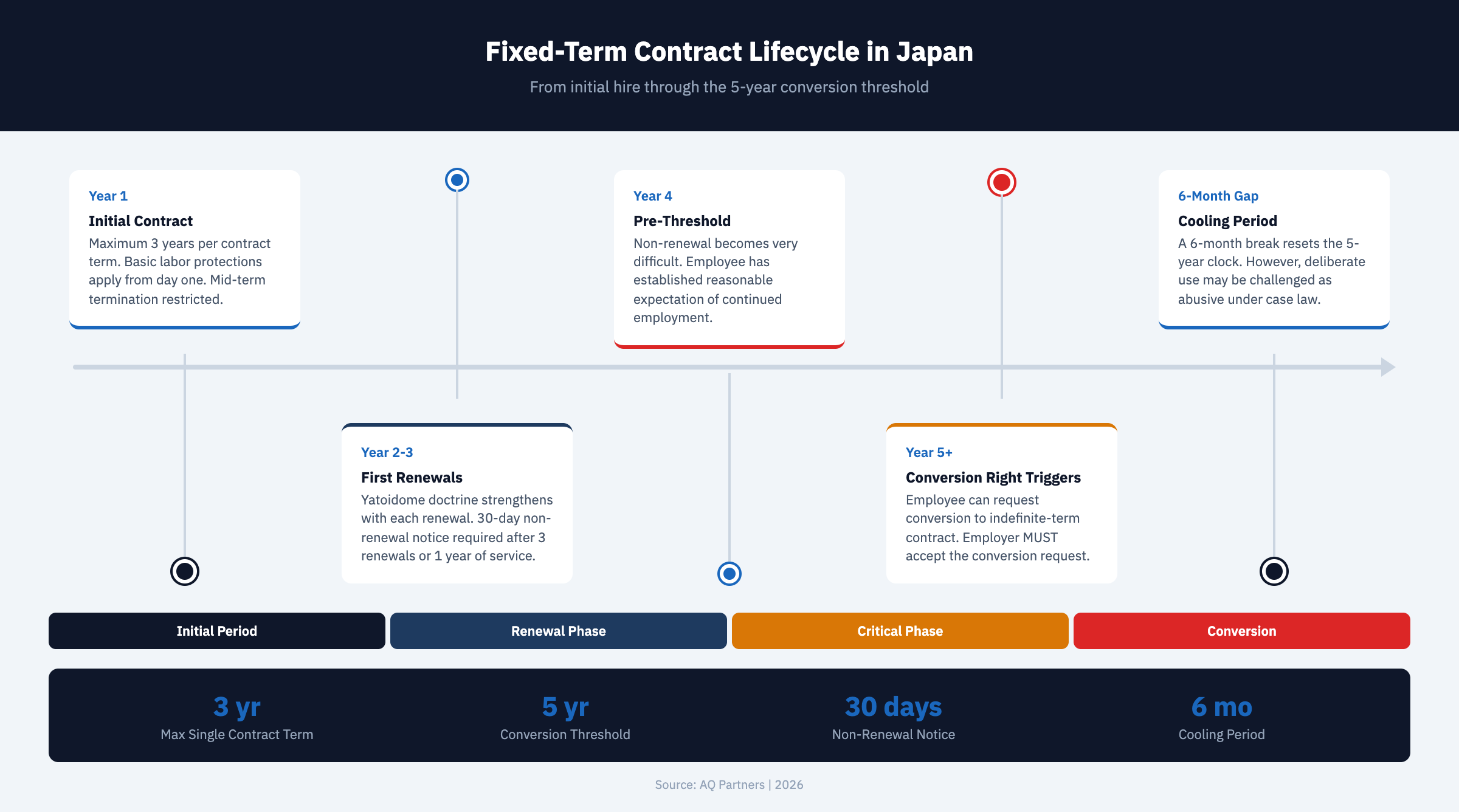
The automatic conversion rule is one of the most significant employment law provisions for employers using fixed-term contracts. Here is how the timeline works:
| Contract Period | Cumulative Duration | Conversion Right | Employer Action Required |
|---|---|---|---|
| 1st contract (1 year) | 1 year | None | None |
| 2nd contract (renewal, 1 year) | 2 years | None | None |
| 3rd contract (renewal, 1 year) | 3 years | None (but yatoidome protections strengthen) | 30-day non-renewal notice now required |
| 4th contract (renewal, 1 year) | 4 years | None | Non-renewal very difficult under yatoidome |
| 5th contract (renewal, 1 year) | 5 years | None yet | Employee may request conversion at next renewal |
| 6th contract (crossing 5-year threshold) | 5+ years | Employee has right to request indefinite conversion | Must accept if requested |
Important nuances of the conversion rule:
- The conversion right arises during the contract period that crosses the 5-year threshold, not after 5 years of completed contracts
- The employer cannot preemptively non-renew specifically to avoid the conversion right—this would likely be challenged under the yatoidome doctrine
- Conversion results in an indefinite-term contract, but the working conditions (salary, duties, working hours) can remain the same as the final fixed-term contract unless different terms are agreed
- The employer must inform employees about the conversion right—MHLW guidelines strongly encourage written notification
The Yatoidome Doctrine (雇止め法理)
Even before the 5-year threshold, employers face restrictions on non-renewal through the yatoidome doctrine, codified in Labor Contract Act Article 19. Non-renewal is restricted when either:
Condition 1: The fixed-term contract has been renewed repeatedly and the employment has become functionally equivalent to an indefinite-term contract—for example, when renewals have been automatic or pro-forma without genuine review of whether renewal is warranted.
Condition 2: The employee has a reasonable expectation that the contract will be renewed based on the employer's statements, the nature of the work, the renewal history, or other circumstances.
When either condition is met, the employer can only refuse renewal if it has "objectively reasonable grounds" that would be "socially appropriate"—essentially the same standard as dismissing an indefinite-term employee. This means that after multiple renewals, non-renewal becomes nearly as difficult as dismissal.
Factors courts consider when evaluating renewal expectations:
- Number of previous renewals and total employment duration
- Whether the work is permanent in nature (ongoing operations vs. genuinely temporary projects)
- Whether the employer conducted substantive renewal evaluations or renewed automatically
- Whether the employer communicated a maximum number of renewals at the outset
- Whether the employer stated or implied that employment would continue
The Cooling Period
A gap of 6 months or more between the end of one fixed-term contract and the beginning of the next resets the cumulative count toward the 5-year conversion threshold. For contracts shorter than 1 year, the required cooling period is half the contract duration (e.g., a 6-month contract requires a 3-month gap).
However, employers should not rely on cooling periods as a systematic strategy to avoid conversion obligations. Courts may view deliberate cooling period cycling as an attempt to circumvent the law's protective purpose, and the employee may still have yatoidome protections based on established patterns. Additionally, a 6-month gap creates operational disruption, loss of trained staff, and potential difficulty re-recruiting the same employee.
Non-Renewal Notice Requirements
Employers who decide not to renew a fixed-term contract must provide 30 days' written advance notice (雇止めの予告) before the contract end date if:
- The contract has been renewed 3 or more times, OR
- The employee has been continuously employed for 1 year or more
If the employee requests a written reason for non-renewal (雇止めの理由の証明書), the employer must provide one. The stated reason must be specific—general statements like "contract period ended" are insufficient if the employer was required to provide notice (indicating the relationship had become established enough to warrant protection).
Best Practices for Foreign Employers
- Define the purpose and end point clearly at contract inception: State in writing that the contract is for a specific project, covers a defined period, and whether renewal is expected or contingent on specific conditions.
- Set a maximum renewal count or duration from the outset: Communicating "this position is available for a maximum of 3 years" from the initial contract reduces renewal expectations, though it does not eliminate yatoidome protections entirely.
- Conduct genuine renewal evaluations: Each renewal should involve an actual review of whether the position is still needed and whether the employee's performance warrants continuation. Document these evaluations.
- Avoid language suggesting permanence: Phrases like "we expect to renew," "this is a long-term position," or "as long as you're performing well" create renewal expectations that strengthen yatoidome protections.
- Plan for the 5-year threshold: Track cumulative contract duration for all fixed-term employees and make deliberate decisions about whether to convert or properly non-renew before the conversion right triggers. The employee termination guide covers the legal framework for ending employment relationships when non-renewal is no longer available.
Fixed-term contracts offer genuine flexibility for foreign companies in Japan, but only when managed with awareness of the conversion rules, yatoidome doctrine, and notice requirements. Employers who treat fixed-term contracts as indefinitely renewable without consequence often find—after 3–4 renewals—that they have effectively created indefinite employment without realizing it. AQ Partners helps foreign companies structure fixed-term contracts, track renewal timelines, and navigate non-renewal decisions in compliance with Japanese labor law. Contact us at hello@aqpartners.jp.

Yuga Koda is a founding Director at AQ Partners, supporting foreign companies, funds, and families operating in Japan. His experience operating companies in both Japan and international markets gives him a practical understanding of back office operations from both sides.