
Advance Ruling Applications in Japan: When & How to Apply

An advance ruling application in Japan is a formal request submitted to the National Tax Agency (NTA) seeking confirmation of the tax treatment applicable to a specific planned transaction before it occurs. Known as jizenkakunin (事前確認) in Japanese, the advance ruling system enables taxpayers to obtain written guidance on how Japan's tax laws apply to complex or novel arrangements. The system encompasses general written responses (bunsho kaito), advance pricing arrangements (APAs) for transfer pricing, and mutual agreement procedures (MAPs) under tax treaties. For multinational enterprises, advance rulings eliminate uncertainty, prevent costly disputes, and provide a framework for multi-year tax planning.
Key Takeaways
What Are Advance Ruling Applications in Japan?
Advance ruling applications allow taxpayers to obtain the NTA's position on tax treatment before executing a transaction — converting tax uncertainty into documented certainty.
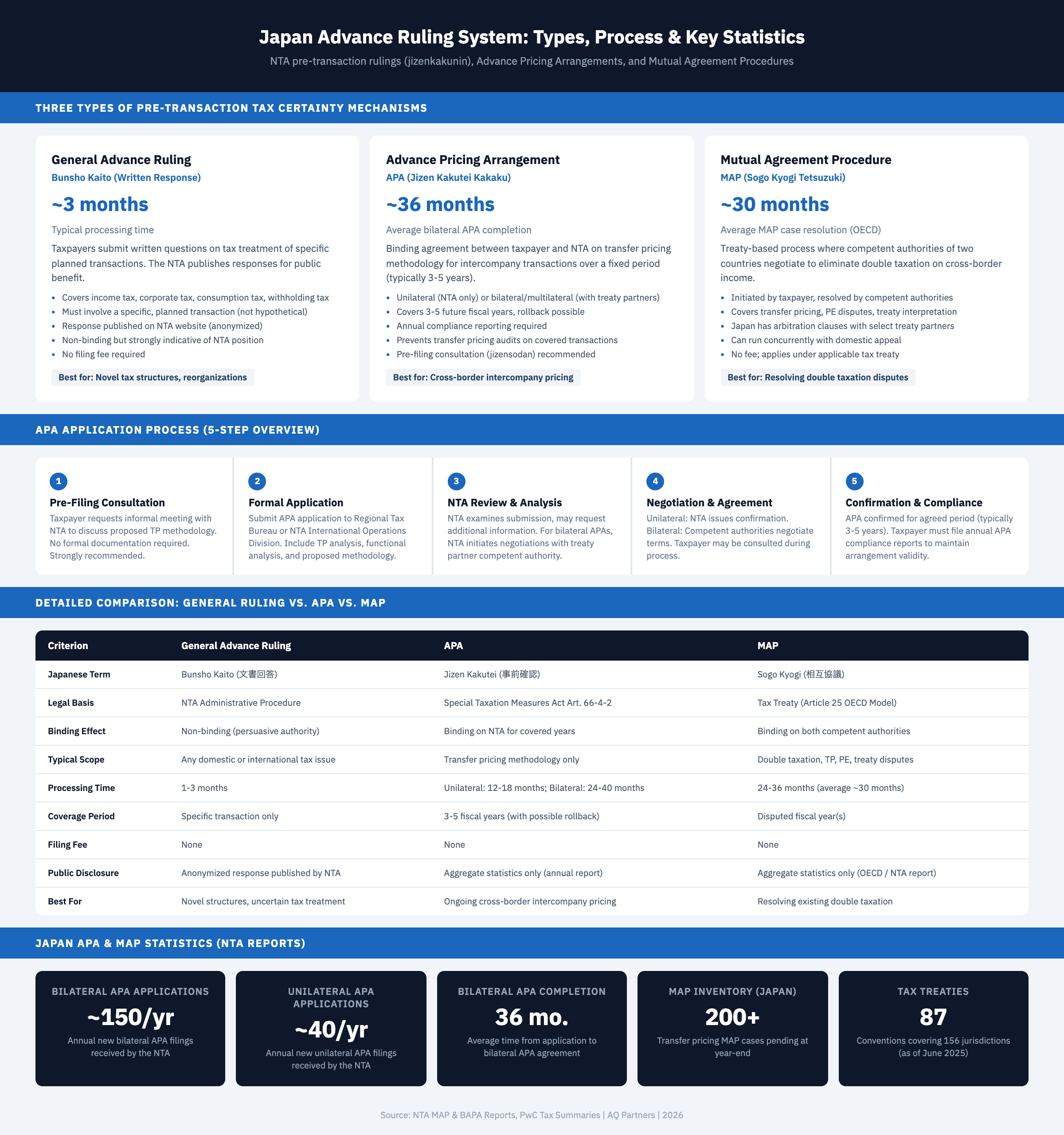
Japan's advance ruling system operates through three mechanisms, each governed by different legal frameworks. The general advance ruling (bunsho kaito) covers any area of tax law and produces a written NTA response with strong persuasive authority. Advance pricing arrangements address transfer pricing specifically, operating under Article 66-4-2 of Japan's Special Taxation Measures Act and producing binding agreements. According to the NTA's 2024 APA Report, Japan concluded 131 bilateral APAs in fiscal year 2023 — one of the highest volumes globally. Mutual agreement procedures resolve double taxation disputes under applicable tax treaties.
Foreign companies entering Japan should understand all three mechanisms as part of their broader tax compliance strategy. The choice depends on whether the goal is clarifying novel tax treatment, establishing ongoing transfer pricing certainty, or resolving an existing dispute.
Types of Advance Rulings Available
Japan provides three advance tax certainty mechanisms — general rulings, APAs, and MAPs — each with different legal standing, scope, and processing timelines.
The general advance ruling system accepts written inquiries on any tax question related to a specific, planned transaction. The NTA publishes anonymized responses, creating precedent for other taxpayers. Common topics include corporate reorganizations, consumption tax classification, and withholding tax obligations on cross-border payments. Responses typically issue within 1-3 months with no filing fee.
The advance pricing arrangement is the most consequential mechanism for multinational enterprises. APAs establish the transfer pricing methodology the NTA will accept for specific intercompany transactions over 3-5 fiscal years, with possible rollback to prior open years. Unilateral APAs conclude within 12-18 months; bilateral APAs average approximately 36 months (NTA APA Report 2024). The NTA reported 147 new bilateral APA applications in fiscal year 2023.
The mutual agreement procedure is treaty-based and initiated after a tax dispute arises. When taxation by two countries creates double taxation, the taxpayer can request MAP relief. According to PwC's Japan tax summary, Japan had over 200 transfer pricing MAP cases pending at year-end 2023, with average resolution of approximately 30 months.
CriterionGeneral Advance RulingAPAMAPJapanese TermBunsho Kaito (文書回答)Jizen Kakutei (事前確認)Sogo Kyogi (相互協議)Legal BasisNTA Administrative Procedure (2001)Special Taxation Measures Act Art. 66-4-2Tax Treaty (typically Art. 25 OECD Model)Binding EffectNon-binding (strong persuasive authority)Binding on NTA for covered fiscal yearsBinding on both competent authoritiesTypical ScopeAny domestic or international tax issueTransfer pricing methodology onlyDouble taxation, TP adjustments, PE disputesProcessing Time1-3 monthsUnilateral: 12-18 months; Bilateral: 24-40 months24-36 months (average approximately 30 months)Coverage PeriodSpecific transaction only3-5 fiscal years (rollback possible)Disputed fiscal year(s)Filing FeeNoneNoneNonePublic DisclosureAnonymized response published by NTAAggregate statistics only (NTA annual report)Aggregate statistics (NTA and OECD reports)Best Suited ForNovel structures, uncertain tax treatmentOngoing cross-border intercompany pricingResolving existing double taxation disputes
The APA Application Process Step by Step
The APA application process follows five stages — from informal pre-filing consultation through formal submission, NTA review, competent authority negotiation, and final confirmation with ongoing compliance.
Step 1: Pre-filing consultation (jizensodan). Taxpayers request an informal meeting with the NTA's International Operations Division or relevant Regional Tax Bureau to present the proposed transfer pricing methodology and receive preliminary feedback. The NTA strongly recommends this step, and experienced practitioners consider it essential — it can save months of back-and-forth during formal review.
Step 2: Formal application submission. The taxpayer files the APA application with supporting documentation including a functional analysis, proposed transfer pricing method, financial data supporting the arm's length range, and a description of covered intercompany transactions. Applications are filed in Japanese.
Step 3: NTA review and analysis. The NTA examines the submission and typically requests additional information. For bilateral APAs, the NTA initiates negotiations with the treaty partner's competent authority. This is the longest phase — bilateral negotiations with the United States, China, South Korea, and Singapore may involve multiple rounds of correspondence.
Step 4: Negotiation and agreement. For unilateral APAs, the NTA issues confirmation. For bilateral APAs, competent authorities must reach mutual agreement on pricing methodology. The taxpayer may be consulted but does not participate directly in competent authority negotiations.
Step 5: Confirmation and ongoing compliance. The APA is confirmed for the designated fiscal years. The taxpayer must file annual APA compliance reports demonstrating adherence to the agreed methodology. APAs can be renewed, and the NTA encourages renewal applications before the current period expires.
Documentation Requirements and What to Prepare
Successful advance ruling applications require comprehensive documentation — functional analyses, financial projections, and comparable benchmarking studies form the core of any APA submission.
For general advance rulings, documentation is relatively straightforward: a written description of the planned transaction, the specific tax question, the taxpayer's interpretation of applicable law, and supporting legal analysis. The NTA requires inquiries to concern concrete, planned transactions — hypothetical questions are not accepted.
For APA applications, required materials typically include: a detailed functional analysis (functions performed, assets used, risks assumed); an industry and market analysis; financial data for the most recent 3-5 fiscal years; a benchmarking study with database searches (typically Bureau van Dijk's Orbis) supporting the arm's length range; the proposed transfer pricing method (TNMM is used in approximately 80% of concluded APAs per NTA statistics for 2019-2023); projected financial results for the coverage period; and details of any existing APAs or MAP cases in other jurisdictions.
All formal submissions must be in Japanese — companies should budget for professional translation. The documentation requirements overlap significantly with transfer pricing documentation obligations, and Local File analyses can serve as the foundation for APA applications.
Strategic Benefits for Foreign Companies
For foreign companies operating in Japan, advance rulings provide measurable financial and operational benefits — chief among them is eliminating transfer pricing audit risk on covered transactions for up to five fiscal years.
The most direct benefit is audit protection. The NTA will not challenge transfer pricing of APA-covered transactions during the agreement period. Given that NTA transfer pricing adjustments totaled over ¥60 billion across approximately 200 examinations in fiscal year 2022 (NTA Annual Report 2023), the financial exposure APAs eliminate is significant.
Double taxation prevention is equally valuable. Bilateral APAs ensure both Japan and the treaty partner accept the agreed pricing. Without one, companies facing a transfer pricing adjustment must pursue MAP relief — averaging 30 months with no guaranteed outcome.
Certainty for financial reporting allows multinational groups to record tax provisions with confidence. Under IFRS and US GAAP, uncertain tax positions require liability recognition — an active APA removes that uncertainty. General advance rulings deliver value in different scenarios: foreign companies frequently use them to confirm the withholding tax treatment of cross-border payments or the tax consequences of corporate restructurings.
ScenarioRecommended MechanismEstimated TimelineKey BenefitRisk If Not PursuedNew intercompany service arrangementBilateral APA24-40 monthsBinding TP methodology for 3-5 yearsNTA audit adjustment, double taxationCorporate reorganization (merger, demerger)General Advance Ruling1-3 monthsWritten NTA position on tax-neutral treatmentUnexpected taxable gain recognitionRoyalty payments to foreign parentGeneral Advance Ruling or APA1-18 monthsConfirmed withholding tax rate and TP treatmentWithholding tax dispute, TP adjustmentExisting double taxation from TP adjustmentMAP24-36 monthsCompetent authority resolution of double taxPermanent double taxationManagement fee allocation methodologyBilateral APA24-40 monthsAgreed cost allocation formulaNTA rejection of cost allocation, penaltiesIP licensing between group entitiesBilateral APA24-40 monthsBinding royalty rate methodologyNTA secret comparables applied at auditConsumption tax on cross-border digital servicesGeneral Advance Ruling1-3 monthsConfirmed CT classification and reverse charge applicabilityIncorrect CT treatment, underpayment penalties
Timelines, Costs, and Practical Considerations
While the NTA charges no filing fees for any advance ruling mechanism, the professional costs and time investment are substantial — bilateral APAs require 2-3 years and advisory fees typically ranging from ¥10-50 million.
Timelines vary by mechanism: general advance rulings take 1-3 months, unilateral APAs 12-18 months, and bilateral APAs approximately 36 months on average (NTA 2024 report). Treaty partner country affects duration — APAs with the United States and China tend longer, while Singapore or Australia may conclude faster. Japan maintains 87 tax treaties covering 156 jurisdictions as of June 2025 (JETRO). Bilateral APAs and MAPs are only available with treaty partners.
Professional advisory costs constitute the primary expense. APA engagements typically range from ¥10 million for straightforward unilateral cases to ¥50 million or more for complex bilateral APAs. These fees cover economic analysis, benchmarking studies, document preparation, and multi-year support through negotiation. General advance rulings cost considerably less — typically ¥2-5 million.
Companies should evaluate whether intercompany transaction volumes justify the investment and whether existing tax audit exposure warrants proactive resolution. APA compliance reports add to annual filing schedule obligations, and companies should factor this ongoing requirement into their decision.
Frequently Asked Questions
Can a foreign company apply for an advance ruling without a Japanese entity?
A foreign company without a permanent establishment can submit a general ruling inquiry if the planned transaction triggers Japanese tax obligations — for example, a payment subject to withholding tax. For APAs, the application is typically filed by the Japanese entity, though the foreign parent's cooperation is essential for bilateral arrangements. MAP relief can be requested through the home country's competent authority.
Are advance ruling responses legally binding on the NTA?
General advance rulings are technically non-binding but carry strong persuasive authority — the NTA very rarely departs from published positions. APAs are legally binding for covered fiscal years, provided the taxpayer complies with the terms. MAPs produce binding agreements between competent authorities under treaty obligation.
How do APAs interact with transfer pricing documentation requirements?
Companies with active APAs still must maintain transfer pricing documentation, but the APA defines the acceptable methodology, making preparation more straightforward. The NTA will not apply "secret comparables" to APA-covered transactions. Annual APA compliance reports complement but do not replace standard documentation requirements under the Special Taxation Measures Act.
AQ Partners supports foreign companies in Japan with tax compliance, financial reporting, and coordination of advance ruling applications — ensuring alignment between your APA strategy, transfer pricing documentation, and ongoing corporate tax filing obligations. Contact our team to discuss whether an advance ruling application is appropriate for your Japan operations.

Yuga Koda is a founding Director at AQ Partners, supporting foreign companies, funds, and families operating in Japan. His experience operating companies in both Japan and international markets gives him a practical understanding of back office operations from both sides.