
Accounting Software in Japan: The Complete Guide

Key Takeaways
- Japan requires specialized compliance — J-GAAP standards, the Qualified Invoice System, and dual consumption tax rates make generic global software a poor fit for most Japan operations.
- Domestic platforms dominate for good reason — freee (~2.6 million users) and MoneyForward Cloud are purpose-built for Japan's tax and reporting requirements, offering compliance out of the box.
- Global tools can work, but at a cost — SAP, Oracle NetSuite, and similar platforms require Japan-specific localization modules that increase both implementation time and total cost.
- The Qualified Invoice System changed the rules — Since October 2023, all consumption-tax-registered businesses must issue and store invoices in a specific format; your software must support this.
- Your company stage determines your best path — Early-stage foreign entrants typically start with freee or MoneyForward Cloud, while larger multinationals often extend existing ERP systems with Japan localization.
What Is Accounting Software in Japan?
Accounting software in Japan refers to digital platforms that manage financial records, tax filings, payroll, and regulatory reporting in compliance with Japanese law. Unlike in many Western markets, accounting software in Japan must satisfy a highly specific and interconnected set of legal requirements: the Japanese Generally Accepted Accounting Principles (J-GAAP), the National Tax Agency's consumption tax framework, the Qualified Invoice System (QIS) introduced in October 2023, and — for public companies — potential alignment with IFRS. For foreign companies entering Japan, choosing the right accounting software is not a matter of convenience; it is a foundational compliance decision that affects how accurately you report to Japanese authorities, how smoothly you integrate with local vendors and banks, and how efficiently your finance team operates across languages and time zones.
Japan's accounting software market is divided into two broad categories: domestic platforms built specifically for Japanese law, and global platforms adapted (with varying degrees of success) for the Japanese market. Understanding this divide is the starting point for any informed decision.
According to JETRO's business setup guidance, approximately 60% of SMEs in Japan use dedicated accounting software as of 2024 — a figure that reflects both the complexity of Japanese compliance and the maturity of local software providers.
Why Japan Requires Specialized Accounting Software
Japan's accounting and tax environment has several distinct requirements that standard global software does not address by default, making domestic or Japan-localized tools a practical necessity for most businesses.
J-GAAP: Japan's Primary Accounting Standard
Japan's primary accounting standard is J-GAAP (Japanese Generally Accepted Accounting Principles), which governs how all domestic companies record and report financial information. J-GAAP differs from IFRS and US GAAP in significant areas, including revenue recognition, lease accounting, and financial instrument measurement. While listed companies may adopt IFRS — and a growing number have done so — the vast majority of operating entities in Japan, including most foreign subsidiaries, file under J-GAAP. Your accounting software must support J-GAAP chart-of-accounts structures, depreciation methods, and statutory reporting formats. For a deeper comparison of these standards, see our guide on IFRS vs. J-GAAP in Japan.
The Qualified Invoice System (適格請求書等保存方式)
Since October 1, 2023, Japan has operated a Qualified Invoice System (QIS), which requires all consumption-tax-registered businesses to issue invoices that include specific fields: the seller's registration number, applicable tax rates (10% standard or 8% reduced), and tax amounts broken out by rate. Buyers can only claim input tax credits on purchases backed by compliant qualified invoices. This means your accounting software must be capable of generating, receiving, and storing QIS-compliant invoices — and must correctly handle the dual-rate consumption tax structure. The National Tax Agency (NTA) provides official guidance on QIS requirements in English.
Consumption Tax: Standard and Reduced Rates
Japan's consumption tax (shouhizei) operates at two rates: 10% on most goods and services, and a reduced rate of 8% on food and beverages (excluding alcohol and restaurant dining). Any business registered for consumption tax must track both rates separately, calculate tax by rate category, and report them distinctly on tax returns. As detailed in PwC's Japan tax summary, consumption tax applies broadly and the filing obligations are substantial. Accounting software that cannot handle this dual-rate structure will require time-consuming manual workarounds.
Fiscal Year and Filing Deadlines
While Japanese law permits companies to adopt any 12-month fiscal year, the most common corporate fiscal year runs from April 1 to March 31, aligning with the government's own fiscal calendar. Consumption tax returns are typically filed quarterly or annually depending on turnover. Corporate income tax returns are due within two months of fiscal year-end. Your accounting software must be configured to generate the correct reports at the correct intervals for the correct fiscal period — and this configuration is non-trivial for non-Japanese platforms.
Japanese Language and Localization Requirements
Financial records submitted to Japanese authorities and shared with Japanese stakeholders — including banks, auditors, and tax officers — are expected to be in Japanese. While your internal finance team may work in English, your software must be capable of producing Japanese-language financial statements, tax forms, and reports. This is a practical barrier for global-first platforms that lack genuine Japanese localization.
Domestic vs. Global: The Core Decision
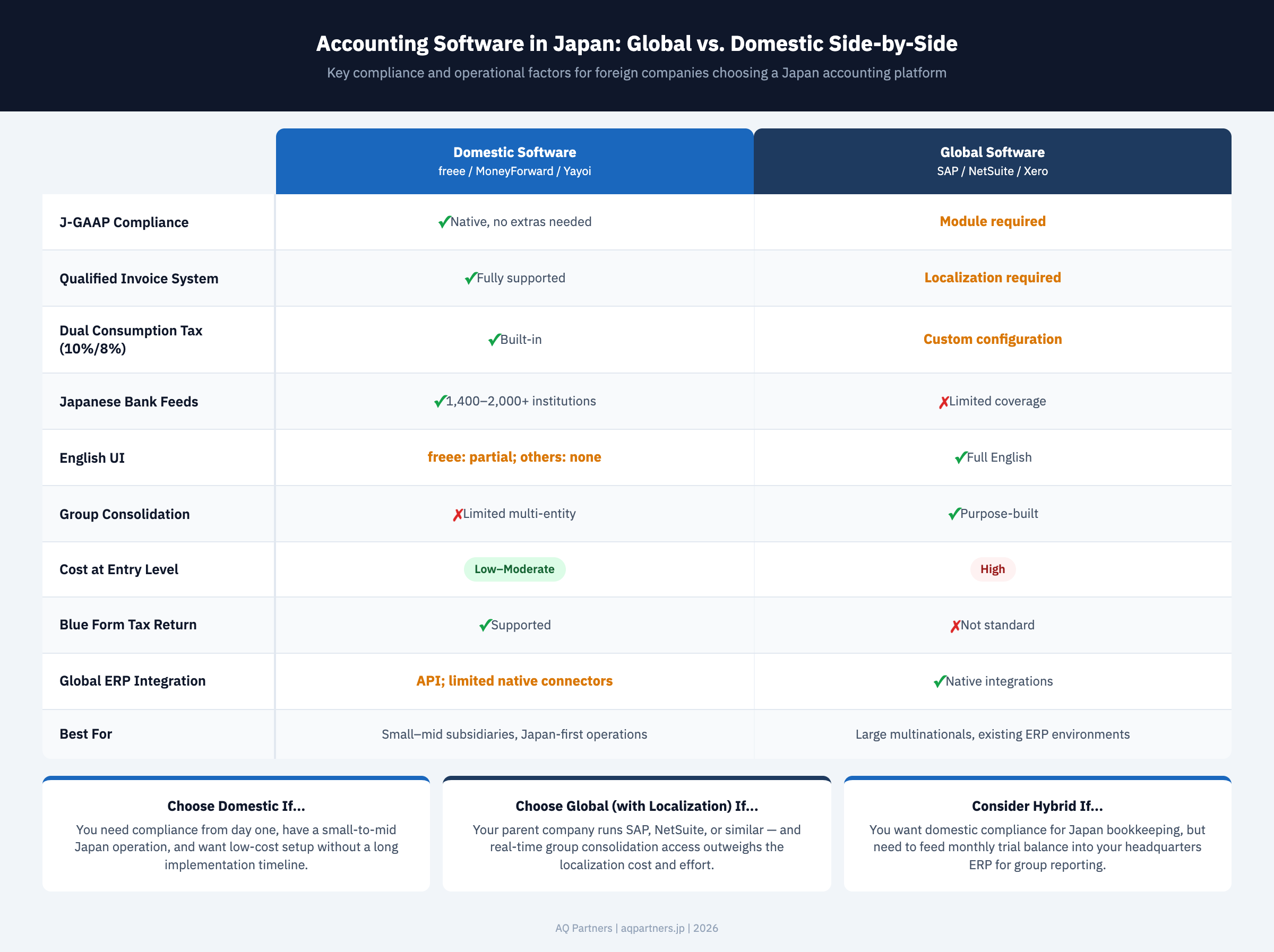
For foreign companies in Japan, the first and most important accounting software decision is whether to use a domestic Japanese platform or to extend an existing global ERP — and there is no universally correct answer.
Domestic platforms such as freee, MoneyForward Cloud, and Yayoi are purpose-built for Japanese compliance. They include J-GAAP templates, consumption tax handling, qualified invoice support, and Japanese-language outputs as standard features. The tradeoff is that they are designed primarily for the Japanese market: English interfaces are limited, global consolidation capabilities are minimal, and integration with international systems requires custom work.
Global platforms — SAP S/4HANA, Oracle NetSuite, Microsoft Dynamics 365 — offer powerful consolidation, multi-currency management, and enterprise-grade reporting. However, Japan localization requires dedicated add-on modules, implementation partner expertise, and meaningful additional cost. QuickBooks discontinued its Japan-specific version and is not a viable option for Japan compliance. Xero offers a Japan localization layer but has limited local partner support and does not fully support the Qualified Invoice System without third-party extensions.
For a detailed analysis of this trade-off, see our post on global vs. domestic accounting software in Japan.
The decision typically maps to company stage and structure:
- Early-stage foreign entrant or small subsidiary: domestic platform (freee or MoneyForward Cloud) is faster, cheaper, and more compliant from day one.
- Mid-size company with existing global ERP: Japan localization module on your existing system, supported by a local implementation partner.
- Large multinational with complex consolidation needs: enterprise ERP with Japan localization, often managed by a Big Four accounting firm or specialist advisory.
Understanding where your Japan entity sits on this spectrum before selecting software will save significant time and cost. Our post on Japanese vs. international accounting practices provides useful context for this decision.
Japan's Leading Domestic Accounting Software
The domestic accounting software market in Japan is mature and concentrated, with three platforms — freee, MoneyForward Cloud, and Yayoi — covering the vast majority of SME and mid-market users, alongside MJS for larger enterprises.
freee Accounting
freee was founded in 2012 and has grown to approximately 2.6 million business users as of 2025. It is a fully cloud-based platform built around simplicity and automation, with strong bank feed integration, payroll, and invoicing modules. freee fully supports J-GAAP, consumption tax at both rates, and the Qualified Invoice System. It is arguably the most English-friendly of the domestic platforms, with an English interface option and growing multilingual support documentation — making it a common first choice for foreign companies setting up in Japan.
MoneyForward Cloud Accounting
MoneyForward Cloud Accounting is part of a broader suite of cloud-based financial tools from Money Forward, Inc. It is widely used by SMEs and growing companies in Japan, offering strong bank integration, qualified invoice management, and modular add-ons for payroll, expense management, and invoicing. MoneyForward Cloud is well-regarded for its clean interface and robust automation features, and it integrates with external HR and ERP systems.
Yayoi
Yayoi is the legacy market leader in Japan's SME accounting software space, with approximately 3.4 million users. Originally desktop-first, Yayoi has expanded to a cloud offering while retaining its dominant position among accountants and bookkeepers. The interface and documentation are primarily Japanese, but Yayoi is widely supported by local tax accountants (zeirishi) and bookkeeping firms, which matters if you are outsourcing your Japan accounting function.
MJS (Miroku Jyoho Service)
MJS serves larger enterprises and professional accounting firms with enterprise-grade accounting, ERP, and practice management solutions. It is typically used by companies with complex consolidation requirements, high transaction volumes, or dedicated in-house finance teams.
| Feature / Criterion | freee | MoneyForward Cloud | Yayoi | MJS |
|---|---|---|---|---|
| Deployment | Cloud-only | Cloud-only | Desktop + Cloud | On-premise + Cloud |
| J-GAAP Support | Full | Full | Full | Full |
| Qualified Invoice System | Supported | Supported | Supported | Supported |
| Dual Consumption Tax Rates | Supported | Supported | Supported | Supported |
| English Interface | Partial (available) | Limited | Japanese only | Japanese only |
| Payroll Module | Included | Add-on | Separate product | Included (enterprise) |
| Bank Feed Integration | Strong (1,400+ institutions) | Strong (2,000+ institutions) | Moderate | Moderate |
| Typical Monthly Cost (JPY) | ¥3,828 – ¥39,600+ | ¥2,980 – ¥40,000+ | ¥1,500 – ¥35,000+ (desktop/cloud) | Custom quote |
| Best Fit | Foreign entrants, startups, SMEs | Growing SMEs, mid-market | SMEs using local accountants | Large enterprises |
For a deeper comparison of freee, MoneyForward Cloud, and Yayoi including pricing tiers and feature breakdowns, see our dedicated post on the best accounting software in Japan.
Global Accounting Software Options in Japan
Global ERP and accounting platforms can operate in Japan, but all require Japan-specific localization and none offer full compliance out of the box — the implementation effort and cost vary considerably by platform.
For multinationals that already operate SAP, Oracle NetSuite, or Microsoft Dynamics 365 globally, extending these systems to Japan is often the most logical path. The key question is not whether the platform can handle Japan, but how much localization work is required and who will maintain it. Dedicated Japan localization modules exist for all major enterprise platforms, but these are typically sold separately, require certified local implementation partners, and must be updated as Japanese tax law changes.
Xero maintains a Japan-localized version with yen currency support and some Japanese tax configurations, but local support resources are limited and QIS compliance requires third-party extensions. QuickBooks no longer offers a Japan-specific version and should not be considered for Japanese compliance purposes.
| Platform | Japan Localization | QIS Support | Typical Implementation Cost | Best For |
|---|---|---|---|---|
| SAP S/4HANA | Full (Japan module) | Supported | ¥5M–¥50M+ | Large multinationals |
| Oracle NetSuite | Partial (Japan SuiteApp) | Via SuiteApp | ¥3M–¥15M+ | Mid-to-large multinationals |
| Microsoft Dynamics 365 | Full (Japan locale) | Supported | ¥3M–¥20M+ | Mid-size to large companies |
| Xero | Partial (Japan localization) | Via third-party add-on | Low setup cost | Small international teams |
| QuickBooks | None (Japan version discontinued) | Not supported | N/A | Not recommended for Japan |
| Workday Financial Management | Partial (requires configuration) | Requires custom setup | ¥10M–¥50M+ | Large global enterprises |
| Zoho Books | Japan locale available | Limited | Low setup cost | Very small operations |
Key Features to Evaluate for Japan Compliance
When evaluating any accounting platform for use in Japan, these are the functional requirements that determine whether the software will meet your compliance obligations.
Qualified Invoice System (QIS) Compliance
The Qualified Invoice System, mandatory since October 2023, requires that invoices include the seller's QIS registration number, a breakdown of tax by applicable rate (10% or 8%), and the tax amount per rate. Your accounting software must support the generation of QIS-compliant invoices, the receipt and storage of compliant invoices from suppliers, and the management of your own QIS registration number. Software that does not fully support QIS will create compliance gaps and risk disallowed input tax credits. For a detailed guide on QIS and software requirements, see our post on the Qualified Invoice System and accounting software in Japan.
J-GAAP Chart of Accounts
Your chart of accounts must align with J-GAAP account structures to produce statutory financial statements in the correct format. Platforms that start from a US GAAP or IFRS template require substantial reconfiguration. For guidance on setting up a compliant chart of accounts, see our post on chart of accounts management in Japan.
Japanese-Language Output
Financial statements, tax forms, and reports shared with Japanese authorities, banks, or local stakeholders must be producible in Japanese. Verify that the software can generate Japanese-language PDFs and forms — not just switch the interface language.
Bank Feed Integration with Japanese Banks
Japanese banks use a distinct banking infrastructure. Verify the platform's Japan-specific bank integration list before committing — major banks such as MUFG, SMBC, and Mizuho must be covered.
Audit Trail and Electronic Records Compliance
Japan's Electronic Book Preservation Act (電子帳簿保存法), updated in January 2024, requires that electronic records be stored in specific formats with audit trail integrity. Your accounting software must meet these requirements to avoid compliance exposure.
How to Choose: A Decision Framework for Foreign Companies
A structured approach to platform selection reduces the risk of choosing software that creates compliance gaps or does not scale with your Japan operations.
Step 1 — Define your entity type and complexity. A representative office, a branch, and a fully incorporated KK each have different accounting obligations. Your entity type determines the minimum viable feature set your software must support.
Step 2 — Assess your existing global technology stack. If your parent company uses SAP, Oracle, or Microsoft Dynamics, there is a strong argument for extending those systems to Japan rather than running a parallel domestic platform.
Step 3 — Evaluate your internal language capability. If your Japan finance team is primarily Japanese-speaking, Yayoi or MoneyForward Cloud will feel natural. If the team is internationally oriented, freee's partial English interface or a localized global platform reduces operational friction.
Step 4 — Factor in your accounting firm or bookkeeper. Many Japanese tax accountants (zeirishi) have preferred platforms. If you are outsourcing your Japan accounting function — which is common for foreign entrants — your service provider's platform compatibility is a practical constraint.
Step 5 — Stress-test QIS and consumption tax handling. Before finalizing any platform, verify specifically how it handles QIS invoice generation, receipt, and dual-rate consumption tax reporting.
Step 6 — Total cost of ownership over 3 years. Subscription costs are only one component. Factor in implementation, training, ongoing support, and the cost of updates when Japanese tax law changes.
Implementation Timeline and Cost Considerations
Implementation timelines and costs vary significantly by platform type and company size. The following benchmarks apply to most foreign company scenarios.
Domestic cloud platforms (freee, MoneyForward Cloud): For a small-to-mid-size foreign subsidiary, implementation typically takes 4–8 weeks. This includes chart of accounts configuration, bank feed connections, user training, and integration with existing systems. Total setup cost, including professional support, is typically ¥200,000–¥800,000 for simple implementations.
Global ERP with Japan localization: Implementation timelines range from 3 months to over a year. Total project costs — including software licensing, implementation fees, training, and data migration — commonly reach ¥5–¥30 million for mid-size deployments. Per industry estimates, foreign companies in Japan typically spend 0.5%–1.5% of Japan revenue on finance and accounting technology in the early years of operations.
Tax law update cycles: Japan updates its tax rules on a regular legislative cycle. Domestic platforms push these updates automatically. Global platforms require you to confirm that your Japan localization module is being maintained and updated — a question to ask explicitly before committing.
Frequently Asked Questions
Can I use QuickBooks or Xero for my Japan entity?
QuickBooks Japan discontinued its Japan-specific version, meaning it does not support J-GAAP, the Qualified Invoice System, or Japanese consumption tax in the format required by Japanese authorities. QuickBooks is not recommended for Japan compliance. Xero has a Japan localization layer but requires third-party add-ons for Qualified Invoice System support, and local support resources in Japan are limited. For most foreign companies, a domestic platform such as freee or MoneyForward Cloud will be more reliable and lower risk.
What is the Qualified Invoice System, and why does my software need to support it?
The Qualified Invoice System (適格請求書等保存方式) became mandatory in Japan on October 1, 2023. It requires all consumption-tax-registered businesses to issue invoices that include the seller's QIS registration number, a breakdown of transaction amounts by applicable tax rate (10% standard or 8% reduced), and the calculated tax amount per rate. Buyers can only claim input tax credits when a purchase is backed by a QIS-compliant invoice. If your software cannot generate or correctly record compliant invoices, you risk losing input tax credits and creating errors in your consumption tax returns.
Is it possible to run a global ERP like SAP or NetSuite in Japan without a local implementation partner?
Technically possible, but not advisable. Japan's localization requirements — J-GAAP chart of accounts, QIS invoice formats, dual-rate consumption tax, and Electronic Book Preservation Act compliance — require deep familiarity with both the platform and Japanese accounting law. The general industry recommendation is to work with a Japan-certified implementation partner for any enterprise ERP deployment.
How often does Japan's accounting software need to be updated for tax law changes?
Japanese tax law is updated on a regular legislative cycle, with major changes typically announced in the December tax reform package and implemented from April of the following year. The QIS system was introduced in October 2023, and the Electronic Book Preservation Act was substantively revised in January 2024. Domestic cloud platforms push compliance updates automatically. For global ERP platforms, you must confirm with your vendor that your Japan localization module is actively maintained and updates are included in your support agreement.
How AQ Partners Can Help
Selecting and implementing accounting software for a Japan entity involves more than a product decision — it requires understanding how your chosen platform fits into Japan's compliance framework, how it connects to your local banking and payroll setup, and how it will serve your reporting needs as your Japan operations grow.
AQ Partners provides back-office services for foreign companies operating in Japan, including accounting setup, bookkeeping, tax filing support, and ongoing financial management. Our team works with the leading domestic platforms — including freee and MoneyForward Cloud — and can advise on the right solution for your entity type, team structure, and compliance requirements.
Whether you are setting up your first Japan entity and need accounting software configured from scratch, or you are inheriting an existing Japan operation and need to assess whether your current setup is compliant with the Qualified Invoice System and current J-GAAP requirements, AQ Partners can help you move forward with confidence.
Get in touch with AQ Partners to discuss your Japan accounting setup. Contact us at aqpartners.jp/contact.

Yuga Koda is a founding Director at AQ Partners, supporting foreign companies, funds, and families operating in Japan. His experience operating companies in both Japan and international markets gives him a practical understanding of back office operations from both sides.